
Build Investor Confidence Without In-Person Meetings
What builds investor confidence when there’s no in-person meeting? Clear, direct answers and transparent communication. Learning how to build investor confidence without in-person meetings starts with explaining the opportunity and your strategy plainly, including what you’re still working to understand.
It’s reasonable to wonder what to say when an investor asks a question you can’t answer yet. Respond candidly, explain how you’re looking into it, and follow up thoughtfully. This keeps the conversation grounded in facts rather than assumptions.
This article explains how to answer difficult questions, describe your market opportunity and strategy, and follow up in ways that support trust. It also covers how to communicate risks and setbacks without becoming defensive. Results vary. No marketing approach guarantees that a raise will close.
Key Takeaways
- Answer investor questions directly. If you don’t know something yet, explain how you’re investigating it rather than guessing.
- Make the opportunity clear by connecting customer needs, market changes, company strategy, and the risks the business is addressing.
- Use follow-up to recap key points, share relevant materials, and clarify the investor’s process and next steps.
- Build trust by communicating setbacks plainly, explaining what you learned, and describing the actions being taken.
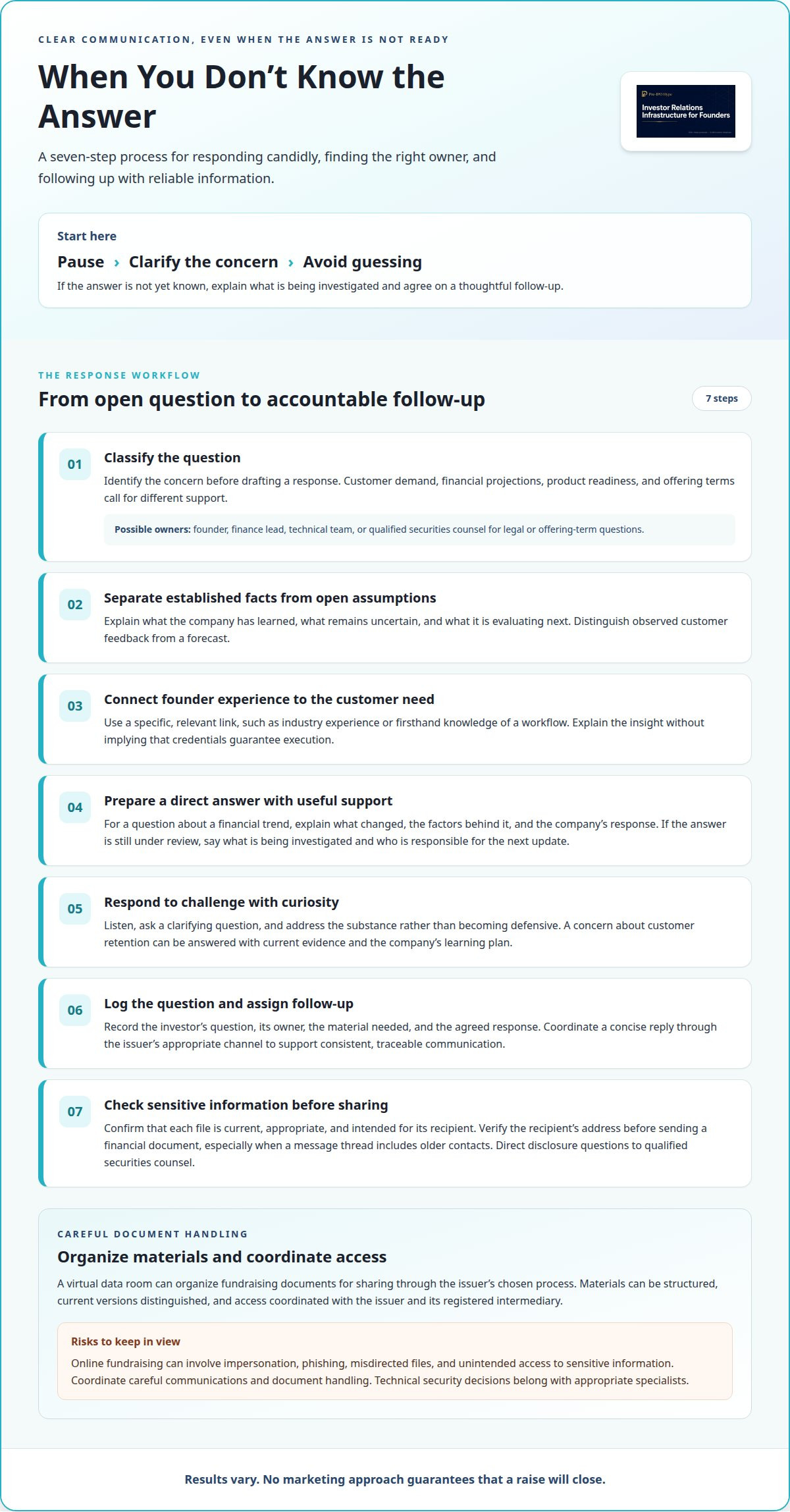
What if a professional supporting the raise does not know the answer to an investor’s question?
Pause, clarify the investor’s concern, and avoid guessing. Record the open question, identify who can provide a reliable answer, and agree on a clear follow-up with the founders. If the question concerns legal or offering terms, qualified securities counsel should guide the response. To understand how to build investor confidence without in-person meetings, make sure every response has a clear owner and a reliable basis.
A virtual data room can organize fundraising documents for sharing through the issuer’s chosen process. A professional can help structure materials, distinguish current versions, and coordinate access with the issuer and its registered intermediary.
Online fundraising can involve risks such as impersonation, phishing, misdirected files, and unintended access to sensitive information. Professionals can help the issuer coordinate careful communications and document handling, while technical security decisions belong with appropriate specialists.
- Classify the question before drafting a response. A question about customer demand needs different support from one about financial projections, product readiness, or offering terms. The professional should capture the investor’s concern, then identify whether the answer belongs to the founder, finance lead, technical team, or qualified securities counsel. This keeps the reply focused and assigns responsibility.
- Separate established facts from open assumptions. If a business model is still being tested, explain what the company has learned, what remains uncertain, and what it is evaluating next. Founders can distinguish observed customer feedback from a forecast. That distinction protects credibility and gives investors a more accurate picture than a confident guess.
- Connect founder fit to relevant experience. Investors may ask why this team understands the problem. A professional can help founders identify a specific link between their background and the customer need, such as industry experience or firsthand knowledge of a workflow. The example should show relevant insight without implying that credentials guarantee execution.
- Prepare a direct answer and useful supporting detail. For a question about a financial trend, explain what changed, the factors behind it, and the company’s response. The professional can help organize that explanation and prepare supporting material. If the information is still being investigated, state what is under review and who is responsible for the next update.
- Respond to challenge with curiosity. An investor’s concern may expose an assumption founders have not addressed. The professional can help the team listen, ask a clarifying question, and respond to the substance rather than becoming defensive. A question about customer retention, for example, can prompt a precise account of current evidence and the company’s learning plan.
- Log the question and assign follow-up. Record the investor’s question, its owner, the material needed, and the agreed response. The professional can coordinate a concise reply through the issuer’s appropriate channel. This reduces conflicting answers and helps the team understand how to build investor confidence without in-person meetings through consistent, traceable communication.
- Control sensitive information before sharing. Coordinate with the issuer to ensure each file is current, appropriate, and intended for its recipient. For example, confirm an address before sending a financial document, especially when a message thread includes older contacts. Direct disclosure questions to qualified securities counsel.
How professionals help explain the market opportunity and company strategy
A credible virtual pitch deck connects the customer problem, solution, market opportunity, business model, and team. Financial information should show relevant performance trends, forecasts, assumptions, and milestones, with figures consistent across the deck and supporting materials.
-
Build Credibility With a Pitch Deck: How Professionals Support the Process
Start by organizing the deck around a clear business narrative, then check that each slide supports it. Professionals help founders present the customer problem, product, market opportunity, business model, traction, and team’s ability to execute. A customer example can make the problem concrete; avoid unsupported market claims or dense technical detail that obscures why the product matters.
- Show how the market estimate connects to real customers. Professionals can help founders explain both the broad market and the reachable customer segment. For example, a company selling workflow software might identify the types of businesses with the problem, describe how it reaches them, and show evidence of willingness to pay. The estimate should connect to the company’s actual sales approach, not just a large industry total.
- Present customer evidence as a signal, not a substitute for context. A customer story can show why the problem matters, while traction data can indicate how the business is progressing. Professionals help founders clarify what each metric measures, the period it covers, and what changed. If a metric is early or uneven, explain its trend and the action the company is taking rather than presenting it as proof of future performance.
-
Present Financial Metrics and Forecasts: Professional Support
Organize financial forecasts around the assumptions and milestones that shape the company’s plan. Professionals can help founders present revenue drivers, expenses, cash needs, and forecast scenarios in a consistent format. Check that the narrative matches the underlying model, and distinguish actual results from projections. Avoid treating a forecast as a guaranteed outcome or obscuring assumptions behind precise-looking figures.
- Adapt the explanation to investor priorities without changing the facts. Investors may focus on scalability, profitability, sustainability, or geography. Professionals can help founders lead with the most relevant evidence, then explain the wider strategy and risks. If market conditions shift, acknowledge the change and describe the company’s response. For example, a climate technology company might explain how its product relates to energy resilience.
- Make the next action clear. After presenting the opportunity, connect the strategy to what the company is doing now, what evidence it will track, and which risks need attention. A professional can help keep the deck, spoken explanation, and supporting materials aligned. For founders preparing an online raise, campaign support alongside the issuer’s registered intermediary and qualified securities counsel can help organize that communication for the issuer.
How professionals support follow-up after investor discussions
Video calls allow direct conversation, but the format alone does not establish trust or predict fundraising outcomes. Preparation, clear communication, and consistent follow-through matter in both virtual and in-person discussions.
-
Send a Post-Discussion Follow-Up With Professional Support
Send a concise follow-up within 24 hours, while the conversation is still easy to remember. A professional can help summarize the investor’s main interests, capture one or two relevant takeaways, and state agreed next steps. Keep the message specific to that discussion. Avoid generic praise, new claims, or pressure that could distract from the company’s vision.
- Confirm the investor’s process before ending the conversation. Ask what feedback timeline to expect, whether additional materials would help, and whether another call would be useful. Record the answers and requested next steps. For example, if the investor asks for a product roadmap, note its intended scope and who will prepare it.
-
Deliver Promised Information With Professional Support
Send only the material promised, and check that it is current, relevant, and approved for sharing. A professional can coordinate with the founders to identify the document owner, confirm the correct version, and prepare a brief explanation of why it answers the investor’s question. For legal or offering materials, qualified securities counsel should guide decisions about what to share.
- Make each follow-up easy to use. Investors may need to share information internally, so organize supporting documents around the questions they address. If the investor requested financial projections, include a clear label and context rather than an unexplained attachment. Keep facts consistent with materials already presented, and avoid unrelated files that make the main point harder to find.
-
Use Video Calls to Build Trust
Prepare the virtual meeting as a focused conversation, not a one-way presentation. A professional can help founders keep materials ready, maintain a clear narrative, and leave space for questions. Avoid treating screen presence as a substitute for evidence. Trust grows when the discussion, shared documents, and later responses present a consistent account of the business.
- Close the loop after sending materials. Record what you sent, when you shared it, and which question it addressed. If a response requires input from the finance team or qualified securities counsel, coordinate internally before replying. A brief update can explain what is being prepared without suggesting an unresolved issue is settled.
- Keep the relationship professional if the investor goes quiet. Follow up politely, refer to the previous conversation, and ask whether the investor needs anything else to assess the opportunity. If the answer is no, acknowledge it and move on without repeated pressure. A clear record of the exchange helps founders track investor interest and outstanding next steps accurately.
How professionals help founders build investor trust through transparency
Transparency gives an online pitch credibility when investors cannot assess a startup through informal, in-person contact. U.S. securities requirements depend on the offering and communication, so qualified securities counsel should guide legal decisions.
- Align online communications with the offering process. Professionals can coordinate campaign language and investor materials for the issuer, while counsel reviews legal questions. For Regulation Crowdfunding promotion, anyone the issuer pays to promote the offering on the platform must disclose that compensation each time under Rule 205. Keep public statements consistent with offering materials and direct investors to the issuer’s registered intermediary or offering page.
- Substantiate identity and founder credentials. Build a factual record for names, roles, relevant experience, and company claims before they appear in a pitch deck or campaign. A professional can compare those statements with materials supplied by the founders and flag inconsistencies for resolution. For example, describe a founder’s prior role precisely rather than implying responsibility for an entire product or venture.
- Connect each business claim to evidence. For customer demand, identify what supports the statement, such as documented customer feedback or company records. Distinguish completed milestones from plans, and actual performance from forecasts. A professional can help organize claims and sources so founders can explain what each signal means without presenting an assumption as established fact.
- Make challenges visible and explain the response. If a startup has lost a customer or missed a target, prepare a concise account of what happened, the cause identified, and the action taken. Avoid minimizing the issue or claiming the response has worked before evidence supports that view. A clear explanation shows how founders assess risk and take responsibility.
- Keep the pitch deck and public narrative consistent. Compare the deck, campaign copy, founder statements, and investor responses for differences in descriptions, metrics, and progress. For example, if one document describes a product as being tested while another calls it fully launched, resolve the mismatch before investors encounter it. Consistent detail helps investors assess the opportunity.
- Explain uncertainty without overstating ability. Professionals can help founders separate verified facts, current estimates, and unresolved questions. If market interest is still being measured, describe the evidence collected and what the company is learning. This gives investors a concrete view of the challenge and the founders’ approach without turning potential into a promise.
- Use a documented review before publishing. Record who supplied each claim, which materials support it, and who approved its use. Route legal questions to qualified securities counsel. This process helps the team correct communications when facts change and keep online statements aligned with current offering information.
Pre-IPO Hype
Pre-IPO Hype provides investor relations infrastructure for Regulation CF and Regulation A+ raises. It is not a broker-dealer, funding portal, or investment adviser, and does not offer or sell securities or make investment recommendations.
For founders building investor confidence remotely, Pre-IPO Hype provides campaign support alongside the issuer’s registered intermediary and qualified securities counsel. Its Investor Relations and Marketing Campaigns, digital marketing, and investor relations infrastructure support clear, consistent communication throughout the fundraising process. These systems can help coordinate campaign materials and investor communications that reflect the company’s opportunity and current information. Legal decisions remain with qualified securities counsel. Results vary, and no marketing approach guarantees a successful raise.
Contact Pre-IPO Hype to discuss campaign support for your raise.
Carry a Clear, Consistent Story Into Your Next Step
Building investor confidence without in-person meetings comes down to how your company communicates over time. Each investor interaction adds to the record of your claims and the materials you share. Treat that record as an ongoing responsibility, not a one-time pitch. Keep communications grounded in current information, and involve qualified securities counsel in legal decisions. Your next step is to decide what support fits your fundraising process and where your team needs more coordination.
Build your process around what your company can substantiate today, then keep the conversation moving with care.
Frequently Asked Questions
How can professional support help startups build investor confidence remotely without in-person meetings?
Structured support can help a startup deliver a consistent, well-organized investor experience across calls, emails, and shared materials. For example, a communications plan can assign who answers product, operations, or financial questions, so investors hear from the right people. It can also help identify gaps between the pitch and supporting documents. Founders remain responsible for company information, while qualified securities counsel handles legal decisions.
How can professionals support virtual investor meetings and follow-up communication?
Organize meeting materials, roles, and follow-up records so founders can focus on the discussion. For example, one team member can lead the presentation while another captures questions and promised materials. Afterward, a shared record can distinguish investor feedback from internal action items. This helps the team prepare a relevant next conversation without relying on memory or sending a generic update.
How can professionals help founders share customer traction and references remotely while protecting confidentiality?
Professionals can help founders choose evidence that demonstrates traction without exposing unnecessary customer information. A company might present aggregated usage trends or a redacted example, then arrange a reference only with the customer’s permission. Before sharing names, documents, or contact details, the team should consider confidentiality commitments and the investor’s specific request. Qualified securities counsel can advise on legal questions about disclosures and offering materials.
Disclaimer
Educational only. Not investment, tax, or legal advice. Pre-IPO Hype is investor relations infrastructure for Regulation CF and Regulation A+ raises. We are not a broker-dealer, funding portal, or investment adviser, and we do not offer or sell securities or make investment recommendations. Any securities offering is made only by the issuer, through its own offering documents and, where required, a registered intermediary.