
How to Show Traction to Investors With No Revenue
Revenue isn’t the only evidence investors use to assess an early-stage startup. A pre-revenue company can demonstrate progress by showing that users activate and return, customers have a real problem, and credible people or organizations engage with the business. How to show traction to investors with no revenue comes down to making that evidence specific, relevant, and transparent.
A waitlist or positive feedback can be a starting point, but stronger evidence shows what people actually do and what the startup learns. Investors also need context: who the users are, how the product meets their needs, and what remains to be tested. This article explains how to present product activation and cohort retention, customer discovery, advisors, and third-party validation as a clear picture of early momentum.
Traction evidence can explain a company’s progress, but it does not replace a sound business case or make an investment outcome certain. Results vary. No marketing approach guarantees that a raise will close.
Key Takeaways
- Show product activation and repeat use, not just signups or positive feedback, to make early engagement easier to assess.
- Use cohort retention to explain whether users return over time and what the figures reveal about product value.
- Present advisors and credible third-party relationships as context for the team’s ability to execute, not as substitutes for customer evidence.
- Build a clear picture of pre-revenue progress with customer discovery, product testing, and evidence of demand.
- For a Regulation CF or Regulation A+ campaign, coordinate marketing support with the issuer’s registered intermediary and qualified securities counsel.
Product activation and cohort retention
Founders asking how to show traction to investors with no revenue can track meaningful product actions and repeat use. These signals help distinguish genuine engagement from initial curiosity.
Product Activation Signals
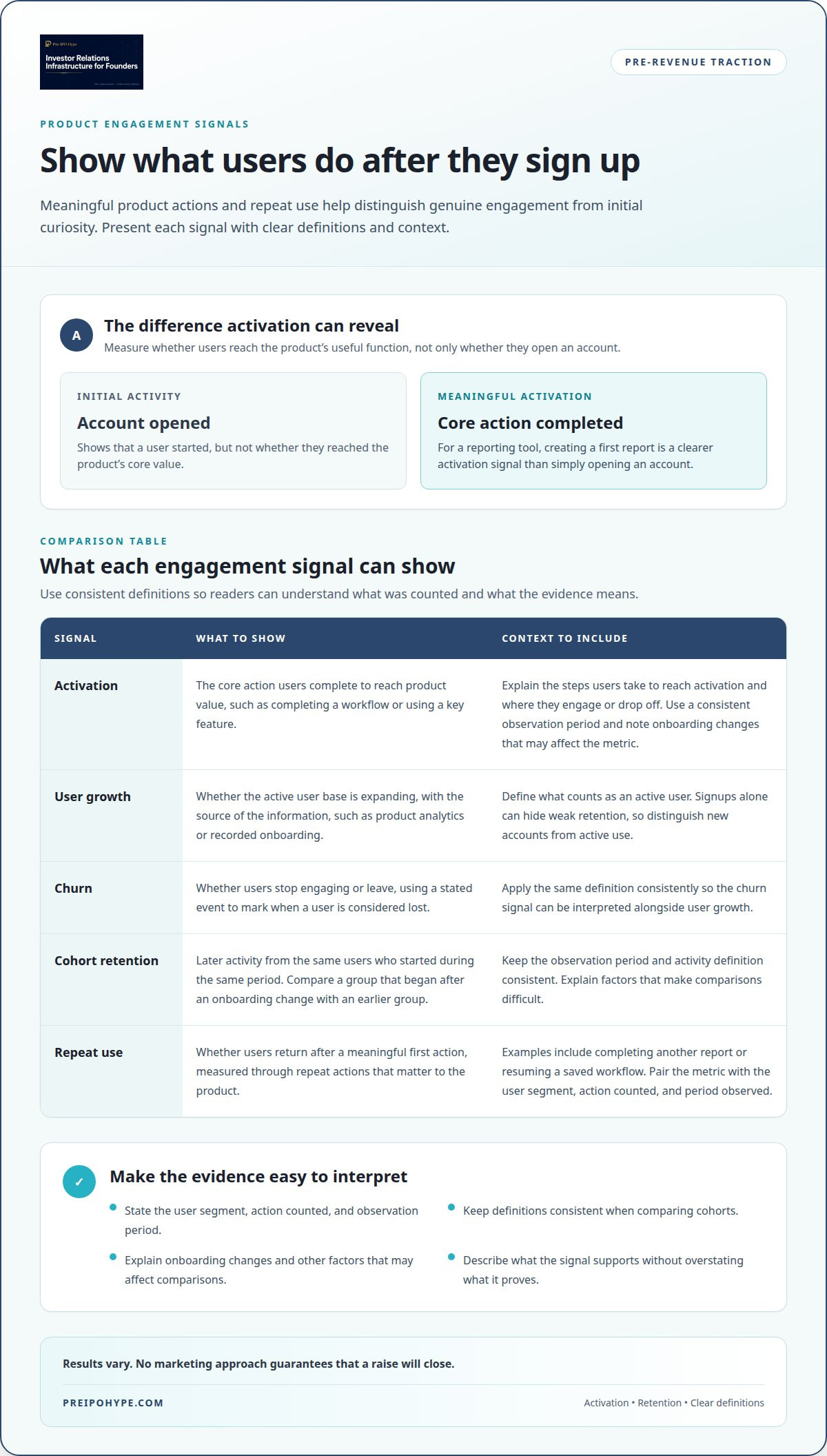
Product activation is when a user completes an action that demonstrates the product’s core value. For a reporting tool, that might mean creating a first report, not merely opening an account. This distinction helps founders show whether users reach the product’s useful function. Report activation alongside the steps required to reach it, so investors can see where users engage or drop off.
Choose an activation event that reflects a real user need, such as completing a workflow or using a key feature. Then track how many new users reach it within a consistent observation period. Explain what the metric means and note any onboarding changes that could affect it. More account creations without more completed core actions signal a different pattern from deeper product use. A practical part of how to show traction to investors with no revenue is making that difference clear.
User Growth and Churn
User growth shows whether the active user base is expanding; churn shows whether users stop engaging or leave. Both matter because new signups alone can hide weak retention. Present growth with its source, such as product analytics or recorded onboarding, and define what counts as an active user. For churn, state the event that marks a user as lost, then apply that definition consistently.
Compare users who started during the same period as a cohort. For example, follow users who first tried the product after an onboarding change, then compare their later activity with an earlier group. This can show whether the change affected repeat engagement. Keep the observation period and activity definition consistent, and explain factors that make comparisons difficult. For teams deciding how to show traction to investors with no revenue, consistent cohort definitions make the evidence easier to interpret.
Retention measures whether users return after their first meaningful action. A cohort view tracks the same users over time instead of blending new signups with returning users. Report repeat actions that matter to the product, such as completing another report or resuming a saved workflow. Pair each metric with the user segment, action counted, and period observed. This gives investors context to assess whether engagement reflects a durable product signal or a temporary spike.
Advisory boards and third-party validation
For a pre-revenue company, experienced advisors and credible external relationships can help investors assess execution capacity. Their value depends on relevant expertise and actual involvement, not titles alone. A former executive from a target industry, a past manager, or a specialist professional may bring useful context. Explain how each person’s experience relates to the company’s market or operating challenge.
Describe advisors by their contributions. An experienced finance leader might review the company’s financial assumptions, while a product specialist could assess technical priorities. State what guidance each person has provided and how the team used it. For example, if an advisor identified a gap in onboarding, describe the resulting product decision. Avoid implying that an advisor’s reputation proves customer demand or amounts to an endorsement.
External validation adds a perspective beyond the founding team. A university, corporation, or industry organization may contribute expertise, facilities, or a structured evaluation. Clarify the organization’s role and the work completed. Investors should be able to distinguish an active collaboration from a discussion, informal introduction, or proposed project.
For a corporate relationship, identify the business function involved and the question being examined. A technology company, for instance, might evaluate whether a new tool fits its existing workflow. Explain who is responsible for the evaluation and what conclusions it can support. Keep claims within the scope of the work: a favorable assessment of one use case does not establish broad market demand.
Supporting documents can make these relationships easier to interpret. Use an advisor’s written scope, a collaboration agreement, or a summary of completed evaluation work where appropriate. Describe each document’s purpose without suggesting it proves more than its terms show. If the relationship is still exploratory, say so. Clear descriptions protect the credibility of the broader investor presentation.
Connect each advisor or external relationship to a relevant execution question. An advisor may strengthen the team’s understanding of a regulated customer segment, while a university collaboration may provide technical input on a product assumption. Explain what remains unresolved and how the team plans to address it. Investors can then assess these relationships as evidence of capability and engagement, not as substitutes for the company’s own progress.
Defining pre-revenue startups
A pre-revenue startup hasn’t generated sales revenue and may still be developing or testing its product. That status describes sales, not whether the business has customer evidence. A team might have a working prototype, conduct user tests, or gather signups before offering a product for sale. Investors therefore need a clear account of both what exists and what remains untested.
Separate revenue status from product progress. For example, a software startup might have a usable prototype but no completed sales. It can describe the problem the product addresses, the intended buyer, and the development stage. If the product is still being tested, explain what users can do today and which core capabilities remain in development. This helps investors assess progress without confusing a plan with a launched product.
Customer discovery can show how a startup understands demand. Summarize recurring themes from conversations with potential users, such as a repeated workflow problem or a workaround customers already use. Explain how those findings shaped the product or ideal customer profile. A waitlist can add context when signups are segmented by relevant customer characteristics. Signups alone, however, do not establish that people will purchase.
A prototype or beta can provide evidence beyond stated interest. Describe the task users tested, the feedback collected, and the changes made afterward. For example, a team building scheduling software might observe how a prospective user handles a booking task. Report what the test demonstrated and what it did not. This makes early product evidence concrete without presenting testing as sales.
Letters of intent also need careful interpretation. They can indicate willingness to trial or buy a product once it is ready, but a letter does not automatically constitute a sale. Its terms determine what the customer has committed to. Describe the proposed next step and any conditions plainly. Likewise, identify a pilot, design collaboration, or partnership by its actual status, not as completed revenue.
For investors, the useful picture combines the company’s sales status with its strongest evidence of progress. A pre-launch venture might present a representative product, documented user research, and a defined testing plan. A startup with active testers can explain what those users are evaluating. In either case, connect each claim to an observable activity or artifact. Clear boundaries help investors distinguish current traction from future milestones.
Early-stage traction without revenue
Before revenue, traction can show whether a startup is reducing the risks that block adoption. Investors assess evidence in context: a pre-launch team must explain what it has learned, while a team nearing launch must show operational readiness and a credible path to customers.
Present evidence as a chain: identify the assumption, describe the test, report the finding, and show the decision it informed. This sequence helps investors judge progress rather than activity alone.
Stage-Based Traction Evidence
Stage-based traction evidence is proof matched to the company’s next major risk. It matters because a polished product may not resolve uncertainty about distribution, while strong customer interest cannot establish technical feasibility. For example, a hardware startup might document a successful prototype test, then explain the remaining manufacturing questions. Investors can see what is proven and what still needs work.
Organize evidence around milestones instead of a long list of accomplishments. For each milestone, state the intended outcome, current status, and next decision. A software team might show that a core workflow functions, then identify integration readiness as its next test. This gives a clear account of execution without implying that an unfinished milestone is complete.
Pilots and Letters of Intent
For an existing pilot or letter of intent, emphasize the path from initial interest to a defined business decision. Identify the customer-side decision-maker, the operational team involved, and conditions that could prevent adoption. This gives investors useful context beyond the document or project name. A pilot’s value also depends on whether its evaluation criteria connect to a plausible purchasing process.
Explain what the startup learned about implementation, procurement, or internal ownership. For instance, a trial may reveal that a product needs approval from another department. That finding can shape the company’s go-to-market plan, even before sales begin. Keep the conclusion specific to the organization and test involved.
Waitlists as Demand Signals
A waitlist can help assess which acquisition channels attract relevant prospects. Compare the context behind signups, such as a referral, product demonstration, or broad promotional message. This helps distinguish audience reach from qualified interest. The source of each response can also reveal which message or channel brings people closer to a meaningful product evaluation.
Use this information to refine customer acquisition assumptions. If one channel attracts intended buyers while another draws mostly casual interest, explain how that affects the next outreach test. Treat signups as a starting signal, not a forecast. Investors can then assess whether the team understands how interest forms and what must happen before it becomes adoption.
Pre-IPO Hype
Pre-IPO Hype provides investor relations infrastructure for Regulation CF and Regulation A+ raises. It is not a broker-dealer, funding portal, or investment adviser, and it does not offer or sell securities or make investment recommendations.
For an issuer preparing a raise, campaign support can help organize communication about its progress. Pre-IPO Hype provides this support alongside the issuer’s registered intermediary and qualified securities counsel. The work can help the issuer present information consistently across investor-facing materials, while responsibility for offering decisions remains with the appropriate parties.
Investor relations and marketing campaigns can communicate an issuer’s milestones, product updates, and other relevant company information. The issuer determines which evidence to present and supplies the facts behind those claims. Campaign materials should describe each milestone accurately, distinguish completed work from plans, and remain consistent with the issuer’s offering documents.
The Investor Relations OS includes a pipeline CRM, outreach automation, and analytics for running a raise. This infrastructure supports investor relations but does not replace the issuer’s registered intermediary or qualified securities counsel. Legal decisions belong with qualified securities counsel. Investors should be directed to the issuer’s registered intermediary or offering page for offering information.
Founders preparing Regulation CF or Regulation A+ campaigns can use this infrastructure to communicate issuer-provided information. It is not investment advice or securities brokerage, and it does not promise a fundraising outcome. The issuer, registered intermediary, and qualified securities counsel each have distinct roles in the process.
Contact Pre-IPO Hype to discuss campaign support for your issuer.
Frequently Asked Questions
Can pre-revenue startups raise investment?
Yes, pre-revenue startups can seek investment, though investors assess the company’s evidence, risks, and development stage. A founder can explain how the business plans to reach customers, what remains untested, and how proposed funding relates to upcoming milestones. For a Regulation CF or Regulation A+ raise, discuss eligibility, disclosures, and other legal decisions with qualified securities counsel. No revenue does not remove the need for a credible business case.
How can startups show traction without revenue?
Startups can show traction by connecting evidence to a clear business claim. For example, a team might show that a product change reduced confusion during user testing, then describe what it plans to test next. Keep records of customer conversations, product decisions, and completed milestones in one timeline. This lets investors follow how evidence influenced execution, rather than seeing isolated activity without context.
What counts as startup traction before revenue?
Pre-revenue traction is observable progress that reduces uncertainty about a startup’s market, product, or ability to execute. Evidence may include a prototype that addresses a defined customer problem, a completed technical milestone, or a team’s response to user feedback. Distinguish activity from progress: building features is an activity, while demonstrating that a feature addresses a specific user need gives investors something concrete to assess.
How can founders demonstrate customer demand without revenue?
Founders can demonstrate demand by documenting how potential buyers describe the problem, what alternatives they use, and what would need to change before they adopt a solution. For a business product, record the buyer’s role and the workflow affected. Then compare responses across customer types and note where needs differ. This helps founders explain which customers they intend to serve and what evidence supports that choice.
What evidence of traction should a startup include in an investor pitch deck?
Include evidence that supports the company’s current claims, plus the context investors need to interpret it. A useful slide can identify the customer segment, the method used to gather evidence, the finding, and the business decision that followed. Pair technical progress with the next unresolved risk, such as integration or adoption. Keep underlying records available so the presentation summary can be traced to actual work.
What are good benchmarks for pre-revenue startup growth and engagement?
There is no single growth or engagement benchmark that fits every pre-revenue startup. A collaboration tool and a product used occasionally may have very different patterns. Set an internal baseline, define an active user consistently, and compare like-for-like groups over equivalent periods. Explain changes in acquisition or onboarding that could affect results. Investors can then assess whether movement is meaningful for that product and customer segment.
Disclaimer
Educational only. Not investment, tax, or legal advice. Pre-IPO Hype is investor relations infrastructure for Regulation CF and Regulation A+ raises. We are not a broker-dealer, funding portal, or investment adviser, and we do not offer or sell securities or make investment recommendations. Any securities offering is made only by the issuer, through its own offering documents and, where required, a registered intermediary.