
How to Keep Investors Engaged After Your Raise
Keep investors engaged after a raise by tailoring updates to company performance, explaining how developments affect the business plan, and setting clear expectations for ongoing communication. A practical approach to how to keep investors engaged post-investment makes every interaction relevant: share meaningful news, address setbacks plainly, and choose activities that fit investors’ interests and the company’s capacity.
Consistent communication matters, but more messages are not automatically better. Investors need a clear view of milestones, risks, and decisions that could change the company’s direction, along with an understanding of when and how they can contribute. This article explains how to adapt outreach as performance changes, communicate impacts transparently, set engagement expectations, and choose activities the team can sustain. Results vary, and no marketing approach guarantees a successful raise.
Key Takeaways
- Align investor outreach with company performance and the specific purpose of each interaction.
- Explain how important developments affect business plans, and communicate setbacks alongside potential responses.
- Set clear expectations for the purpose, topics, and timing of ongoing investor conversations.
- Choose engagement activities that suit investors’ interests and the team’s capacity, rather than sending updates without a clear purpose.
- Results vary. No marketing approach guarantees that a raise will close.
1. Adjusting engagement strategy based on performance
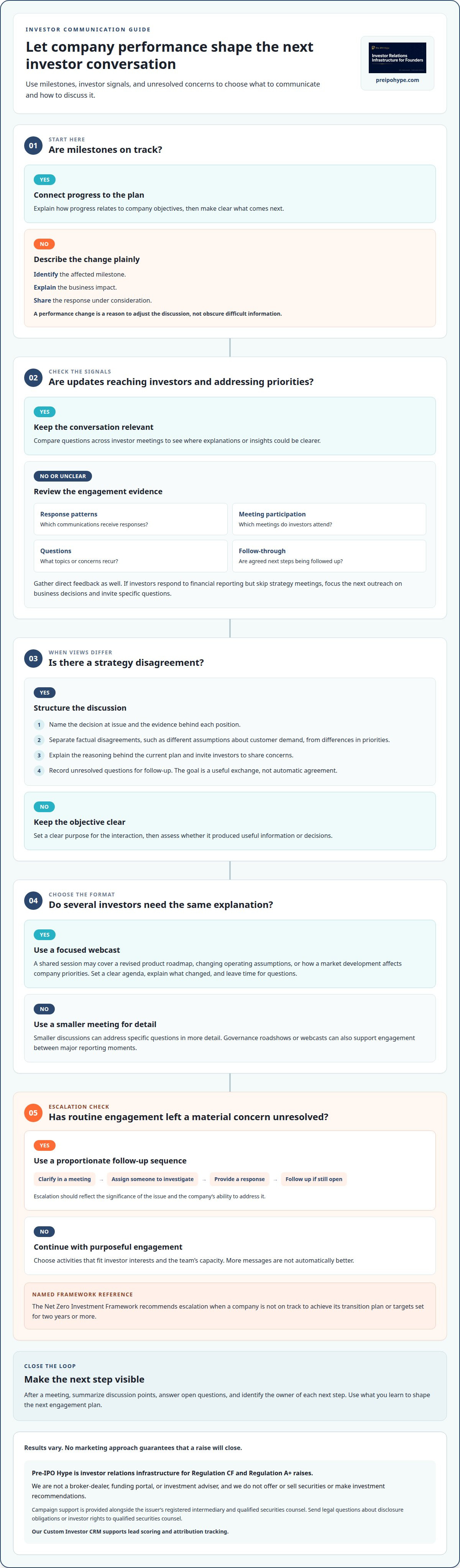
A professional measures investor engagement through response patterns, meeting participation, questions, and follow-through. To assess satisfaction, they also gather direct feedback and track recurring concerns. For example, if investors respond to financial reporting but skip strategy meetings, the next outreach can focus on business decisions and invite specific questions. These signals reveal whether communication is reaching investors and addressing their priorities.
For founders considering how to keep investors engaged post-investment, company performance should shape the subject and format of each update. When milestones are on track, connect progress to company objectives and explain what comes next. If delivery slips, identify the affected milestone, explain the business impact, and describe the response under consideration. A change in performance is a reason to adjust the discussion, not obscure difficult information. Comparing questions across investor meetings can also reveal where explanations or insights need to be clearer.
Strategy disagreements need a defined process. First, identify the decision at issue and the evidence behind each position. Then distinguish factual disagreements, such as different assumptions about customer demand, from differences in priorities. Explain the reasoning behind the current plan, invite investors to share their concerns, and record unresolved questions for follow-up. The goal is a useful exchange, not automatic agreement. Clear objectives keep meetings focused and help show whether the discussion produced useful information or decisions.
Escalation may be appropriate when routine engagement does not resolve a material concern. The Net Zero Investment Framework recommends escalation when a company is not on track to achieve its transition plan or targets set for two years or more. For other business issues, establish a proportionate sequence: clarify the concern in a meeting, assign someone to investigate, provide a response, and arrange a follow-up if the issue remains open. Escalation should reflect the issue’s significance and the company’s ability to address it.
Strategy webcasts can help when several investors need the same explanation. A focused session might cover a revised product roadmap, changing operating assumptions, or how a market development affects company priorities. Share a clear agenda, explain what has changed, and leave time for questions. Governance roadshows or webcasts can also support engagement between major reporting moments. When planning how to keep investors engaged post-investment, use webcasts for shared updates and smaller meetings for detailed discussions. Questions and feedback can inform the next engagement plan.
2. Communicating business impacts transparently
Investor updates should connect company activity to its business impact. A new customer contract, for example, is more meaningful when the update explains how it affects delivery plans, customer demand, or operating capacity. Organize reporting around the development, its effect on company objectives, and the next step. This gives investors useful context instead of a string of disconnected announcements and helps founders explain a milestone without overstating its significance.
Regular communications work best when the company sets a workable cadence and assigns responsibility. Coordinate the calendar with the issuer’s agreements and reporting process, then gather input from finance, operations, and leadership. After a meeting, follow up with a summary of discussion points, answers to open questions, and the owner of each next step. Timing should reflect the subject and any agreed reporting obligations, not a rigid schedule for every investor interaction.
Channel choice depends on the content and audience. A detailed financial report may suit a secure document-sharing process, while a company-wide milestone update may work well by email. Meetings can address complex questions that benefit from discussion. Professionals can help select consistent channels for recurring communications and a more direct format for sensitive matters. The aim is to explain each development effectively, while making the benefit and limits of the update clear.
In the United States, confidentiality and disclosure considerations depend on the offering, company agreements, and the information being shared. Coordinate communications carefully and keep confidential material within its intended audience. Founders should direct legal questions about disclosure obligations or investor rights to qualified securities counsel, who can consider the offering documents and specific circumstances.
Useful metrics depend on the company’s business model and reporting systems. Professionals can help founders prepare measures such as revenue trends, customer retention, sales pipeline, product milestones, cash use, or delivery performance. They can also help define each measure and explain its reporting period. For example, a company reporting customer growth can distinguish new accounts from retained customers, giving investors a more useful view of what the metric shows.
Investor expertise is most useful when a request is specific. A founder might ask an investor with relevant operating experience to review a proposed market-entry plan or offer perspective on a hiring challenge. Record the request, route it to the appropriate company contact, and note any agreed follow-up. Sharing confidential documents or personal contact details should follow company policies and applicable agreements.
For investor questions, log requests, group related topics, assign someone to respond, and decide whether an answer is appropriate for wider distribution. A question about delayed product delivery, for instance, may need input from operations before a response is prepared. This process helps maintain consistent answers, identify unresolved issues, and provide information suited to each question.
3. Clear engagement intentions and expectations
Investor relations work better when each conversation has a defined purpose. Before scheduling a meeting, state what the company wants to discuss, what information it expects to share, and what follow-up may be needed. For example, a meeting about a planned product launch can focus on the decision, current progress, and feedback that would be useful. This framing helps both sides prepare and keeps the discussion focused.
Set practical expectations at the start of the relationship. Clarify who will communicate, which channels the company will use, and how investors can raise questions. Explain which discussions are informational and which require a company decision. For example, a founder might invite feedback on a market opportunity while making clear that management remains responsible for operating choices. Written expectations help prevent differences of opinion from creating confusion about roles.
Before accepting an investment, founders can ask prospective investors what support they provide after investing. This might include operating experience, sector knowledge, or introductions they are willing to make. Discussing expectations can also reveal whether an investor prefers periodic updates or hands-on involvement. These conversations give the company a clearer basis for deciding whether the relationship fits its needs, without assuming every investor will contribute in the same way.
Time horizons are another useful topic. Investors may have different expectations about how long they will remain involved and what progress they hope to see. Discuss how the company will communicate changing priorities or a missed milestone. Not every investor expects the same level of involvement, so a clear conversation can surface differences before they affect the working relationship.
Consider whether an investor conversation would be valuable outside a fundraising process. If so, it can create space to share relevant feedback or discuss an operating challenge. If not, clarify what would make the discussion useful and which requests should go through regular reporting. This keeps investor relations connected to business needs rather than treating every interaction as an obligation.
For each engagement, record its objective and what followed. A brief note might capture the topic, feedback received, agreed next steps, and whether those steps were completed. For example, if an investor raises a concern about a distribution plan, record who will review it and whether another discussion is needed. Consistent records help the team prepare for future conversations and assess whether engagement is useful.
4. Engagement activities and resource levels
Investor activities should match the company’s capacity and the value each interaction can provide. A founder with a small operating team might prioritize concise written materials and focused meetings over elaborate events. A company approaching a product milestone could hold a briefing to explain its relevance to shareholders. The right mix depends on staff availability, reporting needs, and investor questions. Planning how to keep investors engaged post-investment means choosing activities the team can sustain.
Follow-up should feel timely and connected to the conversation, rather than mechanically scheduled. After a meeting, a professional can help prepare a thank-you message that reflects the discussion and captures agreed actions. If investors raise additional questions, the team can respond when it has accurate information and the appropriate input. A later check-in can focus on whether the original discussion led to a useful next step. The cadence can vary with the topic, urgency, and relationship.
Engagement can extend beyond formal updates. A focused meeting might explore a partnership opportunity, while a written briefing could explain a product milestone or operational change. Discussions between fundraising periods give investors and founders room to consider how events, such as supply-chain disruption, affect the company. Give each activity a purpose, such as gathering feedback, sharing a development, or discussing a specific operating challenge.
Resource limits matter. A small team can answer common questions in a shared update, then reserve individual meetings for issues that need deeper discussion. A larger team may assign separate owners for reporting, event coordination, and follow-up. Account for preparation time, leadership availability, and consistency across communications. These constraints help determine which activities are practical and what support the team needs to maintain them.
Investor contributions can include board or advisory-board service, hands-on involvement, or incubation support. Consider which form fits the company’s needs and whether an investor has relevant experience for a particular challenge. For example, an investor familiar with distribution may offer perspective on a channel strategy. Clear boundaries define the role and help avoid commitments the team cannot support.
Content planning makes engagement easier to coordinate. A simple calendar can connect each activity to a business milestone, audience, and internal owner. Content creation and strategy can help shape investor communications. The team can then review whether an event or update met its purpose and identify remaining follow-up. An activity is useful when it helps shareholders understand company progress or contribute to a focused discussion.
Pre-IPO Hype
Pre-IPO Hype provides investor relations infrastructure for Regulation CF and Regulation A+ raises. We are not a broker-dealer, funding portal, or investment adviser, and we do not offer or sell securities or make investment recommendations.
For founders planning ongoing investor communications, Pre-IPO Hype provides campaign support alongside the issuer's registered intermediary and qualified securities counsel. Investor Relations and Marketing Campaigns can support outreach for the issuer, while Content Creation and Strategy can help shape clear updates around business progress and investor engagement objectives. Our Custom Investor CRM supports lead scoring and attribution tracking.
Contact Pre-IPO Hype to discuss campaign support for your investor communications.
Build investor relations into the next stage of growth
The period after a raise is an opportunity to make investor relations part of the company’s operating rhythm. As priorities shift, the communications approach can evolve too. Treat investor feedback as one input among many, then decide which insights warrant follow-up, discussion, or a change in the company’s plans.
A durable approach to how to keep investors engaged post-investment also depends on clear ownership. Assign responsibility for preparing updates, coordinating responses, and reviewing whether communications remain useful. This structure helps the team maintain continuity as leadership focuses on new opportunities and operating demands.
Pre-IPO Hype is investor relations infrastructure for Regulation CF and Regulation A+ raises. We are not a broker-dealer, funding portal, or investment adviser, and we do not offer or sell securities or make investment recommendations. Pre-IPO Hype provides campaign support alongside the issuer's registered intermediary and qualified securities counsel.
Results vary. No marketing approach guarantees that a raise will close.
Frequently Asked Questions
Why Conduct Off-Season Investor Engagement?
Off-season engagement keeps investor relations active when a company has no immediate fundraising announcement. It gives founders room to share operating developments that may not fit a formal raise update, such as a new distribution channel or a shift in customer priorities. It also lets investors ask questions without centering the conversation on a transaction. These exchanges help maintain context as the business evolves.
How often can a professional help startups send investor updates after raising funding?
A professional can help set an update schedule that reflects the company’s reporting commitments, operating pace, and investors’ needs. Monthly updates may suit a company with frequent product or sales developments, while less frequent communications may work when material changes are limited. The schedule should distinguish routine reporting from important news that needs prompt attention. A communications calendar can map these needs without treating every update as a fundraising message.
What can a professional help include in a monthly investor update?
A monthly update can include a concise view of business performance, current priorities, and changes since the last report. For example, a software company might share product releases, customer retention trends, and progress on a planned integration. A professional can help explain how each item relates to company objectives and identify information that needs context. The final content should reflect the company’s actual records and approved communications.
What are best practices for a professional supporting communication of bad news to investors?
Communicate bad news directly, with a clear distinction between confirmed facts and unresolved questions. A professional can organize the message around what happened, the known business impact, the steps underway, and when the company expects to provide another update. For example, if a supplier delay affects a launch, explain the operational effect without presenting estimates as settled facts. Qualified securities counsel should review legal questions about disclosures.
How can a professional help founders engage investors between funding rounds?
Plan useful touchpoints that are not fundraising appeals, such as milestone briefings, feedback sessions, or discussions about a specific operating challenge. For example, a founder developing a new sales channel could invite investors with relevant experience to respond to a focused question. Coordinate the topic, prepare context, and document follow-up. This keeps the exchange connected to business needs while respecting investors’ time and expertise.
What tools and templates can a professional use to support investor relations?
Useful materials include an update template, a communications calendar, a meeting brief, and a log for questions and follow-up owners. The Investor Relations OS includes a pipeline CRM, outreach automation, and analytics for running a raise. The format matters less than consistent definitions, controlled access, and accurate records. For instance, a template can separate operating metrics from commentary, helping readers distinguish reported results from management’s interpretation.
Disclaimer
Educational only. Not investment, tax, or legal advice. Pre-IPO Hype is investor relations infrastructure for Regulation CF and Regulation A+ raises. We are not a broker-dealer, funding portal, or investment adviser, and we do not offer or sell securities or make investment recommendations. Any securities offering is made only by the issuer, through its own offering documents and, where required, a registered intermediary.