
Investor Communication Plan Template for Growth
An investor communication plan template gives your team a practical way to set communication goals, define audiences, and coordinate updates. For a Regulation CF or Regulation A+ raise, it can clarify who prepares, reviews, and sends each investor message, and when.
Clear, consistent communication matters, especially when several people contribute to a campaign. This guide explains how to shape core messages, assign responsibilities, protect confidential information and plan communications from announcement through Day 30. It also covers how to align channels and timing with campaign milestones, and how to handle changes without creating conflicting updates.
Treat the plan as a working document, not a substitute for qualified securities counsel. Keep investor communications accurate and consistent with the issuer’s offering materials, and refer legal decisions to counsel. Results vary. No marketing approach guarantees that a raise will close.
Key Takeaways
- Set communication goals that support the raise, then tailor messages and channels to the audiences who need them.
- Keep the message core consistent, with a clear review path for updates before they are shared.
- Assign an owner to each communication and define how urgent or sensitive issues are escalated.
- Build confidentiality safeguards into the process, including who can access information and how it is distributed.
- Map communications from announcement through Day 30 around campaign milestones, with room to adjust when facts change.
What is a communication plan?
A communication plan sets objectives, audiences, messages, channels, timing, owners, and metrics for a defined initiative. A communications professional builds it by mapping those elements to campaign milestones, then reviewing the format and message flow for gaps.
-
Set communication objectives
Define what each communication should help its audience understand or do. For a Regulation CF or Regulation A+ raise, an objective might be to explain the company’s business, progress, and next milestone in a consistent format. Link each objective to a company goal and choose a metric to assess whether the message reached its intended audience.
A startup investor communication plan template should capture each message’s objective, core points, audience, channel, sender, timing, reviewer, and metric. Make objectives specific to the communication rather than relying on broad aims such as “build awareness.” For example, an announcement can explain what is being announced and direct readers to the issuer’s offering page.
-
Identify investor audiences
List the audiences for each update, then tailor its detail and format. A founder might give current investors a concise progress update, while a public announcement introduces the company and its raise to a broader audience. Keep material information consistent across communications rather than sharing it selectively with a small group.
For an investor update email, use a subject line that identifies the update, an opening that states the main point, a progress section, and the next milestone. For example: “Company update: product launch progress,” followed by a factual summary and a link to the issuer’s offering page. Engage readers without implying an outcome or making unsupported claims.
Tailor the explanation and format, not the underlying facts. A prospective investor may need a clear company overview, while an existing investor may prefer a direct progress summary. Keep both versions aligned with the issuer’s approved communications and offering materials.
-
Schedule communication timing
Map communications to announcement milestones, audience needs, and decision points. An announcement plan can coordinate a press release, investor call, investor deck, and filed materials so each channel carries a consistent message. Assign a sender to each item, such as the CEO for an investor call and the communications lead for an email distribution.
Choose channels based on purpose and audience. A press release supports a public announcement, an investor call lets a company representative explain an update, and an email can share a concise summary and direct readers to the issuer’s offering page. Don’t add a channel simply because it’s available. For each communication, record its timing, owner, reviewer, and intended audience.
Use the plan as a working schedule. If a milestone changes, update the relevant timing and route revised messages through the assigned review process. This creates a coordinated sequence instead of disconnected announcements competing for attention.
Message core and legal review guardrails
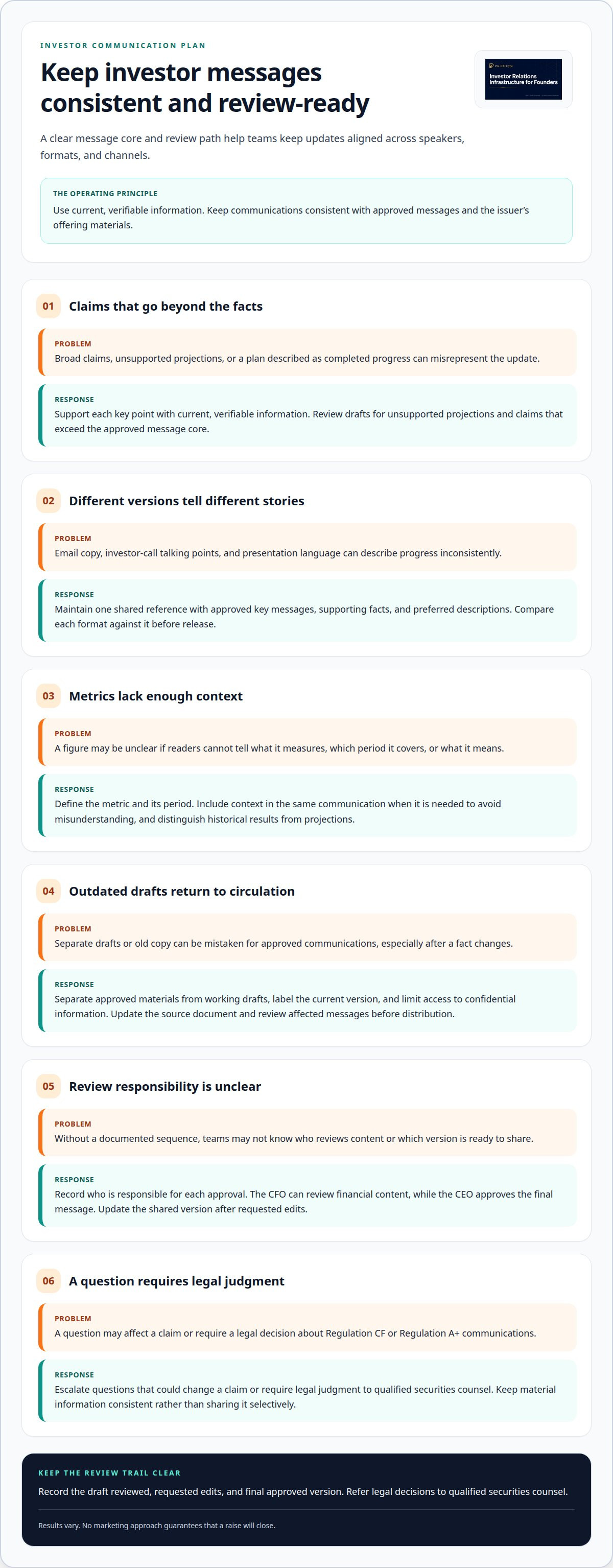
Documented core messages keep investor communications aligned across speakers, formats, and channels. A clear review workflow helps the team catch unsupported claims and conflicting language before release.
-
Define key messages
State the central points investors should understand, then support each with current, verifiable information. Keep the message core concise and focused on the issuer’s business, progress, and relevant context. Avoid broad claims that cannot be backed up with clear facts. For financial metrics, define the period and meaning, and distinguish historical results from projections.
Choose metrics because they clarify the update, not because they make the narrative sound stronger. For example, explain what a customer measure represents before using it to describe progress. If a metric needs context to avoid misunderstanding, include that context in the same communication.
-
Align the team on messaging
Maintain a shared document of approved key messages, supporting facts, and preferred descriptions. Before release, compare email copy, investor-call talking points, and presentation language against it. This gives the CEO, CFO, and communications lead a common reference and reduces the risk of describing company progress inconsistently.
Document the review sequence and who is responsible for each approval. The CFO can review financial content, while the CEO approves the final message. If a reviewer requests edits, update the shared version before distribution. Don’t circulate separate drafts that could be mistaken for approved communications.
-
Review communication risks
Review each draft for unsupported projections, unclear metric definitions, outdated information, and claims that go beyond the approved message core. Don’t present a plan as completed progress or remove context that changes the meaning of a figure. Refer legal questions about Regulation CF or Regulation A+ communications to qualified securities counsel.
Keep investor messaging consistent rather than sharing material information selectively with a small group. Escalate questions that could change a claim or require legal judgment. Record the draft reviewed, requested edits, and final approved version so the team can identify what is ready for release.
- Control document versions throughout the review process. Separate approved materials from working drafts, limit access to confidential information, and clearly label the current version. If a fact changes, update the source document and review affected messages before distribution. This helps prevent outdated copy from re-entering the release process.
- Use investor questions and team feedback to improve clarity, not to reshape facts around a preferred narrative. If readers repeatedly misunderstand a metric, revise its explanation in the next update. Keep its definition consistent across channels, and refer legal decisions to qualified securities counsel.
Responsibilities, escalation, and confidentiality
Assign an owner to every communication task, from drafting through distribution. Clear roles also show stakeholders where to direct questions and how confidential information is handled.
-
Assign communication responsibilities
Name an owner for each message and define who creates, reviews, approves, and distributes it. For example, a communications lead can coordinate the draft, while the CFO reviews financial details and the CEO approves the final message. Assign a backup for critical tasks so a delayed reviewer doesn’t leave an update without a clear path forward.
Separate approval authority from delivery responsibility. The person sending an investor email should use the approved version, not make unreviewed edits. Include internal stakeholders who supply progress information, and specify who resolves conflicting input.
-
Track investor questions and responses
Use one controlled log to record each investor question, its date, assigned owner, response status, and source channel. Group recurring questions by topic, such as company progress or campaign process. This helps the communications team identify unclear material and prepare consistent answers without treating separate investor conversations as separate facts.
Set an expected response process based on each question’s complexity and urgency. Track whether a response is pending, under review, or sent, and note when counsel should assess a legal question. Monitor delivery and response measures, such as messages delivered, failed deliveries, questions received, and unresolved items.
-
Set escalation and confidentiality practices
Define escalation triggers before a sensitive issue arises. A question that could change a public claim, disclose confidential information, or require legal judgment should go to the designated senior reviewer. Identify who receives the escalation and how the team pauses affected communications until the issue is resolved.
Document security protocols for drafts, approved materials, and investor details. Limit access to people who need the information for their assigned work, and use controlled storage instead of broadly forwarding confidential files. Tell each owner how to report an accidental disclosure or a message sent to the wrong audience.
- Measure delivery and follow-up against the plan’s communication goals. Review delivery failures, unanswered questions, and recurring requests for clarification. These signals can help the team improve the next update’s format or routing without changing the underlying facts.
- Review roles when the campaign or team changes. A new employee, revised approval path, or change in communication channels can leave an old owner responsible for work they no longer handle. Update the assignment record, escalation contacts, and access permissions together to support reliable execution.
Communication timelines from announcement through Day 30
A timeline connects investor communications to the announcement, company milestones, and decisions. From announcement through Day 30, it gives the team a shared sequence for preparation, release, and follow-up.
-
Create the communication timeline
Build the schedule around the planned announcement, recording each communication’s release point, audience, channel, and owner. Include preparation and review tasks, not just the release date. Mark dependencies, such as an approved announcement informing related email and call materials. Avoid scheduling several complex releases together if the team cannot prepare them consistently.
Use the Day 30 point as a review checkpoint. Record which communications went out, which questions remain open, and what follow-up is planned. This turns the timeline into a working record rather than a list of intended dates.
-
Map timelines to milestones
Connect each update to an understandable company milestone, such as a product development change or operating update. Note what event prompts the communication and what information is needed before drafting. If the milestone shifts, adjust the schedule and revisit messages that depend on it.
Meetings and written updates can serve different purposes. A meeting lets a representative explain context, while a written follow-up gives everyone a consistent reference. Schedule each format around the information available and the audience’s need for detail.
- Separate announcement communications from follow-up. The announcement can explain what is being shared and direct investors to the issuer’s offering page. Assign an owner to the external release, and leave time in the schedule to respond to questions afterward.
- Build review points into the timeline instead of treating release as the final task. At each checkpoint, compare communications with actual company progress and approved materials. If facts change, pause affected messages and route revised copy through the established review process before distribution.
- Use feedback to improve clarity and timing. For example, recurring questions after an investor meeting may show that a written explanation needs more context. Schedule a clear follow-up, identify its audience, and keep its statements consistent with approved information.
- Close the Day 30 review by documenting completed communications, unresolved questions, and assigned follow-up. This gives the next communication cycle a reliable starting point. It also helps the team distinguish a planned update from completed progress when preparing future external messages.
Account for project milestones, decision deadlines, and stakeholder availability. Use deadlines, caps, and perks only when they are real and disclosed in your offering documents. Schedule an investor deal overview for Day 1 after the public announcement, with Monthly investor integration progress updates.
Pre-IPO Hype
Pre-IPO Hype is investor relations infrastructure for Regulation CF and Regulation A+ raises.
We are not a broker-dealer, funding portal, or investment adviser, and we do not offer or sell securities or make investment recommendations.
For founders preparing investor communications, Pre-IPO Hype provides campaign support alongside the issuer’s registered intermediary and qualified securities counsel. This support can help coordinate campaign messaging and communication materials. Qualified securities counsel handles legal decisions, while the issuer’s registered intermediary manages its role in the offering process.
If you need support with campaign communications, contact Pre-IPO Hype.
Make the Next Communication Cycle Deliberate
After the initial cycle, decide how investor communication fits the company’s operating rhythm. Treat the investor communication plan template as a living reference, and revisit it when business priorities or approved information change. This keeps future communications tied to actual company progress rather than a calendar alone.
Before planning the next cycle, identify which updates help investors understand upcoming priorities and which information belongs in internal planning. A communications professional can help turn approved priorities into clear content and a practical distribution approach, alongside the issuer’s registered intermediary and qualified securities counsel. Legal decisions remain with qualified securities counsel.
Choose a next step based on your team’s communication needs and capacity. A planning conversation can help clarify what campaign support fits, while the issuer remains responsible for reviewing its communications. A thoughtful process gives the company room to communicate clearly as its priorities evolve.
Clear, considered communication can support the company’s next stage of growth.
Frequently Asked Questions
What is an investor communication plan template?
An investor communication plan template is a reusable structure for organizing communications around a raise. It helps your team adapt its process to different campaign stages without starting each planning document from scratch. For example, a startup can use a shared framework for launch preparation and later progress updates. Keep a dated version history so team members can distinguish current approved materials from older drafts.
What sections should an investor communication plan include?
Include the campaign scope, audience and channel matrix, message reference document, release calendar, approval record, escalation contacts, confidentiality practices, and evaluation measures. Add a version history and a glossary for terms that could be interpreted differently, such as operating metrics. Together, these elements help new contributors use the plan and reduce confusion when responsibilities or campaign details change.
How often should companies communicate with investors?
Set a planned cadence around company milestones and the availability of accurate, approved information. Add a communication when a meaningful update needs explanation, rather than sending messages just to fill the calendar. For example, a product milestone may warrant an update when the company can explain what changed and what comes next. If there is no substantive news, avoid implying progress through unnecessary announcements.
What investor communication channels work best?
The best channel depends on the message’s purpose, complexity, and audience. A concise email can direct investors to the issuer’s registered intermediary or offering page, while a meeting lets a company representative explain context and hear questions. Keep channel-specific versions consistent with approved information, and consider whether recipients can access and refer back to the materials afterward.
What financial metrics should be included in investor updates?
Include financial metrics that clarify the update, define their period and meaning, and distinguish historical results from projections. Add context in the same communication when needed to prevent misunderstanding.
Disclaimer
Educational only. Not investment, tax, or legal advice. Pre-IPO Hype is investor relations infrastructure for Regulation CF and Regulation A+ raises. We are not a broker-dealer, funding portal, or investment adviser, and we do not offer or sell securities or make investment recommendations. Any securities offering is made only by the issuer, through its own offering documents and, where required, a registered intermediary.