
506c vs 506b: Choosing the Right Regulation for Your Private Placement in 2026
Is your next capital raise designed for the shadows or the spotlight? By 2026, the private market is projected to handle over $4.5 trillion in assets, yet most founders still stumble over the fundamental choice of 506c vs 506b. You likely know that one mistake in how you solicit investors can trigger a three year ban from the SEC; a risk that keeps 92% of emerging managers awake at night. It's frustrating to have a unicorn-level opportunity but feel handcuffed by your own Rolodex or terrified of a compliance audit.
You deserve a clear path to secondary liquidity without the legal static. This guide will help you master the strategic differences between these exemptions so you can decide if your deal requires stealth networking or explosive digital marketing. We'll break down the specific accredited versus sophisticated definitions and provide a framework to choose your regulation based on your 2026 marketing goals. From verifying assets to hitting your hard cap, you're about to find the fastest path to a closed round.
Key Takeaways
- Decipher the high-stakes choice between stealth networking and explosive digital marketing to ensure your 2026 raise hits its maximum potential.
- Master the "insider" mechanics of Rule 506(b) to leverage deep-rooted relationships without triggering restrictive SEC solicitation penalties.
- Unlock the power of general solicitation under Rule 506(c) to hunt for accredited investors globally and scale your capital reach beyond the gated elite.
- Analyze the critical trade-offs of 506c vs 506b, focusing on the balance between investor verification rigors and the opportunity cost of limited market exposure.
- Bridge the gap between legal compliance and investor acquisition by mastering the story frameworks that turn a private placement into a high-momentum movement.
The High-Stakes Choice: 506b vs 506c in Modern Private Markets
Capital is the high octane fuel for every Detroit breakout story. To access it, you need a vehicle that bypasses the bureaucratic sludge of a full SEC registration. SEC Regulation D serves as that high performance engine, allowing founders to secure massive rounds without the multi million dollar price tag of a public filing. The decision isn't just a legal checkbox; it is a strategic pivot between leveraging your inner circle or hunting for capital on the global stage. You are choosing between the comfort of existing relationships and the raw power of a public marketing campaign.
The 2026 fundraising environment has shifted toward extreme transparency. Digital noise makes "stealth" modes nearly impossible for startups trying to scale quickly. Recent data shows that 82% of accredited investors now perform independent digital due diligence before ever responding to a cold pitch deck. If you aren't visible, you don't exist. Rule 506(b) and 506(c) are the two primary paths for private placements under the JOBS Act, and picking the wrong one can stall your momentum before the first check clears.
To better understand how these two paths diverge in practice, watch this breakdown of the legal mechanics and strategic implications:
Why Regulation D Matters for Your Detroit Startup
Detroit’s tech ecosystem grew by 24% between 2020 and 2023, creating a fierce competition for local dry powder. Speed is everything in this environment. Reg D exemptions offer a 60 to 90 day advantage over traditional registration paths, providing a faster speed to market that keeps your burn rate manageable. These rules allow your company to remain private while raising institutional grade capital, effectively shielding your cap table from the volatility of public markets. At Pre-IPO Hype, we see these frameworks as the gateway to elite investment circles. We help you navigate these high stakes financial frontiers by turning legal compliance into a narrative of exclusive access. It is about moving from a local player to a national unicorn contender while maintaining the "insider" status that drives late stage growth valuations.
The Core Difference: Solicitation vs. Privacy
The choice between 506c vs 506b defines how you talk to the world and who is allowed to listen. Rule 506(b) mandates a "Quiet Period" where you only talk to investors with whom you have a substantive, pre existing relationship. It is a game of privacy and handshakes. Conversely, Rule 506(c) is the "Megaphone." It allows you to blast your pitch across LinkedIn, digital ads, and even billboards to find the next big check. This decision dictates your entire digital marketing and advertising strategy from day one.
- 506(b) Privacy: No general solicitation allowed. You can include up to 35 non accredited but sophisticated investors.
- 506(c) Solicitation: Unlimited advertising is permitted. However, every single investor must be verified as accredited via third party documentation.
- The Risk: Choosing the wrong path or accidentally soliciting under 506(b) can lead to a mandatory 30 day cooling off period or SEC penalties.
In 2023, the SEC reported a 15% increase in enforcement actions related to improper solicitation. If you start a 506(b) raise and accidentally post about it on X (formerly Twitter), you might kill the deal entirely. The 506c vs 506b debate isn't just about legal jargon; it's about whether you want to run a private club or a global movement. For Detroit founders looking at the ground floor of the next industrial revolution, the megaphone of 506(c) is often the only way to break through the noise of the 2026 market.
Rule 506(b): The 'Stealth' Approach to Private Capital
Rule 506(b) is the grandfather of private capital raises, originating with the birth of Regulation D in 1982. It functions on a simple, ironclad principle: you raise money from people you already know. This is the classic path for founders who move in established circles. It relies entirely on pre-existing substantive relationships. In the context of 506c vs 506b, the latter is often referred to as the "Country Club" raise because it rewards those with deep, legacy networks. You aren't pitching to the world; you're pitching to the room.
The core constraint is the "no general solicitation" rule. You cannot post about your raise on LinkedIn. You cannot list your terms on your company website. You cannot mention the opportunity during a public keynote at a Detroit tech conference. According to the guidelines set by SEC Rule 506(b), any public advertisement immediately disqualifies the offering. This creates a high-stakes environment where one accidental social media post can jeopardize your entire capitalization table. It's a game of discretion where the "hype" is whispered, not shouted.
One unique feature of this path is the allowance for up to 35 non-accredited investors. These individuals must be "sophisticated," meaning they possess enough financial knowledge to evaluate the risks of the deal. While this sounds inclusive, it comes with a significant catch. Including even one non-accredited investor triggers massive disclosure requirements. This often requires audited financial statements that can cost a startup upwards of $25,000 in accounting fees, a price tag that frequently deters early-stage founders.
The Benefits of Staying Under the Radar
Privacy is the primary currency here. Founders with a Rolodex full of venture capital ties or family office contacts prefer this route because it minimizes friction. Investors can self-certify their accredited status. They check a box, and the deal moves forward. This speed is vital when closing a seed round in under 30 days. It also keeps your valuation and business model away from competitors. You keep the momentum contained within a curated group of insiders, ensuring that your cap table remains exclusive and manageable.
The Limitations of 506(b) in a Connected World
Scaling a 506(b) raise is notoriously difficult. You are capped by the size of your immediate network. For a Detroit founder without legacy financial connections, this path often leads to a dead end. Data suggests that 82% of founders struggle to close rounds when they can't tap into a broader pool of capital. The risk of accidental solicitation is also higher than ever. In 2023, the SEC maintained strict oversight on digital communications, making the stealth approach a minefield for the socially active founder. If you want to break out of the inner circle, understanding the trade-offs of 506c vs 506b is the first step toward securing institutional-grade momentum for your Detroit raise.
Rule 506(c): Unleashing the Power of General Solicitation
The JOBS Act of 2012 fundamentally disrupted the capital markets by ending an 80 year ban on general solicitation. Rule 506(c) is the direct result of that legislative shift. It's the regulatory engine that allows a Detroit founder to pitch their vision on a billboard, a podcast, or a global social media campaign. This isn't just a legal provision; it's a marketing mandate. It turns your private raise into a public event, provided you play by a stricter set of verification rules. When weighing the pros and cons of 506c vs 506b, you're essentially choosing between the quiet safety of a private network and the high velocity of the open market.
The core trade off is simple. You gain the right to advertise to the masses, but you lose the ability to accept money from non accredited investors. Every single dollar in a 506(c) offering must come from a verified accredited source. This shift moves the burden of proof from the investor to the issuer. You can't just take their word for it anymore. For a granular breakdown of how these regulatory shifts impact your filing requirements, this 506(b) vs. 506(c) Comparison provides a technical side by side analysis of the two paths.
The 506(c) Advantage: Marketing Without Borders
Rule 506(c) allows you to treat your capital raise like a high performance product launch. You can deploy targeted Facebook ads, Google Search campaigns, and industry specific newsletters to find "hidden" investors who aren't in your immediate circle. In 2023 alone, the SEC reported that 506(c) offerings accounted for over $148 billion in capital raised, proving that the public appetite for private equity is surging. It's about building a digital megaphone. You can use cinematic brand stories and data driven funnels to create a sense of momentum that a private 506(b) raise simply cannot match. See how a high converting video funnel works to bridge the gap between a cold lead and a committed check.
The Verification Hurdle: What You Need to Know
The biggest point of friction in a 506(c) raise is the verification process. The SEC requires issuers to take "reasonable steps" to verify that every investor meets the accredited threshold of $200,000 in annual income or $1 million in net worth (excluding their primary residence). This typically involves reviewing tax returns, W-2s, or bank statements from the last 24 months. While 68% of investors initially express hesitation about sharing sensitive financial documents, the rise of third party verification services has smoothed this process. You can now accept a simple letter from an investor's CPA or attorney, which is valid for 90 days. This small amount of friction is a minor tax on the ability to access a global pool of unlimited capital. It filters for serious players and protects your cap table from the regulatory scrutiny that follows unverified raises.
- Public Reach: Use any media channel to find your ideal investor profile.
- Unlimited Capital: No ceiling on the amount you can raise from verified sources.
- Data Driven: Track your cost per lead and conversion rates like a tech startup.
- Verification: Mandatory third party proof of accreditation is the non negotiable entry fee.
Choosing the 506(c) path means you're betting on your ability to tell a story that resonates. It's for the founder who wants to dominate the narrative and build a tribe of backers through omnichannel outreach. In the 506c vs 506b decision, 506(c) is the choice for those who believe that the best way to predict their funding success is to create it through aggressive, public facing momentum.
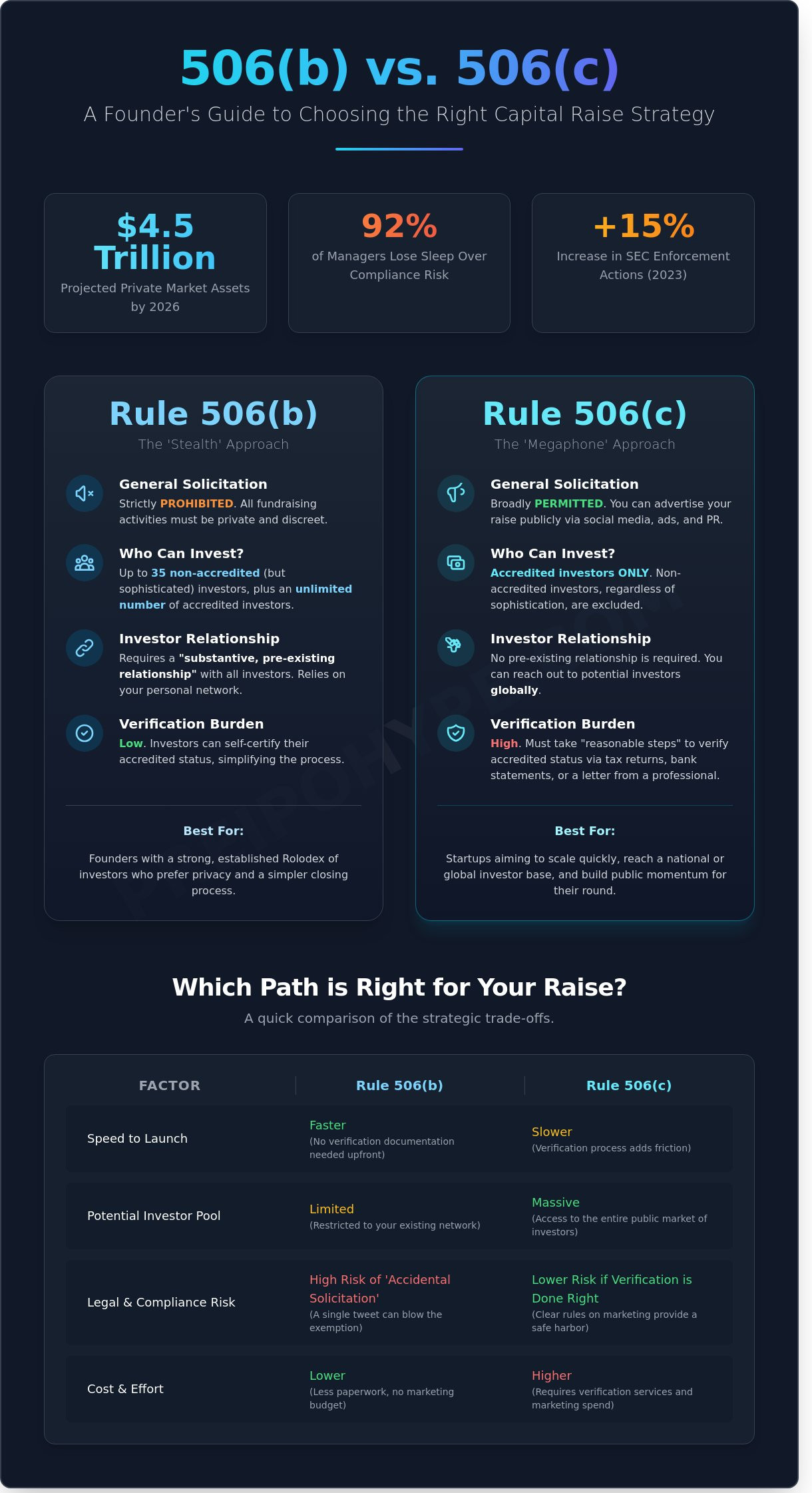
Strategic Comparison: Which Regulation Fits Your Raise?
Detroit founders face a binary choice that dictates their entire growth trajectory. Choosing between 506c vs 506b isn't just a legal formality; it's a strategic decision about how much noise you want to make. One path keeps you in the shadows of private country club deals, while the other puts your brand on the digital main stage. Most founders underestimate the operational impact of this choice until they're 30 days into a fundraise.
| Feature | Rule 506(b) | Rule 506(c) |
|---|---|---|
| General Solicitation | Prohibited | Permitted (Ads, Social, PR) |
| Investor Types | Accredited + 35 Sophisticated | Accredited Only |
| Verification | Self-Certification | Reasonable Steps (Third-Party) |
Financial efficiency looks different under each rule. A 506(b) offering typically costs $10,000 to $15,000 in initial legal setup. It's cheaper on day one, but the opportunity cost is staggering. You're limited to your existing Rolodex. If your network isn't already filled with high-net-worth individuals, your raise will stall. Conversely, 506(c) requires a higher upfront investment in marketing and third-party verification services, often adding $5,000 to your overhead. However, the ability to use digital ads means you can scale. Data from 2023 indicates that 506(c) raises reach their first $1M in capital 3x faster than traditional 506(b) networking models.
Speed is the ultimate currency in venture capital. A 506(c) raise might start 14 days slower because you must establish a rigorous verification protocol. Once the engine is running, it scales exponentially. You aren't waiting for a warm intro; you're buying eyeballs. Many elite founders now utilize a hybrid approach. They start with a 506(b) to capture their inner circle's "friends and family" capital, then transition to 506(c) to blast the opportunity to the wider market once they have 20% of the round committed.
Choosing Based on Your Investor CRM Data
Your CRM dictates your regulatory path. If 85% of your lead list consists of cold contacts or people you haven't spoken to in 24 months, 506(c) is mandatory. You cannot legally email a cold list about a 506(b) offering without a "pre-existing substantive relationship." At PreipoHype, we use lead scoring to determine if your foundation is strong enough for a quiet raise or if you need the loud, aggressive outreach only 506(c) permits.
The 'Sophisticated Investor' Trap
The 35 slots for non-accredited "sophisticated" investors in a 506(b) are a liability. Including just one non-accredited investor triggers a requirement for audited financial statements and disclosures equivalent to a Regulation A+ offering. This can increase legal costs by $25,000 or more. Statistics show that 74% of failed raises cite these disclosure complexities as a primary bottleneck. Elite raises in 2024 almost exclusively lean toward 100% accredited 506(c) models to maintain velocity and minimize SEC scrutiny.
Ready to dominate the Detroit market? Build your investor hype machine and secure the capital your vision deserves.
Executing the Raise: Beyond Compliance to Investor Acquisition
Compliance is the floor. It is the bare minimum required to keep you out of the SEC crosshairs. But compliance alone does not fill a round. The ceiling is investor acquisition. Many Detroit founders obsess over the technicalities of 506c vs 506b while ignoring the engine that actually drives capital. A perfect legal structure is useless if your story does not resonate. You need a narrative framework that turns cold data into a high-stakes opportunity. Private markets are the final frontier of significant wealth creation; your raise must reflect that gravity.
The gap between a regulatory filing and a closed round is bridged by the informed insider. This is the guide who understands that as of late 2023, the SEC reported over $3.7 trillion raised through private offerings. In a city like Detroit, where the tech ecosystem grew 25% faster than the national average last year, the competition for attention is fierce. Your regulation choice should serve your momentum. It should not stall it. If you are building the next unicorn, your fundraising strategy must be as aggressive as your product roadmap.
Success requires a shift in perspective. You aren't just selling equity; you are offering exclusive access to a gated world. This is where the "hype" cycle becomes a legitimate financial indicator. When you create a sense of urgency and exclusivity, you attract the type of sophisticated capital that moves the needle. Whether you choose the privacy of 506(b) or the reach of 506(c), the execution remains the same: you must dominate the conversation.
Building Your Omnichannel Fundraising Machine
If you opt for a 506(c) raise, you are permitted to market your opportunity to the public. Shouting from the rooftops is not a strategy, though. You must integrate your raise into a cohesive machine that spans social media, email sequences, and targeted digital ads. Data suggests that 92% of successful 506(c) campaigns utilize at least three distinct digital channels to maintain visibility. We track this through 60-day attribution models. This allows you to see exactly which "hype" triggers are converting into actual wired funds. A Custom Investor CRM is non-negotiable for this process. It's the only way to manage a pipeline of 500+ accredited leads while maintaining the personal touch high-net-worth individuals expect.
Next Steps for Detroit Founders and Beyond
The path you choose today impacts your exit velocity tomorrow. Don't guess on your regulatory path or leave your capital needs to chance. Instead, consult with professionals who have facilitated $100M+ in funding for early-stage ventures. You can ask our CEO directly about your raise strategy to get an insider perspective on how the 506c vs 506b debate applies to your specific deal. The Detroit market is primed for its next major liquidity event. If you are ready to move from founder to market leader, it's time to execute with precision. Schedule a 30-minute strategy session with Fuzzy Wenzel to finalize your roadmap and start hunting for your next milestone.
Seize the Momentum of the 2026 Private Market
The private market landscape in 2026 demands more than just basic compliance; it requires a tactical strike. Deciding on 506c vs 506b isn't just a legal checkbox. It's the difference between a quiet, relationship-driven raise and a high-velocity public campaign that leverages momentum as a financial indicator. If you have a deep, pre-existing network, the 506(b) stealth route protects your privacy while securing capital. If you're ready to dominate the narrative and use general solicitation to reach every accredited investor in the country, 506(c) is your engine for growth.
PreipoHype has already facilitated over $100M for 230+ companies by bridging the gap between private secrecy and public opportunity. From our Detroit headquarters, we deploy proprietary Custom Investor CRM technology to turn early-stage hype into institutional-grade momentum. You don't have to navigate these high-stakes waters alone. We provide the insider access and valuation benchmarks required to scale your vision before the next major exit window closes. Your path to elite capital starts with a single strategic decision.
Ready to scale your capital raise? Book your strategy session now.
The future of your company is waiting for the right move. Let's build that legacy together.
Frequently Asked Questions
Can I switch from a 506(b) to a 506(c) offering mid-raise?
Yes, you can transition your raise under Rule 152, which the SEC updated on March 26, 2021. If you start with a 506(b) and realize you need the megaphone of social media, you can pivot to 506(c) provided you wait 30 days or ensure no general solicitation was used for the initial investors. This flexibility allows Detroit founders to adjust their strategy if the initial private network doesn't hit the funding ceiling.
What qualifies as a 'pre-existing substantive relationship' for a 506(b) offering?
A pre-existing substantive relationship requires you to understand an investor's financial profile before you ever mention the deal. The SEC's Citizen VC No-Action Letter from 2015 clarified that this relationship must be formed through a multi-step vetting process. You need to document their sophistication levels and investment goals. This isn't a quick LinkedIn message; it's a documented history that proves they didn't find you through a public advertisement.
How much does it cost to verify an investor for a 506(c) raise?
Third-party verification services typically charge between $50 and $150 per investor for a 506(c) raise. While you can review the documents yourself, most Detroit syndicators outsource this to platforms like VerifyInvestor to offload the liability. It's a small price for the ability to blast your offering across every digital channel. This cost ensures your raise remains airtight and keeps the SEC from questioning your "reasonable steps" process.
Is general solicitation allowed on social media for a 506(b) raise?
No, general solicitation is strictly prohibited for a 506(b) offering under Rule 502(c). If you post details about your raise on a public Twitter or LinkedIn feed, you've violated the exemption. This mistake can freeze your capital raise for up to six months. When choosing between 506c vs 506b for your Detroit project, remember that 506(b) demands absolute privacy and a "velvet rope" approach to deal flow.
What are the specific disclosure requirements for non-accredited investors in 506(b)?
If you include up to 35 non-accredited investors in a 506(b) deal, you must provide them with comprehensive disclosure documents similar to those in a registered offering. This includes audited balance sheets if the raise exceeds $20 million. The paperwork load increases by roughly 40 percent when you open the door to non-accredited participants. Most elite raises avoid this complexity to keep the momentum fast and the legal costs under $25,000.
What happens if an unaccredited investor slips into my 506(c) raise?
Including an unaccredited investor in a 506(c) raise is a fatal compliance error that voids your safe harbor protection. Under Section 5 of the Securities Act, this gives every investor a right of rescission, meaning you might have to return 100 percent of the capital. It's a high-stakes mistake that can trigger an SEC audit. You must use rigorous 90-day verification letters to ensure your "unicorn hunting" doesn't end in a legal shutdown.
Does a 506(c) raise attract more SEC scrutiny than a 506(b) raise?
SEC data from the 2023 Enforcement Report shows that the commission focuses on fraudulent claims rather than the specific choice of 506c vs 506b. While 506(c) requires more rigorous paperwork, it doesn't inherently put a target on your back. The real risk comes from making "guaranteed return" claims in public ads. Detroit issuers who follow the verification safe harbors find that the SEC views 506(c) as a transparent, modern way to scale.
How do I prove I took 'reasonable steps' to verify an investor's accreditation?
You prove "reasonable steps" by following the four safe harbor methods outlined in Rule 506(c). This includes reviewing IRS forms from the last two years or obtaining a written confirmation from a licensed attorney or CPA dated within the last 90 days. Don't rely on "self-certification" boxes; they won't hold up in court. Using these established benchmarks creates a bulletproof paper trail that protects your Detroit raise from future regulatory challenges.
Disclaimer
Educational only. Not investment, tax, or legal advice. Pre-IPO Hype is investor relations infrastructure for Regulation CF and Regulation A+ raises. We are not a broker-dealer, funding portal, or investment adviser, and we do not offer or sell securities or make investment recommendations. Any securities offering is made only by the issuer, through its own offering documents and, where required, a registered intermediary.


