
Accredited Investor Lead Generation: How to Find and Verify Prospects
A busy investor pipeline can still be unreliable. Accredited investor lead generation can attract strong interest, but an outdated contact or enthusiastic response doesn’t prove that someone qualifies to invest. Treat discovery, lead qualification, and accreditation verification as separate stages so your team can maintain momentum without confusing marketing activity with eligibility.
If investor lists feel stale, follow-up is scattered across channels, or your team can’t tell who has been verified, a clearer workflow can help. Track where each prospect came from, what they’ve engaged with, and what step is next. Marketing and engagement data can guide outreach, but it can’t establish accredited status.
This guide explains how to attract relevant prospects, assess their fit, and document outreach, engagement, and verification status separately. It also covers how a custom investor CRM can organize campaign sources and follow-up while keeping lead scoring distinct from verification. The result is a clearer path from first contact to the next appropriate step.
Key Takeaways
- Keep prospects, qualified leads, interested investors, and verified accredited investors in distinct stages so interest isn’t mistaken for eligibility.
- Build accredited investor lead generation around a defined audience, appropriate outreach, and a documented path from first engagement to verification.
- Compare issuer review, written confirmation, and third-party verification at a high level, then align the process with the offering and applicable requirements.
- Use separate CRM fields for lead source, consent, engagement, qualification, and verification status, and limit access to sensitive information.
- Campaigns and a custom investor CRM can organize fundraising activity and follow-up, but they don’t establish accredited status or replace legal guidance.
Accredited Investor Lead Generation: What It Can, and Cannot, Establish
Strong fundraising starts with finding people whose interests align with the opportunity. A promising contact, however, is not automatically an eligible investor. Accredited investor lead generation identifies and engages potential prospects; it does not certify that they meet accredited investor criteria. Keep those functions separate so your team can build momentum without treating marketing signals as compliance evidence.
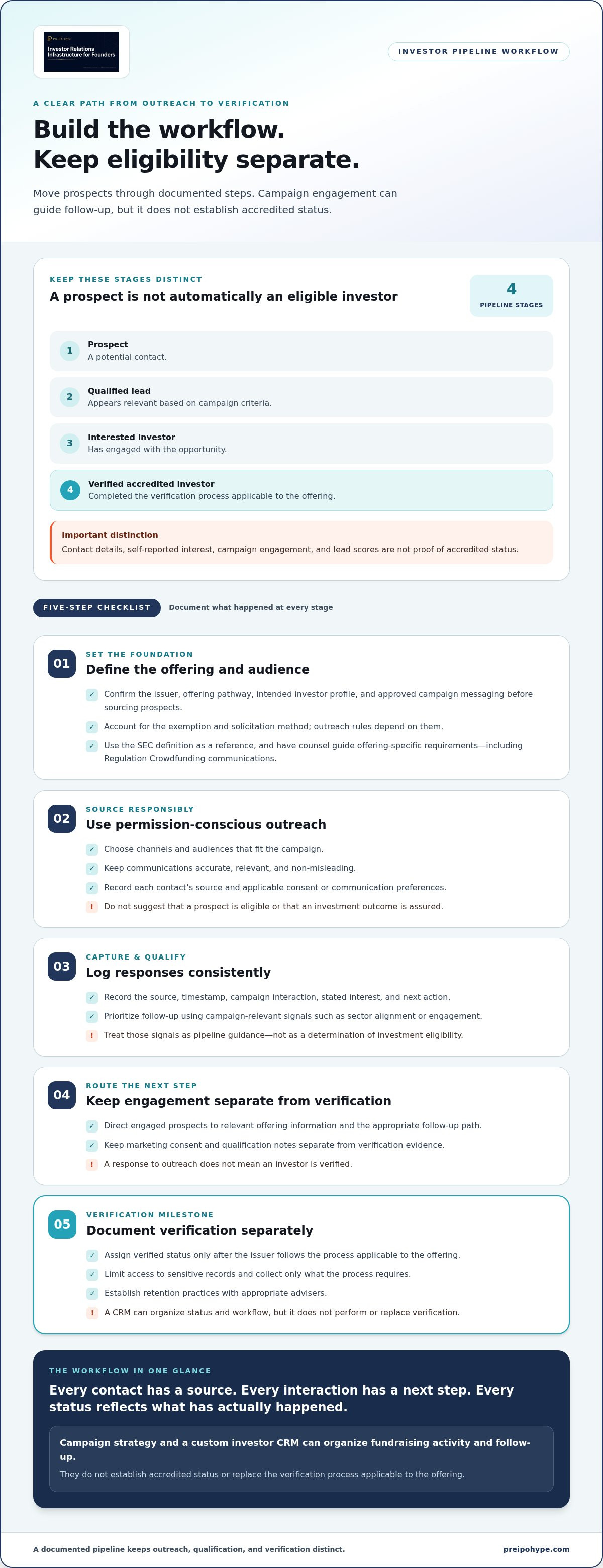
Use clear pipeline stages: a prospect is a potential contact; a qualified lead appears relevant based on campaign criteria; an interested investor has engaged with the opportunity; and a verified accredited investor has completed the applicable verification process. The SEC’s Rule 501(a) defines accredited investor categories. For background on the term and its history, see Accredited investor.
For a practical perspective on sourcing alternative investment prospects, watch this video:
What makes an investor lead relevant to a fundraising campaign?
Relevance means fit with the campaign, not a conclusion about eligibility. Useful signals include a person’s stated interest in the sector, engagement with campaign materials, and alignment with the raise’s audience and focus. These signals can help prioritize who receives follow-up and when.
A database entry, complete contact details, or self-reported interest doesn’t establish accredited status. Neither does a marketing lead score. A CRM can rank engagement and record a contact’s source, but those are campaign insights, not eligibility determinations. Make that distinction clear in both the workflow and the data.
Why accredited investor verification is a separate step
Rule 501(a) sets out categories that may qualify, including certain individuals and entities. Whether and how an issuer must verify status depends on the offering exemption and how securities are offered. Under Regulation D, Rule 506(b) prohibits general solicitation, while Rule 506(c) permits it only when all purchasers are verified accredited investors and the issuer takes reasonable steps to verify that status.
A campaign response can signal interest, but it doesn’t replace the process that applies to the offering. Review the SEC’s Regulation D rules with qualified legal counsel for the specific raise. Keep lead qualification and verification as separate milestones, and record verification status only through the appropriate process.
How to Build an Accredited Investor Lead Generation Workflow
A repeatable process helps maintain campaign momentum while preserving a clear line between outreach and eligibility. Build accredited investor lead generation as a sequence of documented decisions, not a single list of names.
- Define the offering and audience. Confirm the issuer, offering pathway, intended investor profile, and approved campaign messaging before sourcing prospects. Outreach rules depend on the exemption and solicitation method. Counsel should guide offering-specific requirements, including how Regulation Crowdfunding communications are handled. Use the SEC definition of an accredited investor as a reference, not as a substitute for advice on a particular offering.
- Source prospects with permission-conscious practices. Choose channels and audiences that fit the campaign. Keep communications accurate, relevant, and non-misleading. Record each contact’s source and applicable consent or communication preferences. Don’t suggest that a prospect is eligible or that an investment outcome is assured.
- Capture and qualify responses consistently. Log the source, timestamp, campaign interaction, stated interest, and next action. Apply campaign-relevant criteria, such as sector alignment or engagement, to prioritize follow-up. These signals help manage the pipeline, but they don’t determine investment eligibility. Keep campaign activity and prospect status easy to distinguish in each record.
- Route prospects through the appropriate next step. Direct engaged prospects to relevant offering information and the appropriate follow-up path. Keep marketing consent and qualification notes separate from verification evidence. A response to outreach does not mean an investor is verified.
- Document verification separately. Assign verified status only after the issuer follows the process applicable to the offering. Limit access to sensitive records, collect only what the process requires, and establish retention practices with appropriate advisers. A CRM can organize status and workflow, but it doesn’t perform or replace verification.
Consistency makes the process easier to manage: every contact has a source, every interaction has a next step, and each status reflects what has actually happened. Campaign strategy and a custom investor CRM can support that workflow without turning engagement data into an eligibility decision. To discuss investor acquisition and campaign tracking, book a strategy conversation.
Accredited Investor Verification Methods: Comparing the Main Approaches
Verification is a compliance process, not a marketing filter. The appropriate approach depends on the offering exemption and its requirements. For example, Rule 506(c) permits general solicitation but requires the issuer to take reasonable steps to verify that purchasers are accredited investors. No single document or method is sufficient for every offering. The issuer and its advisers should determine the appropriate process for the specific raise.
At a high level, issuers may review information themselves, collect investor representations, or use a third party to support verification. These approaches can serve different roles, but none should be treated as a shortcut around applicable requirements.
| Method | Typical role | Limitations | Decision-maker |
|---|---|---|---|
| Issuer-led review | The issuer reviews relevant information through a process designed for the offering. | Review steps must fit applicable requirements. Retaining a record alone doesn’t establish that eligibility was properly assessed. | The issuer, guided by qualified legal advisers. |
| Written investor confirmation | An investor provides a representation or confirmation about their status. | A self-attestation isn’t automatically sufficient in every context, including when additional verification steps apply. | The issuer and its advisers determine its role in the process. |
| Third-party verification | A qualified third party reviews information and may provide a verification letter or other confirmation. | Using a third party doesn’t automatically make the process suitable for every offering or remove the issuer’s responsibilities. | The issuer and advisers select and assess the process; the third party performs its defined role. |
Issuer-led review and investor representations
An issuer may collect and review relevant information through a process designed for the offering and reviewed with counsel. An investor’s written statement can contribute to the record, but it shouldn’t be treated as a universal substitute for other steps. Recordkeeping shows what was collected and when; it isn’t, on its own, a legal conclusion that the investor qualifies.
Third-party verification and supporting documentation
Where appropriate, a third party can help assess supporting information and communicate the outcome through an established process. Keep sensitive materials out of ordinary marketing forms. Use a separate, controlled verification workflow, limit access to people who need it, and retain only what the process requires under guidance from appropriate advisers.
For accredited investor lead generation, keep the CRM focused on workflow status, such as “verification initiated” or “completed,” rather than treating campaign engagement as evidence. The issuer and its advisers determine whether the chosen verification process meets applicable requirements.
How to Track Investor Leads, Qualification, and Verification Safely
A useful investor CRM makes each stage visible without merging campaign activity, lead fit, and accreditation evidence into one label. This separation improves follow-up and helps teams understand what their data can actually show. Measure campaign performance through engagement and attribution, not assumed eligibility or promised investment outcomes.
CRM fields that preserve a clear investor lifecycle
Give each record distinct fields for campaign source, consent status, last interaction, stated interest, follow-up owner, and next step. Use lifecycle labels such as new lead, engaged prospect, qualified prospect, and verification complete. Define each label so team members apply it consistently. A custom investor CRM can connect campaign activity to follow-up while keeping verification status separate. For audience-data context, explore investor data services.
- Source: Record the campaign or channel that generated the contact.
- Consent: Track communication preferences and relevant permission records.
- Engagement: Log interactions, such as a response or request for information.
- Qualification: Note campaign-relevant fit and why the contact is a follow-up priority.
- Verification: Record process status and completion separately from marketing notes.
Review campaign performance using response, engagement, and source attribution. These measures can show which outreach generates meaningful conversations and where follow-up stalls. They don’t show that a contact is accredited or that a campaign produced an investment. Keep those conclusions out of marketing scores and dashboards.
Privacy, access, and auditability in verification records
Keep financial documents out of ordinary lead-capture forms. Collect sensitive information only through the appropriate verification process, and limit access to people who need it for their role. Define secure storage, retention, and process ownership with qualified advisers. Document who updates status and when, so the record shows a clear sequence without exposing verification materials across general campaign workflows.
CRM design should support disciplined operations, not make legal or eligibility decisions. Review privacy controls, record retention, and securities-law requirements with qualified counsel, then configure access and fields around that process. Discuss your investor CRM and tracking workflow to organize campaign attribution, follow-up, and status management.
Turn Accredited Investor Lead Generation into a Repeatable Fundraising System
A durable fundraising process connects each stage without confusing its purpose: define the raise, reach relevant prospects, qualify engagement, and manage verification separately. This sequence makes the pipeline easier to review and repeat. It also helps teams distinguish campaign performance from eligibility decisions and investment outcomes.
What a structured investor-acquisition system should connect
Campaign sources, communications, engagement signals, and follow-up ownership should work together in one operating view. A team should be able to see how a prospect entered the pipeline, which campaign interactions followed, who owns the next step, and whether verification has been initiated or completed. These records support coordination; they don’t establish accredited status.
Pre-IPO Hype’s custom investor CRM and campaign services provide fundraising infrastructure for organizing outreach, engagement, and attribution. The company supports investor acquisition and campaign operations, not legal eligibility determinations or verification. The issuer remains responsible for its offering process, with legal and verification decisions handled separately. Explore the fundraising technology stack overview for more context on connected systems.
For a repeatable workflow, define ownership at each handoff:
- Campaign team: tracks source, consent, communications, and engagement.
- Fundraising team: reviews prospect fit and manages follow-up.
- Issuer and advisers: oversee offering-specific eligibility and verification steps.
This structure keeps accredited investor lead generation focused on relevant outreach while giving the issuer a clear path to handle verification through the applicable process. It also creates a feedback loop: campaign analytics show which channels generate engagement, while CRM records reveal where follow-up needs attention.
Plan the next step for your fundraising campaign
Start by mapping four elements: your intended audience, campaign channels, CRM workflow, and handoff to the issuer’s verification process. Look for gaps such as unclear follow-up ownership, mixed status labels, or sensitive records stored alongside routine marketing data. A focused review can turn scattered activity into a more coordinated fundraising system.
Pre-IPO Hype supports investor acquisition through campaign strategy, digital marketing, omnichannel outreach, analytics, and a custom investor CRM. These capabilities organize and measure fundraising operations; they don’t guarantee capital or replace legal advice. If you’re ready to map your campaign and workflow, discuss your investor acquisition strategy.
Build a Clearer Path from Outreach to Verification
Effective accredited investor lead generation follows a disciplined sequence: define the raise and audience, engage relevant prospects, qualify campaign fit, then manage verification separately. Keep CRM records clear about source, consent, engagement, follow-up, and status. A well-organized pipeline helps your team act on meaningful interest without treating clicks, conversations, or lead scores as proof of eligibility.
Pre-IPO Hype supports investor acquisition with campaign strategy, digital marketing, analytics, and a custom investor CRM. These tools organize fundraising activity and track engagement. They don’t replace issuer oversight, legal guidance, or the applicable verification process.
Your next step is to map the audience, channels, CRM workflow, and verification handoff for your raise. Discuss your investor acquisition strategy to identify where a more structured process can support your campaign. Clear stages and accountable follow-up create a more organized foundation for fundraising.
Frequently Asked Questions
What does accredited investor lead generation mean?
Accredited investor lead generation means identifying and engaging potential investors who may fit a fundraising campaign. It helps an issuer build awareness, track interest, and prioritize follow-up. It doesn’t establish that a prospect meets the SEC’s accredited investor criteria. Treat prospecting, marketing qualification, and status verification as separate stages, with distinct records for each, so campaign activity isn’t mistaken for proof of eligibility.
How do you verify whether an investor is accredited?
Use the verification process that applies to the offering and its exemption. Depending on the circumstances, an issuer may review relevant information or use a third party to support verification. Under Rule 506(c), the issuer must take reasonable steps to verify that purchasers are accredited. Determine the specific process with qualified legal advisers. A contact’s interest, lead score, or campaign response alone isn’t verification evidence.
Can a lead-generation company verify accredited investor status?
A lead-generation company can support outreach, organize responses, and help track workflow status, but lead generation itself doesn’t verify accreditation. A third-party service may perform a verification role when appropriate to the offering and process. The issuer remains responsible for ensuring the approach meets applicable requirements. Keep marketing systems focused on engagement and pipeline management, and reserve eligibility decisions and verification records for the issuer’s governed process.
What is the difference between Rule 506(b) and Rule 506(c) verification?
Rule 506(b) prohibits general solicitation and permits sales to accredited investors and, within limits, certain sophisticated non-accredited investors. Rule 506(c) permits general solicitation, but the issuer must take reasonable steps to verify that all purchasers are accredited. The pathways differ in both outreach and verification expectations. Don’t assume a process used for one exemption fits the other; have counsel assess the offering and its requirements.
Can an investor self-certify as accredited?
An investor can provide a written representation, but self-certification isn’t automatically sufficient in every offering. For a Rule 506(c) offering, the issuer must take reasonable steps to verify accredited status, so a self-attestation alone may not satisfy the applicable standard. In other contexts, an investor representation may be considered as part of the issuer’s assessment. The issuer and its advisers should determine what the specific offering requires.
What information should a CRM track during investor verification?
Track operational details such as lead source, consent status, campaign engagement, follow-up owner, next action, and a clearly defined verification status. You may also record the process date or an appropriate reference to verification documentation. Don’t treat a marketing score as eligibility, and don’t collect sensitive financial documents through ordinary campaign forms. Limit access to verification records and set retention practices with appropriate advisers.
Is buying an accredited investor list enough to meet verification requirements?
No. A purchased list may help identify or reach potential prospects, but its entries don’t establish that a person currently qualifies or satisfy an issuer’s verification obligations. Data can be outdated, and audience labels aren’t a substitute for the process required by the offering. Use list information as a sourcing input, then manage engagement and verification as separate steps under the issuer’s applicable procedures.
Disclaimer
Educational only. Not investment, tax, or legal advice. Pre-IPO Hype is investor relations infrastructure for Regulation CF and Regulation A+ raises. We are not a broker-dealer, funding portal, or investment adviser, and we do not offer or sell securities or make investment recommendations. Any securities offering is made only by the issuer, through its own offering documents and, where required, a registered intermediary.


