
AI for Investor Lead Scoring: Engineering Precision in Private Capital Raises
Why are you still burning 80% of your precious outreach hours on tire-kickers who have no intention of writing a check? In the high-stakes world of private capital, the most expensive resource isn't your marketing budget; it's your time. You likely feel the frustration of managing data silos that mask true investor intent, making it nearly impossible to see which leads are actually ready to move. Integrating AI for investor lead scoring changes the game by turning raw data into a surgical instrument for capital acquisition.
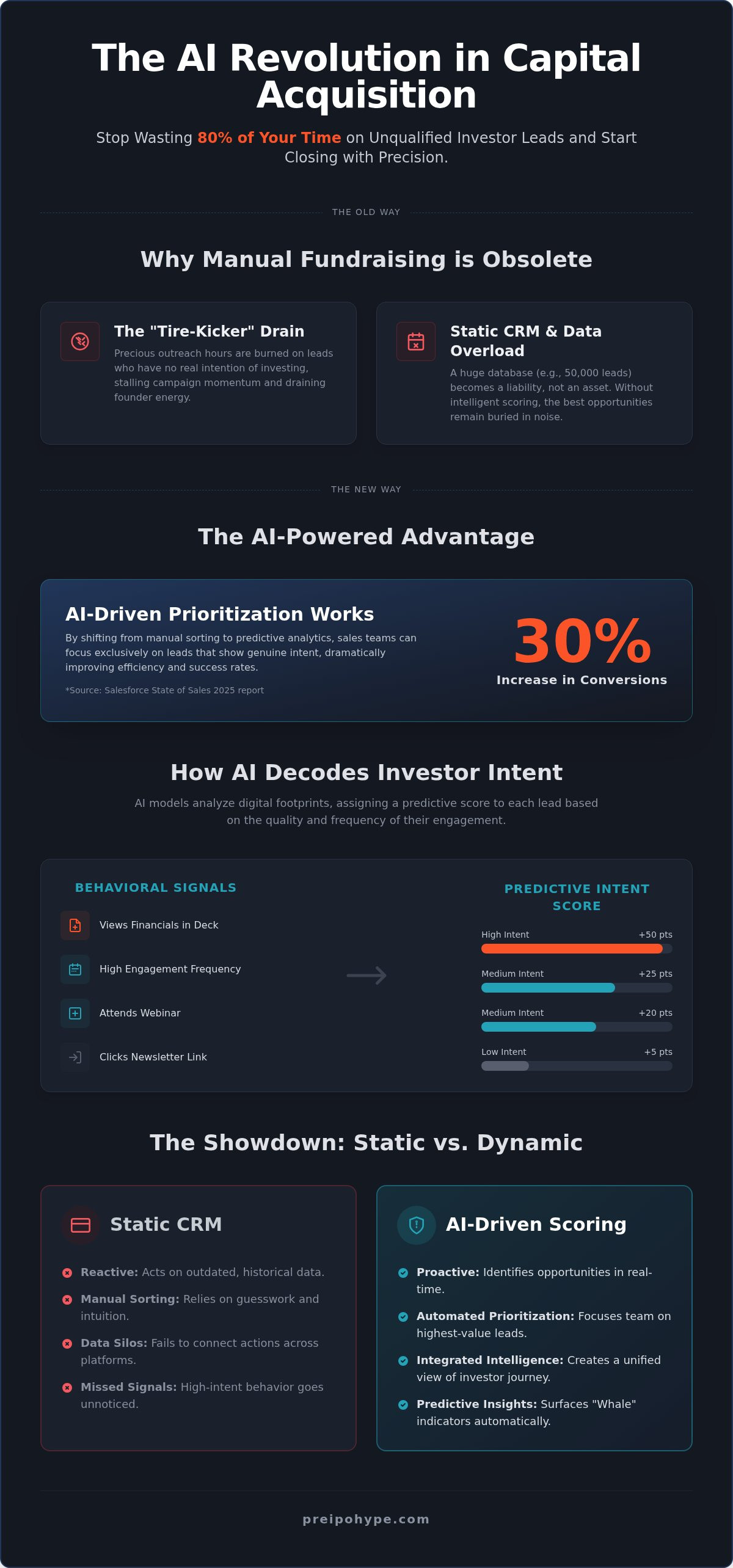
It's a proven shift. Sales teams utilizing AI-driven prioritization are already seeing a 30% increase in conversion rates, according to the Salesforce State of Sales 2025 report. This article promises to show you how to engineer this precision into your own fundraising efforts, transforming curiosity into committed capital. We'll examine how to build the foundation infrastructure needed to shorten your fundraising cycles, eliminate wasted pitches, and secure a higher ROI on every dollar of your digital spend. It's time to stop guessing and start closing.
Key Takeaways
- Eliminate the "tire-kicker" drain on your campaign momentum by adopting automated prioritization based on predictive behavioral data.
- Decode investor intent by tracking digital footprints like newsletter engagement and deck views to identify high-potential backers before the first call.
- Understand why static CRMs lead to missed opportunities and how AI for investor lead scoring creates a dynamic, predictive engine for your fundraising team.
- Learn the strategic steps to audit your data stack and assign weights to investor actions that drive the highest ROI on your marketing spend.
- Discover how elite foundation infrastructure integrates with omnichannel outreach to ensure no high-intent lead ever falls through the cracks.
The Crisis of Capital Acquisition: Why Manual Lead Scoring is Obsolete
The era of the digital Rolodex is dead. In the high-velocity markets of 2026, capital isn't just scarce; it's discerning. If you're still relying on manual spreadsheets to decide which potential backer to call next, you're already behind the curve. AI for investor lead scoring represents the automated prioritization of potential backers based on predictive behavioral data. It isn't about who an investor is on paper. It's about what their digital footprint says they will do next. This shift moves your strategy from static, demographic-based lists to intent-based engagement models that focus on active signals.
Manual sorting is the primary driver of the 'Tire-Kicker' problem. These are the leads that consume hours of Zoom calls and due diligence requests but never cross the finish line. They drain founder energy. They stall campaign momentum. When market volatility hits, as we've seen throughout 2026, you don't have the luxury of a slow burn. You need real-time data processing that identifies shifts in sentiment as they happen. Humans cannot replicate this speed or precision. The modern raise demands a system that filters for heat, not just history.
The Opportunity Cost of Guesswork
A standard 90-day capital raise is a sprint. Every hour spent on a low-probability lead is an hour stolen from a high-conviction institutional player. When you use a "spray and pray" approach, you don't just waste time; you damage your brand authority. Elite investors can smell desperation and lack of targeting from a mile away. The psychological toll is equally heavy. Founders face constant, avoidable rejection simply because they're pitching the wrong people at the wrong time. Precision isn't just a technical advantage; it's a sanity-saver for leadership teams under pressure.
Data Overload vs. Insight Scarcity
Many firms brag about having a database of 50,000 leads. Without a scoring mechanism, that list is a liability, not an asset. It creates a fog of war where the most valuable opportunities are buried under a mountain of noise. There's a massive chasm between "clean data" and "actionable intelligence." You can have the most expensive investor data in the world, but it stays dormant until it's scored. Using a modern Lead scoring methodology allows you to bridge that gap by assigning value to specific interactions like deck views or newsletter clicks. Ultimately, AI for investor lead scoring serves as the signal-to-noise filter for modern capital raises.
The Mechanics of Intelligence: How AI Predicts Investor Intent
Investors leave a trail. Long before a term sheet is signed, a potential backer engages in a series of digital behaviors that signal their level of conviction. The mechanics of intelligence rely on deconstructing the "Investor Persona" into a series of high-intent digital footprints. These footprints include newsletter clicks, webinar attendance, and specific dwell time on your pitch deck. By utilizing AI for investor lead scoring, you can move beyond guesswork and identify which leads are moving toward a "yes" and which are simply browsing.
Machine Learning plays a pivotal role here by identifying patterns from thousands of successful past conversions. It doesn't just look at a single action; it evaluates the entire journey. This is where "Omnichannel Mastery" becomes essential. Your system should track an investor from their initial interaction with a LinkedIn ad all the way to their entry into your CRM. Because private capital raises are rarely impulse decisions, 60-day attribution is the gold standard. It allows you to understand the long-tail journey of an investor, ensuring you don't give up on a high-value lead just because they didn't commit in the first week. If you're ready to see how these signals apply to your specific cap table, you can book a strategic consultation here.
Behavioral Signals that Matter
Not all engagement is created equal. A lead who spends ten minutes on the financial projections section of your deck is significantly more valuable than one who only looks at the team slide. AI models assign a high-weight score booster to these specific "deep-dive" actions. We also look at the frequency of engagement versus the recency of engagement. While a recent click shows immediate interest, a high frequency of engagement over several weeks often predicts a check better than a single isolated event. This data allows the system to identify "Whale" indicators, spotting institutional-sized interest before you even pick up the phone.
Data Sovereignty and Compliance
In the regulatory environment of 2026, precision must be matched by protection. Your AI scoring models must adhere to the SEC's amended Regulation S-P, which saw final compliance deadlines for smaller firms in June 2026. This makes the shift to first-party data non-negotiable. In a post-cookie digital landscape, you cannot rely on third-party scraps. You need to own the relationship and the data it generates. Building this level of intelligence requires a robust foundation infrastructure that acts as the technical bedrock for your raise. This ensures your data is not only actionable but also fully compliant with modern privacy standards and SEC predictive data analytics rules.
Static CRM vs. AI-Driven Investor Lead Scoring
Most firms treat their CRM like a digital graveyard. It's a static repository of names, emails, and outdated notes that records where a lead came from but says nothing about where they're going. This is the "dumb" CRM, a digital Rolodex that requires manual updates and constant human intervention to remain even slightly relevant. Deploying AI for investor lead scoring transforms this database into an "active" predictive engine. Instead of a list that begins to decay the moment it's created, you gain a system that constantly re-evaluates priorities based on real-time interactions.
The "Momentum Factor" is what separates elite raises from stagnant ones. In 2026, traditional filters like net worth or geographical location are secondary to behavioral intent. An investor's liquid net worth doesn't matter if they haven't opened your last three updates. Conversely, a smaller family office showing intense engagement is a high-priority target. AI triggers outreach exactly when an investor is most engaged, allowing your team to strike while the iron is hot. This dynamic approach is why companies using these tools see a 10-15% increase in sales productivity and a 10-20% improvement in conversion rates, according to a Brixon Group analysis.
The Death of the 'Cold Call'
Cold calling is an exercise in inefficiency that erodes brand equity. AI scoring turns every interaction into a "warm" follow-up by providing context before the dial. By using score-based triggers, you can automate personalized email sequences that adapt to the lead's behavior. When your sales team only focuses on "Level 5" leads, those with the highest probability of closing, the energy of the campaign shifts. You aren't begging for attention; you're providing information to those who have already signaled they want it. This surgical precision is why a modern fundraising tech stack is no longer optional for high-growth companies.
Predictive Modeling for Capital Forecasting
One of the most significant advantages of an active scoring system is the ability to forecast your final raise total with surprising accuracy. By analyzing the velocity and quality of leads in the funnel, founders can predict their closing numbers with roughly 90% precision. This foresight allows you to identify "bottlenecks" in the investor journey before the campaign stalls. If high-intent leads are dropping off at the due diligence stage, the data will show it immediately. A static CRM records the past, while AI scoring predicts the future.
Implementation Strategy: Integrating AI Scoring into Your Raise
Moving from a static database to a predictive engine requires more than just a software subscription; it requires a strategic roadmap. For the non-technical founder, the process can feel opaque, but it's fundamentally about engineering your data flow. Implementing AI for investor lead scoring is a five-step evolution that transforms your outreach from a guessing game into a precision strike.
- Step 1: Audit your data stack. You can't score data you don't capture. Ensure your fundraising tech stack is fully integrated, connecting your website, email, and social channels to a central hub.
- Step 2: Define 'Ideal Investor' weights. Not all actions are equal. You must decide which digital behaviors correlate most strongly with a wire transfer.
- Step 3: Deploy the scoring engine. This is the "go-live" moment where your digital marketing efforts begin feeding real-time intent data into your CRM.
- Step 4: Training the model. Use the first 14 to 30 days of campaign data to refine accuracy. If "high-score" leads aren't converting, adjust your parameters.
- Step 5: Human-in-the-loop. Your IR team shouldn't call everyone. They use the scores to prioritize high-touch, high-conviction conversations with the top 5% of your list.
Setting Your Scoring Weights
Precision begins with logic. A "Form C" download or a deep dive into your financial projections should be weighted significantly higher, perhaps 5x or 10x, than a simple social media like or a generic homepage visit. For those running a Reg A+ raise, you might weigh high-frequency engagement from retail investors differently than a single, long-duration session from a family office representative. Refinement is key to avoiding "false positives," where a lead looks active but has no capital to deploy. If you want to see how we build these custom weightings for elite raises, schedule your architecture session here.
Omnichannel Feedback Loops
Your CRM must be the "Single Source of Truth." This means connecting newsletter exposure data directly back to individual lead profiles. When an investor clicks a link in a targeted newsletter, their score should jump instantly. This trigger can then change the retargeting ads they see on LinkedIn or Google, moving them from "awareness" creative to "closing" creative. By closing these feedback loops, you ensure that your marketing spend is always chasing the highest-intent opportunities in your database. This level of AI for investor lead scoring ensures your brand stays top-of-mind for the right people at exactly the right moment.
The Pre-IPO Hype Advantage: Engineering Momentum with Custom CRM
Software is a commodity; momentum is a movement. While many firms offer tools that claim to organize your data, they rarely provide the engineering required to convert that data into capital. The Custom Investor CRM serves as the ultimate execution tool for founders who refuse to leave their raise to chance. It integrates your foundation infrastructure with sophisticated omnichannel outreach, ensuring that every lead is tracked, scored, and nurtured through a high-intent journey. This isn't just a digital Rolodex. It’s a predictive engine designed to find the path of least resistance to a closed round.
Our systems have already facilitated over $100 million in funding for more than 230 companies since 2015. We achieved these results by moving beyond basic metrics and focusing on the behavioral signals that actually matter. By leveraging AI for investor lead scoring, we help you identify the "Whales" in your database before they even speak to your team. We operate as your "Insider Guide," managing the hype cycle and the technical bedrock so you can focus on the vision. We don't just hand you the keys to the gated financial world; we show you exactly which doors are already unlocked.
Beyond Software: Strategic Partnership
Technology alone cannot close a round. Elite founders understand that they need consulting and advisory services to interpret the nuances of AI-driven data. Our team manages the Campaign Management Retainer, constantly optimizing your ROI and ensuring your messaging resonates with the highest-scoring leads. In one recent engagement, our AI for investor lead scoring models helped reduce a client’s cost-per-acquisition by 40%. This efficiency allowed them to shorten their fundraising cycle and focus their energy on scaling operations rather than chasing dead-end leads.
Take Control of Your Capital Future
There is a massive psychological advantage in knowing exactly where your capital is coming from. When you can see the intent scores of your entire database, the anxiety of the "90-day sprint" disappears. You aren't guessing; you're executing. We invite elite founders who are ready to dominate their market to join the Pre-IPO Hype Club, an exclusive circle where restricted information meets broad opportunity. The future of private capital belongs to those who act decisively on the right data. To start your journey, book a strategy session with our CEO today to audit your current lead scoring and engineer a raise that commands attention.
Secure Your Seat in the Elite Circle of Capital Acquisition
The transition from manual outreach to a predictive, intent-based model is the defining factor for successful raises in 2026. You've seen how behavioral signals provide the clarity needed to stop chasing tire-kickers and start closing institutional-grade backers. Implementing AI for investor lead scoring ensures that your campaign momentum never stalls because of bad data or missed signals. It's about transforming your fundraising from a series of hopeful pitches into a calculated engineering feat.
Pre-IPO Hype provides the foundation infrastructure and 60-day attribution tracking required to dominate high-growth markets. Our SEC-compliant systems have already helped founders facilitate over $100 million in funding by focusing on high-conviction opportunities. Don't leave your next round to chance while the market moves forward without you. Scale your capital raise with the AI-driven Custom Investor CRM and take control of your company's financial destiny. The capital is out there; it's time you used the right tools to claim it.
Frequently Asked Questions
What is AI investor lead scoring exactly?
AI investor lead scoring is the process of using machine learning algorithms to rank potential backers based on their likelihood to invest. Unlike manual sorting, this system analyzes thousands of data points, including email opens, deck dwell time, and webinar participation. It allows your team to focus exclusively on high-intent targets. By assigning a numerical value to every interaction, you transform a disorganized database into a prioritized roadmap for capital acquisition.
How does AI scoring improve my Reg CF campaign's ROI?
It improves ROI by surgically directing your marketing spend toward the individuals most likely to convert. In a Reg CF campaign, you often deal with thousands of retail leads. AI scoring filters out the "tire-kickers," allowing you to allocate your retargeting budget toward high-scoring prospects. This precision reduces your cost-per-acquisition and ensures your team's time is spent on leads that actually move the needle for your raise.
Do I need a large data set for AI lead scoring to work?
You don't need millions of records to see immediate benefits. Even with a smaller database, tracking intent-based actions provides a clear advantage over random outreach. The system begins learning from your very first interaction, refining its accuracy as your campaign progresses. While larger data sets allow for deeper pattern recognition, the primary goal of AI for investor lead scoring is to find the signal within the noise of your funnel.
Can AI lead scoring predict institutional investor behavior?
Yes, it identifies specific patterns that characterize institutional interest. Institutional players often engage in "deep-dive" behaviors, such as spending extended time on financial projections or revisiting specific technical documents. AI models recognize these "Whale" indicators early in the journey. This foresight allows you to prepare a high-touch, sophisticated approach for these elite backers before they even request a formal meeting, giving you a significant competitive edge in a crowded market.
Is my investor data secure when using an AI-driven CRM?
Security is a core component of elite foundation infrastructure. Modern AI-driven CRMs are built to comply with the SEC's amended Regulation S-P, which requires firms to notify customers of data breaches. Smaller firms had a compliance deadline of June 2026 for these rules. By using first-party data and secure, encrypted environments, you ensure that your investor information is protected while remaining fully actionable for your fundraising team.
How long does it take to implement AI lead scoring into a new raise?
Integration typically takes two to four weeks depending on the complexity of your current tech stack. This period involves auditing your data flow, setting up your foundation infrastructure, and defining your scoring weights. Once the connections are live, the system begins scoring leads in real-time. You'll see actionable intelligence almost immediately, though the model's predictive accuracy continues to sharpen as it processes more campaign-specific engagement data.
What is the difference between lead scoring and lead qualification?
Lead qualification is a binary process that determines if an investor meets your basic criteria, such as accredited status or minimum check size. Lead scoring is a dynamic, ongoing measurement of their actual interest level. A lead might be qualified but have a low score because they haven't engaged with your content. Scoring tells you when to reach out, while qualification tells you if they're legally allowed to participate in the round.
How does Pre-IPO Hype's CRM handle 60-day attribution?
Our Custom Investor CRM uses 60-day attribution to map the entire investor journey from the first touchpoint to the final wire transfer. Most capital raises aren't instantaneous; they require multiple touchpoints over several weeks. By tracking engagement across this sixty-day window, we identify which specific ads, newsletters, or emails actually drove the investment. This long-tail view is essential for optimizing your marketing spend and understanding the true ROI of your acquisition campaigns.
Disclaimer
Educational only. Not investment, tax, or legal advice. Pre-IPO Hype is investor relations infrastructure for Regulation CF and Regulation A+ raises. We are not a broker-dealer, funding portal, or investment adviser, and we do not offer or sell securities or make investment recommendations. Any securities offering is made only by the issuer, through its own offering documents and, where required, a registered intermediary.


