
Arrived Homes vs Fundrise vs RealtyMogul: The 2026 Real Estate Crowdfunding Insider’s Guide
Most investors are still chasing 4% yields in public REITs while the real momentum has shifted to private, institutional-grade assets that were once gated for the ultra-wealthy. The $13.5 billion real estate crowdfunding sector has evolved into a high-stakes battlefield where the right choice determines your path to secondary liquidity. Deciding between arrived homes vs fundrise vs realtymogul isn't just a matter of preference; it's a strategic move to hedge against the illiquidity traps that caught 15% of retail investors off guard during the 2025 market shift. You've likely felt the frustration of watching hidden fee structures erode your net returns while you struggle to distinguish between simple residential flips and complex commercial equity.
This insider's guide delivers a clear framework for platform selection by stripping away the marketing gloss to reveal the raw capital strategies underneath. You'll learn exactly how to align your portfolio with fractional ownership or diversified eREITs while gaining insight into the institutional mechanics that drive these platforms. We're diving into the secondary market options and valuation benchmarks that will define your success in 2026. It's time to bridge the gap between private secrecy and public opportunity by acting on data rather than just the hype.
Key Takeaways
- Master the 2026 real estate landscape by identifying the shift from general crowdfunding to high-alpha specialized niches that offer elite private market accessibility.
- Navigate the arrived homes vs fundrise vs realtymogul hierarchy to decide if your portfolio demands the psychological edge of specific single-family addresses or the institutional power of diversified eREITs.
- Unlock the door to institutional-grade commercial equity by mastering the dual-track strategy of "MogulREITs" versus individual private placements for sophisticated investors.
- Protect your capital by evaluating the critical trade-offs between 5-7 year residential equity horizons and the quarterly liquidity programs of diversified multi-asset funds.
- Gain the insider perspective on how these titans built $100M+ capital engines, transforming the "hype cycle" into a disciplined strategy for ground-floor wealth creation.
The Evolution of Real Estate Crowdfunding: Arrived, Fundrise, and RealtyMogul in 2026
The real estate hype cycle just hit its peak maturity. In 2026, the barrier between Main Street and Wall Street has effectively dissolved. Private market accessibility isn't a luxury anymore; it's a portfolio requirement. We've moved beyond the experimental era of general crowdfunding. Investors now demand specialized niches that offer more than just a vague promise of returns. This shift has created a clear hierarchy in the arrived homes vs fundrise vs realtymogul debate, as each platform has carved out a distinct territory in the private equity landscape.
To better understand this concept, watch this helpful video:
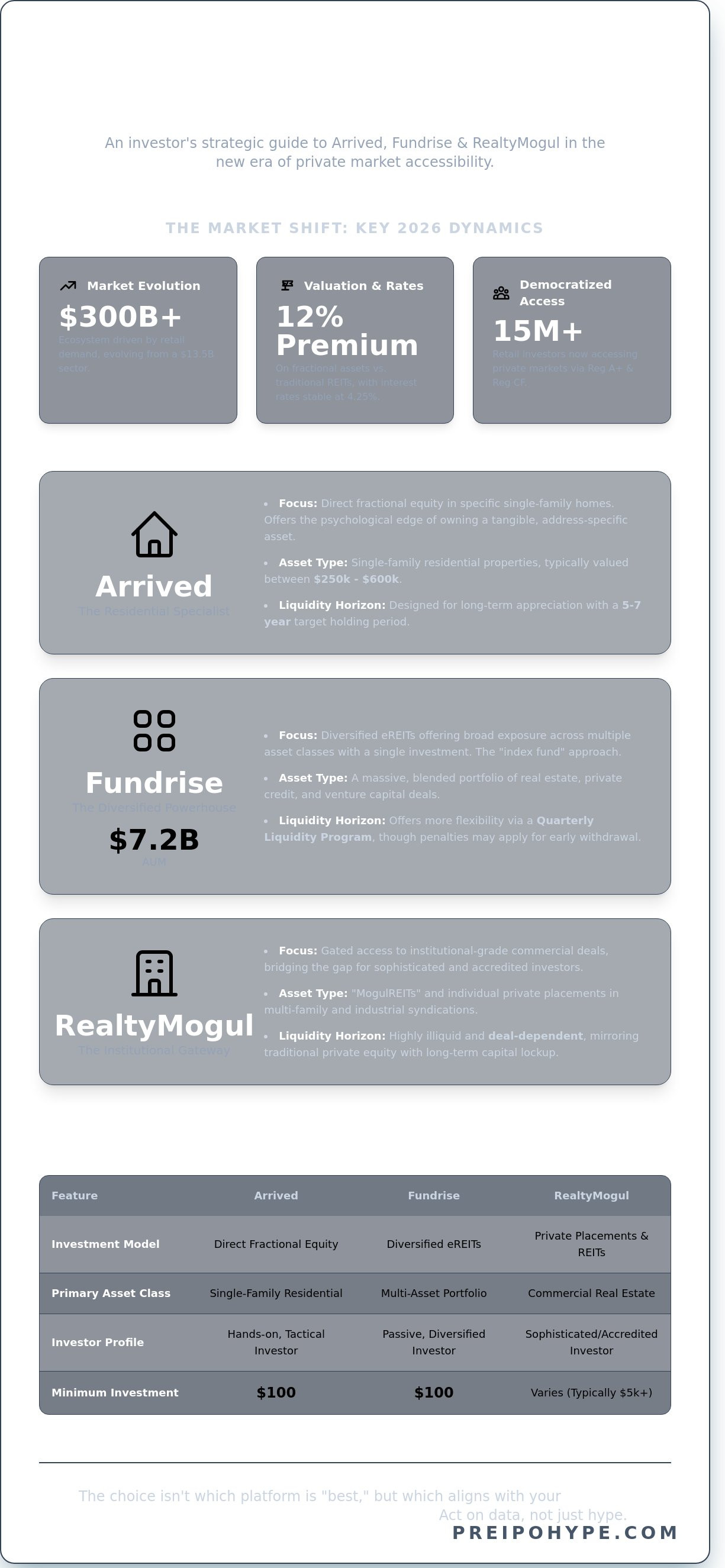
Secondary liquidity changed the game this year. For the first time, fractional real estate isn't a ten-year trap. Platforms have built robust internal exchanges, allowing investors to exit positions with institutional precision. Arrived dominates the single-family residential space, focusing on the "American Dream" as a service. Fundrise acts as the diversified powerhouse with its massive $7.2 billion AUM footprint. RealtyMogul remains the gateway for those hunting institutional-grade commercial deals, providing a bridge to the kind of "ground floor" opportunities that were once strictly gated.
The Democratization of the Ground Floor
Reg CF and Reg A+ frameworks didn't just change the law; they built a bridge for 15 million retail investors to enter the room. Platform-level momentum is now driven by the ability to source "off-market" inventory before the public markets even get a sniff. In 2026, the primary currency isn't just capital. It's insider access. You aren't just buying a share. You're buying into a gated ecosystem that was once reserved for the top 1% of earners. This democratization has turned every smartphone into a portal for unicorn hunting in the residential and commercial sectors.
Market Sentiment and the 2026 Outlook
Current valuation benchmarks show a 12% premium on fractional residential assets compared to traditional REITs. Interest rates stabilized at 4.25% in November 2025, shifting the debate from pure yield to long-term appreciation. Investors are no longer satisfied with 4% dividends when they can chase 15% internal rates of return through specialized platforms. The 2026 real estate crowdfunding market is a $300B+ ecosystem driven by retail demand.
- Arrived: The residential specialist focusing on $250k to $600k single-family homes.
- Fundrise: The diversified giant offering a mix of credit, venture, and real estate.
- RealtyMogul: The institutional gateway for multi-family and industrial syndications.
Choosing between these titans requires a calculated understanding of where you want to sit in the capital stack. The arrived homes vs fundrise vs realtymogul choice isn't about which platform is "better," but which one aligns with your liquidity needs and risk appetite in this high-stakes environment. If you want to talk directly to the experts about your strategy, you can ask our CEO for a deeper dive into these private market benchmarks.
Arrived Homes vs. Fundrise: Direct Residential Equity vs. Diversified eREITs
The battle for your capital in the arrived homes vs fundrise vs realtymogul showdown comes down to one fundamental choice: do you want to own a house or an index? Arrived Homes offers the surgical precision of picking specific street addresses. Fundrise offers the blunt force of a multi-billion dollar machine. Both platforms have successfully weaponized the $100 minimum entry point, effectively killing the era of the exclusive country club gatekeeper. This accessibility represents a seismic shift in how wealth is built in 2026.
This movement is part of a larger institutional pivot toward the retail market, as noted by Forbes on Fractional Real Estate Investing. While Arrived lets you bet on a single zip code in Nashville, Fundrise pools your cash into hundreds of projects simultaneously. Investors often use a valuation calculator to determine if Arrived’s 3.2% to 5.1% dividend yields on residential equity can outperform the diversified debt structures found in Fundrise’s Flagship Fund. The psychological difference is massive; one feels like being a landlord, the other feels like owning a tech stock.
Arrived Homes: The Fractional Landlord Experience
Arrived acts as the ultimate scout. They source Single-Family Rentals (SFR) and handle the 5% to 7% sourcing fees, leaving you with pure equity ownership. By 2026, their aggressive expansion into vacation rentals has redefined their yield profile. These short-term rental assets often target gross yields exceeding 10% in high-demand markets like the Blue Ridge Mountains. It’s a model designed for the investor who wants to point to a specific roof and say, "I own that."
Fundrise: The Tech-Forward Diversification Play
Fundrise is no longer a simple real estate company; it’s a private market ecosystem. Their Flagship Fund manages over $2.8 billion in assets, but their recent move into Private Credit and Venture Capital has changed the risk equation. To keep your portfolio as a "pure" real estate play, you must utilize the "Pro" tier features. This allows you to customize allocations toward income or growth based on your specific 2026 liquidity needs. It’s built for those who prioritize automated diversification over individual asset selection.
Deciding between these two requires a clear understanding of your tolerance for concentration risk. If you are ready to build a custom portfolio of high-performing residential assets, you might want to ask our CEO for an insider perspective on which markets are currently overheated. The "ground floor" is getting crowded; your timing must be precise.
RealtyMogul: The Institutional Play for Sophisticated Investors
RealtyMogul acts as the bridge where retail capital meets institutional-grade private equity. It isn't a platform for casual browsers. It is a gateway for those ready to move beyond basic residential flips. By 2026, the platform has solidified its reputation as the "informed insider" choice for investors who want to sit at the same table as major commercial developers. While competitors focus on the volume of users, RealtyMogul focuses on the quality of the capital stack. Their dual-track strategy allows you to choose between the MogulREITs for immediate diversification or individual private placements for concentrated upside.
The vetting process here is notoriously selective. RealtyMogul rejects over 90% of the deals that cross its desk. They don't just look at the property; they dissect the sponsor's track record and the underlying market data. Since its inception, the platform has facilitated over $1.1 billion in financing across 30,000+ units. This level of due diligence is a primary reason why the arrived homes vs fundrise vs realtymogul debate usually ends with RealtyMogul winning the high-net-worth vote. They provide the transparency of a public market with the exclusive access of a private club.
Commercial Real Estate (CRE) in a Fractional World
In 2026, RealtyMogul’s portfolio remains heavily weighted toward multifamily housing and self-storage assets. These sectors offer a defensive hedge against volatility. They often structure deals using preferred equity or mezzanine debt. This positioning is strategic; it ensures RealtyMogul investors are paid out before common equity holders if a project faces headwinds. For high-net-worth individuals, the platform offers 1031 Exchange opportunities. This allows investors to defer capital gains taxes by reinvesting proceeds into like-kind commercial properties, a sophisticated wealth-preservation tool often highlighted in Benzinga's 2026 real estate crowdfunding platform comparison.
Fees and Minimums: The Cost of Institutional Access
Entry requires a higher level of commitment than most "micro-investing" apps. Minimum investments start at $5,000 for REITs, but individual private placements frequently demand $25,000 to $50,000. Fees are structured to mirror the private equity world. You can expect asset management fees ranging from 1% to 1.25% annually. While these costs might seem higher than a standard index fund, the target net IRR for equity deals often lands between 15% and 18%. RealtyMogul targets the sophisticated segment of the market rather than the micro-investor. It's about maximizing the yield on every dollar through professional-grade asset management rather than just collecting properties for the sake of volume.
Beyond the Hype: Comparing Liquidity, Fees, and Exit Strategies
When can I get my money back? This is the $10,000 question that separates the casual observer from the sophisticated insider. In the high-stakes showdown of arrived homes vs fundrise vs realtymogul, liquidity is the ultimate tiebreaker. You aren't buying a ticker symbol on a public exchange; you're buying into a private equity structure where your capital is the fuel for long-term growth.
Arrived Homes operates on a rigid 5 to 7 year horizon. There's no secondary market button to click when you want to exit early. This lack of an escape hatch is a feature, not a bug, designed to maximize compounding without the drag of forced liquidations. Fundrise offers a more flexible approach with quarterly redemption windows, though they've historically paused these "gates" during 15% market drawdowns to protect the remaining pool. RealtyMogul sits in the middle, offering quarterly liquidity for its REIT products while individual private placements remain locked until a capital event occurs, often 3 to 10 years down the line.
Liquidity Mechanics and Redemption Windows
Fundrise handles liquidity events by maintaining a cash reserve, but this "cash drag" can lower overall returns by 50 to 100 basis points compared to fully deployed portfolios. Arrived’s commitment to the long-term holding period ensures that every dollar is working, but it requires an investor profile that doesn't need emergency access to capital. By 2026, the emergence of internal trade desks is beginning to bridge this gap, allowing investors to swap shares in specific properties. To understand how these structures affect your bottom line, Ask our CEO about how we model liquidity for private market raises to ensure you aren't trapped when the cycle turns.
The Role of Technology in Investor Relations
The 2026 landscape is defined by the tech stack behind the curtain. These platforms aren't just real estate firms; they're data-driven machines using custom investor CRMs to maintain 92% retention rates. They track 60-day attribution with surgical precision, knowing exactly which touchpoint converted a lead into a limited partner. This omnichannel outreach relies heavily on digital marketing and advertising to keep the "hype" alive and the capital flowing into new deals.
Fees are the silent killer of private market returns. Arrived Homes typically charges a 3.5% to 5% sourcing fee upfront, plus a 0.15% quarterly AUM fee. Fundrise keeps it lean with a flat 1% annual fee structure. RealtyMogul’s costs are more opaque, often involving a 1% to 2% management fee plus a "carried interest" or profit split that can reach 20% after a certain hurdle rate. Understanding the arrived homes vs fundrise vs realtymogul fee hierarchy is essential before signing any subscription agreement.
The Investor Acquisition Playbook: Lessons from the Titans
Arrived, Fundrise, and RealtyMogul didn't reach the $100M+ milestone by accident. They engineered capital engines designed for high-velocity growth. Fundrise now manages over $3 billion in assets as of 2024; Arrived Homes scaled its operations rapidly after securing a $160 million credit facility from Goldman Sachs in 2022. These giants leverage the "Hype Cycle" as a legitimate financial tool. They don't just list properties. They create a narrative of exclusivity and urgency through sophisticated digital storytelling.
Your own capital raise requires the same technical backbone. These platforms built systems that handle thousands of investors simultaneously without friction. You need a foundation infrastructure to support elite capital raises. Without this technical bedrock, your deal is just noise. The giants succeeded because they bridged the gap between private secrecy and public opportunity, making every investment feel like joining a movement.
Engineering Momentum for Your Own Raise
Data-driven marketing systems are the secret to converting "curiosity into capital." The most successful raises in 2026 use aggressive newsletter exposure to reach 500,000+ potential investors instantly. They don't wait for the market to find them; they hunt for liquidity. Strategic outreach in private markets is about precision, not volume. To understand how to scale your own base effectively, watch our video funnel guide and master the mechanics of the modern investor journey.
Final Verdict: Which Platform Wins?
The arrived homes vs fundrise vs realtymogul debate depends entirely on your 2026 financial roadmap. Each platform serves a distinct tier of the market:
- Best for Beginners: Arrived Homes. They offer the lowest friction with tangible fractional assets starting at $100.
- Best for Hands-Off Diversification: Fundrise. Their tech-driven, multi-asset approach is perfect for those who want institutional-grade management without the daily oversight.
- Best for Wealth Building: RealtyMogul. They provide commercial scale and a heavy focus on accredited investors looking for complex, high-yield deals.
The private market remains the final frontier for significant wealth creation. If you're ready to stop watching from the sidelines and start building your own investor acquisition machine, book a strategy session today. The keys to the gated financial world are now within reach for those who act decisively.
Seize the 2026 Private Market Momentum
The landscape of real estate crowdfunding has shifted from simple access to strategic dominance. Choosing between arrived homes vs fundrise vs realtymogul depends on your appetite for specific asset classes; whether it is Arrived’s direct residential equity, Fundrise’s diversified eREITs, or the institutional commercial plays found on RealtyMogul. Success in this 2026 cycle isn't just about picking a platform. It's about understanding the underlying liquidity benchmarks and fee structures that determine your ultimate exit velocity.
Building a powerhouse platform requires the same insider precision these titans used to scale. Since 2015, we've helped 230 companies navigate the private markets by facilitating over $100M in funding. Our proprietary Custom Investor CRM is designed to turn cold leads into high-conviction backers. Don't leave your growth to chance when you can leverage a proven acquisition playbook that bridges the gap between private secrecy and public opportunity.
The next era of wealth creation is happening right now in the private sector. You've got the data. Now it's time to execute and claim your ground floor advantage.
Frequently Asked Questions
Is Arrived Homes better than Fundrise for passive income?
Arrived Homes typically offers more direct passive income through quarterly rental dividends from specific single-family residential properties. While Fundrise provides broad diversification via eREITs, Arrived allows you to handpick individual assets with historical cash yields ranging from 3.2% to 7.2%. If your goal is pure cash flow from the ground floor of the housing market, Arrived provides a more granular approach to building a monthly income stream.
Can I lose money on RealtyMogul or Fundrise?
You can absolutely lose your entire principal investment on both RealtyMogul and Fundrise. Real estate markets are cyclical, and a 12% downturn in regional property values directly impacts your equity position. Neither platform guarantees returns; if a specific commercial project in a RealtyMogul deal defaults, your capital is at risk of a permanent 100% loss. Risk management is the only way to survive the hype cycle.
What are the typical fees for real estate crowdfunding platforms in 2026?
Expect to pay an annual management fee ranging from 0.15% to 1.5% across most major platforms in 2026. Fundrise maintains a 0.15% advisory fee plus a 0.85% management fee, totaling 1% annually. Arrived Homes charges a 0.15% quarterly asset management fee based on the property purchase price. Always account for one-time sourcing fees that can reach 5% of your initial capital before the first dividend is even paid.
Do I need to be an accredited investor for Arrived or Fundrise?
You don't need to be an accredited investor to access the core offerings on Arrived or Fundrise. Both platforms utilize Regulation A+ to democratize access, allowing anyone with as little as $10 or $100 to enter the market. This breaks the old barrier where a $200,000 annual income or $1 million net worth was the mandatory entry price for elite private real estate circles.
How does the secondary market work for fractional real estate?
Secondary markets for fractional real estate provide a path to liquidity before the typical five to seven year hold period ends. Fundrise operates a quarterly redemption program, though it's often suspended during periods of high market volatility. In 2026, Arrived is scaling its internal secondary trading desk, allowing investors to sell shares to other users, though these transactions often carry a 1% to 3% discount to the current net asset value.
What happens if a real estate crowdfunding platform goes out of business?
Your investments are legally isolated from the platform's corporate balance sheet because each property is held in a separate LLC. If a platform like Fundrise or Arrived goes bankrupt, a third-party backup manager takes over the administration of the assets. Your ownership stake in the underlying real estate remains intact, though the liquidation process could take 18 to 24 months to finalize during the transition.
Which platform has the highest historical ROI?
RealtyMogul's opportunistic commercial deals have historically targeted internal rate of returns (IRR) between 15% and 20%, though these carry significantly higher risk. When comparing arrived homes vs fundrise vs realtymogul, Fundrise has posted an average annual return of 10.1% over the last decade. Arrived focuses more on total return, combining a 4% dividend with 5% to 8% annual appreciation in high-growth markets like Austin or Phoenix.
How is the income from these platforms taxed?
Income from these platforms is typically taxed as ordinary income or capital gains depending on the specific asset structure. Fundrise and Arrived usually issue 1099-DIV forms for their REIT structures, which simplifies filing for most retail investors. RealtyMogul individual deals often require a Schedule K-1, which tracks your specific share of depreciation and income, potentially delaying your tax filing until the April 15 deadline.
Disclaimer
Educational only. Not investment, tax, or legal advice. Pre-IPO Hype is investor relations infrastructure for Regulation CF and Regulation A+ raises. We are not a broker-dealer, funding portal, or investment adviser, and we do not offer or sell securities or make investment recommendations. Any securities offering is made only by the issuer, through its own offering documents and, where required, a registered intermediary.