
Avoiding Fundraising Mistakes: The Insider Playbook for Elite Capital Raises in 2026
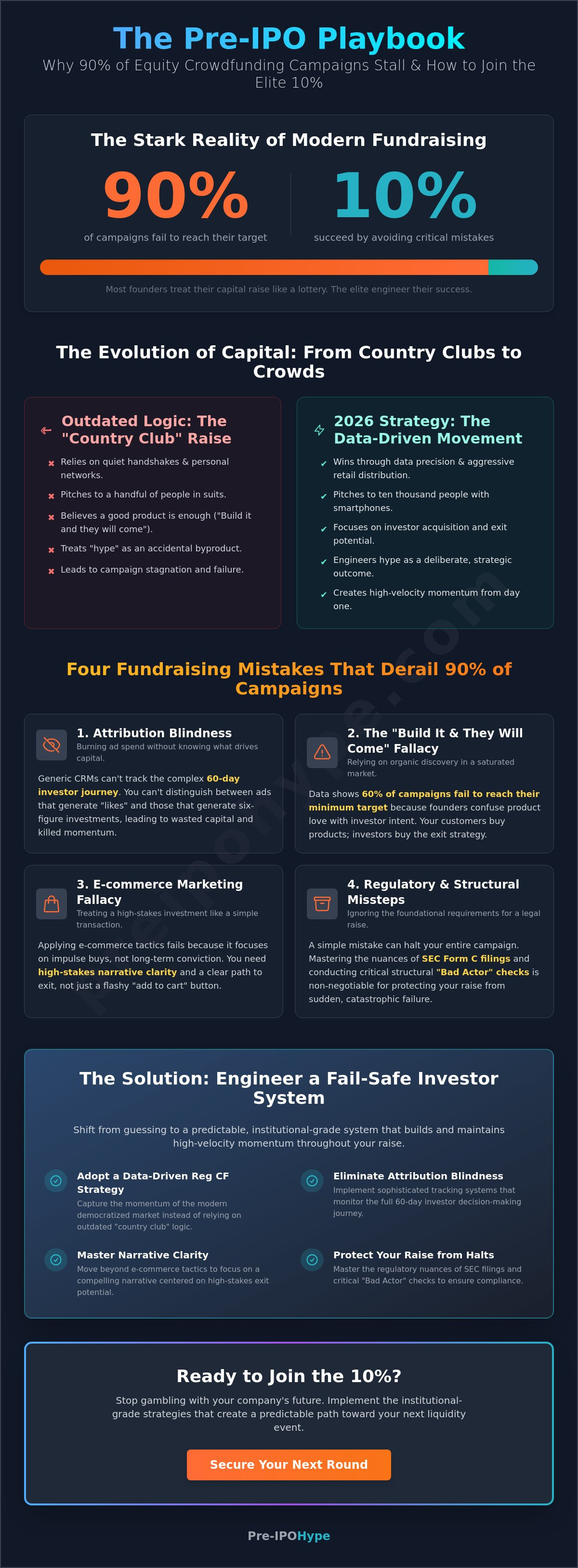
Why do 90% of equity crowdfunding campaigns stall before they ever reach their target? Most founders treat their capital raise like a lottery, yet the elite 10% understand that avoiding fundraising mistakes is the difference between a failed launch and a historic exit. You've likely felt the pressure of rising investor acquisition costs or the anxiety of a campaign that plateaus once the initial "friends and family" round concludes. It's an exhausting cycle, but it's also a signal that your narrative and technical infrastructure aren't aligned with the 2026 market reality.
We're pulling back the curtain on the institutional-grade strategies used to secure secondary liquidity and hit aggressive valuation benchmarks. You'll learn how to build a robust database of high-net-worth leads and implement attribution models that show exactly which ads drive capital. This guide provides the tactical blueprint to ensure your next round isn't just a transaction; it's a movement that creates a predictable path toward your next major liquidity event.
Key Takeaways
- Shift from outdated "country club" logic to a data-driven Reg CF strategy that captures the momentum of the modern democratized market.
- Eliminate attribution blindness by implementing sophisticated tracking systems that monitor the full 60-day investor decision-making journey.
- Master the art of avoiding fundraising mistakes by moving beyond e-commerce tactics to focus on high-stakes narrative clarity and exit potential.
- Protect your raise from sudden halts by mastering the regulatory nuances of SEC Form C filings and critical structural "Bad Actor" checks.
- Engineer a fail-safe investor system that audits your foundation and scores leads to maintain high-velocity momentum throughout the raise.
The Evolution of Capital: Why Traditional Fundraising Logic Fails in 2026
The era of the "Country Club" raise ended years ago. In 2026, capital isn't secured through a quiet handshake at a golf course; it's won through data-driven precision and aggressive retail distribution. The democratization of finance through Regulation Crowdfunding (Reg CF) means you aren't just pitching to ten guys in suits. You're pitching to ten thousand people with smartphones. This shift has turned the old playbook into a liability.
Relying on organic discovery is the fastest way to kill your momentum. Many founders believe that if their product is revolutionary, the crowd will find them. This is a fatal error. Avoiding fundraising mistakes starts with acknowledging that "hype" isn't an accident; it's an engineered outcome. Without a dedicated strategy to drive traffic, your campaign will die in the noise of a saturated market.
To better understand the common pitfalls of modern capital raises, watch this helpful video:
The Hype Cycle vs. the Stagnation Trap is the defining battle of 2026. If you don't hit 30% of your target within the first 72 hours, your campaign enters a feedback loop of perceived failure. Investors don't want to be the first in; they want to be part of a winning movement. Positioning your raise as an exclusive opportunity rather than a plea for capital is the difference between a unicorn and a footnote.
The Death of the "Build It and They Will Come" Philosophy
Data from the last three years shows that 60% of equity crowdfunding campaigns fail to reach their minimum funding target. This happens because founders confuse product marketing with investor acquisition. Your customers love your product, but they might not understand your cap table. A comprehensive overview of fundraising reveals that investor motivation is rarely about the utility of the product itself. It's about the exit. Relying solely on your existing customer base is rarely enough to close a multi-million dollar round in a crowded market.
Navigating the 2026 Private Market Landscape
Retail investors in 2026 demand institutional-grade transparency. They've seen the volatility of the early 2020s and now look for secondary liquidity options and clear valuation benchmarks. By using "insider" framing, you create urgency. You aren't just selling shares; you're offering a seat at a table that was historically gated. Avoiding fundraising mistakes requires you to treat your raise as a high-stakes product launch where the "product" is the future value of the company. The goal is to bridge the gap between private secrecy and public opportunity, making every investor feel like they've just been handed a golden ticket.
Data Silos and Attribution Blindness: The Silent Campaign Killers
Most founders treat their cap table like a spreadsheet, but they treat their marketing like a slot machine. They pull the lever on Facebook ads, hope for a jackpot of checks, and wonder why the dashboard shows plenty of "engagement" but zero liquidity. This is the first hurdle in avoiding fundraising mistakes that derail 90% of retail-focused raises. Generic CRMs are built for 24-hour e-commerce cycles. They're fundamentally incapable of tracking the nuanced, 60-day psychological journey an investor takes before committing five or six figures to your vision.
When you operate with "blind" ad spend, you're essentially burning capital to buy data you can't even read. If you can't see that a $10,000 investment on Tuesday originated from a LinkedIn thought-leadership post three weeks ago, you'll likely kill the very ad that's actually driving your ROI. Engineering momentum requires a Custom Investor CRM designed to bridge these gaps. Without it, you're just guessing in a high-stakes environment where every misallocated dollar shortens your runway.
Solving the 60-Day Attribution Puzzle
Investors rarely commit on the first touchpoint. Data from 2024 capital raises shows that 82% of retail investors require at least 7 distinct brand interactions before they open their wallets. To capture this, you must implement cross-platform tracking that merges Google search intent, Meta retargeting, and LinkedIn professional data into a single investor profile. An Attribution Window is the defined period, usually 30 to 90 days for Reg CF raises, during which a platform credits a final investment to an earlier marketing touchpoint. If your window is too short, your data tells a lie. If it's too long, it's noisy. Elite raises in 2026 will use precision tracking to follow the "capital trail" across every device the investor owns.
From Data Silos to Omnichannel Mastery
The danger of "vanity metrics" is that they feel like progress. A post with 1,000 likes provides a dopamine hit, but it doesn't fund your Series A. You need "capital metrics." This means syncing your email marketing, SMS alerts, and retargeting ads so they act as a single, cohesive engine. When a lead clicks an email, your retargeting ads should automatically shift from "awareness" to "scarcity" messaging without you lifting a finger.
- Lead Scoring: Use behavioral triggers to separate "curiosity clicks" from "capital-ready" prospects.
- High-Net-Worth Prioritization: If an investor with a history of $25,000 checks visits your terms page three times in 48 hours, your internal team needs an instant alert.
- Efficiency: Automated workflows ensure you aren't duplicating effort or spamming the same lead across four different channels.
By avoiding fundraising mistakes like data fragmentation, you position your company as a sophisticated institutional-grade opportunity. If you're unsure where your current funnel is leaking capital, it might be time to ask our CEO for a diagnostic look at your attribution stack.
Marketing Mistakes: The Fallacy of E-commerce Style Fundraising
Selling a $5,000 equity stake isn't the same as selling a $50 subscription. One of the most common errors in avoiding fundraising mistakes is the "Buy Now" mentality. Founders often assume that a slick landing page and a few social media ads will drive immediate conversions. In reality, capital raises in 2026 require a sophisticated trust architecture. High-net-worth individuals and retail backers alike don't click a button and part with thousands of dollars without a narrative that justifies the risk. You aren't just selling a product; you're selling a future liquidity event.
Founder friction often ruins a raise. This happens when the leadership spends 90% of the pitch explaining the technical "how" while ignoring the financial "why." Investors care about the exit. If you don't clearly map out the path to a secondary market sale or an IPO, you lose them. Many issuers fail because they don't leverage professional Reg CF Marketing Services to engineer momentum. These services bridge the trust gap by creating a consistent "hype cycle" that makes the investment feel like an exclusive movement rather than a desperate plea for cash.
Neglecting the "Middle of the Funnel" is another fatal flaw. A 2024 study by DealMaker showed that 60% of capital is often raised in the final 30 days of a campaign. If you stop communicating during the middle weeks, your lead list goes cold. You need a drip sequence that maintains urgency without sounding frantic. This keeps your brand top-of-mind when the investor is finally ready to commit.
Investor Acquisition vs. Product Sales
Transaction-based e-commerce is a one-and-done event. Relationship-based capital raising is a marathon. Your pitch deck shouldn't be a static PDF; it must function as a performance funnel. This means A/B testing your value proposition for different segments. An engineer might invest because of the tech stack, but a finance professional invests because of the valuation benchmarks. Segment your messaging or watch your conversion rates plummet.
The Power of the Video Funnel
In 2026, static landing pages are where capital goes to die. Long-form video content converts at a 42% higher rate than text-heavy pages because it humanizes the founder. A structured Pre-IPO Hype Video Funnel serves as your 24/7 sales force. It answers the "Why Now?" and "How do I exit?" questions before the investor even thinks to ask them. This creates a frictionless path from curiosity to capital commitment, ensuring the "insider" feeling remains intact throughout the journey.
Foundation Failures: Regulatory and Structural Missteps
Elite capital raises aren't built on vibes alone; they're built on bulletproof legal architecture. Many founders treat SEC Form C filings as a late-stage chore, but this is a fatal error. In 2024, the SEC issued comment letters to approximately 18% of Reg CF issuers, often delaying launches by 30 to 60 days. These delays kill momentum and signal to sophisticated investors that the leadership lacks operational discipline. Mastering the technicalities is the first step in avoiding fundraising mistakes that haunt mid-tier campaigns.
Structural oversights like failing a "Bad Actor" check can halt a campaign mid-raise, freezing funds and damaging your reputation permanently. Your Foundation Infrastructure must be locked in at least 90 days before your public launch date. This window allows for the necessary two-year financial reviews or audits that platforms like Wefunder and StartEngine mandate. Choosing between these platforms isn't just about fees. StartEngine often favors consumer-facing brands with high-energy marketing, while Wefunder’s community-centric model excels for tech-heavy startups looking for long-term brand evangelists. By avoiding fundraising mistakes in your platform selection, you ensure your industry's specific audience is actually present to buy.
Compliance as a Competitive Advantage
Transparency isn't a burden; it's a sales tool. High-net-worth individuals look for clean reporting as a proxy for how you'll manage their capital post-exit. During the "Testing the Waters" (TTW) phase, many companies accidentally trigger "gun-jumping" violations by making hard offers before their Form C is filed. You've got to keep the hype within the lines of the law. Marketing materials that promise "guaranteed returns" or fixed exit multiples are illegal under SEC guidelines and will result in an immediate shutdown of your offering and potential permanent bans from the private markets.
Choosing the Right Regulatory Vehicle
Selecting between Reg CF and Reg A+ depends on your 2026 growth trajectory. If you're targeting a $5 million raise, Reg CF is efficient. If you're hunting for $75 million and want to create secondary liquidity, Reg A+ is the institutional standard. Smart issuers often deploy a 506(c) side-car to accommodate institutional "whales" who want to bypass the crowdfunding platform's limits. For a deep dive into which structure fits your specific cap table, you should Ask the CEO for strategic guidance. This decision defines your exit potential before the first dollar arrives.
Engineering the Momentum: Building a Fail-Safe Investor System
Fundraising isn't a search for capital. It's the execution of a high-velocity system. Most founders lose because they treat their round like a bake sale rather than a strategic product launch. By avoiding fundraising mistakes rooted in poor data management, you build a machine that generates its own gravity. Success in 2026 requires a five-step engineering process to ensure your cap table remains elite and your momentum stays terminal.
- Step 1: The Foundation Audit. You can't build on sand. 68% of investor databases contain "dead air" within twelve months. Clean your list, verify accredited status, and ensure your tech stack is ready for 10,000+ hits per hour.
- Step 2: Custom CRM Deployment. Stop using spreadsheets. You need a CRM that scores leads based on engagement. If an investor opens your deck four times in two hours, that's a 90-point lead that requires an immediate call.
- Step 3: The Hype Cycle. Secure a "Cornerstone" group to pre-commit 20% of the round. This creates the social proof necessary to trigger FOMO in the broader market.
- Step 4: Data-Driven Scaling. Use Digital Marketing and Advertising to flood the top of your funnel. In 2026, the brands that win are the ones that dominate the digital scroll.
- Step 5: Secondary Liquidity. Plan for the exit on day one. Establish pathways for secondary market trading to keep your early investors happy and your valuation benchmarks rising.
The 60-Day Fundraising Roadmap
Timing is the difference between a "Sold Out" sign and a stalled campaign. Days 1 through 15 focus on technical infrastructure and lead scoring setup. By day 30, you should be live. The Invst Guru newsletter exposure acts as a critical catalyst here, pushing your message to 50,000+ qualified eyes when the narrative needs a second wind. The final 15 days must leverage "End of Round" urgency marketing. Data shows that 42% of retail capital commits in the final 72 hours of a deadline. Don't leave that money on the table.
Scaling Beyond the First Million
Transitioning from a retail "crowd" to institutional "checks" requires a shift in language and data. Avoiding fundraising mistakes during this phase means keeping a pristine cap table and a data-rich CRM. Institutional players look for 24 months of clean engagement metrics. Your CRM isn't just a tool for today; it's the engine that powers your Series B and eventual exit. 85% of institutional investors prioritize companies that can prove their investor demand through hard data. Ready to build your system? Schedule a Strategy Session to audit your fundraising plan and secure your ground-floor advantage.
Secure Your Seat at the 2026 Capital Frontier
The window for traditional, slow-moving capital raises has closed. Success in the 2026 landscape requires a total shift from e-commerce style marketing to a sophisticated investor system that eliminates attribution blindness. By implementing a Red Dot-level strategic framework for Reg CF and A+ offerings, you move beyond the tactics that drain 2026 balance sheets. Avoiding fundraising mistakes isn't just about risk management; it's about engineering a momentum-driven hype cycle that secures secondary liquidity and hits aggressive valuation benchmarks.
PreipoHype has already facilitated over $100 million for 230 companies using our proprietary Custom Investor CRM technology. This isn't theoretical. It's a battle-tested roadmap designed for the next generation of unicorn hunting. Your cap table deserves a strategy that mirrors institutional precision while capturing the raw energy of the ground floor. Don't leave your liquidity event to chance when the keys to this gated financial world are within reach.
Book a 30-minute strategy session with our elite fundraising consultants to audit your current trajectory. The next major exit is being built in the 2026 cycle. You have the vision; we have the machinery to make it reality.
Frequently Asked Questions
What is the biggest mistake founders make when starting a Reg CF raise?
The biggest mistake is launching without 30% of your target already committed in a private phase. Founders who hit the public market with a $0 balance fail 80% of the time according to 2024 industry benchmarks. You need that initial social proof to trigger the platform algorithm and build the hype that drives retail participation. Momentum is a currency you can't afford to ignore.
How much should I budget for investor acquisition to avoid a failed campaign?
You should budget between 10% and 15% of your total raise goal for digital acquisition and marketing. If you're aiming for a $5 million raise, expect to deploy $500,000 across paid social and email funnels. This investment prevents a failed campaign by ensuring a steady flow of 2,000 to 5,000 new leads per month. High-quality investor leads are the lifeblood of elite raises.
Can I use my existing E-commerce CRM for an equity crowdfunding round?
You shouldn't use a standard E-commerce CRM because it lacks the compliance tracking required by SEC Rule 204. Equity crowdfunding requires managing subscription agreements and accredited investor verification, which tools like Shopify or Mailchimp aren't built for. Switching to a dedicated investor relations platform reduces your churn rate by 25% during the closing process. Precision in data management is a hallmark of the informed insider.
What happens if my fundraising campaign fails to reach its minimum target?
If you miss your minimum funding target, 100% of the capital held in escrow is returned to the investors. This is a critical part of avoiding fundraising mistakes that damage your brand's long-term reputation. You lose the marketing spend and the time invested, often setting a company back 12 months in its growth trajectory. Reaching the minimum is the first hurdle to securing secondary liquidity.
Is it better to focus on retail investors or institutional "whales" first?
You must focus on institutional "whales" or lead investors first to secure 25% to 40% of the total capital. Retail investors rarely lead; they follow the momentum created by big checks. Securing an anchor investor by Q1 of your raise year signals to the market that your valuation is backed by professional due diligence. This strategy transforms your raise into an exclusive club that retail investors want to join.
How do I avoid legal trouble with the SEC during my marketing outreach?
Avoid legal trouble by ensuring every social post includes the mandatory SEC legends required by Rule 206. You can't make specific financial projections or offer "guaranteed" returns in your marketing outreach. Working with a compliance officer ensures your 2026 campaign stays within the safe harbor provisions of Regulation Crowdfunding. Professionalism in communication is what separates unicorn hunters from amateurs.
How long does it typically take to fix a stagnant fundraising campaign?
It typically takes 14 to 21 days to fix a stagnant campaign through a strategic re-launch strategy. This involves updating your lead magnet, refreshing your ad creative, and deploying a high-urgency email sequence to your existing 5,000 leads. Data from 2024 campaign recoveries shows that if the needle doesn't move within this three-week window, the market has likely rejected your current valuation or messaging.
What is the ideal "Foundational" setup time before a campaign goes live?
The ideal foundational setup time is 90 to 120 days before your campaign goes live. This period is essential for avoiding fundraising mistakes like poor lead generation or incomplete legal audits. A 2025 study of elite raises found that campaigns with 4 months of prep raised 3x more than those with 30 days of prep. Use this time to build a waitlist of 10,000 potential investors for a day-one surge.
Disclaimer
Educational only. Not investment, tax, or legal advice. Pre-IPO Hype is investor relations infrastructure for Regulation CF and Regulation A+ raises. We are not a broker-dealer, funding portal, or investment adviser, and we do not offer or sell securities or make investment recommendations. Any securities offering is made only by the issuer, through its own offering documents and, where required, a registered intermediary.


