
Bootstrapping vs Equity Crowdfunding: The Elite Founder’s Guide to Capital Strategy in 2026
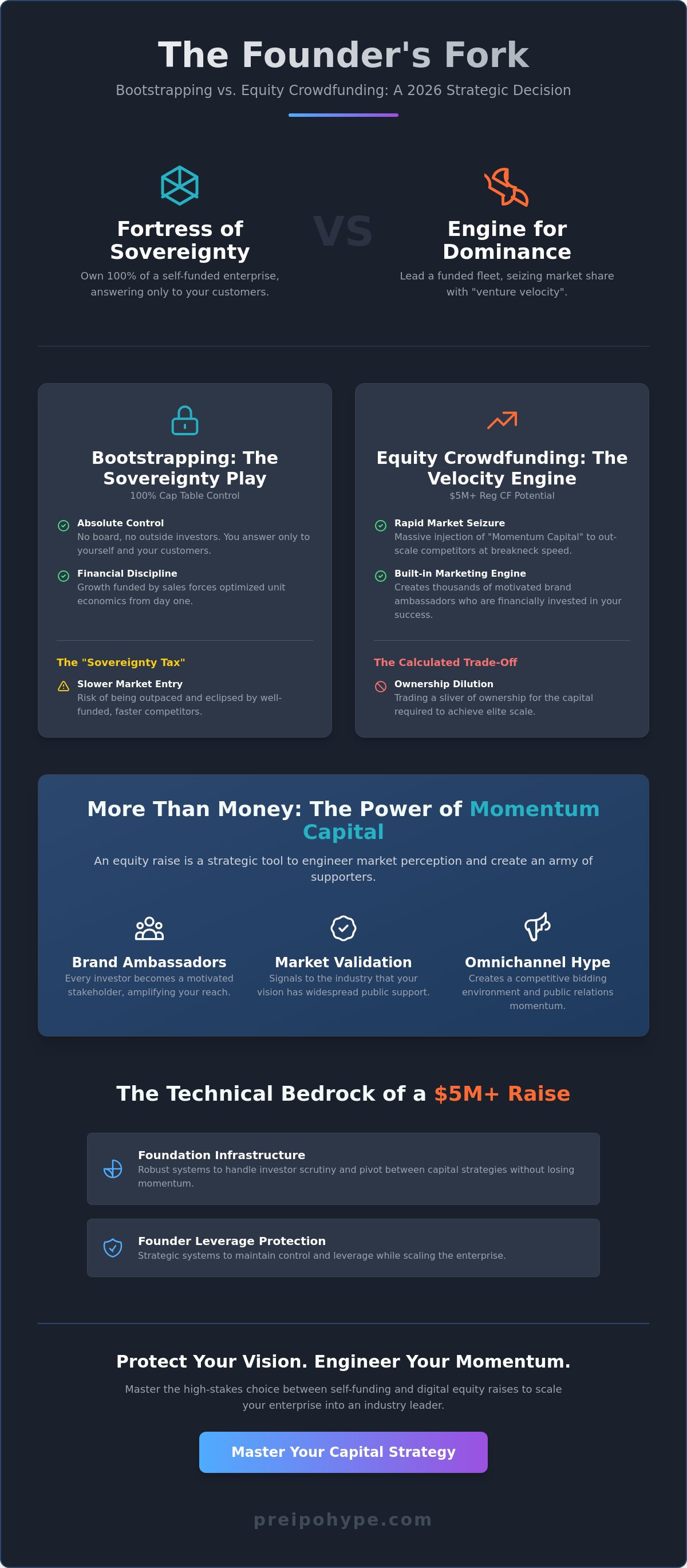
In the 2026 capital markets, your cap table is either a fortress of sovereignty or a high-velocity engine for market dominance. The decision of bootstrapping vs equity crowdfunding isn't just a financial choice; it's a strategic maneuver that determines whether you own 100% of a slow-moving ship or lead a funded fleet. Most founders fear losing operational control, yet they feel a growing anxiety as competitors use digital raises to seize market share at breakneck speeds.
Key Takeaways
- Evaluate the critical trade-off between absolute cap table sovereignty and the "venture velocity" required to seize market share before competitors capitalize.
- Master the high-stakes choice of bootstrapping vs equity crowdfunding by applying a strategic decision matrix that aligns your capital structure with your long-term exit goals.
- Discover how to leverage Reg CF and Reg A+ to turn a digital raise into a powerful marketing engine, creating thousands of motivated brand ambassadors.
- Learn why engineering a competitive bidding environment through omnichannel outreach is more important than the specific source of your capital.
- Identify the technical bedrock of a $5M+ raise, focusing on the systems and infrastructure needed to protect founder leverage while scaling.
The Founder’s Fork: Navigating Bootstrapping vs Equity Crowdfunding in 2026
The choice of bootstrapping vs equity crowdfunding is the most consequential strategic decision a 2026 founder will make. Bootstrapping is the path of absolute sovereignty, where you retain 100% of the cap table by funding growth through revenue and personal reserves. Equity crowdfunding, by contrast, is the engineering of a public movement. It trades a sliver of ownership for a massive injection of "Momentum Capital." In a market where competitors can go from stealth to a $5 million Reg CF raise in months, relying on "Stagnant Savings" is often a gamble on irrelevance. This decision sets the trajectory for your entire enterprise, especially if an IPO is the ultimate realization event.
To better understand how these paths diverge in the early stages, watch this helpful breakdown:
The Core Philosophy of Modern Startup Capital
Identifying Your Startup’s Growth Stage and Needs
The critical "Fork in the Road" usually appears between the seed and growth stages. At this point, your industry’s speed-to-market requirements become the primary driver of your strategy. If you're operating in a sector with high barriers to entry or aggressive venture-backed competitors, the slow burn of bootstrapping might result in a lost market share that you can never recover. This is when having the right Foundation Infrastructure becomes mandatory. You need a technical bedrock that allows you to pivot between paths without losing data or momentum. Whether you are protecting your equity or preparing for a $5M raise, your systems must be robust enough to handle the scrutiny of sophisticated investors and the rapid pace of 2026 markets.
Building this technical bedrock starts with a solid legal framework; Krystal7 Consultants assists entrepreneurs with company registration and legal compliance, ensuring the business is structured to handle rapid scaling and investor due diligence.
Bootstrapping: The "Sovereignty Tax" of Self-Funded Growth
Revenue is the ultimate proof of concept. When your growth is funded by sales rather than subsidies, you possess a level of validation that most venture-backed startups can only dream of. This financial discipline forces you to optimize your unit economics from day one. You can find deep insights into these trade-offs in this analysis of Bootstrapping Versus Venture Capital. Yet, there is a breaking point. Resourcefulness is a virtue until it becomes a liability. Founder burnout often occurs when the "grind" of self-funding prevents you from focusing on the high-level strategy required to scale.
Profitable Growth vs. Hyper-Growth
When to Stop Bootstrapping and Start Raising
Every successful self-funded venture eventually hits an "Inflection Point." This is the moment where continued self-funding actually begins to kill your growth. If your competitors are leveraging digital raises to buy market share, your slow-and-steady approach becomes a slow-and-steady exit from the market. Pre-revenue tech startups rarely survive this phase without external capital. If you are unsure if you've reached this threshold, our Consulting and Advisory Services can help you audit your current trajectory and determine if it's time to pivot toward a raise. If the math suggests that your market is moving faster than your cash flow, you might want to book a strategy session to explore your leverage options before your window of opportunity closes.
Equity Crowdfunding: Engineering Momentum for Elite Scale
Venture Velocity is the core of the bootstrapping vs equity crowdfunding debate. While bootstrapping relies on the slow accumulation of profits, equity crowdfunding allows you to engineer an immediate market presence. It’s about using other people’s capital to buy time and market share before the window of opportunity slams shut. In 2026, speed isn't just an advantage; it’s a survival mechanism. If you aren't scaling, you're likely being overtaken by a competitor who had the courage to raise.
Democratizing your cap table through Reg CF and Reg A+ doesn't mean surrendering your vision to a chaotic crowd. It means building an army. Imagine having 50,000+ brand ambassadors who are financially incentivized to see you win. Unlike traditional venture capital where a single board member can stall your progress, modern crowdfunding platforms allow founders to structure deals that keep voting power firmly in their hands. You get the capital injection without the boardroom coup. It’s the ultimate leverage play for the modern executive.
The Power of the Digital Investor Acquisition
Turning customers into "Elite Insiders" is a psychological masterstroke. When a customer becomes an investor, their lifetime value and brand loyalty skyrocket. Strategic equity offers facilitate this transition by making participation feel exclusive. Using Investor Acquisition Platforms allows you to automate the conversion of curiosity into hard capital. By issuing non-voting shares, you preserve founder autonomy while the crowd provides the fuel for your next stage of expansion.
Calculating the Real ROI of an Equity Raise
It’s a common refrain that equity is the most expensive capital long-term. While technically true on a spreadsheet, it’s the most powerful capital you can deploy today. Stagnation is far more expensive than dilution. Engineering a $20M valuation today is significantly cheaper than enduring 10 years of slow growth that might never reach the same peak. By utilizing Reg CF Marketing Services, you can drive down the cost of investor acquisition and maximize the net capital that actually hits your balance sheet. This efficiency ensures that every dollar raised is working toward your eventual realization event.
The Strategic Decision Matrix: Control vs. Valuation Leverage
Choosing between bootstrapping vs equity crowdfunding requires more than a gut feeling; it demands a clinical evaluation of your exit goals. Are you building a lifestyle business that funds your freedom, or are you engineering a vehicle for a nine-figure IPO? If your goal is the latter, valuation leverage is your primary metric. You must determine if the market is currently rewarding aggressive growth or disciplined profitability. Selling equity when valuations are peaking is a masterstroke; holding onto 100% of a company while its sector cools is a strategic failure.
For founders in specialized sectors, obtaining an accurate valuation is a prerequisite for any exit strategy; for instance, Healthcare Biz Brokers, Inc. provides expert guidance on the buying, selling, and valuation of healthcare-related businesses to help owners maximize their returns.
The "Hybrid Strategy" is often the most sophisticated path for elite founders. You bootstrap to a Minimum Viable Product (MVP) to retain maximum equity during the highest-risk phase. Once you've achieved product-market fit, you switch to equity crowdfunding to fuel your scale. This approach ensures you aren't diluting your ownership before you've proven the concept. To manage this transition effectively, utilizing a Custom Investor CRM is essential. It allows you to track the specific ROI of your capital choices and maintain a direct line to your most valuable supporters.
Market Sentiment and Timing Your Raise
Timing is the difference between a failed raise and a record-breaking hype cycle. If the market sentiment is "Hot," you should be selling equity to capitalize on high multiples. In a "Cold" market, you revert to bootstrapping to protect your valuation until conditions improve. We use deep investor data to determine if your brand story possesses "Hype Potential." The "Sweet Spot" occurs at the intersection of high recurring revenue and intense investor demand, creating a competitive bidding environment that drives your valuation upward.
Investor Relations: The Burden of Transparency
Transitioning from reporting only to yourself to reporting to a community of thousands is a significant operational shift. This transparency isn't just a regulatory requirement; it's a social proof engine. A successful crowdfunding raise serves as a loud signal to Tier-1 VCs that your company has mass-market appeal. Your "Elite Insider" community is your most valuable moat because it represents a loyal base that provides both capital and market defense. If you're ready to map out your specific trajectory, schedule your capital strategy audit today to ensure your next move is your strongest.
Engineering the Raise: The Technical Bedrock of Success
The debate over bootstrapping vs equity crowdfunding often misses the most critical factor: the system matters more than the source. Capital is a commodity, but the infrastructure used to acquire it is a proprietary asset. In a landscape where 60% of Regulation Crowdfunding offerings between 2016 and 2024 raised zero dollars, relying on "hope" is a strategy for the average, not the elite. Success requires engineering a competitive bidding environment. By using omnichannel outreach, you move beyond passive fundraising and start dictating the terms of your growth. You aren't just looking for a check; you're positioning your raise as an elite movement that investors are privileged to join.
Data is the language of the $100M+ realization event. Institutional players and sophisticated individuals look for 60-day attribution models that prove your startup’s growth potential is repeatable and scalable. When you can show exactly how a digital touchpoint converts into a committed investor, you strip away the perceived risk of the "crowd." This level of transparency transforms your cap table from a list of names into a high-performance engine. It signals to the market that you've mastered the technical bedrock required to protect your vision while maximizing momentum.
The Fundraising Tech Stack
Automation is the bridge between the lean discipline of a bootstrapper and the explosive scale of a funded leader. A sophisticated Fundraising Tech Stack allows you to lower your cost of capital through lead scoring and targeted investor acquisition. The secret to winning in 2026 is tracking every single investor touchpoint from the initial "Click" to the final "Commit." This data-driven approach ensures that your marketing spend isn't just an expense, but a calculated investment in your company's valuation. It allows you to maintain the financial discipline of your self-funded days while operating with the fire-power of a venture-backed titan.
Taking the Next Step Toward $100M+ Momentum
The "Pre-IPO Hype" mindset is the ultimate differentiator. It’s the transition from running a business to leading a unicorn. This requires a unique blend of calculated ambition and technical precision. You've analyzed the trade-offs of bootstrapping and the velocity of equity raises; now it's time to execute. Whether you are protecting your sovereignty or engineering a public movement, your capital strategy must be as robust as your product. Don't leave your cap table to chance. Book a 30-minute strategy session with Jeff "Fuzzy" Wenzel to map your raise and secure the leverage your vision deserves.
Seize the Momentum of the 2026 Capital Markets
The strategic choice of bootstrapping vs equity crowdfunding determines whether your enterprise remains a well-kept secret or becomes a market-defining force. You've explored how bootstrapping offers absolute sovereignty and how equity crowdfunding provides the venture velocity required to outpace aggressive competitors. In the current landscape, success isn't just about the capital itself. It's about the technical bedrock you build to manage that capital. By integrating a proprietary Custom Investor CRM and mastering omnichannel outreach, you transform a simple raise into an elite movement that commands premium valuations.
Ready to engineer your next elite capital raise? Book your strategy session now.
The future of your industry is being written right now. It's time to claim your place at the head of the table and turn your vision into an unstoppable reality.
Frequently Asked Questions
Is equity crowdfunding better than bootstrapping for a pre-revenue startup?
Equity crowdfunding is often superior for pre-revenue startups in high-growth sectors because it provides the "Momentum Capital" needed to build without the immediate pressure of sales. While bootstrapping forces discipline, it can lead to stagnation in tech-heavy industries where speed-to-market is the primary indicator of future success. Raising early allows you to engineer a market entry that a self-funded grind simply can't match.
How much control do I actually lose in an equity crowdfunding campaign?
You lose minimal operational control if you structure your raise using non-voting shares or Special Purpose Vehicles (SPVs). Unlike traditional venture capital where a lead investor might demand a board seat, equity crowdfunding allows you to retain 100% of the voting power while democratizing the economic interest. This ensures the founder remains the primary decision-maker while building a massive community of brand ambassadors.
Can I bootstrap my MVP and then switch to equity crowdfunding for Scale?
Yes, this "Hybrid Strategy" is a hallmark of elite founders who want to protect their early-stage valuation. By bootstrapping to a Minimum Viable Product (MVP), you prove the concept without diluting your ownership at the lowest valuation point. Once you have traction, the debate of bootstrapping vs equity crowdfunding shifts toward using external capital to ignite an aggressive hype cycle for rapid scaling.
What is the average cost of an equity crowdfunding raise in 2026?
Founders should budget for costs beyond the 5-8% platform fees, including 10-15% of the target raise for marketing and advertising. Additional expenses include legal fees and accounting costs for reviewed or audited financials, especially for raises above $1,235,000; many accounting firms assisting with these processes use FibreCRM to manage their client relationships and ensure seamless communication throughout the audit. These technical requirements are the bedrock of a compliant $5 million Reg CF offering and are essential for maintaining professional credibility with sophisticated investors.
How does Regulation Crowdfunding (Reg CF) affect my ability to raise VC later?
A successful Reg CF campaign acts as a powerful social proof engine that often attracts Tier-1 venture capitalists. Institutional investors view a high-participation raise as a validated market signal. By using SPVs to keep your cap table clean, you avoid the administrative complexity that sometimes deters later-stage investors. It positions your startup as a proven movement rather than a risky experiment.
What are the main disadvantages of bootstrapping in a competitive market?
The primary disadvantage of bootstrapping is the high opportunity cost of slow growth. In a fast-moving market, being self-funded can lead to a "Sovereignty Tax" where you lose market share to competitors who prioritize velocity. If a rival uses a digital raise to capture the sector first, your 100% ownership of a stagnant company becomes a strategic liability rather than an asset.
How do I use a Custom Investor CRM to manage my equity raise?
A Custom Investor CRM allows you to track every investor touchpoint from the initial lead acquisition to the final commitment. This technical infrastructure is vital for managing the high volume of participants in a Reg CF or Reg A+ raise. By automating outreach and scoring leads based on engagement, you ensure that your capital acquisition is a data-driven process rather than a guessing game.
What do institutional investors think of companies that started with bootstrapping?
Institutional investors generally respect formerly bootstrapped companies because they demonstrate superior unit economics and financial discipline. It shows that the founder can build a resilient model without relying on subsidies. When these companies eventually pivot to an equity raise, they often command higher valuations because their proof of concept is backed by actual revenue and lean operational history.
Disclaimer
Educational only. Not investment, tax, or legal advice. Pre-IPO Hype is investor relations infrastructure for Regulation CF and Regulation A+ raises. We are not a broker-dealer, funding portal, or investment adviser, and we do not offer or sell securities or make investment recommendations. Any securities offering is made only by the issuer, through its own offering documents and, where required, a registered intermediary.


