
Common Equity Crowdfunding Mistakes: Why 80% of Capital Raises Fail in 2026
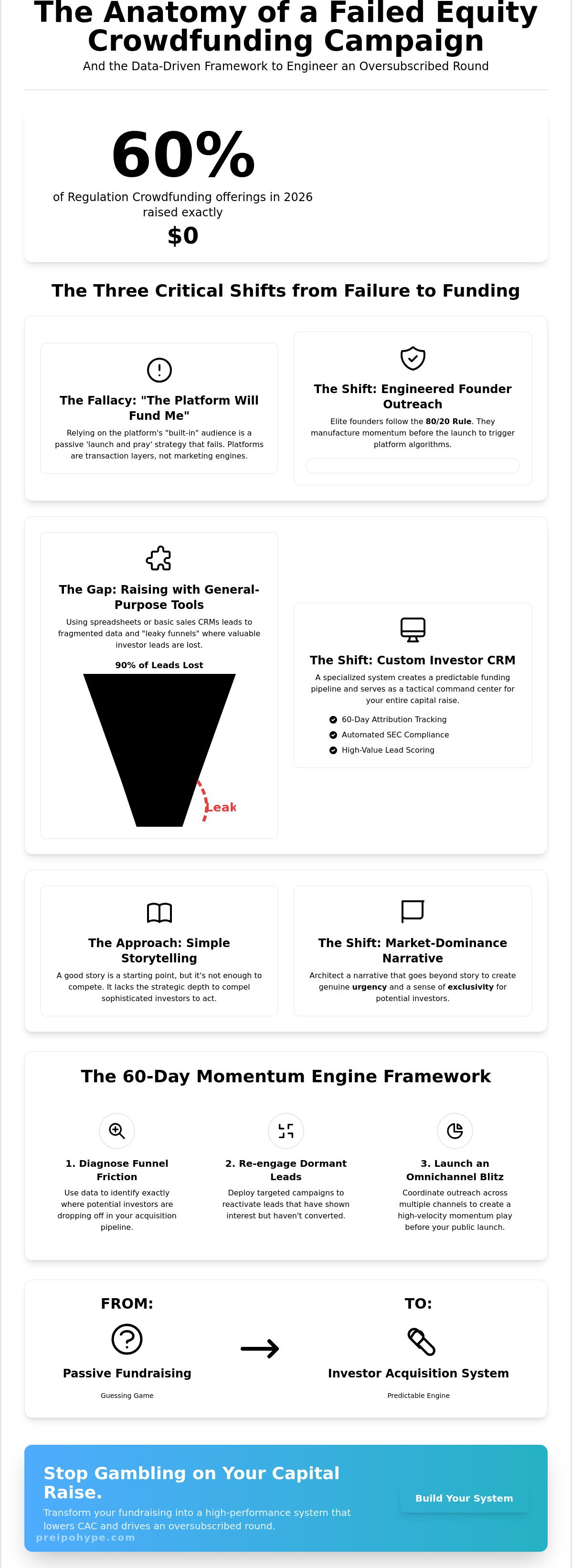
Did you know that 60% of all attempted Regulation Crowdfunding offerings in 2026 raised exactly zero dollars? It's a staggering figure that proves most founders are flying blind in a maturing market. While the global crowdfunding landscape is projected to hit $31 billion by 2032, the reality for many is a stagnant funding bar and an unsustainably high cost-per-acquisition for investors. These failures aren't usually due to bad ideas. They're the direct result of common equity crowdfunding mistakes that stall momentum before the campaign even goes live.
You've likely felt the frustration of watching your marketing spend climb while your conversion data remains a black box. You aren't alone in wanting a more predictable, data-backed path to capital. This article identifies the critical strategic and technical blunders that drain your budget and kill your round. You'll learn the data-driven framework used by elite founders to lower CAC and engineer an oversubscribed raise. We'll break down the specific infrastructure and omnichannel strategies needed to turn your capital raise into a high-velocity momentum play.
Key Takeaways
- Identify how to avoid common equity crowdfunding mistakes by shifting from a reliance on platform traffic to a strategy of engineered founder outreach.
- Understand why general-purpose tools fail and how a custom investor CRM with 60-day attribution tracking creates a predictable funding pipeline.
- Learn to architect a market-dominance narrative that moves beyond simple storytelling to create genuine investor urgency and exclusivity.
- Discover the 60-day momentum engine framework for diagnosing funnel friction and re-engaging dormant leads through an omnichannel blitz.
- Evolve your approach from passive fundraising to a sophisticated investor acquisition system that lowers your CAC and drives toward an oversubscribed round.
The 'Field of Dreams' Fallacy: Relying on Platform Traffic
The most expensive assumption you can make is that a platform’s "built-in" audience will fund your vision. Many founders treat major equity portals like a marketing engine when they are, in reality, just highly efficient transaction layers. This misunderstanding is one of the most common equity crowdfunding mistakes, leading to the "launch and pray" approach that kills raises before they gain traction. To navigate this space successfully, you must first understand the structural reality of What is Equity Crowdfunding? and how it has evolved into a sophisticated digital acquisition game.
To better understand this concept, watch this helpful video:
The Myth of the 'Built-in' Investor Base
Shifting from Passive Hosting to Active Acquisition
Stop viewing the platform as your marketing agency. Its job is to process the investment, not to find the investor. To win in 2026, you must transition your mindset to treat potential backers as high-value customer acquisitions. This means you need to own your investor data rather than relying on the opaque, surface-level analytics provided by the host site. By building your own foundation infrastructure, you can track the long-tail investor journey and ensure your outreach is actually converting rather than just generating empty noise.
The Infrastructure Gap: Raising Without a Custom Investor CRM
Running a capital raise on a spreadsheet or a basic sales CRM is like trying to navigate a high-frequency trading floor with a paper map. While general-purpose tools are fine for selling software, they fail to capture the nuanced behavior and SEC compliance requirements inherent in private markets. This infrastructure gap is one of the most common crowdfunding mistakes that prevents founders from scaling. Without a Custom Investor CRM, you're operating with fragmented data, leading to "leaky funnels" where up to 90% of interested leads never reach the finish line.
Lead Scoring for Capital: Identifying the 'Whales' in the Crowd
You need to distinguish between "retail curious" clickers and high-net-worth individuals. Elite systems automate lead scoring based on specific actions, like how many times a lead views the pitch deck or if they've engaged with previous raises. This allows you to prioritize high-value outreach when the inevitable "mid-campaign slump" hits. Instead of chasing every $100 lead, your team can focus on the "whales" who have the capacity to move the needle. If you want to see how elite founders structure these funnels, you can schedule a technical audit of your current stack.
Omnichannel Mastery and Attribution
Your digital marketing and advertising must sync perfectly with your CRM to be effective. Investing isn't an impulse buy. It follows the "Rule of 7," requiring multiple touchpoints across email, social media, and SMS. The 60-day attribution window is the secret weapon of the elite. Most retail investors don't commit on the first touch. They watch, they wait, and they evaluate your momentum. If your data is fragmented, you lose the ability to nurture these leads through that window. You need to see exactly which email or which retargeting ad finally triggered the investment to optimize your spend and lower your CAC.
Narrative Architecture vs. Simple Storytelling
Selling the Future, Not the Present
You aren't raising money for what your company is today. You're raising for what it will become. Elite founders frame their foundation infrastructure as a competitive moat that makes their market growth feel inevitable. This isn't just about capital. It's about scaling a movement. By using social proof and early investor momentum, you validate your future valuation in real-time. This makes participation feel like joining a winning team rather than funding a struggle. It shifts the focus from current risk to future dominance.
The Anatomy of a High-Conversion Pitch Deck
Traditional VC decks often fall flat in a retail crowdfunding environment because they lack the rhythmic energy needed to convert a digital audience. Your deck needs a 'Momentum Slide' that showcases growth velocity rather than static historical metrics. Retail investors want to see acceleration. They want to see the trajectory. Your 'Call to Action' shouldn't just be a generic button. It should be a curated invitation to an elite club, leveraging the psychological triggers of scarcity and rare opportunity to drive immediate action.
The 60-Day Momentum Engine: A Step-by-Step Recovery Guide
A stalling campaign is a psychological death sentence in the eyes of the crowd. When your funding bar stops moving, potential investors see risk rather than opportunity. This plateau is often caused by common equity crowdfunding mistakes like failing to plan for the inevitable "mid-campaign slump." To fix this, you need a recovery protocol that injects fresh energy and urgency into your raise. Implementing an 'Omnichannel Blitz' allows you to re-engage dormant leads in your CRM and remind them why they clicked in the first place.
One of the fastest ways to break a plateau is through strategic newsletter exposure. By tapping into curated audiences, you're not just buying clicks; you're injecting "fresh blood" into your ecosystem. This should be paired with a 'Founder's Update' strategy. Use transparency to share recent milestones, but frame them in a way that triggers a sense of FOMO. Show that the train is leaving the station, and the opportunity for early entry is closing fast. It's about moving from a passive raise to an active, engineered momentum play.
Step 1: Audit the Friction Points
You can't fix what you can't measure. Use heatmaps and session recordings to identify exactly where investors get "cold feet" in your funnel. Is the drop-off happening at the initial click, the pitch deck view, or the final investment page? The 'Conversion Gap' in 2026 is the critical delta between digital interest and financial commitment, where even minor technical friction can result in a 90% loss of potential capital. If your audit reveals high abandonment on the legal disclosure page, your narrative isn't strong enough to overcome the perceived risk. If you're struggling to diagnose why your momentum has flatlined, you can book a campaign recovery audit to identify the leaks in your funnel.
Step 2: Re-Engaging the 'Maybe' Pile
Your CRM is likely filled with high-intent lurkers who have spent significant time on your page but haven't pulled the trigger. Segment these leads by 'Time on Page' to find those most likely to convert. Craft a 'One-on-One' email that feels personal but scales through automation. This isn't a sales pitch; it's a direct invitation to join an exclusive movement. As your round nears its end, use SMS alerts for 'Round Closing' updates. These high-urgency touchpoints drive final-hour conversions by forcing a decision. By treating your "maybe" pile as a high-priority acquisition target, you can recover significant capital that would otherwise be lost to hesitation.
The Founder’s Roadmap to an Elite Capital Raise
Partnering with a specialized equity crowdfunding marketing agency is a strategic force multiplier rather than a simple line-item cost. At Pre-IPO Hype, our philosophy centers on connecting institutional-grade technology with the infectious energy of retail opportunity. We move beyond surface-level promotion to build deep-funnel systems that convert strangers into capital partners. This is how you bridge the gap between a stagnant raise and a high-velocity movement that captures market attention and drives toward an oversubscribed finish.
Building Your Technical Fundraising Stack
Your raise is only as strong as the data supporting it. A fragmented stack is one of the most common equity crowdfunding mistakes, leading to missed opportunities and wasted ad spend. You must integrate your CRM, ad platforms, and email automation into a single, cohesive ecosystem. Investing in premium investor data early in the process provides the high-octane fuel your acquisition engine needs. This "Foundation Infrastructure" is the technical bedrock that separates a modest $100k raise from a $5M powerhouse. It ensures that every lead is tracked, every touchpoint is measured, and every dollar of CAC is optimized for maximum ROI.
Next Steps: Scaling Your Vision
A successful Reg CF is a powerful proof of concept, but it's just the first milestone on your trajectory. The roadmap for elite companies often leads toward Reg A+ or even IPO-ready status. Maintaining your valuation and preparing for future realization events requires a sophisticated post-raise investor relations phase. You aren't just managing shareholders; you're leading a community of advocates. Ready to stop guessing and start engineering your hype? Book a strategic guidance session with our team today and let’s architect a raise that positions your company for long-term market dominance.
Architecting Your Market Dominance
The window for experimental fundraising has closed. In 2026, the difference between a stalled raise and an oversubscribed round is the technical infrastructure you build before the first dollar is committed. Success requires moving from a passive approach to a sophisticated, engineered investor acquisition model. By mastering your narrative architecture and deploying a 60-day momentum engine, you transform your company from a startup seeking funds into a high-velocity movement that investors are eager to join. For those looking to sustain this growth, elite platforms like The Boardroom Mastermind provide experienced entrepreneurs and real estate investors with the peer network and educational tools necessary to navigate the complexities of long-term market leadership.
Avoiding common equity crowdfunding mistakes is about more than just a polished deck. It's about owning your data and your audience. We've facilitated over $100M for 230+ companies by connecting institutional-grade technology with retail opportunity. Our proprietary 60-day attribution tracking and elite investor outreach via Invst Guru ensure that your round doesn't just launch; it dominates. You have the vision, and now you have the roadmap to ensure the market recognizes it.
The future of your company depends on the momentum you create today. It's time to stop leaving your capital to chance and start engineering your success. Scale your capital raise with our Custom Investor CRM and omnichannel mastery. Let’s build your legacy together.
Frequently Asked Questions
What is the most common reason equity crowdfunding campaigns fail?
How much should I spend on marketing for a Reg CF raise?
Do I really need a CRM for a crowdfunding campaign?
Can I run a successful raise without institutional investors?
You can definitely succeed without institutional backing, but you must manufacture your own crowd through sophisticated outreach. Regulation Crowdfunding democratizes access, allowing non-accredited investors to participate based on income or net worth limits. Success depends on your ability to treat retail investors as high-value acquisitions rather than hoping for a random influx of capital from the platform's organic traffic.
How do I re-engage investors who visited my page but didn't buy?
Re-engagement requires a strategic mix of retargeting ads and segmented CRM outreach. Most investors follow the "Rule of 7," requiring multiple touchpoints before they feel comfortable committing capital. Use your data to identify high-intent lurkers who spent significant time on your investment page and send a personal, scaled invitation that emphasizes the closing window of opportunity.
What is the 'mid-campaign slump' and how do I avoid it?
The "mid-campaign slump" is the natural plateau in funding that occurs once your initial inner circle has already invested. You avoid it by staggering your narrative milestones and injecting fresh leads through newsletter exposure mid-cycle. Keeping the story moving toward future growth events creates the constant sense of urgency required to prevent your funding bar from stalling.
Is social media advertising effective for equity crowdfunding in 2026?
Social media is a powerful engine for top-of-funnel awareness, but it must be part of a larger omnichannel system. In 2026, social ads are most effective when they feed directly into a lead-scoring CRM that tracks the long-tail conversion path. It's a vital tool for reaching the projected $31 billion global crowdfunding market, provided you have the analytics to measure actual ROI.
What is the difference between Reg CF and Reg A+ marketing strategies?
Disclaimer
Educational only. Not investment, tax, or legal advice. Pre-IPO Hype is investor relations infrastructure for Regulation CF and Regulation A+ raises. We are not a broker-dealer, funding portal, or investment adviser, and we do not offer or sell securities or make investment recommendations. Any securities offering is made only by the issuer, through its own offering documents and, where required, a registered intermediary.


