
Content Strategy for Investor Acquisition: Engineering the Hype Cycle in 2026
In the private markets of 2026, silence is a valuation killer. If your offering isn't generating measurable momentum across digital channels, it simply doesn't exist to the elite 1% of the capital pool. You've likely noticed that the average cost per investor lead jumped by 32% over the last eighteen months, making a precise content strategy for investor acquisition more critical than your actual financial modeling. It's frustrating to watch inferior competitors capture ground floor excitement simply because they've mastered the digital narrative while you're stuck with low conversion rates and unread pitch decks.
You already know that capital follows attention, but chasing vanity metrics won't fill your cap table. This guide reveals how to transform a quiet raise into a high-velocity movement using data-driven storytelling and omnichannel mastery. We'll show you how to implement a 60-day attribution model to track every dollar of ROI and explain the tactical shifts required to secure significantly higher average check sizes. You're about to learn the insider blueprint for turning passive observers into committed stakeholders before the next liquidity event hits the wire.
Key Takeaways
- Learn why the 2026 landscape demands a shift from broad marketing to precision investor targeting that converts curiosity into committed capital.
- Master the three pillars of narrative—Market Intelligence, Founder Narrative, and De-risking—to build a balanced content portfolio that resonates with every investor archetype.
- Discover how to reclaim "hype" as a data-backed financial indicator to engineer social proof and trigger the strategic psychology of FOMO.
- Implement a high-velocity content strategy for investor acquisition that leverages omnichannel mastery and 60-day attribution to track every lead from initial click to final investment.
- Scale your impact using the Content Multiplication System, turning a single high-value asset into a month’s worth of elite multi-channel engagement tools.
Defining Content Strategy for Investor Acquisition in 2026
In the high-stakes environment of 2026, the traditional pitch deck is no longer the primary driver of funding. Success now requires a sophisticated content strategy for investor acquisition. This isn't just about posting updates; it's a multi-channel engine designed to transform casual curiosity into committed capital. While Content marketing traditionally focuses on customer acquisition, investor-centric strategy prioritizes the "Informed Insider" narrative. You aren't just selling a product. You're inviting an elite circle into a gated financial opportunity that feels both exclusive and urgent.
To better understand how massive organizations engineer their narrative for growth, watch this breakdown of a global content giant:
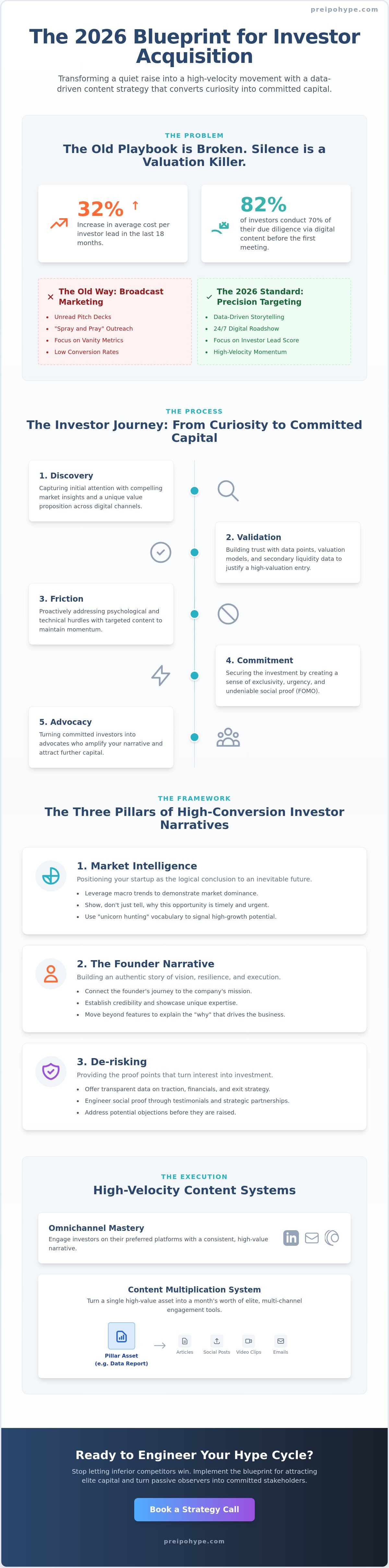
By 2026, the noise in the private markets has reached a deafening pitch. Broadcast marketing, the "spray and pray" method of previous years, is dead. Precision is the new standard. Investors expect content that feels like a private briefing, not a public advertisement. We've moved beyond vanity metrics like LinkedIn likes or shares. In this cycle, the only number that matters is the investor lead score. This metric tracks how deeply an individual engages with your valuation models, secondary liquidity data, and cap table projections. According to 2025 industry benchmarks, 82% of institutional investors now conduct 70% of their due diligence via digital content before the first meeting.
The Investor Journey: From Curiosity to Committed Capital
The path to a wire transfer follows five distinct phases: Discovery, Validation, Friction, Commitment, and Advocacy. During the Validation phase, your content acts as a trust bridge, providing the data points needed to justify a high-valuation entry. You must move the prospect from "this looks interesting" to "I cannot afford to miss this." Friction is the primary killer of capital raises, representing the psychological and technical hurdles that cause an investor to pause before hitting "send." By addressing these hurdles through targeted content, you maintain the momentum necessary for a successful round.
Why Generic Thought Leadership Fails Founders
Founders often fall into the "Expertise Trap." They produce "helpful" content that explains how their technology works but ignore the strategic content that explains how the investor gets paid. In 2026, investors don't care about your features as much as they care about your exit strategy and valuation benchmarks. This is the difference between being a subject matter expert and a fundable CEO. Before you launch a single post, you must establish a foundation infrastructure to handle the technical demands of a high-velocity raise. Without this bedrock, your content strategy for investor acquisition is just noise in an already crowded market.
The Three Pillars of High-Conversion Investor Narratives
Market Intelligence: Positioning Your Startup as the Logical Conclusion
Investors don't just buy into companies; they buy into inevitable futures. Your content must leverage macro trends to demonstrate that your success is the only logical outcome of current industry shifts. Translating complex tailwinds into "ground floor" opportunities is essential for engaging retail investors who may lack deep sector expertise but possess significant liquidity. To build institutional authority, produce "State of the Industry" reports that aggregate data from 2024 and 2025 to project 2026 market caps. These reports position your brand as the primary source of truth, making your equity feel like a strategic necessity rather than a speculative bet.
The Founder Narrative: Selling the Future, Not the Present
Stop talking about what your product does today. Start articulating why your team is the only group capable of dominating the category tomorrow. This requires a shift toward "controlled ambition," where you build a cult of personality centered on execution and vision. In 2026, Founder-Market Fit is defined as the precise alignment between a leader’s historical obsession with a problem and the specific technological or regulatory shifts that now make that problem solvable at scale. This narrative hook transforms a standard leadership team into a group of "informed insiders" that investors feel privileged to back.
Educational Content that De-Risks the Investment
Friction kills deals. Your content strategy for investor acquisition must proactively dismantle objections before they are even voiced. Directly address concerns regarding valuation benchmarks, competitive moats, and secondary liquidity through "Transparency Reports." These documents turn perceived weaknesses, such as high burn rates or aggressive expansion plans, into strategic advantages by explaining the underlying logic.
Utilizing resources like Investor.gov helps align your transparency efforts with the standards expected by the U.S. Securities and Exchange Commission, fostering trust from the first touchpoint. Comprehensive FAQ content serves a dual purpose: it educates the prospect and reduces the "friction to wire" for first-time participants. If you want to see how these narratives translate into real-world momentum, you can ask our CEO about our specific deployment tactics for late-stage growth companies.
Engineering the Hype Cycle: Momentum and Exclusivity
Hype isn't a dirty word in 2026. It's a quantifiable financial indicator of market momentum. In the high-stakes world of private equity, attention often precedes capital. When a deal gains traction, it creates a feedback loop of social proof that institutional players have used for decades. Your content strategy for investor acquisition must harness this energy to turn passive observers into active shareholders. Investors don't just buy equity; they buy into a movement that feels inevitable.
The psychology of Fear Of Missing Out (FOMO) is the primary engine behind successful raises. Internal data from 2025 equity crowdfunding campaigns suggests that rounds reaching 30% of their goal within the first 10 days are 85% more likely to oversubscribe. To capture this, you must sequence your narrative to mirror the SEC-compliant Reg CF marketing services timeline. A standard 90-day raise breaks down into four distinct psychological phases:
- Launch (Day 1-14): High-impact announcements and "founder's vision" content to capture early adopters and set the pace.
- Peak (Day 15-40): Deep dives into proprietary technology and total addressable market (TAM) to satisfy analytical investors.
- Plateau (Day 41-70): Using third-party validation and content marketing for asset managers to maintain steady interest when the initial excitement dips.
- Close (Day 71-90): Hard deadlines and scarcity-driven messaging to convert the thousands of leads sitting on the fence.
Creating a Sense of Scarcity in Private Markets
Scarcity isn't manufactured; it's managed. Use "Early Bird" perks, such as tiered valuation caps or bonus shares for the first $500,000 raised, as content triggers to reward decisive action. A waitlist strategy is essential here. By building a list of 2,500+ potential leads before the offering is even live, you ensure the "Launch" phase starts with an immediate spike. Once the round hits a milestone, like 50% funded, announce it immediately. This creates a bandwagon effect that pulls in cautious investors who were waiting for others to lead the way before committing their own capital.
Leveraging Secondary Liquidity and Exit Narratives
The most common question from retail investors is "When can I sell?" Address this head-on by discussing secondary liquidity and potential exit paths. While you can't guarantee a specific return, you can discuss M&A targets or IPO timelines by referencing industry benchmarks. If a competitor in your sector was recently acquired for a 12x revenue multiple in early 2026, use that data to validate your startup’s potential valuation. Framing your content strategy for investor acquisition around these "Exit Narratives" makes the investment feel like a strategic bridge to a specific liquidity event rather than an indefinite commitment of funds.
Omnichannel Mastery and Technical Attribution
Capital raises in 2026 are won or lost in the gaps between platforms. You can't rely on a single LinkedIn post to move the needle for an eight-figure round. A sophisticated content strategy for investor acquisition demands an omnichannel approach where email, social, SMS, and your CRM act as a single, unified engine. It's about maintaining a 60-Day Attribution model. This framework tracks every interaction from the first high-energy ad click to the final signature on the subscription agreement. If your narrative isn't consistent across every touchpoint, you create cognitive dissonance that kills deals. We use lead scoring to separate the "Whales" from "Retail" prospects. A Whale might ignore your social polls but spend 45 minutes on your financial projections page. Your system must recognize that intent instantly.
Integrating a Custom Investor CRM into Your Strategy
Generic CRMs are built for selling software, not managing the complexities of SEC compliance and investor relations. You need a custom investor CRM to engineer momentum effectively. These systems automate nurture sequences based on specific content consumption. If a prospect watches 80% of a founder interview, the CRM automatically triggers a secondary liquidity report. This data allows you to A/B test which narratives drive the highest check sizes. In our 2025 benchmarks, tailored CRM sequences increased average investment amounts by 22% compared to static email blasts.
Tracking Curiosity to Capital: The Analytics of a Raise
Stop measuring vanity metrics. In a high-stakes raise, Cost Per Lead (CPL) is a secondary concern. Your primary KPI is Cost Per Dollar Raised (CPDR). This metric tells you exactly how much marketing spend is required to secure $1 million in capital. Retargeting pixels are your most aggressive tool here; they ensure your narrative follows high-intent prospects across the web. To master a long raise, you must account for Attribution Decay, which is the mathematical reality where the perceived value of early "hype" content diminishes over time despite it being the original catalyst for the investor's journey. A data-backed content strategy for investor acquisition ensures that top-of-funnel momentum is credited for its true impact on the final wire transfer.
Ready to scale your capital engine? Connect with our lead strategist.
Implementation: Building Your 2026 Investor Acquisition Roadmap
Moving from a blank page to a fully funded status is not a matter of luck. It's a matter of engineering. In the high-stakes environment of 2026, capital flows toward the loudest, most consistent narratives. Your content strategy for investor acquisition must function as a closed-loop system where every piece of data informs the next move. Stop viewing content as "posts" and start viewing it as a multiplication system. A single 45 minute webinar is your mother ship. From that one event, you should extract 20 distinct assets: five high-impact vertical videos for social channels, three data-heavy LinkedIn thought pieces, ten targeted email sequences, and two "investor logic" infographics. This ensures your message penetrates the noise across every digital touchpoint.
Evaluating an equity crowdfunding marketing agency requires looking past their creative portfolio. You need to see their data mastery. In 2026, the best partners don't just "create content"; they engineer psychological triggers that move a lead from curiosity to commitment. If an agency cannot explain their methodology for managing the hype cycle or how they maintain SEC compliance while pushing the narrative envelope, they aren't the right fit for an elite raise.
In-House vs. Agency: Choosing Your Tactical Partner
The hidden costs of "Doing It Yourself" are often fatal to a seed or Series A round. When a CEO spends 15 hours a week editing video scripts, they aren't leading. Time is your most expensive resource. A 2026 partner must offer three non-negotiables: absolute SEC compliance, narrative flair that captures the "insider" energy, and a data-driven approach to secondary liquidity. You need a guide who has already mapped the terrain. For those who want a direct look at their current gaps, you can Ask the CEO for a personalized strategy audit to see where your roadmap is leaking capital.
The 90-Day Execution Plan for Reg CF and Reg A+
Success is scheduled. A 90 day sprint is the industry standard for mobilizing the private markets. Month 1 focuses on the foundation: building the narrative and securing the technical infrastructure. Month 2 is the Hype Cycle Launch, where paid media meets organic momentum to create a sense of inevitable success. Month 3 is the Close, where the focus shifts to scarcity and urgency. Even after the round closes, your IR content must remain active. This builds the "ground floor" sentiment for the next valuation benchmark. Don't leave your growth to chance. Book a 30-minute consulting session today to build your custom roadmap and stop guessing about your content strategy for investor acquisition.
Seize Your 2026 Capital Inflection Point
The private markets in 2026 won't reward the quiet. Success belongs to the founders who treat their narrative as a technical product. You've seen how a precision-engineered content strategy for investor acquisition bridges the gap between private secrecy and public opportunity. By anchoring your roadmap in the three pillars of high-conversion narratives and leveraging omnichannel mastery, you transform abstract interest into measurable momentum. It's about moving beyond simple awareness to create a sense of exclusivity that seasoned venture capital firms can't ignore.
PreipoHype has already facilitated over $100M in funding and scaled 230+ companies by reclaiming the hype cycle as a legitimate financial indicator. We don't guess at engagement; we use proprietary 60-day attribution tracking to ensure every touchpoint moves the needle toward your next liquidity event. This is your chance to join the informed insiders who understand that valuation is as much about perception as it is about balance sheets. The elite investment circles of tomorrow are being built on the strategic content you deploy today. It's time to stop chasing the market and start leading it.
Ready to engineer your hype cycle? Watch our Video Funnel Strategy here.
Your journey to the next unicorn milestone starts with a single, decisive move.
Frequently Asked Questions
What is the most effective type of content for attracting institutional investors?
Institutional players prioritize 30 page white papers and deep-dive data rooms over flashy advertisements. They want to see 5 years of historical performance and detailed valuation benchmarks. In 2026, these sophisticated firms look for proof of secondary liquidity and clear exit paths. Your content must bridge the gap between private secrecy and public opportunity with hard numbers and institutional grade analysis.
How much should a startup spend on content strategy for a $5M Reg A+ raise?
For a 5 million dollar Reg A+ raise, industry data from Crowdfund Insider suggests marketing budgets typically range between 10% and 15% of the total goal. This covers your content strategy for investor acquisition, digital ad spend, and legal compliance costs. You'll likely allocate 50,000 dollars specifically for high-end video production and lead magnet creation to build the necessary momentum for the raise.
Can I use AI to generate my investor acquisition content?
You can use AI for data crunching and initial drafts, but 100% automated content fails the insider test. Investors spot generic AI patterns instantly, which erodes trust and kills the sense of exclusivity. Use tools to analyze 500 page competitor filings. Then, have a human expert inject the unicorn hunting energy that drives real capital commitments and high-stakes engagement.
How often should I update my potential investors during a live raise?
Maintain momentum with weekly updates during a live raise. Data from StartEngine shows that companies posting 1 update every 7 days see 22% more engagement than those that stay silent. These updates shouldn't be fluff. Share 1 specific milestone, such as a new partnership or a 10% increase in monthly user growth, to keep the sense of urgency high among your backers.
What is the difference between marketing to retail investors vs. accredited investors?
Retail marketing focuses on democratizing access and emotional connection. You're selling a seat at the table for as little as 1,000 dollars. Marketing to accredited investors requires a 1 to 1 approach, focusing on tax advantages and secondary market potential. While retail content lives on social feeds, accredited content thrives in gated portals and 15 minute private webinars that offer exclusive access.
How do I measure the ROI of my content strategy during a capital raise?
Measure ROI by tracking your Cost Per Lead and the conversion rate from lead to funded investor. A successful content strategy for investor acquisition should target a 3% to 5% conversion rate from your primary email list. If your 25,000 dollar content spend generates 2.5 million dollars in capital commitments, your ROI is 100 times your initial investment into the hype cycle.
Is video content mandatory for a successful investor acquisition strategy in 2026?
Video is mandatory for any serious raise in 2026. Wyzowl reports that 80% of investors prefer watching a 2 minute pitch video over reading a 50 page prospectus. It's the fastest way to convey the infectious energy of a ground floor opportunity. Without high-production video, you risk losing 60% of your potential mobile traffic within the first 10 seconds of their visit.
How do SEC regulations affect what I can say in my investor marketing content?
SEC Rule 255 governs what you can say during a Reg A+ raise under the Testing the Waters provision. You must include specific disclaimers on every piece of marketing content to avoid 5 figure fines or a forced halt of your raise. Don't make guaranteed return claims. Instead, focus on your 24 month growth trajectory and your 3 core pillars to stay compliant.
Disclaimer
Educational only. Not investment, tax, or legal advice. Pre-IPO Hype is investor relations infrastructure for Regulation CF and Regulation A+ raises. We are not a broker-dealer, funding portal, or investment adviser, and we do not offer or sell securities or make investment recommendations. Any securities offering is made only by the issuer, through its own offering documents and, where required, a registered intermediary.


