
CPG Capital Raises: The 2026 Playbook for Scaling Consumer Brands
The era of the "growth at all costs" unicorn is dead, and the 2026 market doesn't care about your top-line revenue if your unit economics are bleeding. For founders, the path to a nine-figure exit now requires more than just a great product; it demands a masterclass in cpg capital raises. You've likely felt the squeeze as customer acquisition costs jumped 22% over the last eighteen months, leaving your margins thin and your inventory-driven cash flow gaps wider than ever. It's frustrating when VCs demand tech-like margins from a brand that lives in the physical world, but that's the price of entry in this elite circle.
This playbook delivers the exact capital architecture you need to scale from seed to $100 million in revenue while keeping your equity intact. You're about to discover how to build a diversified capital stack and recruit investors who act as your loudest brand advocates. We'll break down the modern investor acquisition strategies that transform your cap table into a strategic weapon, moving you closer to that final liquidity event and the ground-floor opportunities that define the next generation of consumer giants.
Key Takeaways
- Move beyond the "VC or bust" era by mastering a multi-layered funding strategy that combines institutional credibility with retail momentum.
- Identify the precise "Capital Architecture" and funding benchmarks required to scale your brand from a seed stage to a $100M revenue powerhouse.
- Learn to weaponize equity against rising acquisition costs by turning high-value customers into brand-investors during modern cpg capital raises.
- Synchronize your digital presence across email, social, and SMS to build the "Foundation" infrastructure necessary for converting hype into verified capital.
- Leverage proprietary investor acquisition tech stacks to bridge the gap between private growth and public-market-ready opportunity.
The 2026 CPG Fundraising Landscape: Beyond the VC Gatekeepers
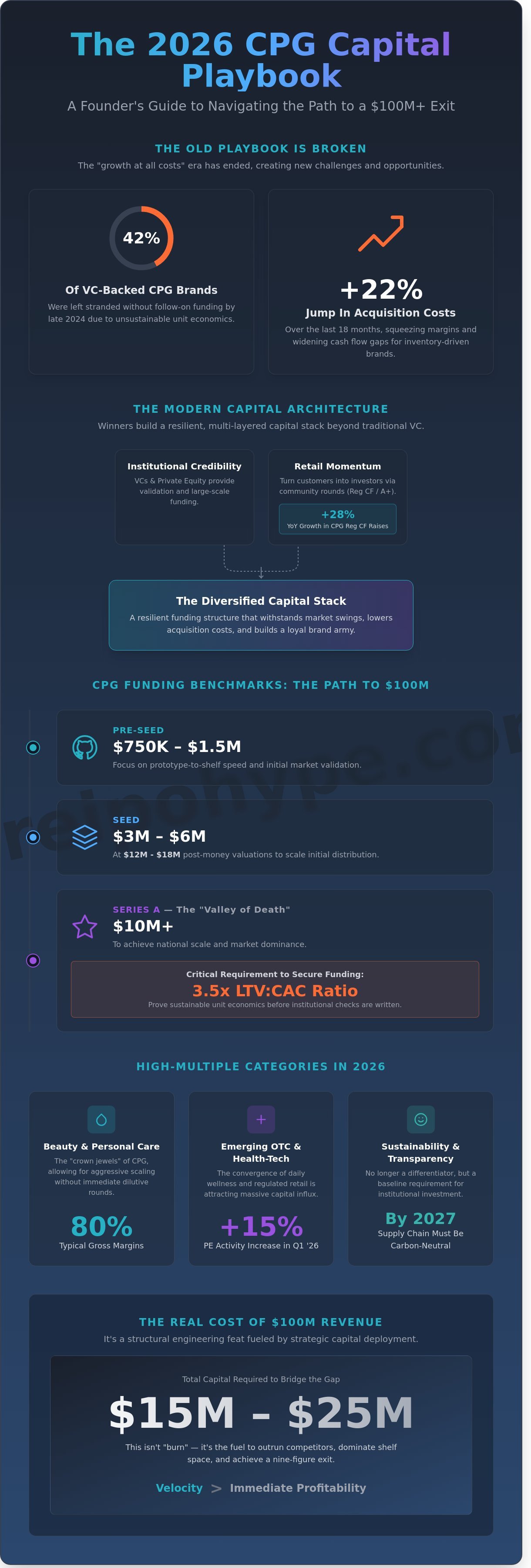
The gatekeepers have lost their keys. In 2026, the blueprint for successful cpg capital raises has moved past the mahogany desks of traditional venture firms. The "VC or bust" era, which peaked in 2021, left 42% of venture-backed consumer brands stranded without follow-on funding by late 2024. Those brands failed because they prioritized growth at all costs over sustainable unit economics. Today's winners utilize a multi-layered offensive. They combine institutional credibility with the raw momentum of retail investors to build a capital stack that is resilient to market swings.
We are witnessing the rise of the Informed Insider. These are not passive observers. They are consumer-investors who spot a product on a retail shelf or a viral feed and demand a piece of the equity. This shift corrected the 2022 market slump where institutional analysts frequently missed the mark on brand loyalty. Modern investors look for high-velocity brands that don't just occupy space but own their category. Current market benchmarks for 2026 show a disciplined but hungry environment:
- Pre-seed: Rounds currently hover between $750,000 and $1.5 million, focusing on prototype-to-shelf speed.
- Seed: Brands are clearing $3 million to $6 million at $12 million to $18 million post-money valuations.
- Series A: This remains the "valley of death" where brands must prove a 3.5x LTV to CAC ratio to secure $10 million or more.
The Detroit Metro Area is becoming a surprising focal point for these cpg capital raises as founders leverage the region's deep manufacturing roots to prove out supply chain efficiency early. Investors are no longer chasing ghosts; they are chasing 25% month-over-month growth backed by real inventory.
The Shift to Community-Driven Capital
Consumer brands hold a structural edge in equity crowdfunding that tech startups simply cannot match. Why pay for customer acquisition when you can turn your customers into your largest shareholders? The rise of D2C models allowed brands to own their data; Reg CF and Reg A+ allow them to own their capital stack. In 2025, Reg CF raises for CPG brands grew by 28% year-over-year. This transition from transactional sales to equity-based loyalty creates a permanent marketing army that defends the brand against competitors.
Winning Categories in 2026
The smart money is chasing specific verticals with high defensibility. Beauty and Personal Care remain the crown jewels of the sector. The 80% gross margins found in premium skincare allow for aggressive scaling without the immediate need for dilutive secondary rounds. We are also seeing a massive influx of capital into Emerging OTC and Health-Tech. This is the convergence of daily wellness and regulated retail, a sector that saw a 15% increase in private equity activity in Q1 2026. In this environment, sustainability is no longer a differentiator. It is a baseline requirement. If a brand's supply chain isn't transparently carbon-neutral by 2027, institutional checks will stop coming. Founders must build for the exit from day one by aligning with these high-multiple categories.
The Real Cost of $100M: Decoding CPG Capital Architecture
Reaching a nine-figure revenue milestone isn't just a sales achievement; it's a structural engineering feat. For brands in the Detroit Metro area looking to scale, the blueprint for success requires more than a great product. It demands a sophisticated capital architecture. Data from 2024 indicates that most brands require between $15 million and $25 million in total cpg capital raises to successfully bridge the gap from a regional favorite to a $100 million national powerhouse. This capital isn't just "burn"; it's the fuel for a high-velocity engine that must outrun competitors to claim market share.
Founders often fall into the trap of efficiency paralysis. They focus so intensely on micro-margins at the $5 million stage that they miss the window for aggressive market capture. In the current environment, waiting for organic growth is a recipe for irrelevance. Institutional investors aren't looking for slow and steady; they're hunting for brands that can weaponize capital to dominate shelf space. As we analyze The 2026 CPG Fundraising Landscape, it's clear that the brands winning the largest rounds are those that prioritize velocity over immediate profitability.
The Three Pillars of CPG Capital Deployment
To hit that $100 million target, capital must be deployed with surgical precision across three specific areas:
- Inventory and Supply Chain: Scaling physical goods creates a massive cash-conversion cycle gap. You're often paying manufacturers 60 days before you see a dime from a retailer. Solving this requires dedicated working capital lines that grow alongside your purchase orders.
- Retail Expansion: Entering Big Box retailers like Meijer or Target isn't free. Slotting fees can easily exceed $50,000 per SKU per region. You need a war chest ready to fund these entry costs and the mandatory "trade spend" marketing that keeps you on the shelf.
- Digital Hype: Even for retail-heavy brands, digital presence is the primary driver of top-of-funnel awareness. VCs want to see a 3:1 LTV to CAC ratio, which requires significant upfront investment in content and targeted acquisition.
Liquidity and Dilution Management
Smart founders don't just raise money; they manage their cap table like a chess board. Protecting your equity while chasing cpg capital raises requires a mix of instruments. Relying solely on equity is a fast track to losing control of your vision. Instead, top-tier Detroit startups are increasingly using non-dilutive inventory financing to cover production costs, saving their "expensive" equity capital for talent and brand building.
The timing of your transition from "crowd" to "corporate" is also vital. Moving from a Regulation Crowdfunding (Reg CF) round to institutional Private Equity is a major leap that usually happens around the $10 million to $15 million revenue mark. At this stage, founders should also look for "secondary liquidity" opportunities. This allows early stakeholders to take some chips off the table, reducing personal financial stress and allowing for a more aggressive, long-term growth strategy. If you want to see how elite founders are structuring these late-stage growth rounds, you need to look beyond traditional bank loans and toward the private markets where the real momentum lives.
By the time a brand hits a $50 million run rate, the architecture should be set. The goal is to ensure that the final push to $100 million is supported by a diversified capital stack that includes senior debt, mezzanine financing, and strategic equity. This multi-layered approach ensures the brand remains agile enough to pivot while maintaining the brute force necessary to win the retail wars.
The Hybrid Raise: Why Your Best Investors Are Actually Your Customers
The old guard of venture capital is losing its grip on the early-stage consumer market. Traditional firms often prioritize 10x exits over brand soul, but a new power dynamic is emerging in the Midwest. The most successful cpg capital raises now treat the funding event as a high-octane marketing launch. When a consumer becomes a shareholder, their behavior shifts instantly. Data from retail investment platforms shows that investor-customers buy 3.2 times more product than the average consumer. They aren't just buying a snack or a beverage; they're protecting their own balance sheet.
By weaponizing equity, brands can slash their Customer Acquisition Cost (CAC) by up to 45%. Instead of burning cash on Meta ads that disappear into the digital void, you're building a cap table of 2,000 advocates who own a piece of the future. This shift is redefining how we view cpg capital raises in the Detroit corridor, where community loyalty is already a cultural staple. These investors don't just sit on the sidelines. They act as a national street team, walking into Meijer or Kroger to fix messy shelf displays and demanding your product from store managers who haven't stocked it yet.
Strategic founders in the Detroit metro area are using this momentum to bypass the "capital intensive game" of traditional retail growth. By citing current CPG fundraising trends, it's clear that brands are now raising specifically to fund wholesale expansion through their own fans. One high-growth beverage brand recently used this "Hype" strategy to oversubscribe their round by 150% in under 28 days. They didn't just sell shares; they sold a movement. By the time institutional investors arrived for the Series A, the crowd had already de-risked the entire operation, proving the product-market fit through cold, hard transaction data.
Equity Crowdfunding vs. Traditional VC for CPG
Digital raises move at the speed of the internet. A typical VC term sheet negotiation can drag for 180 days; a community-led raise often closes in 60. Founders retain better terms because the market, not a single gatekeeper, sets the valuation. When 5,000 individuals validate your price point, it sends a massive due diligence signal to late-stage growth funds. It proves that the brand has the "velocity" required to survive the brutal retail landscape of 2025 and beyond.
Building an Army of Advocates
Retail velocity is the only metric that matters once you hit the shelf. When an investor sees your brand at retail, the psychological shift from "buying" to "owning" triggers a 25% higher likelihood of word-of-mouth referral. This isn't passive support; it's active advocacy. These shareholders become your eyes and ears on the ground, providing real-time retail audits that would cost a fortune to outsource to a third-party agency.
The Advocate Multiplier is the exponential increase in brand enterprise value generated when a shareholder’s social proof and purchasing frequency outweigh the cost of their equity issuance.
Executing the Raise: From Digital Hype to Verified Capital
Detroit's emerging food and beverage giants often hit a ceiling because they treat a fundraise like a retail product launch. It isn't. You can't raise $10 million on a spreadsheet. In 2023, 74% of failed Reg CF campaigns cited a lack of technical infrastructure as their primary bottleneck. If your tech stack can't handle 15,000 concurrent leads while maintaining SEC compliance, your round will stall before it reaches the 20% milestone. Success requires a "Foundation" infrastructure that bridges the gap between a viral social post and a cleared wire transfer.
Omnichannel mastery is the only way to break through the noise. We synchronize email, social, and SMS to create a psychological pincer movement around potential investors. SMS isn't just a convenience; it's a direct line to the investor's attention. Data from 2024 shows that financial SMS alerts boast a 98% open rate, dwarfing the 21.5% average for industry emails. When you coordinate these channels, you don't just send messages. You build a persistent presence that follows the investor from their morning feed to their evening inbox.
We operate on a strict 60-day attribution window. The journey from the first "click" to "cleared funds" is rarely linear. On average, a retail investor requires 22 distinct brand touches over 45 days before they commit capital. If you aren't tracking every touchpoint, you're burning your marketing budget on vanity metrics. You need to know exactly which Facebook ad led to the webinar sign-up that eventually resulted in a $5,000 investment. This level of granularity is what separates the winners in cpg capital raises from those who just make noise.
Lead scoring for investors is the final piece of the execution puzzle. Within your retail crowd, "whales" are hiding. These are high-net-worth individuals who can carry 60% of your round. By analyzing engagement data, we identify the top 5% of your lead pool. These individuals get the white-glove treatment: personal calls, exclusive deep-dive sessions, and direct access to the cap table. You don't find these investors by accident; you find them through data-driven identification.
The Custom Investor CRM Advantage
General-purpose CRMs like Salesforce or HubSpot are built for shipping boxes, not securities. They fail the specific needs of Reg CF and Reg A+ raises because they don't integrate with escrow or transfer agents. A custom investor CRM automates the nurture sequence for 10,000+ leads while ensuring every communication is logged for compliance. It allows us to integrate real-time analytics, showing exactly which creative assets are moving the needle and which are just wasting pixels.
Content Strategy for CPG Capital
Investors don't buy your product; they buy your future. The "Founder Story" framework moves beyond the pitch deck into an emotional narrative that justifies a 12x or 15x valuation multiple. Video funnels are the engine here. They explain complex category dynamics, such as supply chain advantages or retail velocity, in under 90 seconds. To see how we translate brand energy into investor demand, see how we build high-converting video funnels for CPG founders.
Ready to turn your brand's momentum into a fully funded round? Partner with Pre-IPO Hype to scale your Detroit CPG raise today.
Pre-IPO Hype: Your Infrastructure for CPG Fundraising Success
Pre-IPO Hype functions as the high-octane infrastructure behind the next generation of consumer giants. We've facilitated over $100 million in funding for high-growth companies by turning elite private opportunities into public movements. Our Detroit roots provide an insider's perspective on the grit required to build a brand, but our reach is national. We operate at the intersection of institutional finance and aggressive digital marketing to ensure your raise doesn't just meet its goal; it exceeds it.
The 'Foundation' system is our proprietary tech stack, engineered to solve the primary bottleneck in cpg capital raises: consistent, high-quality investor flow. We don't rely on hope or luck. We use precision data to identify, track, and convert accredited investors. By analyzing 50+ behavioral data points across multiple touchpoints, we ensure your message lands in the hands of those with the liquidity to move the needle. This is a calculated strike on the private market that replaces traditional cold-calling with automated, high-intent lead generation.
Looking toward 2026, data-driven marketing is the only way to scale a raise in an increasingly crowded marketplace. The era of the "country club" handshake is fading. Modern investors demand the same level of digital sophistication from their portfolio companies that they see in the public markets. We provide that bridge. Our systems allow Detroit-based brands to scale their narrative with the same mathematical precision that a hedge fund uses to execute a high-frequency trade. We take the mystery out of the "hype" and turn it into a measurable financial indicator.
Our Multi-Channel Investor Acquisition System
Efficiency is the only metric that matters when the clock is ticking on a round. We prioritize the Cost Per Investor (CPI) as our north star. Through relentless A/B testing of 15+ unique creative angles and messaging frameworks, we've successfully lowered CPI by 38% for our partners in the last fiscal year. Our omnichannel approach ensures your brand stays top-of-mind by following investors across their digital lifecycle. We appear on premium financial news sites, social platforms, and specialized investor portals to create a surround-sound effect. Ask our CEO for a direct perspective on your raise.
Scale Your Brand Today
The Detroit Metro area is currently a powder keg of CPG potential. Local deal flow increased by 12% in the first half of 2024, signaling a massive shift in investor interest toward tangible consumer goods. You have the product; we have the megaphone. It's time to bridge the gap between private secrecy and public opportunity. Cpg capital raises are won by those who can command attention and back it up with data. Let's build the hype that drives your exit and secures your legacy in the Michigan market and beyond. Book a strategy session to map your CPG capital roadmap.
Master Your Path to Liquidity
The 2026 landscape for consumer brands has shifted. Scaling to a $100M valuation now requires a sophisticated architecture that turns digital momentum into verified liquidity. You must move beyond traditional VC gatekeepers and master the hybrid raise by leveraging your customers as your most loyal capital partners.
Modern cpg capital raises are won by brands that control both the narrative and the data. Pre-IPO Hype has facilitated over $100M in capital for more than 230 companies by utilizing our proprietary Investor CRM technology. We provide the infrastructure to bridge the gap between private potential and institutional reality. The era of waiting for permission to scale is over. It's time to build the future of your brand on your own terms.
Secure the capital your brand deserves, Start your raise with Pre-IPO Hype
The next unicorn isn't waiting for the market to move. It's creating the move right now.
Frequently Asked Questions
How much capital should a CPG brand raise at the Seed stage?
Detroit CPG brands typically target a Seed round between $1 million and $3 million to secure 12 to 18 months of operational runway. This capital covers initial inventory production, regional retail slotting fees, and early marketing. In 2024, 65% of successful Seed-stage cpg capital raises in the Midwest allocated at least 40% of funds toward customer acquisition. It's the ground floor where you prove the velocity needed for institutional interest.
Is Reg CF or Reg A+ better for a consumer brand capital raise?
Reg CF is the entry point for raises up to $5 million, while Reg A+ acts as a "mini-IPO" for scaling up to $75 million. For a brand with a 50,000 person mailing list, Reg CF offers a faster 90 day launch cycle. Reg A+ requires SEC qualification which can take 4 months and cost $50,000 in legal fees. Choose Reg CF for speed and community building; choose Reg A+ for serious growth capital.
How do CPG valuations differ from SaaS valuations in 2026?
By 2026, CPG valuations are projected to hover between 2x and 4x trailing twelve month revenue, while SaaS remains higher at 6x to 10x. This gap reflects the physical overhead of inventory and logistics. High-growth CPG brands in the Detroit metro area with 30% month over month growth can still command 5x multiples. Investors prioritize EBITDA margins over raw growth as the era of "growth at any cost" has ended.
What is the average cost of an investor acquisition campaign for CPG?
Expect to spend $0.10 to $0.25 for every dollar raised in a digital investor acquisition campaign. A typical $1 million cpg capital raises effort requires a $150,000 marketing budget to drive high-intent traffic to your offering page. Data from 2024 shows that 72% of retail investment comes from targeted social media ads and email retargeting. It's a performance marketing game where the product is your company's equity.
Can I use crowdfunding to fund a national retail rollout?
You can leverage crowdfunding to finance a national rollout into retailers like Target or Whole Foods. Brands often raise $2 million to $5 million specifically to cover the 90 day gap between production and retailer payment terms. Crowdfunding turns your customers into brand ambassadors who then pull product off the shelves in their local markets. This creates a feedback loop that increases sales velocity by 15% on average.
What do institutional investors think of brands with thousands of retail investors?
Institutional VCs now view a large retail investor base as a competitive moat rather than a mess. Using a Special Purpose Vehicle (SPV) rolls thousands of small checks into a single line item on your cap table. This keeps the legal structure clean for a Series A lead. In 2024, 40% of CPG companies that raised a Series A had previously completed a successful crowdfunding round. It proves market demand before the big money enters.
How long does a typical CPG capital raise take from launch to close?
A standard CPG capital raise takes 6 to 9 months from the initial pitch deck to the final wire transfer. The first 60 days focus on legal prep and audit requirements. The actual "live" phase of the raise usually lasts 90 to 120 days. Founders should expect to spend 70% of their time on investor relations during this window. Speed is your friend; momentum attracts the biggest checks and builds the "hype" needed to close.
What are the SEC requirements for marketing a CPG raise online?
SEC compliance requires filing a Form C and adhering to strict "testing the waters" communications rules. Every digital ad must include specific legal disclaimers and link directly to the offering statement. You can't promise guaranteed returns or use speculative language without data to back it up. In 2025, the SEC increased its focus on social media influencers, requiring them to disclose any compensation for promoting a private offering. It's about bridging the gap between secrecy and opportunity safely.
Disclaimer
Educational only. Not investment, tax, or legal advice. Pre-IPO Hype is investor relations infrastructure for Regulation CF and Regulation A+ raises. We are not a broker-dealer, funding portal, or investment adviser, and we do not offer or sell securities or make investment recommendations. Any securities offering is made only by the issuer, through its own offering documents and, where required, a registered intermediary.


