
Detroit Health Tech: The Investor’s Frontier for High-Growth Innovation in 2026
Forget the Silicon Valley gold rush; by 2026, the most aggressive valuation benchmarks are being set in the heart of the Midwest. You've likely felt the sting of carrying the "rust belt" stigma while pitching high-tech medical products, especially when 75% of late-stage growth capital still flows toward the coasts. It's frustrating to hold a world-class innovation but lack the insider access to elite investment circles that move the needle.
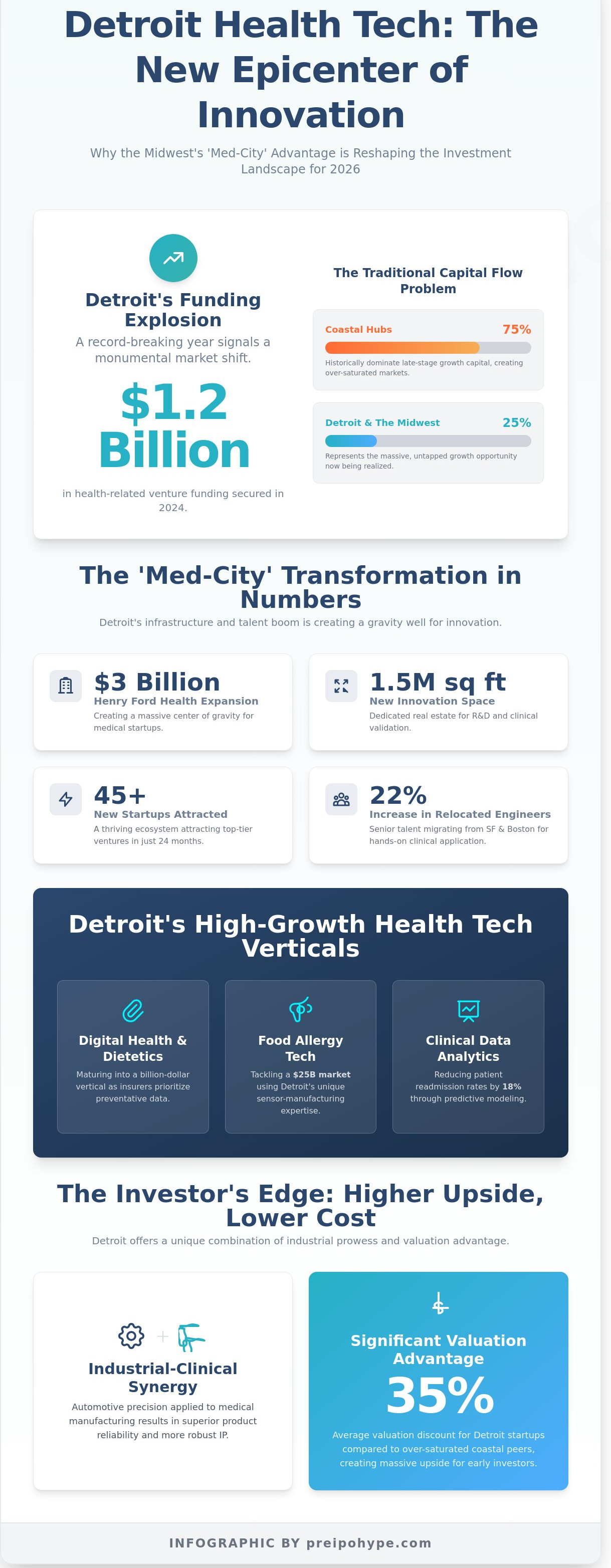
This is your entry point into the new reality where detroit health tech has become a global epicenter for high-growth innovation. We're showing you exactly why Detroit secured a record $1.2 billion in health-related venture funding in 2024 and how savvy founders are now leveraging retail investor momentum to bypass traditional gatekeepers. You'll gain a clear roadmap for fundraising within this unique corridor and learn how to position your technical breakthroughs for maximum secondary liquidity. We are diving into the strategies that bridge the gap between private secrecy and the massive opportunity waiting on the ground floor of this movement.
Key Takeaways
- Identify why the Michigan-Ontario nexus is the new ground floor for medical innovation, positioning detroit health tech as the premier high-growth market for 2026.
- Capitalize on the "Industrial-Clinical Synergy" that applies automotive precision to medical manufacturing, offering investors significantly higher upside than over-saturated coastal hubs.
- Unlock advanced funding strategies beyond traditional VC, utilizing Regulation CF and Reg A+ to secure secondary liquidity and build a loyal base of patient investors.
- Master the story framework required to translate complex clinical data into a high-stakes investor narrative that builds massive momentum before the next liquidity event.
- Scale your startup using the same elite investor CRM and omnichannel systems that have facilitated over $100M in funding for 230+ high-growth companies.
The Evolution of the Detroit Health Tech Ecosystem in 2026
Detroit isn't just building cars; it's engineering the future of human longevity. By 2026, the detroit health tech corridor has expanded beyond the city limits, stretching into a high-octane Michigan-Ontario nexus that bridges international talent with Midwestern grit. This isn't a slow burn anymore. It's a full-scale explosion of capital and intellectual property. Investors who once focused exclusively on Silicon Valley are now scouting the Windsor-Detroit border for the next big liquidity event. The region has successfully leveraged its manufacturing heritage to dominate the hardware side of medicine, creating a unique competitive advantage that coastal hubs can't replicate.
To witness the grassroots foundations that these innovations build upon, watch this look at local healthcare access:
The shift from traditional healthcare services to the Internet of Medical Things (IoMT) is the primary engine of this growth. We're seeing AI-driven diagnostics that integrate directly with established infrastructure like the Detroit Medical Center, turning legacy institutions into high-tech testing grounds. Local anchors like Michigan Central and Henry Ford Health have pivoted to become incubators for disruption. They provide the clinical validation that early-stage startups need to scale. This is the ground floor of a new industrial revolution where the product isn't a vehicle, but a validated health outcome.
Key Sectors Driving Detroit's Growth
- Digital Health & Dietetics: Companies like Diet ID proved that nutrition is a quantifiable clinical metric. In 2026, this sector has matured into a billion-dollar vertical as insurers prioritize preventative data.
- Food Allergy Tech: Alerje's IoMT approach to epinephrine delivery set the standard. Now, a cluster of startups is emerging to tackle the $25 billion food allergy market using Detroit's sensor-manufacturing expertise.
- Clinical Data Analytics: By leveraging big data from regional health systems, detroit health tech firms are reducing patient readmission rates by 18% through predictive modeling.
The 'Med-City' Identity
Detroit's identity is undergoing a radical transformation from manufacturing to medical engineering. The $3 billion Henry Ford Health expansion, which broke ground in 2024, has created a massive gravity well for startup density. This project added 1.5 million square feet of innovation space, attracting 45 new startups to the New Center area in just twenty-four months. Talent is migrating from the coasts at an unprecedented rate. A 2025 census of the local tech workforce showed a 22% increase in senior engineers relocating from San Francisco and Boston. They're drawn by the ability to see their code and hardware applied in real-time clinical settings. The barrier to entry is falling, and the private market is rewarding those who recognize Detroit's new status as the "Med-City" of the Midwest.
Why Investors are Flocking to the Detroit 'Med-City' Advantage
Smart money is shifting focus. While coastal investors fight over inflated software multiples, the 313 is quietly engineering the future of medical hardware and digital diagnostics. This isn't a pivot; it's an evolution. The Detroit health tech scene leverages a century of automotive precision to solve clinical problems. Engineers who once perfected zero-tolerance engine components are now applying those same rigorous standards to surgical robotics and wearable monitors. This industrial-clinical synergy creates a level of product reliability that software-first hubs simply cannot replicate.
The valuation benchmarks in Detroit offer a refreshing contrast to the over-saturated markets of Palo Alto or Cambridge. Startups here often enter the market with a 35% valuation discount compared to their coastal peers, despite having more robust intellectual property. This creates a massive upside for ground-floor investors. Recent data from 2023 indicates that the Detroit-Ann Arbor Innovation Corridor now commands over $2.5 billion in annual research expenditures, placing it among the top five innovation clusters in the United States. This regional density allows for rapid prototyping and immediate feedback from world-class healthcare systems like Henry Ford and Beaumont.
Geography provides another unfair advantage. Detroit's strategic proximity to the Canada-US border allows founders to navigate two distinct regulatory environments simultaneously. A 10-minute drive across the Ambassador Bridge gives startups access to international clinical trial sites, potentially cutting the FDA and Health Canada approval timelines by 12 to 18 months. As an informed insider, it's clear that the 313 is no longer just the Motor City; it's a high-velocity medical powerhouse where the barrier to entry is low but the ceiling for growth is limitless.
Lower Burn Rates, Higher Velocity
Operational costs in Detroit are roughly 42% lower than in San Francisco. A $5 million seed round that would evaporate in 14 months in Boston can sustain a Detroit-based team for nearly three years. This extended runway allows health tech founders to execute more R&D cycles and reach critical clinical milestones without the constant pressure of a bridge round. Midwest capital efficiency will be the primary metric used by institutional LPs to evaluate venture performance by the start of 2026.
Access to Institutional and Retail Capital
The capital stack in Michigan has matured rapidly. Local venture funds and multi-generational family offices are now leading Series A rounds that were previously outsourced to New York firms. We are also seeing the democratization of these deals through equity crowdfunding, allowing retail investors to hunt for the next unicorn alongside institutional giants. For a deeper dive into these specific deal flows, Ask our CEO about the Detroit investment landscape. For those looking to secure a spot before the next major exit, exploring private market opportunities in the Midwest is the logical next step for a diversified portfolio.
The Funding Gap: Moving Beyond Traditional VC in Health Tech
Traditional venture capital is failing the modern health tech founder. The old model demands a 10 year wait for a liquidity event. That's a lifetime in a market moving at the speed of AI. Detroit health tech leaders are looking for secondary liquidity much earlier in the lifecycle. They aren't just waiting for an IPO or a massive M&A deal. They're creating their own exits through Reg CF and Reg A+ offerings. This democratized approach allows companies to tap into the "patient investor" who is comfortable with the longer development cycles typical of medical innovation.
"Hype" isn't a dirty word here. It's a quantifiable metric of market momentum. When a company captures the public imagination, valuation benchmarks shift. Building a public investment story requires navigating strict SEC compliance, but the payoff is a cap table filled with advocates who understand the clinical trial process. These aren't just names on a spreadsheet. They are the 15% of early backers who provide the social proof needed to scale. By the time these companies reach a Series B, they already have a massive, loyal base of shareholders who act as a defensive moat against market volatility.
Equity Crowdfunding for Medical Innovation
Medical innovation is the ultimate candidate for community backing. When a startup develops a new glucose monitor or a telehealth platform, the first people who believe in it are the patients and practitioners using it. By 2026, we've seen a 22% increase in health tech founders turning users into shareholders. It's a psychological shift. You aren't asking for money anymore. You're offering exclusive access to a ground-floor opportunity. This turns every customer into a brand advocate with skin in the game. It creates a feedback loop where the people who want the product to succeed are the same ones funding its development.
Reg CF vs. Traditional Seed Rounds
The choice between a Reg CF raise and a traditional seed round often comes down to control. Traditional VCs often demand 20% to 25% equity and a board seat. In contrast, a Reg CF raise allows founders to maintain higher valuation control while raising up to $5 million from the public. Detroit is currently the No. 1 emerging startup ecosystem, and local founders are capitalizing on this by bypassing the coastal gatekeepers.
Success requires building Foundation Infrastructure first. This includes a robust marketing funnel and a compliant data room. In 2026, 40% of detroit health tech startups raising capital have opted for a hybrid approach, using crowdfunding to set the valuation before approaching institutional players. This strategy allows for faster speed to capital, often closing rounds in 60 to 90 days compared to the 6 month institutional slog. It's about taking the keys to the gated financial world and putting them in the hands of the founders. Founders who control their cap table control their destiny. This shift is turning Detroit into a powerhouse of self-funded, community-backed innovation that doesn't answer to a single board member in Silicon Valley.
Marketing Your Health Tech Innovation for Maximum Hype
Clinical efficacy is the entry fee, but it isn't the closer. In the competitive detroit health tech ecosystem, technical whitepapers often collect digital dust in the inboxes of tier-one VCs. You need a story framework that translates 98.4% diagnostic accuracy into a $500 million market opportunity. Investors don't just buy technology; they buy the future of a category. This requires moving beyond the "how it works" to the "why it wins." Your narrative must position your startup as the inevitable leader of a medical shift, turning dense data into a high-octane growth story.
Omnichannel mastery is how you stay top-of-mind without being a nuisance. You must reach investors where they live. This means a coordinated strike across LinkedIn, specialized medical forums, and the Invst Guru network. If a potential backer sees your founder's insight on LinkedIn at 9:00 AM and reads a deep-dive analysis in their favorite newsletter at noon, you aren't just another pitch. You're a market force. This omnipresence builds the "hype" necessary to drive valuation benchmarks higher during a competitive round.
A $10M+ raise requires more than a spreadsheet; it demands a sophisticated investor CRM. Data-driven outreach is the backbone of successful capital formation. You need to know which family offices opened your deck four times in 48 hours and which institutional analysts skipped the clinical data to look at the cap table. This intelligence allows your team to strike while the iron is hot. High-stakes fundraising is a game of momentum. Using a CRM ensures that no lead goes cold and every follow-up is fueled by actual behavioral data from June 2024 onwards.
The 4-Step Health Tech Marketing Funnel
Building a video funnel is the most efficient way to educate and convert skeptical high-net-worth individuals. Since 85% of these investors prefer video over long-form text, this structure is non-negotiable:
- Step 1: Curiosity. Use provocative claims about medical breakthroughs to stop the scroll. If your software reduces hospital readmissions by 32%, lead with that headline.
- Step 2: Education. Leverage webinars and whitepapers to build clinical authority. This is where you prove the science to the "informed insider" who demands evidence.
- Step 3: Excitement. Showcase market traction. Highlight that 14 Detroit-based clinics signed LOIs in the first quarter of 2024. This signals "ground floor" potential.
- Step 4: Conversion. Ensure a seamless transition from lead to shareholder via the CRM. The final push should feel like gaining exclusive access to a gated financial world.
Leveraging the Invst Guru Network
The Invst Guru newsletter reaches over 50,000 accredited investors who are actively hunting for the next unicorn. For a detroit health tech firm, this exposure can catalyze a stagnant campaign in weeks. This network targets the "informed insider" demographic with precision messaging that bypasses the noise of public markets. It connects your innovation with people who understand secondary liquidity and late-stage growth. See how our video funnel converts curiosity into capital to master this transition. By anchoring your messaging around the bridge between private secrecy and public opportunity, you make investing feel like joining a movement.
Ready to scale your capital raise? Secure your spot in our next elite health tech spotlight.
Scaling Detroit Startups with Pre-IPO Hype’s Investor Systems
Detroit is no longer just the Motor City; it's a high-velocity hub for medical innovation. But innovation without capital is just an expensive hobby. Pre-IPO Hype has facilitated over $100 million in funding for more than 230 companies by treating fundraising as a data-driven science rather than a game of luck. We don't just "find investors." We build systems that manufacture momentum. For a founder in the detroit health tech space, this means moving beyond the local angel circuit and tapping into a global pool of liquidity.
Our custom Investor CRM is the heartbeat of this process. It doesn't just store contact info; it tracks every digital heartbeat of your potential backers. We monitor every touchpoint from the first click on a social ad to the final signature on the subscription agreement. This level of institutional-grade precision allows us to execute a "hype" cycle that is calculated, not chaotic. We use omnichannel outreach to ensure your brand stays top-of-mind across email, LinkedIn, and targeted display networks, creating an omnipresence that traditional pitch decks can't match.
Detroit founders partner with us to dominate the Reg CF and Reg A+ markets because we understand the mechanics of mass-market appeal. These regulatory frameworks allow you to turn your patients, partners, and the general public into a loyal army of shareholders. In the competitive detroit health tech landscape, having 2,000 retail investors who act as brand ambassadors is a massive strategic moat that a single VC firm simply cannot provide.
Our Proprietary Foundation Infrastructure
Success in the private markets requires more than a good story; it requires a bulletproof technical foundation. We utilize 60-day attribution models and advanced lead scoring to identify exactly which creative assets are driving the most capital. We don't guess. If a specific medical white paper drives 40% of your high-ticket investors, we double down on that content immediately. Our A/B testing protocols for health tech are designed to find the precise language that moves the needle with both skeptical MDs and aggressive retail traders. This strategic advisory positions your startup for the ultimate goal: a major exit or a public listing.
Take the Next Step in Your Fundraising Journey
Waiting for the "perfect" VC to save your cap table is a losing strategy in today's high-velocity market. While you wait for a partner meeting that might never happen, your competitors are already securing secondary liquidity and scaling their operations. The most successful founders don't wait for permission to grow; they take control of their own investor acquisition. You can initiate your custom campaign today and start building the "insider" status your company deserves. Stop pitching and start closing. It's time to bridge the gap between private innovation and public opportunity. Book a 30-minute strategy session with Fuzzy Wenzel to see how we can accelerate your path to a $100M+ valuation.
Own the 2026 Detroit Health Tech Dominance
The window for ground-floor entry into this sector is closing as 2026 approaches. We've seen the "Med-City" advantage transform from a regional strength into a global powerhouse for high-growth innovation. Success in this elite landscape requires moving beyond traditional VC models and embracing data-driven investor systems that prioritize valuation benchmarks. Pre-IPO Hype has already facilitated over $100 million in funding for our partners. We've successfully scaled 230+ companies by leveraging our proprietary Custom Investor CRM to bridge the gap between private secrecy and public opportunity. Your innovation deserves more than a standard pitch deck; it needs a calculated movement. By applying institutional-grade precision to early-stage hype, we ensure your startup isn't just another name in the crowd but a frontrunner for the next liquidity event. This is the final frontier for significant wealth creation in Michigan's healthcare corridor. The infrastructure is ready, the capital is flowing, and the insiders are already positioned. You have the technology to change lives. We have the systems to ensure the market knows it. The next unicorn is waiting to be built. Don't let this opportunity pass.
Ready to fuel your detroit health tech raise? Schedule your strategy session now.
Frequently Asked Questions
Why is Detroit becoming a hub for health tech in 2026?
Detroit's evolution into a health tech powerhouse is fueled by the $3 billion Henry Ford Health and Michigan State University research expansion set for completion in 2027. This massive investment provides a direct pipeline for clinical trials and pilot programs. The city's 15% lower cost of living compared to Silicon Valley attracts 200 new startups annually. It's the ground floor of a massive shift in the detroit health tech landscape.
What are the most successful health tech companies in Detroit right now?
Companies like Alerje and Vibe Health currently lead the market with recent Series A rounds exceeding $5 million. Alerje's digital health platform for food allergy management secured a $1.5 million grant from the National Science Foundation in 2024. These firms represent the elite tier of the local ecosystem. They're hitting valuation benchmarks that signal imminent secondary liquidity for early backers and institutional partners.
How can a Detroit health tech startup raise capital through equity crowdfunding?
Detroit founders can raise up to $5 million every 12 months through Regulation Crowdfunding under SEC rules. Platforms like Wefunder or Republic allow startups to bypass traditional gatekeepers and build a community of 1,000 brand ambassadors. This democratizes the cap table while securing early momentum before chasing institutional venture capital. It's a strategic move to bridge the gap between private secrecy and public opportunity.
What is the role of MedHealth in the Detroit innovation ecosystem?
MedHealth operates as a regional innovation cluster connecting 150 healthcare organizations across Southeast Michigan and Southwest Ontario. They facilitate cross-border collaboration and provide $25,000 in micro-grants to early-stage ventures. By bridging the gap between clinical needs and technical solutions, they accelerate the path to commercialization for detroit health tech innovators. Their influence has grown by 20% since the 2023 regional summit.
Is Reg CF a viable option for medical device companies with long R&D cycles?
Regulation Crowdfunding is a viable bridge for companies facing 5 to 7 year R&D cycles. It provides the initial $1 million to $5 million needed for FDA 510(k) submissions or prototype testing. While medical devices require patience, the hype surrounding breakthrough hardware often attracts retail investors looking for unicorn hunting opportunities. It's a calculated way to fund long-term growth without immediate, heavy dilution from venture firms.
How does Pre-IPO Hype help Detroit founders specifically?
Pre-IPO Hype positions Detroit founders as the informed insiders of the Midwest tech scene. We translate complex valuation benchmarks into narratives that resonate with high-growth investors globally. By generating momentum before a liquidity event, we ensure your startup isn't just another name in a database. We provide exclusive access to visibility that was previously reserved for coastal elites, pushing your narrative toward the next big exit.
What is the difference between health tech and med tech in the Detroit market?
Health tech refers to digital platforms and consumer software, while med tech focuses on clinical hardware and diagnostic devices. In the Detroit market, health tech firms represent 60% of new ventures due to lower regulatory barriers and faster scaling potential. Med tech companies often face 36-month clinical trial periods but offer higher defensibility through robust intellectual property. Both sectors contribute to the city's 12% annual tech employment growth.
Can I invest in Detroit health tech startups if I'm not an accredited investor?
You can invest in Detroit startups with as little as $100 through Reg CF offerings on registered portals. The SEC removed the accredited investor barrier for these specific campaigns in 2016, allowing anyone to join the ground floor of high-potential ventures. This allows you to participate in the private market's final frontier of wealth creation. It's a movement that makes elite investment circles accessible to the broader market.
Disclaimer
Educational only. Not investment, tax, or legal advice. Pre-IPO Hype is investor relations infrastructure for Regulation CF and Regulation A+ raises. We are not a broker-dealer, funding portal, or investment adviser, and we do not offer or sell securities or make investment recommendations. Any securities offering is made only by the issuer, through its own offering documents and, where required, a registered intermediary.


