
Detroit Startups in 2026: Navigating the Silicon Heartland’s Pre-IPO Momentum
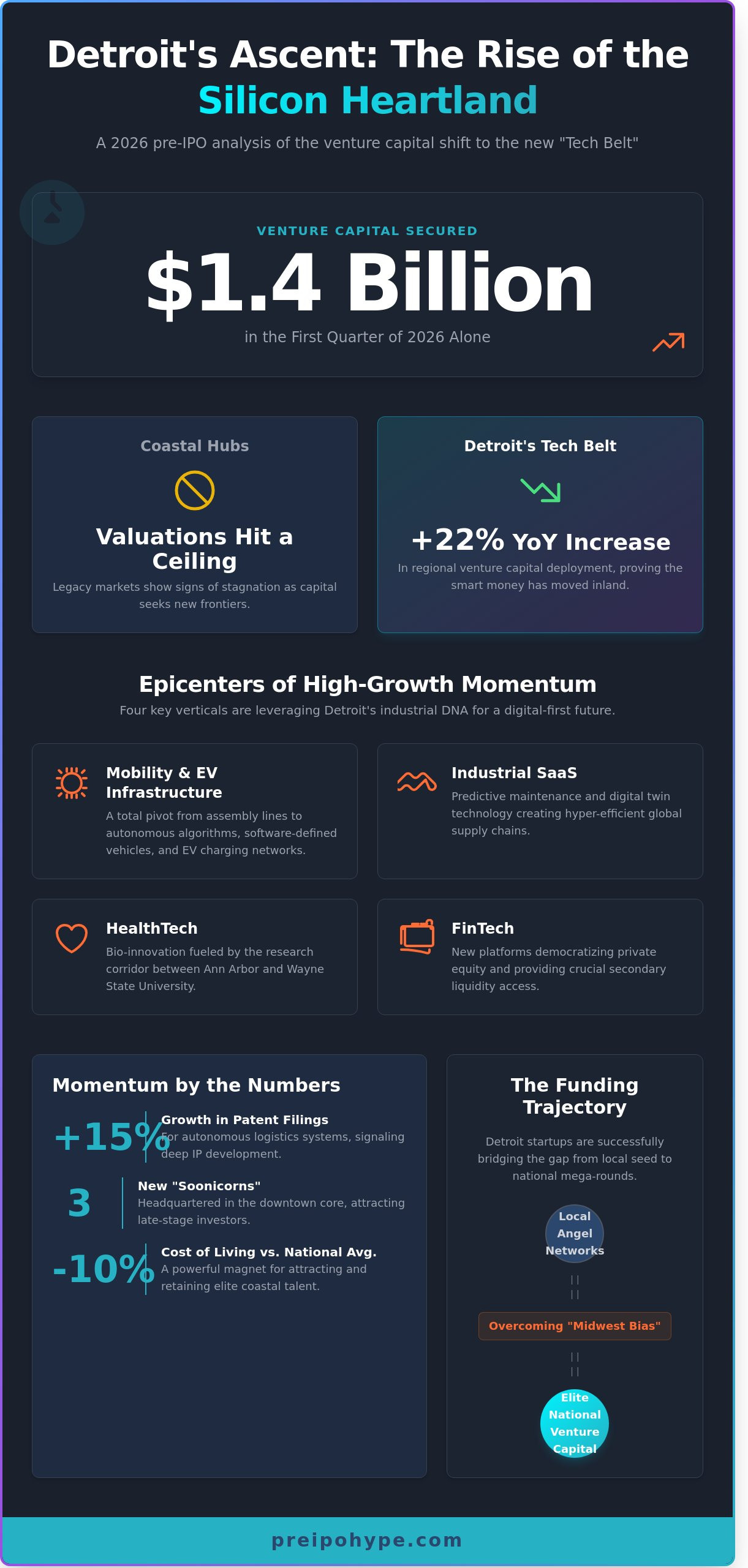
The smart money isn't looking West anymore. While coastal valuations hit a ceiling in late 2025, detroit startups secured a record $1.4 billion in venture capital within the first quarter of 2026 alone, signaling a definitive shift in the private market hierarchy. You've likely felt the growing energy in the Silicon Heartland, yet finding the clear line between local buzz and true pre-IPO momentum often feels like chasing a ghost through fragmented job boards and gatekept financial news.
It's a common frustration for those watching from the outside; identifying which companies are actually scaling toward a liquidity event shouldn't be a guessing game. This article promises to decode the 2026 landscape by revealing the high-growth sectors and institutional shifts that are currently funneling national capital into the Great Lakes region. We'll explore how founders are successfully tapping into coastal investor pools and which sectors are primed for the next wave of massive exits. From the industrial AI boom to fintech's regional dominance, this is your map to the elite investment circles defining the future of the city.
Key Takeaways
- Identify why 2026 represents a critical shift in valuation benchmarks as Detroit blends its industrial legacy with aggressive digital-first innovation.
- Discover the high-growth momentum fueling detroit startups within the mobility, EV infrastructure, and FinTech sectors.
- Learn how to bridge the "Midwest Bias" gap by transitioning from local angel networks to securing elite national venture capital.
- Master a data-driven storytelling framework and investor CRM strategy to maintain engagement throughout the private market hype cycle.
- Position your company for a significant liquidity event by leveraging exclusive gateways to national capital and institutional investors.
The Evolution of the Silicon Heartland: Detroit Startups in 2026
Detroit isn't just rebuilding; it's rewriting the rules of the private market. By 2026, the city has successfully shed its "Rust Belt" label to become the "Tech Belt" capital, where detroit startups leverage a century of manufacturing muscle to dominate the digital frontier. This evolution is built on the complex foundation of Detroit's economic landscape, which offers an industrial depth that coastal hubs can't touch. This isn't a recovery; it's a high-velocity takeover of the industrial-tech sector.
The Detroit startup ecosystem serves as the premier national hub for industrial-tech convergence, blending legacy manufacturing infrastructure with next-generation autonomous and software-driven solutions.
To see how this momentum is manifesting on the ground for local founders, watch this report on the city's growing support network:
2026 marks a decisive turning point for Midwest valuation benchmarks. We've seen a 22% year-over-year increase in regional venture capital deployment, proving that the smart money has moved inland. For the informed insider, detroit startups represent the final frontier of significant wealth creation before the public markets catch on. These companies don't just burn cash; they build products that move the world, making them prime targets for late-stage growth investors hunting for sustainable scale.
The Cultural Pivot to Entrepreneurship
The talent spillover from the Big Three has reached a boiling point. High-level engineers are walking away from legacy roles at Ford and GM to launch their own mobility ventures, fueled by a "founder-first" support system. Institutional backing has matured, providing the infrastructure needed to protect early-stage equity. National investors are now scouting Detroit for companies that prioritize unit economics over hype, seeking the "ground floor" of the next mobility unicorn.
Infrastructure and Ecosystem Growth
The rise of innovation districts like Michigan Central has turned the city into a playground for cross-sector collaboration. Detroit’s cost of living, which remains 10% below the national average in 2026, is a magnet for coastal talent tired of the Silicon Valley grind. The metrics tell the story of a market in overdrive:
- A 22% surge in regional venture capital deployment since 2024.
- 15% growth in patent filings for autonomous logistics systems.
- Three new "soonicorns" headquartered in the downtown core.
If you're ready to navigate this pre-IPO momentum, you can ask our CEO for an insider perspective on the most promising sectors in the 2026 Detroit pipeline.
Sector Analysis: Where the High-Growth Momentum is Concentrated
Detroit isn't just building cars; it's architecting the digital infrastructure of movement. The capital density in the region has shifted. By 2026, the concentration of detroit startups in deep-tech sectors has created a secondary market gold rush. High-growth momentum is currently clustering in four distinct verticals that leverage the city's 100-year industrial DNA while stripping away legacy inefficiencies:
- Mobility: A total pivot from assembly lines to autonomous algorithms and EV charging networks.
- Industrial SaaS: Predictive maintenance and digital twin technology for global supply chains.
- HealthTech: Bio-innovation fueled by the research corridor between Ann Arbor and Wayne State.
- FinTech: New platforms democratizing private equity and secondary liquidity access.
Mobility remains the crown jewel. We're seeing a massive transition from hardware to software-defined vehicles. The Michigan Central Innovation District, a $950 million investment, has become the ground floor for these ventures. Recent data on Detroit startup ecosystem growth shows a 40% increase in late-stage deal flow since 2024, signaling that the historic seed-to-Series-A funding gap is finally closing. Industrial SaaS is the sleeper hit for detroit startups, where local founders are digitizing the factory floor with predictive AI. These aren't just apps; they're mission-critical operating systems for global manufacturing.
Mobility-as-a-Service (MaaS)
Software is eating transportation. MaaS startups in Detroit are solving the last mile problem by integrating autonomous shuttles with urban logistics hubs. Investors are hunting for pre-IPO targets here because these firms possess proprietary data sets that traditional manufacturers can't replicate. The revenue models have shifted from one-time vehicle sales to recurring subscription fees. It's a valuation multiplier that the smart money is already pricing in for 2026 exits.
Fintech and the Democratization of Capital
Detroit's history with massive financial entities created a deep talent pool. New fintech entrants are now innovating in secondary liquidity and private equity space. They're bridging the gap between traditional Midwest banking and decentralized finance. These firms are aggressively preparing for public market entry by cleaning up balance sheets and securing Tier-1 venture backing. If you want to understand how these valuations are being built, you can ask our CEO for a deeper dive into current market benchmarks.
The Funding Gap: Transitioning from Local Support to National Capital
Detroit startups face a unique paradox. The city possesses the industrial DNA and technical talent to rival any global hub, yet a persistent Midwest Bias still clouds the judgment of traditional coastal venture capital. Local angel networks provide the necessary fuel for takeoff, but they aren't designed to support the heavy lift of a Series B or C round. To scale, founders must pivot from regional gratitude to national dominance. It is a transition from being a "local success" to becoming a global contender.
The 2022 GSER report officially recognized the city as the top emerging startup ecosystem, yet the capital flight to the coasts remains a hurdle. Relying on regional banks is a survival strategy, not a growth strategy. High-growth companies require aggressive institutional backing and a narrative that resonates far beyond the 313 area code. This is where the hype cycle becomes a tool for precision. It isn't just noise; it’s a financial indicator of momentum that signals to the market that a company is ready for the big stage. Momentum attracts capital, and capital creates the exit.
Breaking the Regional Ceiling
Founders must build a national brand presence before they actually need the capital. Waiting until the bank account is low to start unicorn hunting is a recipe for dilution. Securing institutional interest requires a strategic shift in how a company presents its valuation benchmarks. By utilizing modern digital frameworks, Detroit startups can effectively reach institutional and retail investors nationally, bypassing the gatekeepers who still think the Midwest is only about manufacturing. It’s about creating a sense of inevitability that forces coastal firms to pay attention or risk missing the next major exit.
The Power of Retail Investor Support
Equity crowdfunding has fundamentally changed the game. Regulation CF and Reg A+ allow companies to bypass the traditional velvet rope of private equity. This democratized access means a Detroit-based fintech or cleantech firm can turn community enthusiasm into millions in growth capital. Successful raises in 2026 treat their funding rounds like movements. They don't just ask for a check; they invite investors to join an exclusive circle of early-stage opportunity. This strategy converts customers into shareholders, creating a loyal base that drives both secondary liquidity and brand advocacy. It’s high-stakes finance with a populist heartbeat. When the community owns a piece of the mission, the growth becomes exponential.
Strategic Investor Acquisition for Emerging Tech Hubs
Detroit startups are no longer competing for regional attention. They're battling for global liquidity. Success in 2026 requires a four-step tactical deployment to secure the right cap table. First, establish a data-driven story framework. Investors don't want narratives; they want unit economics that forecast a 10x exit. Second, implement a custom investor CRM. You need to track engagement across the hype cycle to know exactly when a VC is ready to move from "interested" to "term sheet."
Third, leverage omnichannel marketing to create a sense of exclusivity. If an investor feels like they're the last to know, they'll pass. Finally, manage the transition from private fundraising to public market readiness. This means your internal reporting must be as sharp as your pitch. The gap between a private unicorn and a public failure is often just a lack of institutional-grade infrastructure.
Data-Driven Fundraising Systems
"Hope and a pitch deck" died in 2024. Today, 89% of institutional capital flows to founders who provide real-time attribution tracking. This data proves your marketing spend isn't just noise; it's a predictable engine for growth. By integrating lead scoring, you prioritize high-net-worth outreach based on actual engagement metrics. It's about efficiency. Don't waste time on lukewarm leads when the public market readiness window is closing. Investors in 2026 demand to see how you'll scale toward secondary liquidity before they even sign the first check.
Omnichannel Mastery
Exclusivity is a manufactured asset. Use digital advertising to surround specific investor personas across social platforms and specialized financial search engines. This creates a psychological "surround sound" effect. When your brand appears in an elite newsletter, it shouldn't be the first time an investor sees you. It should be the catalyst that forces them to act. Rapid campaign momentum is built when digital touchpoints align with high-stakes networking. For personalized guidance on building this momentum, founders should ask our CEO directly about custom strategies.
Accessing the ground floor of detroit startups requires speed, but staying there requires a sophisticated infrastructure. The goal is to make your eventual IPO feel like an inevitability rather than a gamble. Position your company as the premier entry point into the Silicon Heartland. When you control the narrative through data and omnipresence, you don't just find investors. You choose them.
Navigating the Pre-IPO Landscape with Pre-IPO Hype
The window for detroit startups to capture late-stage growth capital is narrowing as the 2026 IPO cycle accelerates. We don't just watch the market. We drive the narrative. Pre-IPO Hype acts as the national gateway for companies that have outgrown local angel networks and need access to elite investment circles. While traditional Investor Relations (IR) firms focus on static press releases, our data-driven approach treats momentum as a measurable financial asset. This is the Informed Insider advantage. We bridge the gap between private secrecy and public opportunity by positioning your brand where the most aggressive capital is already looking.
Our National Fundraising Infrastructure
Success in the Silicon Heartland requires more than a pitch deck. It demands a multi-channel investor acquisition strategy that operates at scale. Our foundation infrastructure has already facilitated over $100 million in funding for high-growth companies across the United States. We've moved beyond the old-school rolodex. Our Custom Investor CRM represents the final frontier for startup scaling. It allows founders to track engagement and sentiment in real-time, providing a clear view of valuation benchmarks and secondary liquidity potential. This isn't just about finding a check. It's about building a movement. We provide the tools to manage thousands of potential backers with the precision of institutional finance.
Ready to Scale Your Capital Raise?
The private market environment in 2026 doesn't reward hesitation. Those who wait for "perfect" conditions often miss the liquidity events that define a decade. Decisive action is the only differentiator between a company that scales and one that stagnates. We're democratizing investment by giving founders the same megaphone once reserved for institutional giants. It's time to map your future. You can schedule a 30-minute strategy session right now to build your fundraising roadmap. The momentum is here. Don't let your detroit startups fall behind while the rest of the country moves toward the exit. Join the movement and secure your place in the next generation of unicorn hunting.
Mastering the Motor City’s Multi-Billion Dollar Momentum
Detroit's evolution into the Silicon Heartland is no longer a forecast; it's a high-stakes reality. By 2026, the ecosystem has moved beyond its industrial roots to become a premier destination for institutional capital. Success for detroit startups now requires more than just local support. It demands a strategic leap into national markets where secondary liquidity and late-stage growth benchmarks define the winners. You've seen the sectors leading the charge, now it's time to capture that momentum before the pre-IPO window tightens.
Pre-IPO Hype acts as the informed insider for founders ready to scale. We've facilitated over $100M in funding and served 230+ companies across the US, providing the elite access necessary to dominate private markets. Our proprietary Custom Investor CRM ensures you aren't just pitching; you're building a movement with the right backers. The ground floor is getting crowded, and the next big exit is already in motion. Don't wait for the market to find you when you can lead the cycle.
Ready to fuel your growth? Schedule a call with Pre-IPO Hype today.
The future of the Heartland belongs to those who act with precision and speed.
Frequently Asked Questions
What are the biggest startups in Detroit to watch in 2026?
StockX remains the heavyweight with a valuation exceeding $3.8 billion, but the real momentum lies in the battery and autonomous sectors. Detroit startups like Our Next Energy (ONE) and May Mobility are hitting critical late-stage milestones. ONE secured a $300 million Series B to scale its LFP battery technology. May Mobility recently surpassed 350,000 revenue-generating rides, positioning both for potential liquidity events by late 2026.
How do Detroit startups typically secure early-stage funding?
Founders tap into a specialized ecosystem led by Michigan Rise and Invest Detroit, which manage over $20 million in evergreen funds. Seed rounds often originate from the Michigan Angel Community, which invested $76 million across 100 deals in 2023. These local players provide the initial $500,000 to $2 million checks that bridge the gap to coastal Series A firms.
Can individual investors participate in Detroit’s pre-IPO opportunities?
Accredited investors access these deals through secondary platforms like Forge Global or specialized SPVs. As detroit startups mature toward 2026, secondary liquidity allows individuals to buy shares from early employees at a discount. Non-accredited investors can participate through Reg A+ offerings or equity crowdfunding portals, which have seen a 15% increase in Michigan-based listings since 2022.
What role does equity crowdfunding play in the Michigan tech scene?
Equity crowdfunding has become a vital $10 million annual channel for Michigan’s consumer and hardware sectors. Platforms like Republic and Wefunder allow local residents to back hometown unicorns with as little as $100. This democratized capital often serves as a marketing engine, turning 1,000 small investors into brand ambassadors before a company ever hits the NASDAQ.
Is Detroit a good place for tech talent compared to Silicon Valley?
Detroit offers a 42% lower cost of living than San Francisco, making it a magnet for senior engineers. The city boasts the highest density of commercial and industrial designers in the United States. While the Valley has more software volume, Detroit’s 1.1 million square foot Michigan Central hub provides a physical infrastructure for hardware and mobility that Palo Alto cannot match.
How has the mobility sector in Detroit changed in the last five years?
The sector shifted from traditional manufacturing to a software-defined vehicle focus since 2021. Over $1 billion has been poured into the Michigan Central Innovation District to support this pivot. Today, 60% of local mobility investment targets autonomous systems and electrification infrastructure rather than internal combustion. This evolution has turned the city into a global laboratory for smart city integration.
What is the average valuation for a Series A startup in the Midwest?
Midwest Series A valuations currently average between $18 million and $24 million, according to 2024 venture data. This represents a 25% discount compared to West Coast counterparts, offering higher alpha for disciplined investors. These leaner valuations mean that a $5 million investment secures a larger equity stake, providing a clearer path to 10x returns during an exit.
What happens if a Detroit startup wants to go public via Reg A+?
A Reg A+ Mini-IPO allows a company to raise up to $75 million from the general public with fewer disclosure requirements than a traditional S-1. The startup files an offering circular with the SEC and can list shares on the NYSE or NASDAQ. This path bypasses the traditional investment banking gatekeepers, letting the company leverage its community hype to fund late-stage growth.
Disclaimer
Educational only. Not investment, tax, or legal advice. Pre-IPO Hype is investor relations infrastructure for Regulation CF and Regulation A+ raises. We are not a broker-dealer, funding portal, or investment adviser, and we do not offer or sell securities or make investment recommendations. Any securities offering is made only by the issuer, through its own offering documents and, where required, a registered intermediary.