
Engineering Momentum: The Insider Guide to Pre-Launch Marketing for a Capital Raise in 2026
Capital raises are not won during the live round; they are engineered during the 60-day pre-launch phase. Most founders approach their offering with a hope-and-pray strategy, only to face the crushing silence of a cold start where the ticker sits at zero for weeks. If you're waiting for the launch date to start your outreach, you've already lost the momentum required to close a Tier 2 Regulation A or a $5 million Reg CF round. Success in 2026 requires a sophisticated approach to pre-launch marketing for a capital raise that treats investor interest as a data point to be tracked, scored, and optimized long before any funds change hands.
It's natural to feel overwhelmed by the technical infrastructure needed to score leads or the ambiguity of SEC Rule 163B regarding pre-raise communications. You want a waitlist that isn't just a list of names, but a validated engine of Day 1 conversions. This guide promises to hand you the blueprint for building that infrastructure, from Testing the Waters protocols that validate your valuation to the CRM systems that track every dollar of future ROI. We'll explore how to navigate the current regulatory landscape while building an elite circle of demand that makes your eventual launch feel like an inevitable success rather than a high-stakes gamble.
Key Takeaways
- Understand why the first 48 hours of a raise are won or lost in the 60 days prior, and how to engineer that initial surge of momentum.
- Learn to deploy pre-launch marketing for a capital raise using custom Foundation Infrastructure that tracks every touchpoint of investor interest.
- Navigate the complexities of SEC 'Testing the Waters' rules to gather non-binding indications of interest while staying fully compliant.
- Execute an omnichannel strategy that leverages high-impact newsletter exposure to build a high-intent, scored investor waitlist.
- Master the transition from curiosity to capital by using early engagement data to optimize your advertising spend the moment you go live.
What is Pre-Launch Marketing for a Capital Raise?
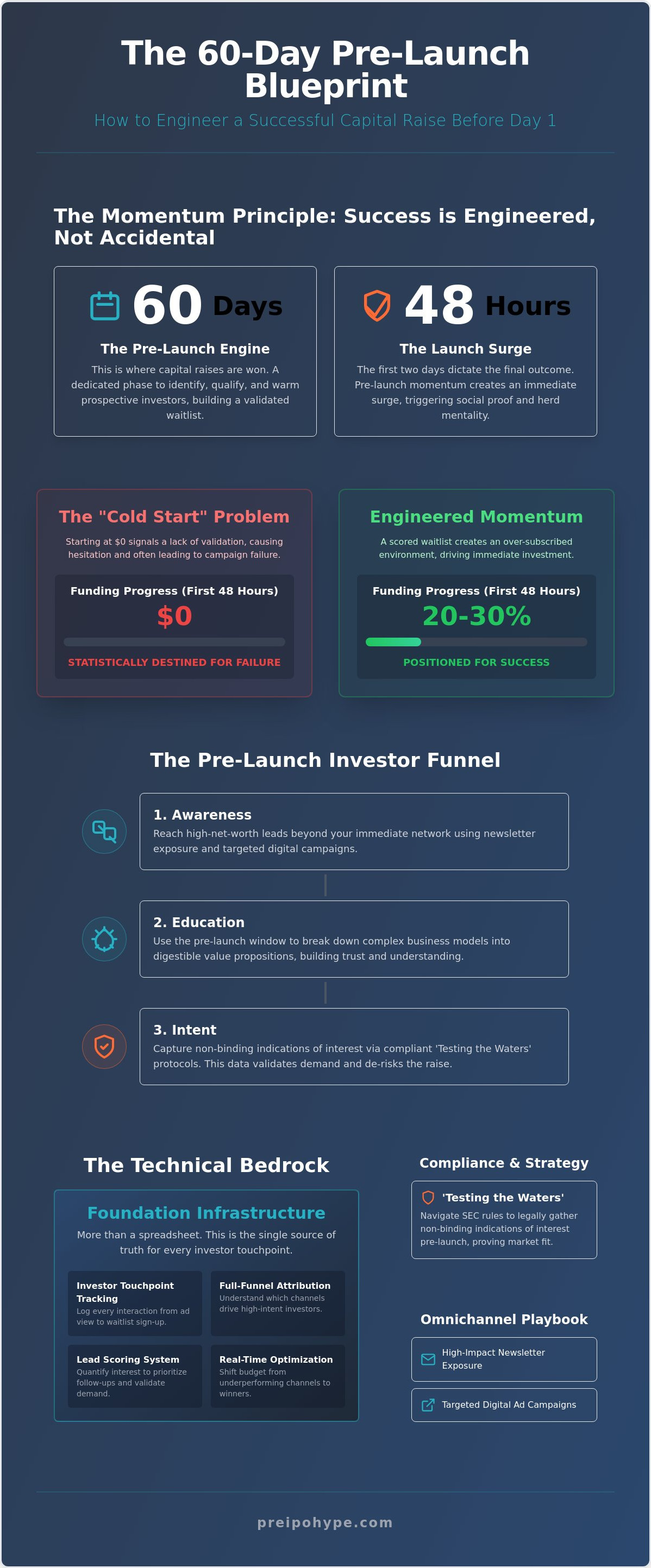
In the high-stakes arena of private equity and crowdfunding, the launch date is a climax, not a starting line. Pre-launch marketing for a capital raise is the calculated process of identifying, qualifying, and warming a massive pool of prospective investors before your offering officially opens. It's the difference between a campaign that explodes out of the gate and one that languishes in obscurity. Industry data indicates that the first 48 hours of a raise typically dictate the final trajectory. If you don't hit 20% to 30% of your goal immediately, the herd mentality that drives retail and institutional interest never kicks in.
This phase isn't about general brand awareness; it's about engineering a technical infrastructure that converts curiosity into committed capital. While understanding seed funding provides the basic context for early capital, modern 2026 raises require a sophisticated "Foundation" phase to de-risk the investment for larger partners. Institutional players need to see a scored waitlist and a validated valuation before they'll commit their own capital to your round.
To better understand this concept, watch this helpful video:
Don't confuse product hype with investor momentum. You can have a million fans of your product who won't spend a dime on your equity. Investor momentum is purely financial. It's the belief that an opportunity is exclusive, rapidly closing, and backed by a crowd of smart money. Pre-launch marketing builds this aura by focusing on the "Testing the Waters" phase, where you solicit non-binding indications of interest to prove your market fit to the SEC and your future cap table.
The 'Cold Start' Problem in Equity Crowdfunding
Campaigns starting at zero are statistically destined for failure. Investors are inherently risk-averse; they follow the crowd rather than leading it. A cold start signals a lack of market validation, causing even interested parties to hesitate. By building a pre-launch waitlist, you create an over-subscribed environment. This social proof acts as a powerful psychological trigger, transforming your raise from a request for money into a rare chance to join an elite movement.
Defining the Pre-Launch Investor Funnel
The funnel begins with Awareness, where you move beyond your immediate network to reach high-net-worth leads through newsletter exposure and targeted digital campaigns. Next is Education, where you use the pre-launch window to break down complex business models into digestible value propositions. Finally, you capture Intent. This is where "Testing the Waters" interest is secured, providing the data needed to scale your fundraising tech stack and optimize your live-round spend.
The Technical Bedrock: Building Your Foundation Infrastructure
A spreadsheet is where momentum goes to die. If you're managing a $75 million Regulation A+ round with a generic sales tool, you're flying blind. Successful pre-launch marketing for a capital raise requires a technical foundation that does more than store email addresses. It must function as a single source of truth for every investor touchpoint. This isn't just about organization; it's about survival in a market where timing is everything. Generic tools fail because they lack the granularity needed for high-stakes finance.
Foundation Infrastructure is the engine of your attribution strategy. If a prospect sees a social ad, reads your newsletter on Invst Guru, and eventually joins the waitlist, your system must track that entire journey. This level of insight allows you to refine your pre-launch marketing plan in real-time. You can shift capital from underperforming channels to those driving high-intent leads, ensuring every dollar of your budget is working toward Day 1 conversions.
Custom Investor CRM: More Than Just a Contact List
Generic CRMs fail the high-stakes requirements of private markets because they aren't built for securities compliance or investor psychology. You need lead scoring to separate retail curiosity from accredited interest. High-net-worth individuals behave differently; they consume technical whitepapers and spend more time on financial performance pages. By automating omnichannel outreach based on these specific triggers, you keep your brand top-of-mind for the right people. A custom investor crm turns curiosity into capital by providing the technical precision needed to nurture elite leads through the entire pre-launch cycle.
Lead Scoring and Engagement Tracking
Identify your "whale" investors early. These are the individuals who will anchor your round and provide the social proof others need to follow. By tracking content consumption patterns, you can flag leads who have downloaded your investor deck multiple times or attended every webinar. This data reveals the velocity of your waitlist growth, which is a critical KPI for campaign health. If growth stalls, your attribution data will tell you exactly where the friction is. You might find that your fundraising tech stack needs a calibration to better capture mobile traffic or cross-platform clicks. If your current setup feels like a liability, it may be time to discuss a technical audit to ensure your infrastructure is ready for the 2026 market.
Compliance and 'Testing the Waters': Navigating SEC Regulations
Compliance isn't a barrier to your raise; it's the framework that protects your momentum. If you trigger an SEC 'gun-jumping' violation before your round goes live, your campaign is dead on arrival. Mastering pre-launch marketing for a capital raise requires a surgical understanding of 'Testing the Waters' (TTW) rules. These regulations allow you to gauge market appetite and solicit non-binding indications of interest long before you file a Form C or a Form 1-A. It's a legal green light to build demand, provided you play by the rules.
Every digital asset must carry mandatory disclaimers. You can't ask for money yet. You can only ask for interest. Failing to include the specific 'no money is being solicited' language in your social ads or landing pages invites regulatory scrutiny that can halt your progress for months. Lock in your compliance protocols and your story framework simultaneously. Your narrative needs to be bulletproof before the first dollar of ad spend leaves your account. This isn't just about legal safety; it's about establishing the professional authority that elite investors expect.
Reg CF vs. Reg A+ Pre-Launch Nuances
The rules change depending on your target cap. Reg CF allows for a more streamlined approach for raises up to $5 million, but it still requires careful management of the 12-month lookback period. Your Reg CF marketing services must adapt as you move from the pre-launch phase into the live round. The goal is to build a massive waitlist without 'conditioning the market' in a way that violates communication safe harbors. It's a delicate balance of creating hype while maintaining strict factual accuracy in all public communications.
The Story Framework: Positioning for Momentum
Your pre-launch phase is the ultimate focus group. Use the feedback from your early waitlist to refine your pitch. If investors are asking the same three questions about your valuation or market share, address them in your formal filing. Position your company as an elite, high-growth opportunity from day one. As you approach the launch, your messaging must shift. You move from the aspirational 'we are raising' to the urgent 'the round is opening.' This transition creates the scarcity needed to turn a waitlist into a flood of Day 1 capital. Don't leave your narrative to chance; engineer it to win.
The Omnichannel Playbook: Multi-Channel Strategies for Waitlist Growth
Omnipresence isn't just a marketing buzzword; it's a financial necessity. To dominate the 2026 private markets, your brand must appear everywhere your target investors live, work, and research. Executing a sophisticated omnichannel approach to pre-launch marketing for a capital raise ensures that your company isn't just a fleeting thought, but a persistent opportunity. This synergy between channels builds the psychological familiarity required for a prospect to move from a casual click to a high-intent, scored lead on your waitlist. You aren't just running ads; you're engineering a movement.
The goal is to build a hype cycle that peaks exactly when the 'Invest Now' button goes live. This requires a synchronized effort where your social media presence, retargeting ads, and high-value content creation all point toward a single realization event. When an investor sees your brand on LinkedIn, encounters a retargeting ad on a financial news site, and then reads a deep-dive analysis in their favorite newsletter, the perceived risk of the investment drops significantly. You've moved from being a stranger to being an industry leader in their eyes.
Paid Media Strategy for Investor Acquisition
Precision targeting is the hallmark of an elite campaign. You must reach institutional and retail investors across LinkedIn, Meta, and Google with tailored messaging that speaks to their specific motivations. Use retargeting to keep your raise top-of-mind during the critical 60-day pre-launch window. If a lead visits your landing page but doesn't join the waitlist, your ads should follow them with social proof and technical milestones. High-performance digital marketing and advertising is the engine of modern fundraising, providing the scale needed to hit your maximum cap.
Strategic Outreach and Newsletter Mastery
Direct access to pre-vetted communities is a shortcut to momentum. Utilizing newsletter exposure through platforms like Invst Guru allows you to tap into a pool of seasoned professionals who are already looking for the next big opportunity. Once they're in your ecosystem, deploy a sequence of high-stakes emails that build urgency and exclusivity. Don't just send updates; tell a story that makes participation feel like joining an elite circle. For those high-scoring leads identified in your CRM, consider direct outreach to address technical concerns and solidify their commitment. To ensure your multi-channel strategy is optimized for maximum conversion, schedule a strategy session to review your current funnel.
A successful pre-launch doesn't happen by accident. It's the result of a calculated, omnichannel playbook that treats every digital touchpoint as an opportunity to build trust. By the time your round officially opens, your waitlist should be so primed that the first 48 hours of funding become a foregone conclusion. This is how you engineer a raise that doesn't just meet its goal but shatters it.
Scaling the Hype: Converting Pre-Launch Curiosity into Capital
Launch day is the moment of truth. The 60 days of meticulous preparation, lead scoring, and data-gathering culminate in a single realization event. Converting curiosity into capital is not a matter of luck; it's the final stage of a calculated engineering process. By the time you flip the switch, your waitlist should be so primed that the transition from 'interested' to 'investor' feels like an inevitable next step. Successful pre-launch marketing for a capital raise ensures that your campaign launches with the 'over-subscribed' aura that institutional and retail investors find irresistible. You've built the demand; now it's time to capture it.
The Foundation phase data is your most powerful tool for the live campaign. You don't guess where to spend your next dollar of ad budget; you know. You look at the attribution models built during the pre-launch and double down on the channels that delivered high-scoring leads. Pre-IPO Hype facilitates this move by providing the technical infrastructure and strategic advisory needed to turn a list of names into a funded reality. This isn't just about finishing a round; it's about building a movement that establishes your company as a dominant force in its sector.
Day One Execution: The Launch Event
On Day One, execution must be flawless. You activate your waitlist through a coordinated omnichannel blast that hits every touchpoint simultaneously. Whether it's an SMS alert, a priority email, or a retargeting ad, the message is clear: the opportunity is now open. You monitor this activity in real-time through your Custom Investor CRM, watching as scored leads convert into reported proceeds. This early funding success creates a massive signal of market validation. You then leverage this momentum to attract secondary and tertiary waves of capital from those who were waiting for proof of traction before committing.
Ready to Engineer Your Raise?
Scaling to a $75 million Regulation A Tier 2 limit or a $5 million Reg CF cap requires more than just a good product. It requires a specialized equity crowdfunding marketing agency that understands the technical and regulatory nuances of the 2026 market. Beyond the immediate round, your investor database remains a high-value asset for future realization events or secondary offerings. If you're ready to move beyond the cold start and engineer $100M+ momentum, the path is clear. Book a strategic session with Jeff 'Fuzzy' Wenzel to map your pre-launch roadmap and secure your place in the next elite investment circle.
Own the Narrative: Your Path to an Over-Subscribed Round
The era of the "cold start" is over. Founders who win in 2026 recognize that pre-launch marketing for a capital raise is the only way to ensure Day 1 velocity. By mastering the Testing the Waters phase and deploying a technical foundation that tracks every investor touchpoint, you transform a risky venture into a calculated realization event. You aren't just looking for donors; you're building a scored, high-intent waitlist that treats your offering as the elite opportunity it is.
Success in the private markets belongs to those who act decisively before the ticker starts. We've facilitated over $100 million in funding and managed successful raises for 230+ high-growth companies using our proprietary Custom Investor CRM for 60-day attribution. Don't leave your capital stack to chance or generic marketing tactics that fail to move the needle. You've engineered a great company. Now, it's time to engineer the funding it needs to dominate the market.
Scale your capital raise with the Pre-IPO Hype Foundation Infrastructure and engineer the momentum your company deserves. Your breakthrough is waiting for you to seize it.
Frequently Asked Questions
Is pre-launch marketing legal for a Reg CF or Reg A+ capital raise?
Yes, pre-launch marketing is entirely legal under specific SEC provisions known as "Testing the Waters." This framework allows issuers to gauge market interest and build a waitlist before officially filing their offering documents. To stay compliant, all communications must include mandatory disclaimers stating that no money is being solicited and no obligation is created. Executing pre-launch marketing for a capital raise is now a standard requirement for founders who want to avoid the stigma of a slow start.
What is 'Testing the Waters' and how does it help my fundraising?
Testing the Waters (TTW) is a regulatory provision that permits companies to solicit non-binding indications of interest from the public. It serves as a vital de-risking mechanism by validating your valuation and messaging before you commit to the costs of a full launch. By gathering these early signals, you can build an over-subscribed waitlist. This ensures that when the round officially opens, you hit the ground with immediate, visible momentum that attracts institutional and retail players alike.
How long should the pre-launch marketing phase last for a startup?
The ideal pre-launch window typically spans 60 to 90 days. This timeframe provides enough room to deploy your technical Foundation Infrastructure and execute an omnichannel warming strategy without losing the audience's attention. Current trends show that fundraising cycles are lengthening, with private equity funds now taking an average of 18 to 24 months to close. Starting your pre-marketing early ensures your brand is omnipresent and high-intent leads are fully nurtured before the first dollar is ever requested.
Do I need a special CRM for investor acquisition during the pre-launch?
Yes, a generic sales CRM is a liability in a high-stakes capital raise. You require a Custom Investor CRM designed to handle the specific attribution needs of private equity and crowdfunding. These systems allow you to score leads based on technical engagement, such as whitepaper downloads or deck views. Without this specialized infrastructure, you can't distinguish between a casual observer and a "whale" investor, making it impossible to prioritize your outreach for maximum Day 1 impact.
Can I mention my valuation during pre-launch marketing for a raise?
You can mention a proposed valuation, but it must be framed as part of your "Testing the Waters" communications. This phase is actually the best time to float your valuation to see how the market reacts. If prospective investors show resistance at your target price, you can adjust your strategy before your SEC filing is finalized. This data-driven approach prevents you from launching an offering that is misaligned with current market appetite, saving your campaign from a public failure.
What happens if I don't build a waitlist before my round goes live?
Without a waitlist, you face the "cold start" problem where your campaign sits at zero for the first several weeks. Investors are inherently social creatures; they follow the crowd rather than leading it. A stagnant ticker signals a lack of market validation, which can cause even interested parties to walk away. Building a massive, scored waitlist ensures you hit significant funding milestones in the first 48 hours, creating the "must-join" aura necessary for a successful raise.
How do I track which marketing channels are bringing in the best investors?
Tracking requires Foundation Infrastructure that captures every digital touchpoint in a single source of truth. You must monitor the entire journey, from an initial LinkedIn click to a newsletter sign-up on Invst Guru. By analyzing 60-day attribution data, you can see which channels produce the highest-scoring leads rather than just the most traffic. This allows you to reallocate your digital marketing and advertising budget to the highest-performing platforms, ensuring every dollar spent contributes to your final funding goal.
Can I target institutional investors during the pre-launch phase?
Yes, SEC Rule 163B specifically permits issuers to communicate with Qualified Institutional Buyers (QIBs) and Institutional Accredited Investors (IAIs) to gauge interest. Institutional players often expect a higher level of operational readiness, including fund administration and compliance reporting. Engaging them during the pre-launch phase allows you to anchor your round with professional capital. This institutional backing acts as a powerful signal to retail investors, accelerating your momentum once the offering moves into the public phase.
Disclaimer
Educational only. Not investment, tax, or legal advice. Pre-IPO Hype is investor relations infrastructure for Regulation CF and Regulation A+ raises. We are not a broker-dealer, funding portal, or investment adviser, and we do not offer or sell securities or make investment recommendations. Any securities offering is made only by the issuer, through its own offering documents and, where required, a registered intermediary.


