
Engineering the Close: Converting Investor Curiosity into Capital in 2026
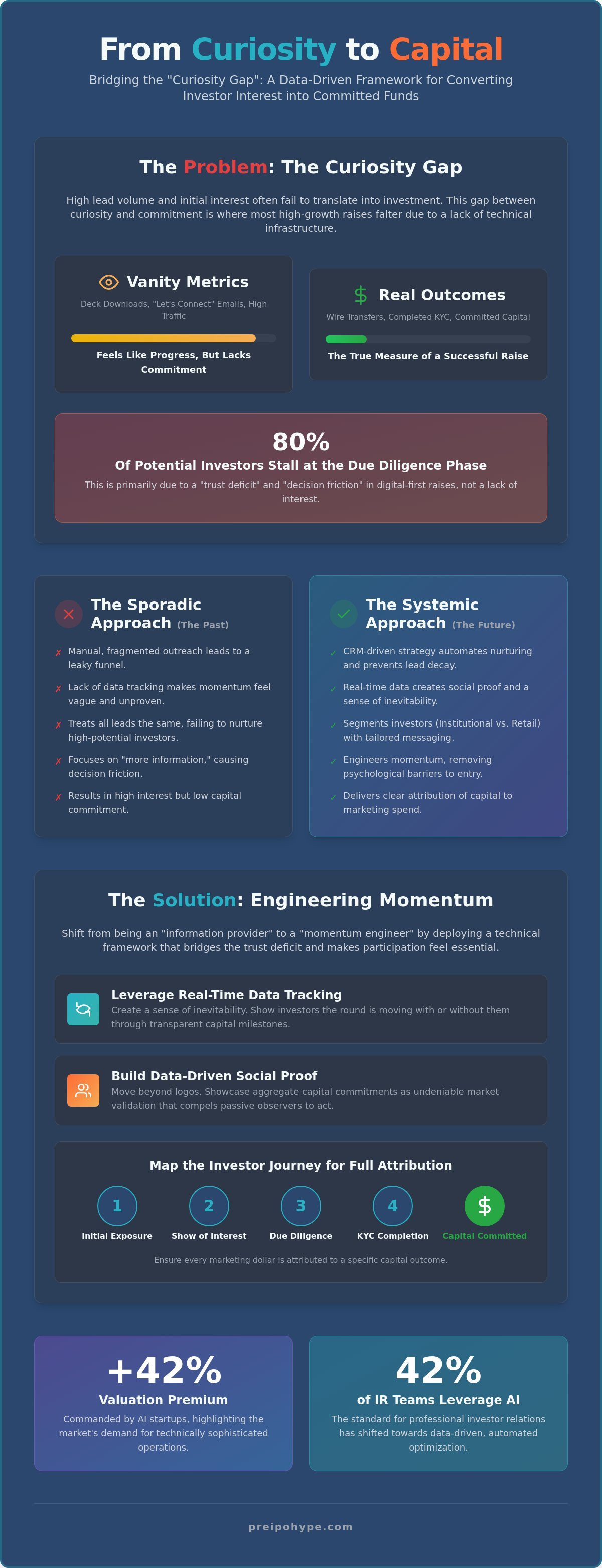
Curiosity is the most expensive vanity metric in your deal room. You've likely seen the surge in deck downloads and the initial flurry of "let's connect" emails, only to watch those leads go cold before the first wire transfer. In a market where AI startups command a 42% valuation premium and the SEC is actively simplifying public float requirements, having eyes on your deal isn't the challenge; it's the bridge between interest and commitment that's broken. Most founders are drowning in high lead volume with zero follow-through because they lack a technical framework for converting investor curiosity into capital.
You know that fragmented investor communications are costing you more than just time; they're costing you momentum. This article promises to hand you the data-driven systems and psychological blueprints needed to transform passive interest into committed capital for your next high-growth raise. We'll explore how to engineer a repeatable closing system, automate your nurturing sequences, and finally achieve clear attribution of capital to your specific marketing spend. It's time to stop guessing which channels drive results and start operating with the precision of an institutional insider.
Key Takeaways
- Identify the "Curiosity Gap" to understand why high interest often fails to translate into committed funds without the right technical infrastructure.
- Leverage real-time data tracking to create a sense of inevitability and social proof that compels passive observers to act decisively.
- Replace manual, sporadic outreach with a systemic, CRM-driven strategy for converting investor curiosity into capital without losing leads to a leaky funnel.
- Map the entire investor journey from initial exposure to KYC completion to ensure every marketing dollar is attributed to a specific capital outcome.
- Discover how implementing Foundation Infrastructure removes the technical friction that typically stalls high-growth raises during critical market windows.
The Curiosity Gap: Why Interested Investors Aren't Writing Checks
The Curiosity Gap isn't just a hurdle; it's the graveyard where most high-growth raises go to die. We define it as the psychological distance between an investor's initial "tell me more" and the final wire transfer. While many founders celebrate a spike in deck views as a win, the hard reality is that hype without technical infrastructure leads to high bounce rates. In the fast-moving world of venture capital, curiosity is a commodity, but capital is a commitment. You don't need more people looking at your deal; you need a way to stop them from looking away.
To better understand this concept, watch this helpful video:
Institutional investors often operate with a "wait-and-see" curiosity, looking for specific de-risking milestones before they commit. Retail investors, conversely, are often driven by "FOMO" curiosity, chasing the next big realization event. Bridging these two requires treating momentum as a measurable financial metric. It's not a vague feeling. It's the velocity at which you move leads through your funnel. Mastering the art of converting investor curiosity into capital requires more than just a great pitch; it requires an engineered system that turns passive interest into an active obligation to participate.
The Psychology of the Passive Observer
Why do 80% of potential investors stall at the due diligence phase? It's rarely a lack of interest. Usually, it's the trust deficit inherent in digital-first equity environments. When an investor feels like just another number in a spreadsheet, they retreat into the safety of non-action. You need to close the gap between being a passive observer and an active participant by creating a narrative of inevitability. The Curiosity-to-Capital ratio is the ultimate KPI for modern founders who want to scale.
Why Education Alone Fails to Close the Round
Industry giants like KKR often argue that more insights and deeper education solve investor hesitation. They're wrong. In high-stakes raises, more information often leads to decision friction, where the investor feels overwhelmed rather than empowered. You don't need to be an information provider. You need to be a momentum engineer. Successfully converting investor curiosity into capital isn't about giving them more homework; it's about deploying a fundraising tech stack that removes the technical and psychological barriers to entry. This shift moves the focus from explaining what you do to demonstrating exactly where the market is going, with or without them.
The Mechanics of Momentum: How Data Bridges the Trust Deficit
Trust in private markets is no longer a byproduct of long lunches and country club handshakes. In 2026, trust is a data-driven commodity. When you deploy real-time tracking, you aren't just watching leads; you're creating a sense of inevitability. Investors need to see that the round is moving with or without them. By utilizing specific investor data, you can transform a cold pitch into a warm, "informed insider" opportunity that feels exclusive yet accessible. This shift in perspective is the secret to converting investor curiosity into capital at scale.
Adopting a data-driven approach to investor relations allows founders to bridge the trust deficit that plagues digital raises. Social proof isn't just a list of logos; it's the aggregate capital milestones that signal market validation in real time. When a curious lead sees that 42% of IR teams are now leveraging AI to optimize these touchpoints, they realize the standard for professionalism has shifted. You're no longer just asking for money. You're inviting them into a movement backed by technical precision and institutional-grade analytics.
Lead Scoring for Private Placements
Not all curiosity is created equal. To succeed in converting investor curiosity into capital, you must distinguish between high-net-worth intent and "tire kickers." Behavioral triggers are your best friend here. A lead who downloads your full data room and attends a deep-dive webinar signals a much higher commitment level than a casual clicker. Identifying "whale" behavior early in the hype cycle allows you to prioritize high-stakes outreach where it actually moves the needle. If you want to see how this scoring looks in practice, you might want to schedule a technical audit of your current investor funnel.
Omnichannel Mastery: Staying Top-of-Mind
The path to a wire transfer is rarely linear. In the current landscape, an investor often requires between 7 and 12 touchpoints before they feel comfortable committing capital. This is why omnichannel mastery is vital. You need a seamless synergy between retargeting ads, automated email sequences, and direct IR outreach. By leveraging an investor acquisition platform, you ensure your narrative stays top-of-mind without becoming a nuisance. This constant, rhythmic pulse of information keeps momentum high and prevents leads from falling through the cracks of a fragmented communication strategy.
Systemic vs. Sporadic: Comparing CRM-Led Outreach to Manual IR
The era of the "spray and pray" pitch is dead. Relying on manual outreach and disjointed spreadsheets is no longer just inefficient; it's a strategic liability. When you manage a raise through sporadic emails and manual follow-ups, you create a "leaky funnel" where curious leads evaporate before they reach the finish line. In 2026, the standard for converting investor curiosity into capital has shifted toward a systemic, technical approach that captures every intent signal with surgical precision.
A custom investor crm acts as the central nervous system for your raise. It maintains the "hype" by ensuring no lead is left in the dark, regardless of where they are in the 60-day attribution window. This 60-day window is the new benchmark for modern fundraising, allowing founders to track the exact journey from the first click to the final KYC completion. Without this level of technical infrastructure, you aren't running a raise; you're running a lottery. You need a system that treats every download as a data point and every delay as a trigger for automated re-engagement.
The Cost of Manual Inefficiency
Consider the logistical nightmare of managing 1,000+ leads in a static spreadsheet. Manual IR fails to capture real-time intent signals, such as an investor re-opening a pitch deck at midnight. By the time you follow up manually, the psychological momentum has vanished. Research shows that 64% of investor relations professionals cite a lack of customization as the top reason for switching CRM systems. For a founder, the psychological impact of this blindness is debilitating. It creates a cycle of uncertainty where you never truly know which marketing channels are driving capital and which are simply burning cash.
Automated Nurturing: The Invisible Closer
High-ticket conversions require a delicate balance of persistence and personalization. Automated nurturing, or "drip hype," keeps curiosity warm even during the necessary quiet periods of a raise. By deploying data-driven messaging tailored to specific investor behaviors, you can move a lead from "interested" to "committed" without manual intervention. This isn't about generic spam. It's about delivering the right technical update or social proof milestone at the exact moment an investor is ready to act. To see how this scales, you can explore our newsletter outreach strategies for broader exposure. Ultimately, automation preserves the founder's most valuable asset: time.
The Conversion Playbook: 60-Day Attribution and Omnichannel Mastery
Social media platforms often treat curiosity as a fleeting sentiment, but in elite capital raises, it's the start of a sophisticated 60-day cycle. You can't rely on a single "viral" moment to close a round. Successfully converting investor curiosity into capital requires a tactical playbook that accounts for the long-tail nature of modern decision-making. If you aren't tracking the journey from the first impression to the final signature, you're leaving your raise to chance. This is where technical execution meets psychological pressure.
- Step 1: Implement foundation infrastructure to ensure every click, download, and view is logged and attributed.
- Step 2: Map the specific trajectory from the initial hype exposure through to the final KYC completion.
- Step 3: Segment your lead pool into active and passive workflows based on real-time behavioral intent signals.
- Step 4: Execute an omnichannel blitz that surrounds high-intent leads with consistent, authoritative messaging across all platforms.
- Step 5: Close the loop with a direct ask, powered by real-time scarcity data that shows the round is nearing capacity.
Mapping the 60-Day Attribution Window
Investors in 2026 take longer to move from initial interest to a final wire transfer. They might discover your deal through a mobile ad on Instagram but won't perform deep-dive due diligence until they are at a desktop three weeks later. This cross-device behavior makes pixel tracking and UTM parameters essential for equity crowdfunding. Without these technical markers, you lose the thread of the narrative. You need to know exactly which touchpoint triggered the final commitment to optimize your spend effectively. Understanding this window is the only way to master the art of converting investor curiosity into capital without wasting resources on dead-end leads.
The 'Invst Guru' Strategy: Leveraging Newsletter Exposure
Third-party validation is the ultimate trust accelerator in a crowded market. By integrating newsletter outreach through high-authority platforms like Invst Guru, you convert skeptical curiosity into institutional trust. Consistent mentions in elite financial circles provide the social proof needed to push a passive observer into the active category. This strategy ensures your deal isn't just another ad; it's a recognized opportunity within the broader market movement. If you're ready to engineer your own momentum machine, schedule a technical strategy session to map your 60-day conversion window.
Beyond the Hype: Scaling Your Raise with Foundation Infrastructure
Fundraising is not a season; it's a scalable business process. At Pre-IPO Hype, we act as the architects of your "Momentum Machine," transforming the chaotic scramble for checks into a predictable engine for growth. By implementing Foundation Infrastructure, you remove the technical friction that stalls most rounds. You move from a position of hoping for interest to a position of demanding commitment. This is the final step in converting investor curiosity into capital, turning the technical bedrock of your raise into a permanent competitive advantage.
The shift from "fundraising" as an isolated event to "investor acquisition" as a repeatable process is what separates elite founders from the rest of the pack. When you treat capital as an input rather than a lucky break, you gain the leverage to dictate terms. The infrastructure we build ensures that every lead is nurtured with the same precision as a Fortune 500 sales funnel. You've already built the vision; now it's time to build the machine that funds it.
The Founder-to-CEO Evolution
Adopting a systemic approach allows you to step out of the weeds of manual investor relations. When your acquisition engine is automated, you can focus on scaling actual operations while capital flows in the background. A proprietary investor database isn't just for today's raise; it's the foundation for your Series B and every future realization event. Considering that 64% of IR professionals cite a lack of customization as their top reason for switching CRM systems, starting with a tailored solution is non-negotiable. If you're ready to evolve your approach, Consult with the Informed Insiders at Pre-IPO Hype.
Executing the Elite Capital Raise
The 2026 market is unforgiving to those who rely on stories alone. With AI adoption in investor relations jumping to 42% this year, the technical bar has been raised significantly. You need a rigorous checklist to ensure your first $1M in curiosity actually reaches the bank. This involves more than just a pitch; it requires a total commitment to data integrity and momentum engineering.
- Confirm all UTM parameters are firing across omnichannel touchpoints.
- Verify your 60-day attribution window is capturing cross-device intent accurately.
- Ensure your Custom Investor CRM is scoring leads for immediate, high-stakes follow-up.
- Transition the narrative from "providing information" to "closing capital."
Stop managing curiosity and start engineering commitment. Elite investment circles are now accessible to those who act with technical authority and decisive momentum. Schedule your fundraising strategy session today and finalize your path to converting investor curiosity into capital.
Master the Inevitable Momentum of 2026
Curiosity is a liability, but capital is the result of engineered momentum. You've seen how the Curiosity Gap acts as a silent killer for high-growth raises and why Foundation Infrastructure is the only technical cure. By bridging the trust deficit with real-time analytics and proprietary 60-day attribution tracking, you transform a fragmented list of leads into a focused, committed capital base. We don't just provide insights; we build the systems that drive results.
With over $100M in funding facilitated and 230+ companies scaled, we know exactly what it takes to stop the bleed in your deal room. The market is moving fast, and the tools of the past won't secure the wins of the future. It's time to stop managing interest and start converting investor curiosity into capital with institutional precision. The gated world of elite finance is open to those who act with technical authority.
Schedule your fundraising strategy session today and take the first step toward a fully automated, high-velocity raise. Your future milestones are waiting for the capital they deserve.
Frequently Asked Questions
How do you define the difference between investor curiosity and actual intent?
Intent is defined by specific behavioral triggers that indicate a readiness to commit, such as multiple data room logins or starting the KYC process. Curiosity is merely passive interest, like a single deck download or a social media click. Distinguishing between the two allows you to prioritize high-net-worth leads who are actually capable of converting investor curiosity into capital before the round closes.
Why is 60-day attribution critical for equity crowdfunding campaigns in 2026?
The 60-day window accounts for the complex, cross-device journey modern investors take before signing a subscription agreement. In 2026, a lead might discover your raise on a mobile device but won't execute due diligence until they are at a secure desktop weeks later. Attribution ensures you don't misidentify which marketing channel actually drove the final wire transfer, allowing for surgical optimization of your acquisition spend.
Can a standard sales CRM work for converting investor curiosity into capital?
Standard sales CRMs often fail because they aren't built to handle the unique regulatory requirements and momentum-driven workflows of a private placement. A Custom Investor CRM tracks specific investor behaviors and capital milestones that a generic tool would miss. It's the difference between managing a sales pipeline and engineering an elite capital raise where every data point serves the narrative of inevitability.
What is the average conversion rate from a lead to a committed investor in Reg CF?
While specific rates fluctuate based on sector and traction, the industry focuses on the "Curiosity-to-Capital" ratio as the primary performance indicator. High-performing campaigns often see a significant lift when they move from sporadic outreach to a systemic, infrastructure-led approach. Success isn't just about high lead volume; it's about how many of those curious observers move through the technical funnel to become committed shareholders.
How does omnichannel outreach impact the cost of investor acquisition?
Omnichannel strategies actually lower the overall cost of acquisition by reducing the time required to bridge the trust deficit. By surrounding a lead with consistent, authoritative touchpoints across email, social, and newsletters, you reach the necessary 7 to 12 impressions faster. This rhythmic pulse of information keeps momentum high and prevents the expensive lead decay that happens during manual, fragmented follow-up cycles.
What are the most common mistakes founders make when trying to close curious investors?
The most frequent error is treating fundraising as a one-time event rather than a scalable business process. Founders often fail to capture intent signals in real time, allowing hot leads to cool down during manual spreadsheet updates. Another common pitfall is providing too much educational data, which creates decision friction, instead of focusing on the momentum and scarcity that actually drive a close.
Is it possible to automate the investor relations process without losing the personal touch?
Automation actually enhances personalization by allowing you to deliver data-driven messages tailored to an investor's specific behavior. When a system sends a targeted update based on a deck re-opening, it feels like an insider tip rather than a generic blast. This "drip hype" maintains the infectious energy of the opportunity while preserving the founder's time for high-level strategic negotiations and final closes.
How does newsletter exposure accelerate the curiosity-to-capital timeline?
Newsletter exposure through platforms like Invst Guru provides the third-party validation that skeptical investors demand in 2026. This high-authority mention acts as a trust bridge, moving leads from the "passive curiosity" phase into the "active intent" category much quicker than direct ads alone. It positions your raise within an elite financial context, making the act of converting investor curiosity into capital a natural progression of market momentum.
Disclaimer
Educational only. Not investment, tax, or legal advice. Pre-IPO Hype is investor relations infrastructure for Regulation CF and Regulation A+ raises. We are not a broker-dealer, funding portal, or investment adviser, and we do not offer or sell securities or make investment recommendations. Any securities offering is made only by the issuer, through its own offering documents and, where required, a registered intermediary.


