
Equity Crowdfunding Compliance: A Marketing Checklist for Founders
A compliant raise takes more than a strong campaign. For founders, equity crowdfunding compliance means understanding the offering rules and keeping investor communications consistent with required disclosures.
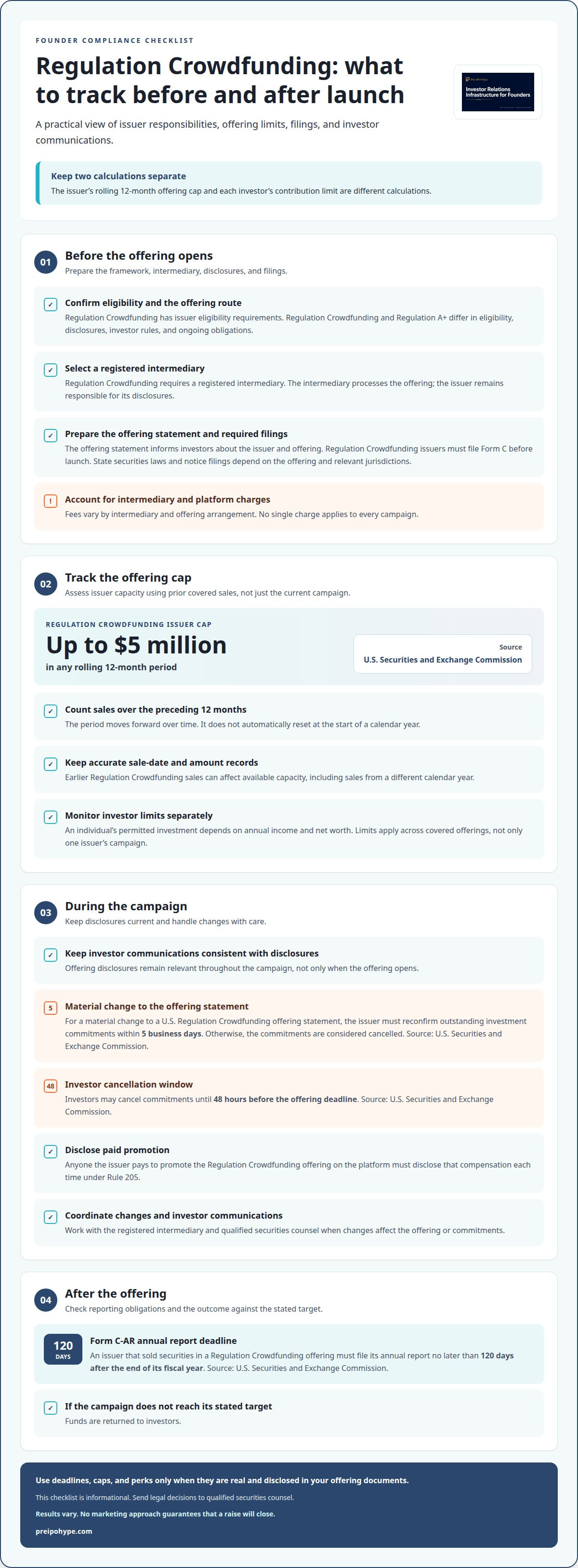
It’s reasonable to want a clear view of the process before marketing begins. This article explains how Regulation Crowdfunding works, how its offering limit is calculated over a rolling 12-month period, when issuers file Form C-AR, and where a broker-dealer may fit. According to the U.S. Securities and Exchange Commission, an issuer that sold securities in a Regulation Crowdfunding offering must file its annual report no later than 120 days after the end of its fiscal year.
Marketing has compliance boundaries, too. Under Rule 205 of Regulation Crowdfunding (17 CFR 227.205), the issuer must take reasonable steps to make sure anyone it pays to promote the offering in the platform’s communication channels discloses the payment with every communication. Outside those channels, paid promotion is limited to the notices Rule 204 allows. The issuer should run any paid promotion past qualified securities counsel and its registered intermediary. The sections ahead distinguish the issuer’s responsibilities from the intermediary’s role, so founders can see how campaign planning and securities compliance intersect. Results vary. No marketing approach guarantees that a raise will close.
Key Takeaways
- Understand how Regulation Crowdfunding gives eligible companies a route to offer securities to both accredited and non-accredited investors.
- Learn how prior securities sales factor into the rolling 12-month offering limit and why the total must be tracked carefully.
- Know when an issuer’s annual report is due after a Regulation Crowdfunding offering and what ongoing reporting involves.
- Distinguish the registered intermediary’s role from a broker-dealer’s possible involvement, and understand the disclosure requirement when the issuer pays someone to promote the offering on the platform under Rule 205.
- Use deadlines, caps, and investor perks only when they are real and disclosed in your offering documents.
What is equity crowdfunding?
Equity crowdfunding lets a company offer securities to investors online. In the United States, Regulation Crowdfunding and Regulation A+ provide distinct routes for raising capital from the public.
Regulation Crowdfunding requires a registered intermediary and an offering statement that informs investors about the issuer and the offering. Those disclosures remain relevant throughout the campaign, not just when the offering opens.
Investor Contribution Limits
Regulation Crowdfunding investor limits restrict how much an individual may invest across covered offerings during a 12-month period. The calculation depends on annual income and net worth, and the applicable formula changes based on those financial measures.
For founders, these limits affect how commitments are accepted and monitored through the registered intermediary. They apply to investors, not the issuer’s total offering cap, so keep the calculations separate. The investor limit also applies across covered offerings, not just to one company’s campaign.
Investor Protections and Accreditation Criteria
Investor protections under Regulation Crowdfunding include issuer disclosures and limits on individual investments. Accredited investor status is generally assessed using income or net-worth criteria; non-accredited investors may also participate, subject to applicable limits. When coordinating checks and managing administrative workflows for participating organizations, teams can streamline intake with tools like cateno.ai, which provides customizable workflows for onboarding any entity.
Regulation A+ also allows non-accredited investors to participate, subject to the offering’s requirements. The two routes differ in eligibility, disclosure, and ongoing obligations. Founders should work with qualified securities counsel to assess which framework fits their company and intended investor base.
Campaign Filings, Fees, and Launch Steps
Campaign filings, platform charges, and launch planning cover the documents, costs, and sequence involved in preparing an offering. State securities laws and notice filings depend on the offering and relevant jurisdictions. Qualified securities counsel can identify the issuer’s obligations.
Platform fees vary by intermediary and offering arrangement, so no single charge applies to every campaign. Before launch, understand the applicable charges and account for them in planning.
A compliant launch generally involves selecting an exemption and registered intermediary, preparing disclosures, completing required filings, and opening the offering. Regulation Crowdfunding issuers must file Form C before launch. Paid promotion also carries the disclosure obligation described earlier.
Regulation CF and Regulation A+ differ in offering requirements, disclosures, and investor rules. The appropriate route depends on the issuer’s circumstances, the securities offered, and its capacity to meet ongoing obligations.
If there is a material change to the terms of a Regulation Crowdfunding offering or to the information the issuer provided, the intermediary must notify investors who have made commitments that the commitment will be cancelled unless the investor reconfirms it within five business days of receiving the notice, under 17 CFR 227.304. An amendment can affect commitments already made, not just future decisions.
Investors may cancel their commitments until 48 hours before the offering deadline, under 17 CFR 227.304. If a Regulation Crowdfunding campaign does not reach its stated target, funds are returned to investors. Issuers should coordinate changes and investor communications with the registered intermediary and qualified securities counsel.
Regulation Crowdfunding offering limits and rolling 12-month calculation
The issuer cap and each investor’s limit are separate calculations. Both shape how a Regulation Crowdfunding offering is planned and monitored.
Offering Eligibility and Fundraising Limits
Regulation Crowdfunding eligibility and limits define which issuers can use the exemption and how much they may offer. In the United States, Regulation Crowdfunding permits an issuer to raise up to $5 million in any rolling 12-month period, under 17 CFR 227.100. The JOBS Act established the framework for eligible companies to raise capital through this exemption.
The investor limit is distinct from the issuer’s cap. For an individual, the permitted investment depends on annual income and net worth, and the applicable calculation depends on whether either measure falls below the relevant threshold. Commitments across covered offerings matter, not just an investment in one issuer’s campaign.
This distinction matters when planning a campaign. A company should not treat its maximum offering amount as a target that every investor can contribute individually. A registered intermediary processes the offering, while the issuer’s disclosures explain the security and its terms. Work with qualified securities counsel on eligibility and offering requirements.
Rolling 12-Month Limit Calculation
A rolling 12-month calculation counts securities sold during the preceding 12 months when assessing the issuer’s available Regulation Crowdfunding capacity. The period moves forward over time, rather than resetting automatically at the start of a calendar year. The U.S. Securities and Exchange Commission states the offering cap; earlier covered sales remain relevant to the calculation.
For example, an issuer considering a new offering should account for securities already sold under Regulation Crowdfunding during the preceding 12 months. A prior sale can affect how much capacity remains, even if it occurred in a different calendar year. Accurate records of sale dates and amounts help the issuer and its registered intermediary assess the aggregate.
Regulation CF securities generally cannot be resold for one year, subject to limited exceptions, under 17 CFR 227.501. This restriction concerns transfers after purchase, not the issuer’s rolling offering calculation. Founders should account for both rules when explaining the security and the timeline to investors.
Broker-dealer research reports are separate from the issuer’s offering disclosures. Broker-dealer research reports follow their own FINRA rules, such as FINRA Rule 2241. A research report does not replace the issuer’s filing or disclosure obligations.
Use deadlines, caps, and investor perks only when they are real and disclosed in your offering documents. Qualified securities counsel can help founders assess the legal treatment of earlier sales and proposed offering communications.
Annual reporting on Form C-AR
Form C-AR is the annual report used by issuers that have sold securities through a Regulation Crowdfunding offering. Under 17 CFR 227.202, a U.S. issuer that sold securities in a Regulation Crowdfunding offering must file its annual report no later than 120 days after the end of its fiscal year.
The filing keeps investors informed after a campaign ends. It is a continuing disclosure obligation, separate from the offering statement and campaign updates. Completing a raise does not, by itself, end reporting.
Investors should be able to review current information about the company, its operations, financial condition, and risks. Regulation Crowdfunding disclosures also cover officers, directors, and owners with significant stakes. Annual reporting helps investors compare what the issuer described during the offering with its later position.
Founders can use the fiscal year-end as the starting point for an internal reporting process. Assign responsibility for gathering financial and operational updates, reviewing changes since the prior disclosure, and preparing the annual report for filing. Coordinate the reporting calendar with the issuer’s finance team and qualified securities counsel, who can advise on required content and filing decisions.
A report should present material company developments clearly, rather than read like a promotional recap. If operations or risks have changed since the offering, for example, the annual disclosure should give investors a factual account. Consistent language across investor communications and formal filings helps prevent campaign messaging from conflicting with later company reporting.
Annual reporting generally continues while securities issued under Regulation Crowdfunding remain outstanding, subject to specified conditions for ending the obligation. Since those conditions depend on the issuer’s situation and filing history, founders should have qualified securities counsel assess whether reporting can stop. Keep records of filed reports and the basis for any conclusion that the duty has ended.
Tax reporting is a separate process. Tax filings do not replace the Form C-AR, so confirm the issuer’s tax reporting duties with a qualified tax adviser.
For startups, a useful reporting workflow connects finance records, business updates, risk disclosures, and investor communications. Track each item’s owner and status, then prepare consistent information for the issuer’s registered intermediary and counsel. This keeps post-campaign reporting distinct from marketing and gives investors a clearer account of the issuer after the offering.
Broker-dealer involvement in equity crowdfunding
Broker-dealer involvement matters because Regulation Crowdfunding requires a registered intermediary for each offering. The U.S. Securities and Exchange Commission says each offering must run exclusively through one online platform operated by an intermediary registered with the SEC and FINRA as a broker-dealer or funding portal. The platform is part of the regulated offering structure, not simply an advertising channel.
A funding portal and a broker-dealer are distinct types of registered intermediary. Under Regulation Crowdfunding, either may operate the required platform. The issuer should understand which intermediary handles the offering and keep its marketing activity separate from the intermediary’s regulated role. Work with qualified securities counsel on legal decisions about these roles.
For Regulation A+, engaging a broker-dealer is not required under the exemption, though one may still participate in an offering. If a broker-dealer is involved, it must file with FINRA, and that information must be disclosed in the offering circular filed with the SEC. The issuer’s offering documents should accurately reflect the broker-dealer’s role.
Broker-dealer research is distinct from an issuer’s campaign materials. Funding portals are barred from offering investment advice or recommendations. A research report does not replace the issuer’s required disclosures. Do not present issuer promotional content as independent broker-dealer research.
Marketing communications require their own controls. As noted earlier, Rule 205 requires anyone paid by the issuer to promote a Regulation Crowdfunding offering on the platform to disclose that compensation each time. The issuer should coordinate paid promotion with its registered intermediary and qualified securities counsel.
Keep responsibilities distinct: the issuer prepares and maintains accurate offering information, the registered intermediary operates the platform, and paid promoters follow applicable disclosure requirements. For example, an issuer’s campaign post should not imply that the platform or a broker-dealer endorses the offering. Clear attribution helps investors understand who is communicating and in what capacity.
Before fundraising begins, founders can map each activity to the responsible party: platform operation, offering disclosures, broker-dealer participation, and paid promotion. Then align campaign content with filed offering materials and the intermediary’s process. This division helps prevent confusion between capital-raising communications and registered securities activity. Qualified securities counsel handles legal determinations.
Pre-IPO Hype
Pre-IPO Hype / FWSC is a marketing agency, not a broker-dealer or investment adviser. We do not sell securities or take a percentage of any raise. We are not a funding portal and do not make investment recommendations.
For founders preparing an offering, Pre-IPO Hype provides campaign support alongside the issuer's registered intermediary and qualified securities counsel. Investor relations and marketing campaigns help organize how the issuer communicates offering information throughout its campaign. Keep content consistent with filed disclosures, accurately describe the offering, and avoid implying endorsement by the intermediary or a broker-dealer.
For legal decisions about eligibility, filings, or promotional rules, work with qualified securities counsel. For campaign support, contact Pre-IPO Hype.
Build a disciplined path from campaign to company communications
Use the next planning stage to assign clear ownership for offering communications, investor updates, and ongoing reporting. A consistent process keeps campaign materials connected to the issuer’s formal disclosures as the company evolves. Qualified securities counsel can assess how the issuer’s circumstances affect its legal obligations.
Marketing planning is most useful when it matches the company’s operating capacity. Consider who will maintain accurate information, coordinate reviews, and manage investor communications after the offering opens. For founder-led organizations managing these operational demands, advisory resources like foundedpartners.com offer specialized consulting and transaction guidance. This makes equity crowdfunding compliance part of the company’s broader governance approach, not a task limited to launch preparation.
Results vary. No marketing approach guarantees that a raise will close.
With clear responsibilities and qualified counsel, founders can proceed with greater clarity and care.
Frequently Asked Questions
What is equity crowdfunding and how does it work in the United States?
It is a securities offering made to investors online under an available exemption. In practice, founders prepare the offering information, work with the registered intermediary operating the platform, and communicate with prospective investors through permitted channels. Investors review the issuer’s disclosures and decide independently whether to participate. The company remains responsible for accurate statements in its campaign materials and formal offering documents.
What are the SEC rules for Regulation Crowdfunding (Regulation CF)?
Regulation Crowdfunding rules govern issuer disclosures, intermediary platforms, investor limits, communications, and ongoing reporting. The SEC’s Regulation Crowdfunding: Guidance for Issuers discusses these subjects, including advertising and promotion limits, resale restrictions, and bad actor disqualification. Campaign materials should be coordinated with the filed offering information. For paid promotion on the platform, follow the Rule 205 disclosure requirement described earlier in the article.
What are the issuer eligibility requirements for a Regulation Crowdfunding offering?
An issuer must qualify to use the exemption and provide required information about its business, finances, risks, and management. Eligibility also involves reviewing whether specified disqualifying events apply to the issuer or other covered persons. The assessment is not limited to the company’s current officers: ownership and control relationships may matter. Qualified securities counsel can evaluate the issuer’s circumstances before it proceeds.
What are the funding portal and broker-dealer registration requirements?
A Regulation Crowdfunding offering uses an online platform operated by an intermediary registered with the SEC and FINRA as a broker-dealer or funding portal, according to the U.S. Securities and Exchange Commission. These intermediary categories have different roles, so founders should identify which one operates their offering platform. Running campaign communications does not make the issuer the registered intermediary.
What are the ongoing reporting requirements after a Regulation CF offering?
Issuers that sold securities through Regulation Crowdfunding generally continue annual reporting unless an applicable termination condition is met. A U.S. issuer that sold securities in a Regulation Crowdfunding offering must file its annual report no later than 120 days after the end of its fiscal year. Reporting status depends on the issuer’s circumstances and filing history. Keep governance and finance records organized so required disclosures can be prepared consistently with company operations.
What are the penalties and legal risks of noncompliance with equity crowdfunding rules?
Noncompliance can create offering, disclosure, and reporting risks, with consequences depending on the facts and applicable rules. Specified disqualifying events can make an issuer ineligible to rely on the exemption. A material change to an offering statement also requires timely investor reconfirmation under the rule. If an error may have occurred, consult qualified securities counsel about its significance and the appropriate response, rather than relying on marketing guidance.
Disclaimer
Educational only. Not investment, tax, or legal advice. Pre-IPO Hype is investor relations infrastructure for Regulation CF and Regulation A+ raises. We are not a broker-dealer, funding portal, or investment adviser, and we do not offer or sell securities or make investment recommendations. Any securities offering is made only by the issuer, through its own offering documents and, where required, a registered intermediary.