
Reg A+ Investor Outreach Campaign Guide
A compelling business case matters more than a large audience. Regulation A+ is a U.S. offering framework with Tier 1 and Tier 2 pathways; according to the U.S. Securities and Exchange Commission, issuers file an offering statement on Form 1-A. A Regulation A+ investor outreach campaign should explain the company’s business clearly and keep its communications aligned with the offering.
It’s understandable to focus first on reach. But outreach works only when prospective investors can also understand what the company does and why its offering may interest them. This guide explains how Regulation A+ works, how campaign outreach and business appeal fit together, and which common mistakes can weaken a campaign.
You’ll get a practical overview of the process, including how to shape messaging around the issuer’s business and handle campaign communications carefully. Results vary, and no marketing approach guarantees that a raise will close.
Key Takeaways
- Understand the two Regulation A+ tiers and how investor eligibility can shape outreach.
- Identify the business-model details that help prospective investors assess an issuer’s appeal.
- Spot campaign missteps that can undermine clear, credible communication.
- Learn how advertising and solicitation fit into the offering process, including the role of the issuer’s qualified securities counsel and, if it uses one, its broker-dealer.
- See how coordinated campaign support can keep the issuer’s messaging consistent across outreach channels.
1. Marketing capabilities and investor outreach
A Reg A+ investor outreach campaign combines issuer messaging, audience education, and a clear path to the offering. Regulation A+ can reach accredited and non-accredited investors, so communications should explain the company’s business without assuming every reader has the same investment background. The U.S. Securities and Exchange Commission describes one individual accredited investor test using income exceeding $200,000 in each of the two most recent years, or joint income with a spouse or spousal equivalent exceeding $300,000 in each of those years, with a reasonable expectation of reaching the same level in the current year. The U.S. Securities and Exchange Commission also describes a net-worth test of individual or joint net worth with a spouse or spousal equivalent exceeding $1 million, excluding the value of the person's primary residence. Other tests exist, including certain professional licenses. See the SEC's accredited investor page.
Those thresholds help explain one audience distinction, but they don’t replace campaign planning. A message for prospective investors should identify the issuer, describe its business model, and direct readers to the issuer’s offering page or, if the issuer uses one, its broker-dealer. For example, a company selling a physical product can explain how it serves customers, earns revenue, and works toward business milestones. Claims should match the offering materials, not a more optimistic version created for an advertisement.
Unlike private-offering campaigns, Regulation A+ outreach is designed for a public offering and can address a broader investor audience. Campaign teams should not assume that another exemption’s eligibility rules or communication approach applies. The issuer’s securities counsel can assess the rules for its specific offering and advise on legal decisions. A Regulation A+ issuer is not required to use a registered intermediary. Some issuers sell directly and others engage a broker-dealer.
A practical campaign starts with the issuer’s approved offering information. The team turns it into consistent content for channels such as email, social media, and webinars. Each asset should explain one useful point, such as the company’s product, customer problem, or operating plan. Then direct interested readers to the issuer’s offering page or, if the issuer uses one, its broker-dealer, where offering details are presented. Engagement data can show which messages prompt questions or page visits, but attention is not a commitment to invest.
State requirements can differ by Regulation A+ tier. Tier 1 issuers must comply with state Blue Sky laws; qualified securities counsel can determine the filings and other obligations that apply to the issuer’s offering. A national audience does not remove the need to consider the offering’s tier and state-law requirements.
Campaign and legal expenses cover different work. A campaign budget may include strategy, content production, advertising, channel management, and performance analysis. Legal expenses relate to offering preparation and securities-law review. These are separate workstreams, with scope depending on the issuer’s materials, channels, and legal needs. Qualified securities counsel should advise on legal decisions, while outreach planning keeps communications consistent with the offering.
To build the campaign, first define the issuer’s business story and intended audience. Align each message with the offering materials, and have counsel review legal questions. Then prepare channel-specific content and a clear route to the offering page. Finally, monitor engagement and refine messages for clarity, keeping every public claim accurate and consistent.
2. Business model and investor appeal
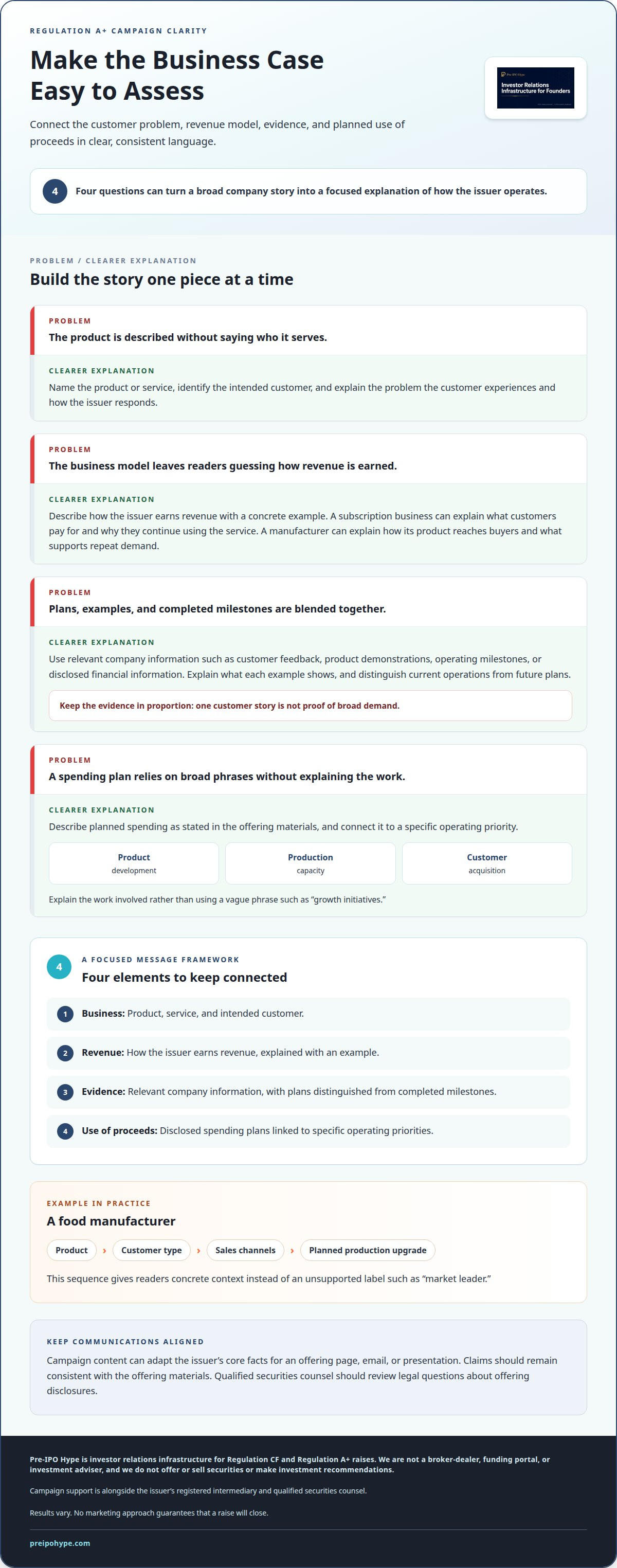
Investors need a clear account of how the issuer operates. A useful explanation connects the product to customers, revenue, and the company’s plans. For example, a software company might describe who uses its platform, what problem it addresses, and how subscriptions generate revenue. This gives readers a basis for understanding the business instead of relying on broad claims about future potential.
Start with the customer problem: explain who experiences it and how the issuer’s product or service responds. Then describe the revenue model in plain terms. A subscription business, for instance, can explain what customers pay for and why they keep using the service. A manufacturer can show how its product reaches buyers and what supports repeat demand. Keep each claim consistent with the issuer’s offering materials.
Next, connect the business model to evidence. Relevant examples might include customer feedback, product demonstrations, operating milestones, or disclosed financial information. Explain what each example shows, and don’t present one customer story as proof of broad demand. If the issuer discusses a planned expansion, distinguish current operations from future plans. Clear distinctions help readers assess the opportunity without confusing projections with completed results.
Investors may also consider how the issuer intends to use proceeds, as described in its offering materials. Campaign content can explain how planned spending relates to business priorities, such as product development, production capacity, or customer acquisition. Give each use a specific operational purpose. Avoid vague phrases such as “growth initiatives” without explaining the work involved. The issuer’s qualified securities counsel should review legal questions about offering disclosures.
A practical messaging framework keeps the story focused:
- Business: Name the product, service, and intended customer.
- Revenue: Explain how the issuer earns revenue, using a concrete example.
- Evidence: Support claims with relevant company information and distinguish plans from completed milestones.
- Use of proceeds: Connect disclosed spending plans to specific operating priorities.
For example, a food manufacturer could explain its product, identify the type of customer it serves, describe its sales channels, and outline a planned production upgrade. That sequence is more useful than calling the company a “market leader” without supporting context. A Reg A+ investor outreach campaign can adapt those core facts for an offering page, email, or presentation while keeping the issuer’s explanation consistent.
Before campaign materials go live, compare each claim with the issuer’s offering documents. Remove unsupported superlatives, explain unfamiliar terms, and distinguish current operations from future plans. This review helps the issuer present a coherent business case across channels.
3. Common Reg A+ campaign mistakes
A frequent mistake is letting promotional copy drift from the issuer’s offering materials. An advertisement might describe a planned product launch as completed, or present a target market as established customers. Keep every statement accurate, current, and consistent with the issuer’s disclosures. Qualified securities counsel should review legal questions before campaign materials are published.
Another risk is leaving out context that changes how readers understand a claim. If an issuer describes a growth plan, distinguish projections from operating results. If it highlights a customer example, don’t imply that one customer represents the whole market. Investor outreach materials should direct readers to the issuer’s offering page or, if the issuer uses one, its broker-dealer for offering information.
Disclosures in campaign materials should align with the issuer’s offering circular and put claims in context. For example, a statement about planned use of proceeds should match the disclosed plan, and a description of business risks should not be contradicted by promotional language. Qualified securities counsel can determine which disclosures apply to each communication.
Unsupported performance language creates another avoidable problem. Terms such as “guaranteed,” “risk-free,” or “certain to grow” can imply outcomes the issuer cannot promise. Replace them with precise descriptions of current operations, documented milestones, and clearly identified plans. A product demonstration, for instance, should show what exists today, not suggest unfinished capabilities are already available.
Campaign teams can also create confusion by publishing inconsistent versions across email, social media, and presentations. One channel might show an older business description while another uses revised offering language. Maintain a controlled set of approved content, record revisions, and remove outdated materials when the issuer updates its disclosures. This gives the team a practical way to trace which claims appeared in each channel.
- Unclear audience direction: Make the next step clear by directing interested readers to the issuer’s offering page or, if the issuer uses one, its broker-dealer.
- Unsubstantiated urgency: Don’t imply that an opportunity is scarce unless the claim is accurate and disclosed.
- Unreviewed edits: Route material changes to qualified securities counsel before publication.
Use deadlines, caps, and perks only when they are real and disclosed in your offering documents. A countdown graphic, for example, should not suggest an expiration that the offering documents do not support.
Common compliance risks include misleading statements, omitted context, and claims that conflict with offering materials. These issues may expose an issuer to regulatory scrutiny or legal disputes. Potential consequences depend on the conduct and applicable law. Qualified securities counsel should assess legal risks and possible penalties for the issuer’s circumstances.
4. What are the SEC rules for advertising a Regulation A+ offering?
These requirements apply to the issuer and its counsel. Pre-IPO Hype is a marketing agency and does not solicit or sell securities.
For a Regulation A+ offering, the key campaign milestone is SEC qualification of the offering statement. No securities may be sold and no money may be accepted before qualification. Under SEC Rule 255 (17 CFR 230.255), an issuer may solicit indications of interest in a Regulation A+ offering both before and after the offering statement is filed, provided the testing-the-waters materials carry the legends that rule requires and are filed as required. An indication of interest is not a commitment and is not a completed sale. Qualified securities counsel should confirm the legend and filing requirements for the issuer's materials.
This distinction shapes the campaign calendar. Before qualification, outreach can introduce the issuer and gauge interest, but must not present interest as a completed investment. After qualification, the issuer can direct prospective investors to its offering page or, if the issuer uses one, its broker-dealer for offering details. This sequence keeps public campaign messaging distinct from the transaction process.
Make the purpose of each communication clear. An issuer introduction might describe the company’s product and business model. An offering announcement can point readers to the issuer’s offering materials. A social post should not imply that someone has invested simply because they clicked, subscribed, or requested more information. Keep engagement metrics separate from investment commitments.
The offering circular is the central reference for campaign offering details. Before publishing an advertisement, email, presentation, or public post, compare its claims with the issuer’s current materials. For example, a post about a planned product expansion should not suggest that the expansion is already complete. Qualified securities counsel should review legal questions about the specific communication and offering.
Teams also need a workable review process across channels. A practical sequence is:
- Identify whether the communication gauges interest or relates to the qualified offering.
- Match descriptions of the issuer and offering with the current offering materials.
- Route legal questions and proposed public statements to qualified securities counsel.
- Use the issuer’s offering page or, if the issuer uses one, its broker-dealer for investor-facing offering information.
- Keep published versions organized so outdated language can be identified and replaced.
For example, an email may introduce a company’s product and invite readers to review its public information. If it discusses an offering, the language should reflect the offering’s actual status. Reusing a presentation after a material update can create confusion if it describes an earlier plan. Version control helps campaign teams spot the mismatch before distribution.
Advertising rules depend on the offering’s circumstances and the communication itself. A general campaign checklist is not a legal determination. Counsel can assess how federal requirements apply and whether state requirements also affect the issuer’s process. The campaign team can then coordinate approved content and keep directions to investors consistent.
Talk to us about your Reg CF or Reg A+ marketing
Pre-IPO Hype: Investor Relations and Marketing Campaigns
Pre-IPO Hype provides investor relations infrastructure for Regulation CF and Regulation A+ raises. Pre-IPO Hype / FWSC is a marketing agency, not a broker-dealer or investment adviser. We do not sell securities or take a percentage of any raise. We are not a broker-dealer, funding portal, or investment adviser, and we do not offer or sell securities or make investment recommendations. Pre-IPO Hype fees are never tied to investment results. FWSC and Pre-IPO Hype are paid per form filled out and per meeting booked, with no commission, equity or share of the raise. This article is educational only and is not legal, tax or investment advice.
Investor Relations and Marketing Campaigns support marketing planning for the issuer. The issuer and its securities counsel, and its broker-dealer if it uses one, control all offering communications. For an issuer preparing a campaign, Pre-IPO Hype provides campaign support alongside the issuer's qualified securities counsel and, if it uses one, its broker-dealer. This support can help coordinate investor relations content and outreach across channels, while legal decisions remain with qualified securities counsel. Our Custom Investor CRM supports campaign attribution tracking. It does not screen, qualify, or verify investors.
This support can suit founders who have established offering materials and need structured campaign execution. Investors should be directed to the issuer’s offering page or, if the issuer uses one, its broker-dealer for offering details.
Talk to us about your Reg CF or Reg A+ marketing
Build a campaign your team can manage
A strong campaign is more than a set of public messages. It is a working process for keeping the issuer’s story clear as materials, channels, and questions evolve. Before the next campaign milestone, decide who owns content updates, how changes are reviewed, and where current approved versions live. That operating discipline gives the team a practical foundation for a Reg A+ investor outreach campaign.
Set a regular review point to assess whether communications remain accurate and useful. Consider the questions prospective investors are asking, identify unclear explanations, and refine content without overstating the issuer’s progress. Keep legal decisions with qualified securities counsel, and direct prospective investors to the issuer’s offering page or, if the issuer uses one, its broker-dealer.
Pre-IPO Hype can provide campaign support alongside the issuer's qualified securities counsel and, if it uses one, its broker-dealer. Results vary, and no marketing approach guarantees that a raise will close.
Talk to us about your Reg CF or Reg A+ marketing
A clear process makes the next campaign decision easier to approach with care and confidence.
Frequently Asked Questions
What is Reg A+?
Regulation A+ is a U.S. offering framework with two tiers for eligible issuers. According to the U.S. Securities and Exchange Commission, Tier 1 is limited to offerings of up to $20 million in a 12-month period, and Tier 2 is limited to offerings of up to $75 million in a 12-month period. The tiers have different requirements, so a founder’s choice affects preparation and ongoing obligations. Qualified securities counsel can help assess which tier fits the issuer’s circumstances.
Who do you need to work with to launch a Reg A+ campaign?
An issuer typically coordinates with qualified securities counsel and, if it uses one, a broker-dealer, alongside its internal leadership and finance team. Counsel addresses legal decisions and reviews offering communications; the issuer's broker-dealer, if it uses one, handles its role in the offering process. The issuer’s leadership supplies accurate business information and approves campaign materials. Campaign support can help organize the issuer’s content and outreach while preserving those distinct responsibilities.
Which channels work best for Reg A+ investor outreach, including social media, email, and crowdfunding platforms?
The right mix depends on the issuer’s audience and the content it can maintain accurately. Social media can share concise company updates, email can deliver more detailed explanations, and the issuer’s offering page or, if the issuer uses one, its broker-dealer provides offering information. Use each channel to guide readers to that official destination.
How do Reg A+ outreach campaigns compare with Regulation D fundraising campaigns?
Reg A+ is designed for a public offering and can reach accredited and non-accredited investors. Campaigns should not assume that Regulation D’s eligibility rules or communication approach applies.
Disclaimer
Educational only. Not investment, tax, or legal advice. Pre-IPO Hype is investor relations infrastructure for Regulation CF and Regulation A+ raises. We are not a broker-dealer, funding portal, or investment adviser, and we do not offer or sell securities or make investment recommendations. Any securities offering is made only by the issuer, through its own offering documents and, where required, a registered intermediary.