
What Is Testing the Waters Advertising? A Guide
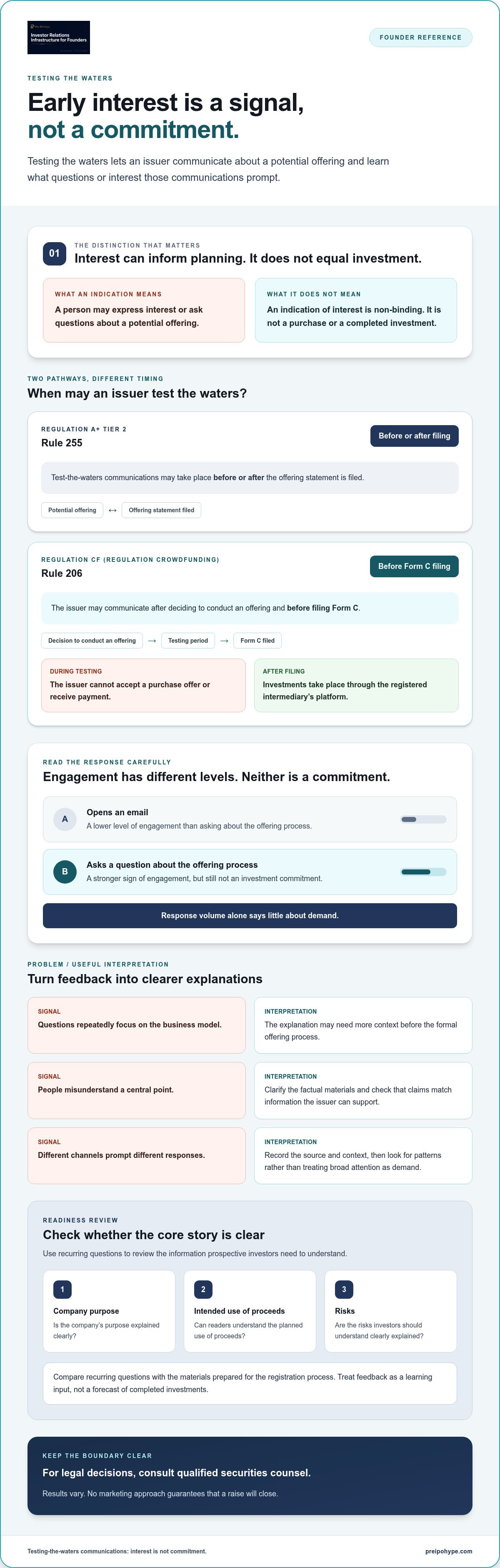
Investor interest can be explored before a formal raise, but it isn’t the same as an investment commitment. For founders asking what testing the waters advertising is, it means communicating about a potential securities offering to gauge interest before moving into the formal fundraising process. Under Rule 255, Regulation A+ issuers in both Tier 1 and Tier 2 may test the waters at any time before the offering statement is qualified, including before and after it is filed. Under Rule 206, a Regulation Crowdfunding issuer may do so at any time before filing Form C.
That distinction matters: potential investors can signal interest, but those signals are non-binding. In a Regulation Crowdfunding campaign, the issuer cannot accept a purchase offer or receive payment until the offering statement is filed, and any investment must then go through an intermediary’s platform. Early outreach can inform planning, but interest alone does not show that a raise will close. This guide explains how testing-the-waters communications work, how the rules differ between Regulation CF and Regulation A+, and what founders should consider when assessing investor demand.
Key Takeaways
- Testing investor interest can help a founder assess demand before a formal raise, but indications of interest are not investment commitments.
- Regulation A+ Tier 2 and Regulation CF have distinct rules for when and how issuers may communicate with potential investors.
- For Regulation CF, an issuer cannot accept a purchase offer or receive payment during the testing-the-waters stage.
- Testing-the-waters materials have filing and disclosure requirements that depend on the offering pathway and stage.
- Results vary. No marketing approach guarantees that a raise will close.
Validating fundraising demand before a formal raise
Testing investor demand can inform a founder’s decision to proceed, refine the campaign, or reconsider its assumptions. For Regulation A+, Rule 255 permits test-the-waters communications in both Tier 1 and Tier 2 offerings, before or after the offering statement is filed and until it is qualified. The U.S. Securities and Exchange Commission states that the Regulation A+ offering limit is $75 million in a 12-month period for Tier 2 and $20 million for Tier 1. That ceiling describes the offering pathway, not evidence that investors will commit or that a company can raise the full amount.
Regulation CF offers a separate route for early interest. Under Regulation Crowdfunding, an issuer may sell up to $5 million in securities in a 12-month period. Under Rule 206, an issuer may communicate at any time before filing Form C to find out whether there is interest in a contemplated Regulation CF offering. People can express interest, but those indications are non-binding. At this stage, an issuer cannot accept a purchase offer or receive payment. After filing, investments take place through the registered intermediary’s platform.
Use the testing period to learn what investor communications reveal. A high response count alone says little about demand. Compare which messages prompt substantive questions, which audiences request more information, and whether people understand the company’s purpose. For example, if a campaign explains a product clearly but prompts questions about the business model, that feedback may point to a gap in the materials. Record responses and use them to improve clarity, not to exaggerate momentum.
Distinguish expressions of curiosity from stronger signs of engagement. Someone who opens an email has shown less engagement than someone who asks about the offering process. Neither action is a commitment. Track the source and context of each response, then look for patterns across communications. If social media generates broad attention while direct questions come through another channel, that distinction can help shape the public campaign. Keep every claim consistent with information the issuer can support.
Testing the waters also helps founders assess readiness. Review whether the proposed raise clearly explains the company, its intended use of proceeds, and the risks investors should understand. Compare recurring questions with the content prepared for the registration process. If prospective investors repeatedly misunderstand a central point, clarify it before a formal public offering. Treat this as a learning stage, not a forecast of completed subscriptions or available capital.
Rules differ by offering type, and communications can carry legal obligations. Founders should coordinate campaign materials with qualified securities counsel, especially before making public statements about the offering. Use deadlines, caps, and perks only when they are genuine and disclosed in the offering documents. A disciplined test-the-waters process can generate useful feedback while preserving the distinction between early interest and an investment decision.
Definition and purpose of testing the waters
Testing the waters means exploring whether a potential securities offering is feasible before committing to the formal process. For an issuer, this involves sharing information about a planned offering and learning how prospective investors respond. The purpose is to gather feedback, assess interest, and identify questions the campaign materials should answer. It is an early information-gathering stage, not a measure of completed investments.
The phrase is associated with the Securities Act and rules that permit certain pre-offering communications. The JOBS Act, passed by the U.S. Congress in 2012, added Section 5(d) for emerging growth companies. That provision allows eligible issuers to communicate with qualified institutional buyers and institutional accredited investors about a potential offering. In 2019, Rule 163B extended testing-the-waters communications to all issuers, but only with those institutional audiences.
The audience and purpose matter. Under Rule 163B, an issuer may use communications to assess interest among qualified institutional buyers or institutional accredited investors. These are not general-public advertisements. Regulation CF and Regulation A+ have separate pathways with their own rules, so founders should not assume that a communication permitted under one provision automatically fits another. Qualified securities counsel can help determine which rules apply to an issuer’s planned raise.
Testing the waters can help a company assess whether its explanation is clear. For example, an issuer that describes a new product but receives questions mainly about its business model may need to add context before advancing the formal offering process. Founders can also compare questions across communications, note recurring interests, and distinguish general curiosity from detailed engagement. These signals can inform decisions, but they do not establish actual demand or predict completed investments.
Keep three concepts separate: interest, commitment, and investment. A person may express interest without agreeing to buy securities. In a Regulation CF testing-the-waters campaign, an indication of interest is non-binding, and a reservation does not itself complete an investment. Any eventual investment follows the applicable offering rules and platform requirements. This distinction is central to understanding what testing-the-waters communications can reveal.
Use feedback to refine factual explanations, not to create a stronger impression than the evidence supports. Check that each statement matches the issuer’s current information and that prospective investors understand the offering’s purpose. Because testing-the-waters communications can be subject to securities-law requirements, discuss their content and use with qualified securities counsel before distributing them.
Who is eligible to use SEC testing-the-waters communications?
Eligibility depends on the offering pathway and the audience for the communication. Under Rule 163B, adopted in 2019, all issuers may test the waters with qualified institutional buyers or institutional accredited investors. This is broader than the earlier Section 5(d) provision, which applied to emerging growth companies. Rule 163B does not make every public advertisement a permitted test-the-waters communication.
Section 5(d) remains relevant to emerging growth companies. The JOBS Act of 2012 created this provision, allowing those companies to discuss a potential offering with qualified institutional buyers and institutions that are accredited investors. The communication can occur before or after filing a registration statement. Eligibility therefore rests on both the issuer’s status and the audience reached under this provision.
Rule 163B uses a different issuer test. An issuer does not need to qualify as an emerging growth company to rely on the rule, but its communications must target qualified institutional buyers or institutional accredited investors. A company planning outreach to the general public cannot treat Rule 163B as the basis for that broader audience. Founders should identify the intended recipients before preparing materials, then have qualified securities counsel assess the applicable requirements.
Regulation CF has a separate route under Rule 206. An issuer may test the waters at any time before filing Form C. The issuer may communicate orally or in writing, and it need not use a crowdfunding intermediary platform for those communications. This timing differs from Rule 163B, so a founder should not assume that the institutional-audience limits or process under one rule carry over to Rule 206.
Rule 241 offers another option when an issuer has not yet chosen an offering exemption. It permits generic testing-the-waters communications at that earlier decision point. The communication must remain generic rather than presenting itself as a specific Regulation CF or Regulation A+ offering. Once the exemption is selected, the issuer must consider the rules tied to that offering path.
Regulation A+ issuers, in both Tier 1 and Tier 2, may use Rule 255 to test the waters before or after filing the offering statement. That provision is distinct from Rule 163B’s institutional-audience framework. For example, a founder considering Regulation A+ can assess interest under Rule 255, while an issuer that has not selected an exemption may consider Rule 241’s generic approach. Qualified securities counsel can help determine which pathway fits the issuer and the planned audience.
What disclosures and filing requirements apply to testing-the-waters materials?
Requirements depend on the exemption and the stage of the offering. For Regulation CF, Rule 201(z) requires the issuer to include its Rule 206 testing-the-waters materials with Form C. Under Rule 206, the communications must state that no money or other consideration is being solicited and none sent in response will be accepted, that no offer to buy can be accepted and no part of the purchase price can be received until the offering statement is filed and only through an intermediary's platform, and that an indication of interest involves no obligation or commitment of any kind. That wording helps distinguish an early indication of interest from an investment transaction. Before sharing materials, founders should coordinate their content and filing process with qualified securities counsel.
Regulation A+ has its own filing path. Testing-the-waters materials must be submitted to the SEC as an exhibit under Part III of Form 1-A. After Form 1-A is filed, materials must include the offering statement or explain where investors can obtain it. A link to the EDGAR filing satisfies that requirement. Before the offering statement is qualified, solicitation materials must also explain that money isn’t being solicited or accepted, and that an indication of interest creates no commitment to purchase securities.
For Regulation A+, the communication’s timing changes what it needs to contain. For example, material distributed after Form 1-A is filed must direct readers to the filed offering information or identify how to obtain it. Before qualification, the material must preserve the distinction between an indication of interest and a purchase commitment. Founders should align each version of an advertisement, email, or presentation with the offering’s current filing stage.
Rule 163B communications follow a different filing approach. They need not be filed with the SEC or include specific legends under the rule. They aren’t treated as free writing prospectuses under Rule 405. However, the SEC may request copies during its review of a related registration statement. Issuers subject to Regulation FD must also consider whether a communication triggers disclosure duties or falls within an exemption.
Filing treatment doesn’t remove responsibility for accurate statements. Rule 163B communications remain subject to potential liability under Section 12(a)(2) of the Securities Act. An issuer should compare each communication with the related registration statement and correct inconsistencies before distribution. For Regulation CF promotion on the platform, anyone paid by the issuer to promote the offering must disclose that compensation each time under Rule 205. Keep copies of the materials and their versions so counsel can review what was shared.
These requirements make review part of campaign preparation, not an afterthought. A founder can organize materials by offering type, filing stage, audience, and channel, then submit them for counsel’s review. This helps identify missing disclosures, outdated references, or inconsistent claims before an email or public post reaches prospective investors. Decisions about wording, filings, and applicable obligations belong with qualified securities counsel.
Pre-IPO Hype: Custom Investor CRM
Pre-IPO Hype provides investor relations infrastructure for Regulation CF and Regulation A+ raises.
We are not a broker-dealer, funding portal, or investment adviser. We do not offer, sell or recommend securities. This article is educational only and is not legal, tax or investment advice. Pre-IPO Hype fees are never tied to investment results. FWSC and Pre-IPO Hype are paid per form filled out and per meeting booked, with no commission, equity or share of the raise.
For founders preparing a testing-the-waters campaign, Pre-IPO Hype provides campaign support alongside the issuer’s registered intermediary and qualified securities counsel. Our Custom Investor CRM supports lead scoring and attribution tracking. Legal decisions remain with qualified securities counsel.
Marketing support does not guarantee that a raise will close.
Contact Pre-IPO Hype to discuss campaign support for your raise.
Turn early feedback into a clear next step
Before moving from market feedback to a formal raise, decide what you need to learn from prospective investors. Which parts of the company’s story prompt informed questions? Where do people need more context? What changes to your communications does the feedback support? Clear answers can help shape a focused campaign plan without overstating interest.
Understanding what testing-the-waters advertising is can help founders distinguish useful engagement data from investment commitments. Keep the next phase grounded in accurate materials, a defined audience, and review with qualified securities counsel. Consider how messaging, outreach, and engagement records will support the issuer’s campaign planning.
Use the feedback to make the next decision deliberately. A considered plan gives your team a clear basis for moving forward.
Your next step can be measured and practical: build on what the feedback actually shows.
Frequently Asked Questions
What does “testing the waters” advertising mean?
It means communicating about a potential securities offering to learn how prospective investors respond before proceeding with a formal raise. For example, a company might share a description of its business and ask whether recipients want more information. Their replies can reveal which parts of the story need clarification. An expression of interest is not the same as agreeing to invest, and the communication must follow the rules for the issuer’s offering path.
How does testing-the-waters advertising work for companies considering an IPO?
A company considering an IPO may use eligible communications to gauge interest among qualified institutional buyers or institutional accredited investors. It can use feedback to refine its explanation of the business and prepare for investor questions. For example, repeated questions about revenue drivers may indicate that the company’s materials need clearer context. These discussions do not accept investments or replace registration or the IPO process.
What are the SEC rules for testing-the-waters communications in the United States?
The applicable rule depends on the issuer and offering. Section 5(d) covers emerging growth companies, while Rule 163B permits communications with qualified institutional buyers and institutional accredited investors. Regulation A+ issuers may use Rule 255, and Regulation CF issuers may use Rule 206. Rule 241 allows generic communications before an issuer chooses an exemption. Each route has distinct audience, timing, and material requirements, so counsel should assess the planned communication.
When can a company begin testing the waters before an IPO?
Under Section 5(d) and Rule 163B, eligible issuers may communicate before or after filing a registration statement, subject to each provision’s requirements. A company relying on Rule 163B must limit its communications to qualified institutional buyers or institutional accredited investors. For a company considering an IPO, the practical starting point is to identify the rule, intended audience, and proposed materials, then review them with qualified securities counsel before outreach.
How is testing the waters different from general solicitation and a public IPO roadshow?
Testing the waters is an early effort to gauge interest, and any indications are non-binding. Under Rule 163B, communications are directed to qualified institutional buyers or institutional accredited investors, not the general public; Regulation CF and Regulation A+ have separate rules.
Disclaimer
Educational only. Not investment, tax, or legal advice. Pre-IPO Hype is investor relations infrastructure for Regulation CF and Regulation A+ raises. We are not a broker-dealer, funding portal, or investment adviser, and we do not offer or sell securities or make investment recommendations. Any securities offering is made only by the issuer, through its own offering documents and, where required, a registered intermediary.

