
Reg A+ Tier 2 Requirements: A Founder’s Checklist for 2026
What if the SEC filing is only the starting point for a Tier 2 raise? Founders often focus first on preparing the offering statement, but the Reg A+ tier 2 requirements also affect financial reporting, investor eligibility, and ongoing compliance. Readiness is a continuing workflow, not a single filing milestone.
This guide explains the main requirements, compares Tier 2 with Tier 1, and highlights questions to resolve with qualified securities counsel. It covers filing and financial statement obligations, ongoing reports, investor limits, and state-level considerations. It also outlines how the issuer, registered intermediary, counsel, and campaign support can coordinate. Results vary. No marketing approach guarantees that a raise will close.
Key Takeaways
- Use this overview of Reg A+ tier 2 requirements to map filing, financial statement, and ongoing reporting topics for discussion with qualified securities counsel.
- Compare Tier 1 and Tier 2 across audit, reporting, and state-law considerations before assessing which path fits your company.
- Bring eligibility, disclosure, and investor-limit questions to counsel early so your readiness review can address them before filing.
- Assign distinct roles for legal decisions, issuer communications, intermediary responsibilities, and campaign support.
What Regulation A+ Tier 2 means for a company planning an offering
The U.S. Securities and Exchange Commission (SEC) describes Regulation A as an exemption from registration that allows eligible companies to offer and sell securities under specified requirements. For founders, this means a company may pursue an offering through this regulatory pathway, but the exemption does not remove disclosure or other obligations.
The SEC states that Tier 2 offerings may raise up to $75 million in a 12-month period. That limit is a ceiling, not a target or assurance that an offering will qualify or close. Tier 2 also brings obligations beyond the basic Regulation A framework. This overview is educational, not legal advice. Ask qualified securities counsel to assess how the rules apply to your company.
For background on the framework and its development, see the Regulation A Wikipedia overview. The SEC’s regulatory materials should guide a current filing review.
For a visual introduction to the filing process, watch this video:
Who should assess Tier 2 eligibility first?
Start with an eligibility review before committing substantial time to filing preparation or campaign planning. Company eligibility and disqualification provisions apply across Regulation A tiers, but how they apply depends on the issuer’s circumstances. A general checklist cannot determine whether your company qualifies. Ask qualified securities counsel to review the relevant facts and identify issues that could affect the offering path.
This early review helps separate questions that require legal analysis from operational planning. Counsel can advise on eligibility and the filing approach. The issuer can then organize the people and materials needed for disclosure development and financial preparation.
What Tier 2 does and does not establish
Tier 2 is a route an eligible company may pursue under Regulation A. It does not establish that a specific issuer meets every requirement, that the SEC will qualify its offering statement, or that investors will participate. The SEC qualifies an offering statement, but qualification is not an endorsement of the company or its securities.
Think of qualification as a regulatory milestone, not a verdict on business quality. Tier 2 also brings additional obligations to plan for alongside the filing process. The following sections compare the tiers and outline areas to review with counsel.
Because the $75 million limit is a cap, do not treat it as a fundraising forecast. Use deadlines, caps, and perks only when they are real and disclosed in your offering documents.
Regulation A+ Tier 2 requirements: filings, finances, investors, and reports
The practical work spans several connected areas. The issuer and its counsel assess eligibility, prepare accurate disclosures, assemble offering materials, and plan for financial statements and ongoing reporting. The U.S. Securities and Exchange Commission identifies audited financial statements, investor limitations, and continuing reports among Tier 2 requirements. Its SEC Regulation A Guidance is a useful starting point. Counsel should confirm which current rules apply to the specific offering.
Use this checklist to organize the work, not to make legal determinations:
- Eligibility and disqualification review: Ask qualified securities counsel to assess the issuer’s eligibility and review disqualification provisions relevant to the company and offering.
- Disclosure planning: Gather reliable company, business, financial, and offering information for counsel to evaluate and use in preparing disclosure.
- Offering materials: Confirm which offering statement, exhibits, and supporting materials are required under current SEC instructions.
- Financial statements: Plan for the audited financial statements required for Tier 2. Confirm applicable standards and presentation with counsel and the audit team.
- Investor limitations: Identify how investor status and applicable participation limits will be addressed. Have counsel determine how the rules apply and how relevant calculations should be handled.
- Continuing reports: Establish who will monitor the issuer’s reporting obligations and prepare applicable filings after qualification.
Offering statement and disclosure preparation
Disclosure is a coordinated issuer and counsel workstream. Company leadership supplies and verifies the underlying information; counsel advises on its presentation and the filing process. Keep a clear record of source materials, updates, and unresolved questions so the filing team can work from consistent information. Ask counsel to confirm the current forms, exhibits, SEC review steps, and timing for the offering. Filing materials or SEC qualification do not replace legal review of disclosures.
Financial statements and continuing reporting
Separate pre-offering financial preparation from post-qualification reporting. Before filing, the company needs audited financial statements that meet applicable Tier 2 requirements. Confirm current audit standards and required periods with qualified securities counsel and the audit team rather than relying on a generic checklist.
After qualification, reporting becomes an ongoing company responsibility. The SEC identifies continuing reports as part of the Tier 2 framework, so the initial filing should not be treated as the end of the issuer’s obligations. Ask counsel to identify applicable reports, filing dates, responsible staff, and the process for collecting information. Assign clear ownership for review and submission, and build the work into the company’s operating calendar.
For counsel discussions, organize open questions across eligibility, disclosure, financial statements, and reporting. A planning conversation about issuer readiness can help structure that preparation; legal conclusions belong with qualified securities counsel.
Tier 1 vs. Tier 2: compare requirements before choosing a path
The tier decision is not only about how much a company may offer. It also affects financial preparation, ongoing reporting, investor limitations, and state-level requirements. The U.S. Securities and Exchange Commission (SEC) sets the Tier 1 maximum at $20 million and the Tier 2 maximum at $75 million in a 12-month period. The SEC also allows offerings up to $20 million to proceed under either tier’s requirements. Review the SEC’s Regulation A guidance with qualified securities counsel for the current rules.
| Requirement | Tier 1 | Tier 2 |
|---|---|---|
| Offering limit | Up to $20 million in a 12-month period | Up to $75 million in a 12-month period |
| Audited financial statements | Audited financial statements are not required unless the company already has them; confirm with counsel | Audited financial statements are required |
| Ongoing reports | No Tier 2-style ongoing reporting framework; confirm applicable reporting obligations | Ongoing reports are required, with applicable filings and timing to be confirmed |
| State-law treatment | State registration and qualification requirements may apply | Exempt from state registration and qualification, though notice filings or fees may still apply |
| Non-accredited investors | Confirm applicable participation rules with counsel | Investor limits apply; counsel should assess how they apply to the offering |
How the offering limit affects the comparison
The SEC’s 12-month framing matters when assessing a planned offering amount. A company considering an offering of up to $20 million may evaluate either tier’s requirements, rather than assuming the lower limit automatically dictates Tier 1. Tier 2’s higher limit does not make it the better fit by itself. Weigh the intended offering structure alongside the added reporting and audit work.
State-law treatment and investor considerations
Tier 2’s federal preemption means the offering is not required to register or qualify with state securities regulators. It does not necessarily remove every state-level step: notice filings and fees may still apply, and counsel can identify what is relevant to the issuer. Tier 2 also carries limits for non-accredited investors, while its reporting obligations continue beyond the initial filing. Ask counsel to explain the investor rules and assess the company’s capacity to meet ongoing obligations.
Use the table to frame a decision, not make one. The Reg A+ tier 2 requirements may fit a company’s intended structure, but the higher offering ceiling alone does not settle eligibility, state compliance, or readiness. Qualified securities counsel should review the issuer’s facts, planned offering, investor approach, and ability to maintain reporting before the company selects a tier.
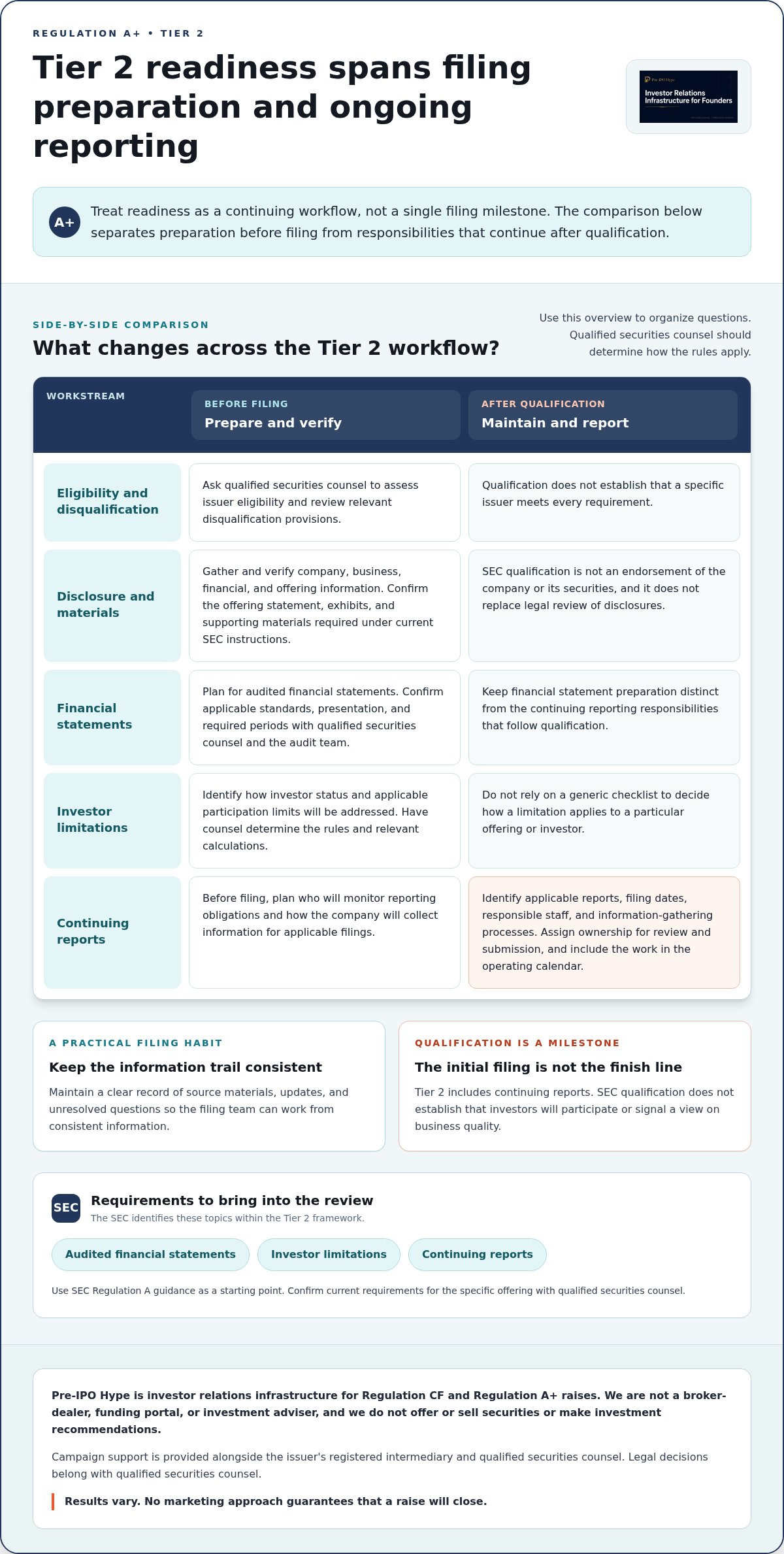
A founder’s Tier 2 readiness checklist before filing and promotion
Turn preparation into a sequence with named owners. The Reg A+ tier 2 requirements involve legal analysis, issuer information, financial work, and ongoing operations. The U.S. Securities and Exchange Commission (SEC) outlines the regulatory framework, but qualified securities counsel should assess how it applies to your company and confirm current requirements.
- Start with counsel review. Share the company’s structure, planned offering, and known compliance questions with qualified securities counsel. Ask counsel to assess eligibility and disqualification provisions before significant filing or campaign work begins.
- Assess eligibility and investor rules. Have counsel review issuer eligibility, applicable investor limitations, and state-law treatment for the proposed offering. The SEC describes Tier 2 investor and state-law requirements in its Regulation A guidance; counsel should confirm the rules and applicable state steps for your facts.
- Plan disclosure. Assign company owners to gather and verify the information needed for offering materials. Counsel should advise on disclosure, current forms, exhibits, and filing process. Keep a record of source documents and updates so issuer communications stay consistent with reviewed disclosure.
- Prepare financial information. The SEC identifies audited financial statements as a Tier 2 requirement. Ask counsel and the audit team to confirm current standards, applicable periods, and the preparation process for the offering.
- Map continuing responsibilities. The SEC also identifies ongoing reporting as part of Tier 2. Ask counsel to specify applicable reports and deadlines, then assign internal owners for collecting information, review, and filing. Build the work into the company’s operating calendar.
Questions to resolve with qualified securities counsel
Before filing or promotion, get clear answers on the issuer’s eligibility, disqualification review, disclosure, financial statements, and current filing requirements. Ask how investor limitations and state-law treatment apply, and which ongoing reports and deadlines the company must plan for. This article is educational and does not provide legal or investment advice. Legal decisions belong with qualified securities counsel.
Separate issuer communications from campaign support
The issuer controls its offering information and communications. Outreach and campaign activity are conducted for the issuer as operational support alongside its registered intermediary and qualified securities counsel. Define who reviews content, who approves changes, and who directs investors to the issuer’s registered intermediary or offering page. Campaign support does not replace legal review or intermediary responsibilities.
For Regulation Crowdfunding, a separate rule applies to platform promotion: anyone the issuer pays to promote the offering on the platform must disclose that compensation each time under Rule 205. Do not assume that rule describes Regulation A+ promotion; have counsel review the requirements for the specific offering. Communications should be accurate and based on disclosed information, not artificial scarcity, demand, momentum, or social proof.
Checklist summary: Resolve legal questions first, organize verified disclosures and financial information, assign reporting owners, and set clear boundaries for issuer communications and campaign support. For more on operational planning alongside the issuer’s registered intermediary and qualified securities counsel, see the fundraising workflow conversation.
How campaign support fits alongside a Regulation A+ raise
Pre-IPO Hype is investor relations infrastructure for Regulation CF and Regulation A+ raises. We are not a broker-dealer, funding portal, or investment adviser, and we do not offer, sell or recommend securities. This article is educational only and is not legal or investment advice. Pre-IPO Hype fees are never tied to investment results.
For a Regulation A+ raise, campaign support is an operational workstream alongside legal review and the registered intermediary’s role. Keep responsibilities explicit. The issuer owns its offering information and approves communications. Qualified securities counsel advises on legal requirements and compliance questions. The registered intermediary handles its role in the offering process. Campaign support is conducted for the issuer alongside these parties.
Keep operational support within the right roles
A clear review path helps prevent campaign materials from getting ahead of offering disclosures. The issuer can identify who supplies source information, who approves public-facing content, and how updates are routed to counsel for review when needed. Support teams can then work from issuer-approved materials and follow the agreed process for outreach. Investors should be directed only to the issuer’s registered intermediary or offering page.
The Reg A+ tier 2 requirements concern the issuer’s legal and reporting obligations, while campaign work supports communications and coordination. Campaign support does not determine eligibility, interpret securities rules, or make investment recommendations. Qualified securities counsel should resolve legal questions, and the intermediary’s responsibilities remain distinct.
Our Custom Investor CRM supports lead scoring and attribution tracking. This is an operational feature, not a substitute for the issuer’s disclosure, counsel review, or intermediary process. The issuer and its advisers should set the rules for how information is recorded and used in campaign workflows. For a broader view of campaign support, see investor relations campaign support as one part of the issuer’s operating plan.
Make a practical next step without assuming an outcome
Before campaign activity begins, founders can document approved information, review owners, the escalation path for questions, and the destination for investor inquiries. This gives each participant a defined role and helps keep issuer communications aligned with counsel’s guidance and the registered intermediary’s process. It also gives the team a practical basis for coordinating updates as the offering develops.
A workflow conversation can focus on roles, timing dependencies, and how campaign support sits alongside the issuer’s legal and intermediary workstreams. It cannot replace legal advice or determine whether a company or offering meets SEC requirements. Legal decisions should remain with qualified securities counsel.
Set up your next step with clear roles
Before moving from planning to execution, turn open questions into decisions, owners, and review points. A working plan can help your team track what still needs attention without treating readiness as a one-time milestone. Keep the Reg A+ tier 2 requirements in view as the company develops its process, and take legal questions to qualified securities counsel.
Keep the focus on the issuer’s preparation and the people responsible for each part of the work. A clear internal workflow gives founders a practical way to organize next steps while leaving regulatory judgments with counsel.
Approach the next stage with realistic expectations and a process your team can maintain. Careful preparation can make the work easier to organize, while each legal and operational decision remains specific to the company and its offering.
Frequently Asked Questions
Is Regulation A+ Tier 2 the same as an initial public offering?
No. A Regulation A+ Tier 2 offering is an exempt offering pathway, not automatically a traditional initial public offering or a stock exchange listing. The company’s securities and trading status depend on the offering structure and any separate steps the issuer takes. Ask qualified securities counsel to explain how the proposed offering differs from an IPO and what it means for the company’s securities.
Can a company choose Tier 2 if its offering is below the Tier 1 limit?
Yes. The U.S. Securities and Exchange Commission states that an offering of up to $20 million in a 12-month period may proceed under either Tier 1 or Tier 2 requirements. The amount alone does not settle which tier fits. Compare the obligations attached to each option and ask qualified securities counsel to confirm how the proposed offering amount and structure affect the choice.
Can a Regulation A+ issuer test the waters before an offering is qualified?
Yes. Regulation A+ permits issuers to solicit indications of interest before and after filing an offering statement, subject to applicable conditions. Testing the waters is not the same as completing a securities sale, and communications must follow the rules that apply to the offering. Before preparing or sharing these materials, have qualified securities counsel review the proposed process and content.
Does Tier 2 automatically make a company publicly traded?
No. Using Tier 2 does not by itself list a company’s securities on a national securities exchange or establish that they trade publicly. An offering and a listing or trading arrangement are distinct matters. If public trading is part of the company’s plans, ask qualified securities counsel what additional requirements and steps may apply to the issuer and its securities.
Does SEC qualification mean the SEC endorses the offering?
No. SEC qualification is not an endorsement of the issuer, its business, or its securities. It also does not mean the SEC has judged an investment’s merits. Readers evaluating an offering should distinguish the agency’s role in the filing process from their own review of the offering disclosures. Founders should ensure communications do not imply that qualification signals SEC approval or a recommendation.
What should founders do if they are unsure which Tier 2 requirements apply?
Ask qualified securities counsel to assess the company’s circumstances against current SEC requirements. Prepare concise questions about eligibility, disclosure, financial statements, investor limitations, state-level steps, and ongoing reports. The Reg A+ tier 2 requirements depend on issuer and offering details, so a general checklist can organize the discussion but cannot replace legal analysis. This FAQ is educational, not legal or investment advice.
Disclaimer
Educational only. Not investment, tax, or legal advice. Pre-IPO Hype is investor relations infrastructure for Regulation CF and Regulation A+ raises. We are not a broker-dealer, funding portal, or investment adviser, and we do not offer or sell securities or make investment recommendations. Any securities offering is made only by the issuer, through its own offering documents and, where required, a registered intermediary.


