
Startup Fundraising Automation Tools
Founders need fundraising tools that support investor research, relationship management, and campaign materials. The right startup fundraising automation tools connect these tasks in a usable workflow instead of adding another disconnected system. AI can help draft investor outreach, but founders still need to personalize each message with relevant proof points and a clear ask.
Automation can reduce repetitive work and keep investor activity organized. But software helps only when its data is accurate, its workflow fits the raise, and the team can see what needs follow-up. More outreach alone is not a reliable measure of progress.
This guide explains how to assess AI-assisted investor discovery and outreach, choose tools based on workflow and data quality, use free fundraising resources, and measure return through time saved and pipeline quality. It also covers useful signals, including response patterns across investor segments, follow-up consistency, and the pace of narrative updates. Results vary, and no marketing approach guarantees that a raise will close.
Key Takeaways
- Prioritize investor fit by stage, sector, and evidence of alignment, then review AI-generated outreach before sending it.
- Choose tools around your actual workflow and keep investor records accurate, consistent, and useful for follow-up.
- Use free due diligence resources to organize work across financials, controls, and team processes.
- Measure performance through qualified-introduction-to-meeting conversion, segment response rates, follow-up consistency, and time saved.
AI-assisted investor matching and outreach
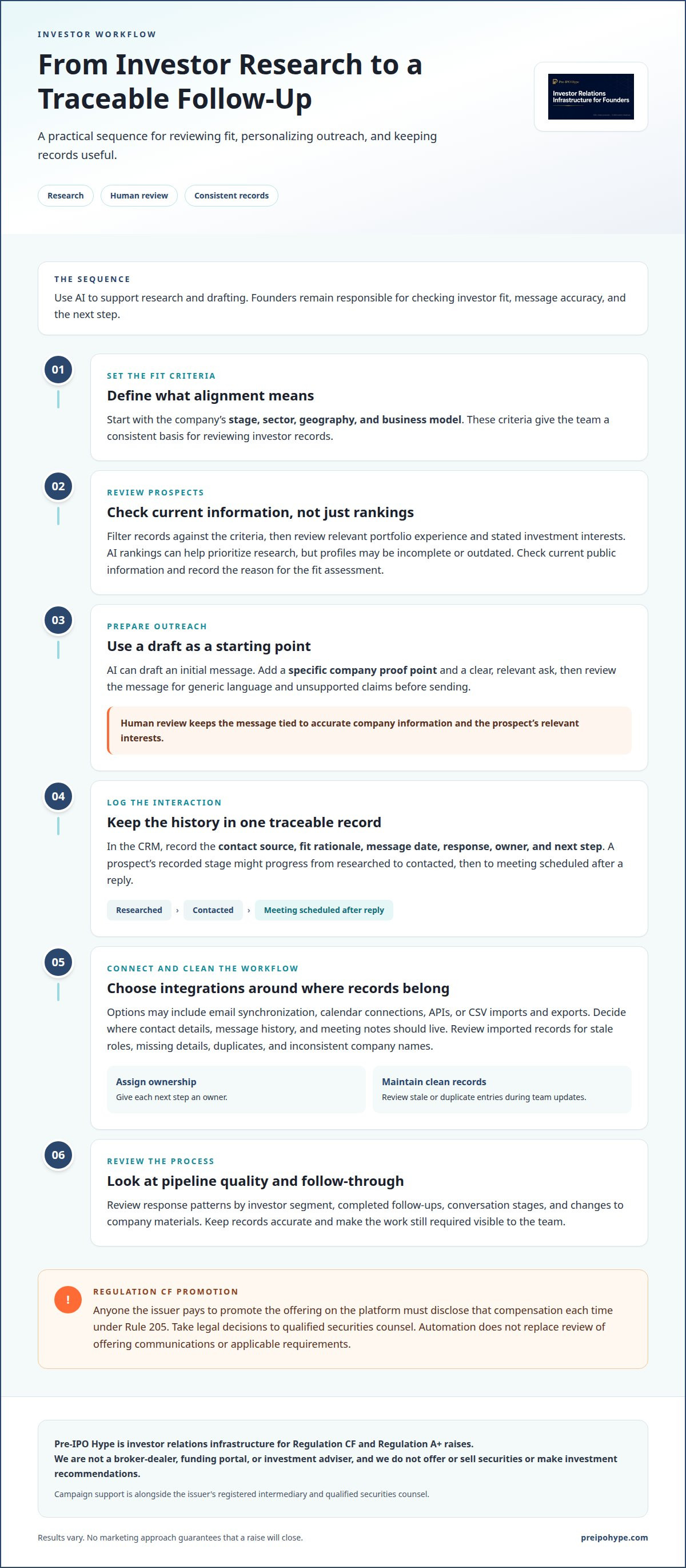
For founders, startup fundraising automation tools can organize investor research, outreach, and follow-up. AI can help sort records and draft messages, while founders remain responsible for checking investor fit and message accuracy.
Investor Search and Filtering
Start with criteria that reflect the company’s stage, sector, geography, and business model. Filter investor records against those criteria, then review relevant portfolio experience and stated investment interests. AI rankings can help prioritize research, but incomplete or outdated profiles may produce poor matches. Check each prospect’s current public information before treating an automated result as a qualified lead. Record why the investor fits so the team can reassess that judgment later.
Outreach and Investor Pipeline Management
Use AI to draft an initial message, then add a specific company proof point and a clear, relevant ask. Human review can catch generic language and unsupported claims. In the CRM, record the contact source, fit rationale, message date, response, owner, and next step. For example, a prospect might move from researched to contacted, then to meeting scheduled after replying. This creates a traceable history instead of leaving details in separate inboxes.
Fundraising automation platforms support investor discovery and pipeline management by bringing searchable records, communication history, and follow-up tasks together. Their value depends on the accuracy of the underlying data and the team’s process for reviewing it.
Outreach Compliance and Tool Integrations
U.S. securities requirements depend on the offering and communication. Keep outreach accurate and take legal decisions to qualified securities counsel. Automation does not replace review of offering communications or applicable requirements.
CRM and email connections vary by platform. Options may include email synchronization, calendar connections, APIs, or CSV imports and exports. Before choosing an integration, decide where contact details, message history, and meeting notes should live. Then define investor criteria, import clean records, review AI-ranked prospects, personalize drafts, and log replies. These steps help teams use startup fundraising automation tools without losing track of who owns each action.
Investor updates and KPI dashboards can show whether the process is being maintained. Track response patterns by investor segment, completed follow-ups, conversation stages, and changes to company materials. Assign an owner to each next step, and review stale or duplicate records during team updates. Reliable records give founders a clearer view of pipeline activity and the work still required.
Choose tools to match the team’s fundraising needs, not a lengthy feature checklist. Early-stage founders often need investor discovery, outreach support, and a lightweight CRM. Later-stage teams may prioritize pipeline reporting, stakeholder visibility, and collaboration. A proportionate workflow makes it easier to maintain consistent records and ownership as fundraising activity changes.
Build a focused investor target list, then concentrate research and outreach on prospects whose interests align with the company. Founders can note potential connectors alongside each target and track whether an introduction is available. This keeps relationship context visible while leaving room for carefully personalized direct outreach.
Choosing tools by workflow fit and data quality
For pre-seed and seed-stage startups, a focused setup is often the most practical: investor discovery, a lightweight CRM, and tools to prepare the fundraising narrative. Choose based on the team’s next workflow problem, not the longest feature list.
Map the raise before comparing platforms. Write down how the team identifies potential investors, reviews fit, prepares materials, records conversations, and shares updates. For example, a founder working from spreadsheets may first need a central CRM. A team with reliable contact records but inconsistent materials may instead need stronger tools for deck and narrative collaboration.
Fundraising software typically serves distinct purposes: investor databases support research, capital-raising platforms support campaigns, CRMs organize relationships, and deck tools help shape the story. A tool may cover several tasks, but that matters only if it fits the company’s process. During a venture capital raise, define which task each system owns and who maintains it.
- Workflow fit: Can the team record a source, assess investor relevance, log communication, and assign a follow-up?
- Data quality: Can users correct stale roles, missing sector details, duplicate contacts, and inconsistent company names?
- Usability: Can a founder update a record after a call without rebuilding the process in another spreadsheet?
- Reporting: Can the team view conversation stages and next steps without treating email volume as progress?
Data quality is operational, not cosmetic. If one investor appears under multiple names, reports can overstate pipeline activity. If an investment focus is outdated, filters may surface poor-fit contacts. Assign someone to review imported records, standardize fields such as stage and sector, and log the source for each contact. Test the process with a small set of real records before importing the full working list.
Assess integrations by tracing a single interaction. If an investor replies by email, does the message history reach the CRM? Can a meeting note be connected to the same contact? If not, decide whether a manual update is manageable or whether the workflow needs a different connection. Review privacy terms and training policies before entering sensitive company information into a tool. Restrict data-room access to people who need it.
Reassess the tool stack as the fundraising process changes. A founder-led outreach workflow may later require clearer team visibility, shared ownership, and pipeline reporting. Keep tools that support those tasks and remove overlap that creates conflicting records. The goal is a reliable fundraising operating system where every contact, communication, and next step has a clear place.
Ensuring predictable handoffs across the team is vital. Founders should assess startup fundraising automation tools by time saved and pipeline quality rather than email volume alone. Founders can evaluate tool ROI by tracking qualified-introduction-to-meeting conversion, response rates by investor segment, follow-up consistency, and the speed of narrative iteration. These measures keep evaluation tied to the work the team needs to improve, from identifying relevant investors to refining its materials.
Review these measures when comparing tools or reassessing the setup. A tool that increases recorded activity without improving pipeline quality may not solve the workflow problem. Faster narrative iteration can matter when preparing and updating the fundraising story. Use the measures to decide what to retain, change, or simplify as the team’s process evolves.
Free fundraising tools and resources
Free resources can help founders organize diligence before adding paid software. A spreadsheet, shared document, and clearly named folders can support early fundraising work, as long as the team assigns owners and keeps records current.
Privacy and security risks arise when sensitive company or investor information enters generic chat tools, shared files, or a data room with broad access. Limit sensitive details, review each platform’s privacy terms and training policies, and restrict data-room permissions to people who need them.
A due diligence checklist spreadsheet can turn preparation into assigned work. The described template covers general due diligence, profit and loss, controls, and HR-stage checklists. Use those categories to identify missing records, assign an owner, and note whether each item is ready, in progress, or awaiting review. For example, an open controls task can name its owner and the document needed to complete it.
A separate startup due diligence plan spreadsheet template includes a work plan, checklist, and controls. Adapt its structure to the raise: list each preparation task, record its owner, and link it to the relevant file. Add a version date to the document name so the team can distinguish current materials from older drafts. Qualified securities counsel should guide legal decisions and review legal materials.
Free tools can also help shape the company narrative, but they cannot replace accurate evidence. Use a shared outline to organize the team, problem, solution, market, and traction. Connect each claim to a supporting source, such as a current operating metric or customer evidence. If a claim changes, update the outline and related presentation together. This keeps the story consistent as founders prepare to discuss the business and its capital needs.
Before entering investor or company information into an AI service, follow a simple data-handling process:
- Classify the information. Separate public company facts from confidential financial, customer, or investor details.
- Minimize what you share. Use a generalized prompt rather than pasting sensitive source documents into a generic chat tool.
- Review platform terms. Read privacy and training policies before using a tool with internal materials.
- Limit access. Give each data-room user permission only for the files needed for their role.
- Review outputs. Check generated summaries against source records before using them in fundraising materials.
Treat a spreadsheet as a controlled working file, not automatically as a permanent source of truth. Assign an editor, limit sharing, and reconcile its checklist with the actual data room before sending materials. These steps help a small team use practical resources while protecting sensitive information and maintaining a clear diligence record.
Measuring fundraising tool ROI
A fundraising tool earns its place when it improves the work behind funding conversations. Measure time saved and pipeline quality, not email volume alone. A higher send count can reflect activity without showing whether investor interest or team execution improved.
Set a baseline before introducing a new workflow. Record how the team currently handles investor research, follow-up, meeting notes, and narrative revisions. After implementation, compare those tasks using the same definitions. For example, measure the time spent preparing an update and whether the team can make revisions with fewer handoffs. Keep the comparison consistent so you can link changes to the process rather than relying on memory.
Track four indicators that reveal different parts of the pipeline:
- Qualified-introduction-to-meeting conversion: Compare relevant introductions with meetings held. Define “qualified” consistently before reviewing the result.
- Response rates by investor segment: Separate responses by stage, sector, or another useful segment. This can show where message relevance differs.
- Follow-up consistency: Review whether agreed next steps are logged and completed. A CRM record should make ownership visible.
- Narrative iteration speed: Track how quickly the team incorporates new evidence into its materials. Faster revisions matter only when accuracy remains intact.
Pair each indicator with a quality check. A meeting count, for example, says little if the meetings involve poor-fit investors. Review a sample of records and confirm that the fit rationale, contact history, and next step are complete. A higher response rate also needs context: compare similar investor segments and message types instead of combining every reply into one headline figure.
Assess the whole workflow, not just the automation feature. Include setup, record cleanup, staff training, manual corrections, and ongoing review. If a tool saves time drafting messages but creates duplicate records, the net benefit may be limited. Note both gains and added work. A monthly review can document what changed, which process improved, and what still requires manual attention.
Use a decision rule tied to the company’s priorities. If follow-up is the bottleneck, examine overdue tasks and ownership. If investor fit is the issue, review the quality of qualified introductions and meeting conversion. If the story changes often, assess revision speed alongside factual consistency. Keep a tool when its measured contribution supports a real workflow need. Reconsider it when the team cannot connect its outputs to better pipeline visibility, more reliable follow-through, or less administrative effort.
Fundraising automation supports process discipline, not a guaranteed outcome. Treat dashboard movement as operational evidence, not proof that funding will result. Review the measures with the team, update definitions when the workflow changes, and base decisions on accurate records.
Pre-IPO Hype: Custom Investor CRM
Pre-IPO Hype provides investor relations infrastructure for Regulation CF and Regulation A+ raises. We are not a broker-dealer, funding portal, or investment adviser, and we do not offer or sell securities or make investment recommendations. Pre-IPO Hype fees are never tied to investment results. FWSC and Pre-IPO Hype are paid per form filled out and per meeting booked, with no commission, equity or share of the raise. This article is educational only and is not legal, tax or investment advice.
For founders organizing investor activity, our Custom Investor CRM supports lead scoring and attribution tracking. Investor Relations and Marketing Campaigns support marketing planning for the issuer. The issuer and its registered intermediary control all offering communications. This can suit a team that needs a structured way to manage campaign workflows while leaving legal and securities decisions to qualified professionals.
Contact Pre-IPO Hype to discuss investor relations infrastructure for your raise.
Build a Fundraising Workflow That Can Adapt
Fundraising processes change as a company develops, so treat your tools as part of an operating system, not a fixed stack. Assign someone to review whether each tool still supports the team’s priorities, and document changes before they create conflicting records or unclear responsibilities.
Choose one workflow to improve first. Define what the team needs to do, who owns each action, and what evidence will show whether the process is working. Then adapt your startup fundraising automation tools to that operational need, keeping communications accurate and legal decisions with qualified securities counsel.
Keep that coordination clear as your team prepares its next phase. A deliberate process gives founders a steadier foundation for the work ahead.
Each well-defined step gives your team a clearer path forward.
Frequently Asked Questions
Which tools automate investor research, outreach, and follow-ups?
Use an investor research database to build and filter prospect records, an AI writing assistant to prepare message drafts, and a CRM or email platform to log outreach and schedule follow-ups. For example, a founder can tag prospects by sector, review each draft personally, and assign a next step after a reply. Choose connected tools that preserve contact history and let the team correct inaccurate records.
Disclaimer
Educational only. Not investment, tax, or legal advice. Pre-IPO Hype is investor relations infrastructure for Regulation CF and Regulation A+ raises. We are not a broker-dealer, funding portal, or investment adviser, and we do not offer or sell securities or make investment recommendations. Any securities offering is made only by the issuer, through its own offering documents and, where required, a registered intermediary.