
Managing Investor Expectations: Reg CF & Reg A+ Guide
Can a candid update about a missed milestone strengthen investor confidence? For founders preparing a Regulation CF or Regulation A+ raise, managing investor expectations means communicating what the company can substantiate, including when plans change.
Uncertainty can be difficult to communicate, but distinguishing confirmed facts from projections and goals helps investors understand what the company knows and what remains unresolved. The aim is not to promise an outcome. It is to explain the plan and report changes accurately.
This guide offers a repeatable approach to setting expectations and keeping investor communications clear as circumstances evolve. It covers how to describe milestones, respond to changes, and organize updates around supportable information. Results vary. No marketing approach guarantees that a raise will close.
Key Takeaways
- Managing investor expectations starts with separating confirmed facts from assumptions, forecasts, and goals.
- Use a consistent message structure to explain what’s known, what remains uncertain, and when investors can expect another update.
- Match the response to the situation, whether it’s a routine update, a material change, or corrected information.
- Build investor updates around verified company information and compare them with current issuer materials and the offering page.
- Campaign support can help organize communications alongside the issuer’s registered intermediary and qualified securities counsel.
What Managing Investor Expectations Means During a Fundraise
Managing investor expectations means aligning company communications with available evidence, known uncertainty, and current plans. It does not mean trying to make every investor reach the same conclusion. Investors have different levels of familiarity with the business and may encounter information in different places, including campaign materials, issuer updates, and conversations with the company.
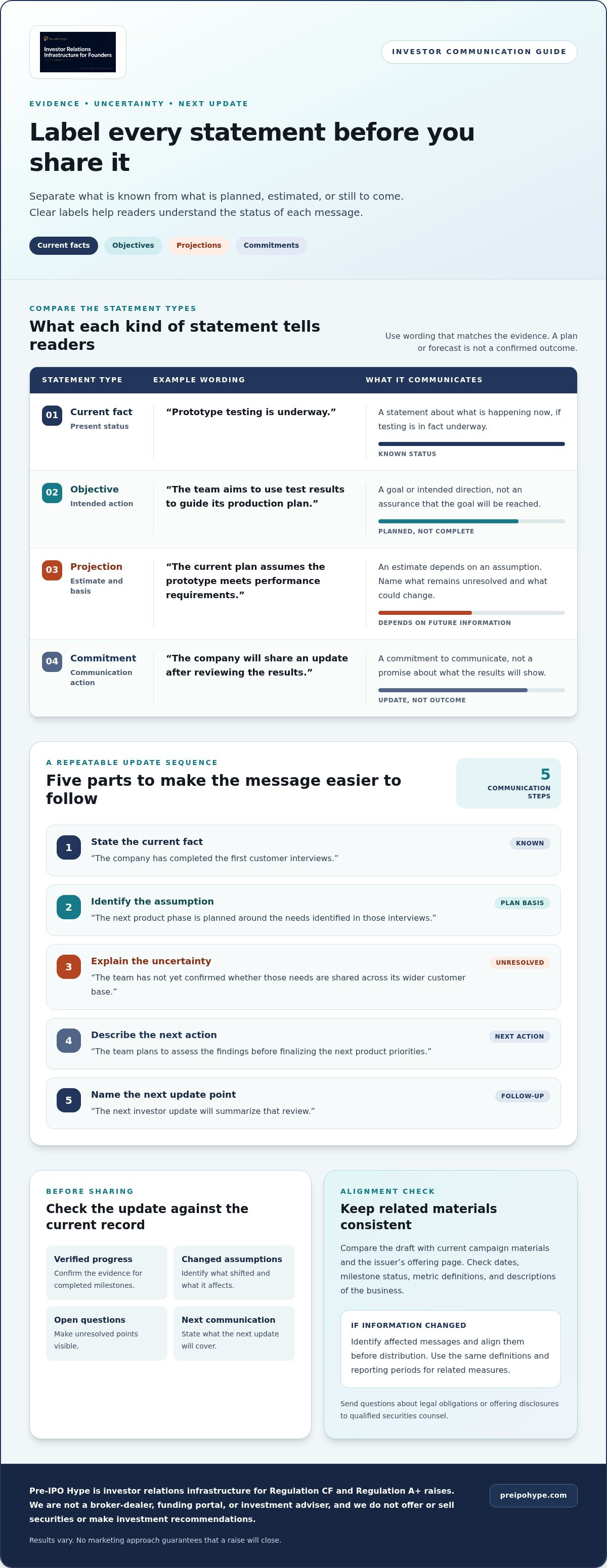
Clear labels help readers understand what kind of statement they’re seeing. Consider a company developing a new product. “The team is testing a prototype” describes a current fact if testing is underway. “The team aims to complete testing before moving into production” states an objective. “The team projects that testing will support a production plan” is a projection based on assumptions that could change. “The company will publish an update after reviewing test results” is a commitment to communicate, not a promise about the results.
A projection can sound like a confirmed outcome when its assumptions are left unstated. Explain what an estimate depends on, such as test performance or supplier availability, and identify what remains unknown. This gives investors context without presenting a plan as certain.
Which expectations can founders actually manage?
Founders can control the accuracy, clarity, and consistency of their messages. They can’t control how the business develops, how external conditions change, or what investors decide. They can make the reasoning behind a plan easier to follow by naming its assumptions and separating evidence from estimates.
- Current fact: “Prototype testing is underway.”
- Objective: “The team aims to use test results to guide its production plan.”
- Projection: “The current plan assumes the prototype meets performance requirements.”
- Commitment: “The company will share an update after reviewing the results.”
This makes it easier for a reader to see what is known, what the team intends to do, and what depends on future information. It reduces ambiguity without implying that a target or forecast is assured.
Why does fundraising context change the communication task?
During a Regulation CF or Regulation A+ raise, founders may need to keep issuer updates, campaign materials, and the offering page aligned as business plans evolve. Investors can encounter information in more than one place, so an update should not conflict with older campaign language. For background on Regulation A+, see Regulation A+ on Wikipedia.
The task is to explain the business accurately in the context of the raise, not to predict how investors will respond. If a supplier change affects a plan, distinguish the confirmed change from its possible effects and explain what the company is doing next. Send questions about legal obligations or offering disclosures to qualified securities counsel. Clear communication supports understanding, but it cannot promise a fundraising outcome.
How to Set Investor Expectations with Evidence and Clear Language
A useful investor message makes the status of each statement clear. Use the same sequence when drafting an update, campaign material, or response to an investor: state the current fact, identify the assumption behind the plan, explain what remains uncertain, describe the next action, and name the next update point. This gives readers context without presenting an estimate as a result.
- Current fact: “The company has completed the first customer interviews.”
- Assumption: “The next product phase is planned around the needs identified in those interviews.”
- Uncertainty: “The team has not yet confirmed whether those needs are shared across its wider customer base.”
- Next action: “The team plans to assess the findings before finalizing the next product priorities.”
- Update point: “The next investor update will summarize that review.”
Choose wording that matches the evidence. “The team aims to complete the review” describes a goal. “The current forecast assumes the review supports the planned priorities” labels an estimate and its basis. Avoid wording such as “the review will confirm the plan” unless that outcome is already known. Keep the difference between what is planned and what has happened visible throughout the message.
How should founders describe forecasts, goals, and milestones?
Label forecasts as estimates, then name the assumptions that materially affect them. If a plan depends on customer feedback, supplier availability, or another unresolved factor, say so plainly. Describe a milestone as an objective until it is complete. Once achieved, report the evidence that supports calling it complete. Avoid turning a possible outcome into a certainty through the wording.
What belongs in a useful investor update?
Organize an update around verified progress, changed assumptions, open questions, and the next communication. Define measures clearly and use the same definitions and reporting periods across related materials. If a measure changes, explain what changed in its calculation or context instead of presenting unlike figures as a direct comparison. Leave out unsupported performance claims and statistics.
Before sharing, compare the draft with current campaign materials and the issuer’s offering page. Check dates, milestone status, metric definitions, and descriptions of the business. If any item has changed, identify the affected messages and align them before distribution. A consistent fundraising technology stack can be part of the campaign workflow, but it does not replace a careful factual review.
Founders refining this process can schedule a fundraising workflow conversation about how communication steps fit into their campaign workflow.
Choosing the Right Response When Plans or Conditions Change
A change calls for a response matched to what the company knows. Start by identifying the communication need: routine progress, a material change, an unresolved development, or a correction. In each case, separate verified facts from assumptions, then decide what investors need to understand and what should happen next.
Planned update
Communicate: Progress against the stated plan and relevant next steps.
Avoid: Presenting an objective as complete before it is achieved.
Counsel review: Seek qualified securities counsel’s guidance if the update may affect offering disclosures.
Material change
Communicate: What changed, what is confirmed, and which parts of the plan may be affected.
Avoid: Minimizing the change or asserting an outcome that remains uncertain.
Counsel review: Ask qualified securities counsel whether issuer materials or disclosures need attention.
Uncertain development
Communicate: What is known, what is unresolved, and what the company is doing to learn more.
Avoid: Speculating about causes or predicting the final effect.
Counsel review: Refer questions about legal obligations or offering disclosures to counsel.
Correction
Communicate: The inaccurate statement, the corrected information, and where the correction applies.
Avoid: Quietly replacing or obscuring information in a way that could leave readers confused.
Counsel review: Consult counsel when the correction relates to offering materials or disclosures.
How should founders communicate a missed milestone or changed plan?
Be direct about the status. If a supplier delay means a planned product test has not started, for example, state that the test has not started. Identify the supplier delay as the confirmed cause only if that information is verified. Explain the operational effect only as far as the facts support it. If the effect on the broader plan is still being assessed, say so and describe the next step, such as reviewing alternatives. Don’t announce a revised date or recovery plan as certain before the company has evidence to support it.
How can a team respond to investor concerns consistently?
Keep a shared record of recurring questions and the factual responses approved for issuer communications. Include the source of each answer, its status, and whether it needs review if circumstances change. This helps team members avoid giving different explanations in conversations, campaign materials, and updates. The overview of investor relations and marketing support provides context on campaign support alongside the issuer’s registered intermediary and qualified securities counsel.
Keep professional boundaries clear: the team can explain verified business information, but legal or offering-document questions belong with qualified securities counsel. Route those questions rather than improvising an answer. A consistent process makes it easier to acknowledge uncertainty without filling gaps with speculation.
A Practical Investor Update Process for a Regulation CF or Regulation A+ Raise
A repeatable update process helps founders manage investor expectations while keeping communications grounded in current information. Use the same review sequence for routine progress and responses to changes. Assign responsibility for gathering facts, checking the draft, and approving distribution so key details don’t depend on memory or informal handoffs.
- Gather current information. Ask the people responsible for each area of the business to provide confirmed results, relevant dates, open issues, and changes since the last update.
- Sort the information. Separate verified results from assumptions, unresolved questions, and planned actions. Keep the source for each key statement so reviewers can check it.
- Draft for investors. Explain what has happened, what has changed, and what the company is doing next. Use plain language and make uncertainty clear.
- Review the facts and disclosures. Compare the draft with current issuer materials and the offering page. Ask the appropriate issuer professionals to review claims and disclosure questions before distribution.
- Distribute and record. Use the issuer’s established communication channels, record what was sent and where, and note follow-up questions that may inform a future update.
Keep a record of the information used to prepare each update. If a figure or milestone is revised later, the team can identify which statement changed and assess whether related communications need attention. This record also helps keep wording consistent when more than one person prepares issuer communications.
What steps make an investor update clear and reviewable?
Start with information from the people closest to the work, then draft around facts rather than assumptions. Mark unresolved items for review instead of filling gaps with a likely explanation. Before release, verify that statements accurately describe progress and that claims are supported by available information. Send questions about legal obligations or offering disclosures to qualified securities counsel.
How can teams keep messages consistent across channels?
Maintain a shared source of current, approved facts for communications prepared for the issuer. Include approved wording for key business descriptions, metric definitions, milestone status, and known changes. When information is updated, identify affected materials so the campaign update, issuer communications, and offering page can be reviewed together.
For Regulation Crowdfunding promotion, anyone the issuer pays to promote the offering on the platform must disclose that compensation each time under Rule 205. Coordinate campaign communications for the issuer alongside its registered intermediary and qualified securities counsel. The overview of issuer campaign communication support describes how campaign support fits into that workflow.
To discuss how a repeatable update and review process fits into campaign operations, schedule a fundraising workflow conversation.
How Campaign Support Fits into Investor Expectation Management
Clear investor communication depends on more than careful wording. The issuer also needs a workable process for preparing campaign materials, coordinating reviews, and keeping information aligned as business plans develop. Campaign support can help organize those activities for the issuer, alongside the issuer’s registered intermediary and qualified securities counsel. It does not replace their respective roles.
The issuer remains responsible for its communications and business information. The registered intermediary handles its role in the offering process, while qualified securities counsel advises on legal decisions and offering disclosures. Campaign support can sit alongside these participants to help coordinate communications, without being treated as legal review or offering administration.
What can campaign support contribute to the process?
Campaign support can help the issuer organize messaging tasks, materials, and review steps. For example, a team might identify which materials need attention after a business plan changes, assign internal owners, and coordinate review before sharing an update. This structure makes responsibilities visible and reduces reliance on informal handoffs. It supports the communication process, not a particular investor response or fundraising outcome.
Operational infrastructure can be part of an issuer’s campaign workflow. A fundraising technology stack does not replace the issuer’s judgment or professional review. Clear ownership of facts and review responsibilities remains central to preparing and managing communications.
What should founders discuss before planning the workflow?
Start by identifying the issuer’s communication goals, the materials already in use, and who owns each review step. Map how drafts move from the people providing business information to the people reviewing and approving communications. Agree on where current materials are maintained and how changes are shared with the team. A practical workflow should fit the issuer’s responsibilities and available information.
Keep professional boundaries clear as the workflow takes shape. Qualified securities counsel should address legal decisions and questions about offering disclosures. The issuer’s registered intermediary remains responsible for its role in the offering process. Campaign support can help the issuer coordinate communications alongside these professionals without substituting for their work.
Founders can discuss communication goals, materials, and review steps for their process. Schedule a fundraising workflow conversation.
Make Clear Communication Part of the Plan
A fundraising workflow is most useful when it reflects how your team works. Decide who gathers current information, who reviews drafts, and how approved messages stay aligned as plans evolve. Put those responsibilities into a process your team can return to, rather than relying on memory when a change needs to be explained.
Managing investor expectations is an ongoing discipline, not a single campaign task. A steady approach gives your team a practical way to communicate what it knows, identify what remains uncertain, and keep investors informed without overstating what the company can deliver. Continue to work with qualified securities counsel on legal decisions and offering disclosures.
Pre-IPO Hype is investor relations infrastructure for Regulation CF and Regulation A+ raises. We are not a broker-dealer, funding portal, or investment adviser, and we do not offer or sell securities or make investment recommendations. Campaign support is provided alongside the issuer’s registered intermediary and qualified securities counsel. Our Custom Investor CRM supports lead scoring and attribution tracking.
If you’re planning the communication workflow for a Regulation CF or Regulation A+ raise, schedule a fundraising workflow conversation. A clear process is a useful foundation for the work ahead.
Frequently Asked Questions
How often should a company update investors during a Regulation CF or Regulation A+ raise?
Set a predictable schedule the company can maintain, such as monthly or quarterly updates, and explain the cadence to investors. Managing investor expectations is easier when readers know when to look for routine news, even if there’s no major milestone to report. A schedule doesn’t replace communications that may be needed when circumstances change. Ask qualified securities counsel about any update obligations that apply to the issuer’s raise.
What should founders tell investors when a business milestone is delayed?
Tell investors the milestone is delayed and state what’s confirmed about the effect on the plan. If a delivery issue prevents equipment installation, for example, distinguish the confirmed delay from any unverified estimate of when installation can begin. Don’t quietly replace the original milestone with a new date. Explain what the company is assessing and when it expects to communicate again, if that next update point is supportable.
Can founders share projections with prospective investors during a raise?
Projections may be part of communications, but founders should label them clearly as estimates, explain the key assumptions, and avoid presenting possible outcomes as certain. For example, identify whether a forecast depends on customer adoption or completion of product testing. Before sharing projections with prospective investors, have qualified securities counsel review whether the proposed communication is appropriate for the raise and consistent with current issuer materials.
How should a founder distinguish a goal from a commitment?
A goal describes an intended result, while a commitment states an action the company has decided to take. “The team aims to complete testing this quarter” is a goal. “The team will publish the test findings after its review” is a commitment to communicate, not a promise about what the tests will show. Use verbs carefully so readers can tell an aspiration from an action the company controls.
What happens if campaign materials and an investor update give different information?
Pause distribution of the conflicting draft while the issuer checks which information is current and accurate. Identify every affected communication, including campaign materials and the offering page, then coordinate any needed corrections. Don’t assume that changing one version resolves the inconsistency elsewhere. If the difference involves offering disclosures or raises a legal question, ask qualified securities counsel how to proceed before publishing revised information.
Do paid promoters have to disclose compensation for a Regulation Crowdfunding offering?
Yes. Under Rule 205, anyone the issuer pays to promote the offering on the platform must disclose that compensation each time they promote it. Account for this requirement when reviewing promotional communications, not only when preparing the initial campaign materials. For questions about how Rule 205 applies to a specific communication or arrangement, consult qualified securities counsel.
Who should review legal questions about investor communications?
Send legal questions about investor communications to qualified securities counsel. This includes questions about offering disclosures, whether a proposed statement needs review, or how to address a correction. The issuer’s registered intermediary can address questions within its role in the offering process, but it doesn’t replace counsel for legal decisions. If a draft raises both communication and legal concerns, hold distribution until the appropriate review is complete.
Disclaimer
Educational only. Not investment, tax, or legal advice. Pre-IPO Hype is investor relations infrastructure for Regulation CF and Regulation A+ raises. We are not a broker-dealer, funding portal, or investment adviser, and we do not offer or sell securities or make investment recommendations. Any securities offering is made only by the issuer, through its own offering documents and, where required, a registered intermediary.


