
Full-Funnel Analytics for Fundraising: A Guide for Issuers
What if a busy fundraising campaign still leaves you unsure which activity is contributing to investor interest? For many issuers, campaign data sits across channels and reporting systems, while attribution can suggest more certainty than the evidence supports. Full-funnel analytics for fundraising helps bring those signals into one view without treating activity as proof of cause.
You may already be tracking visits, inquiries, or other campaign interactions. The challenge is defining what each signal means, where it belongs in the funnel, and what it can reasonably tell you. Clear definitions make it easier to compare channels and review progress without overstating what the data shows.
This guide explains how to map campaign signals to funnel stages, assess attribution approaches and their limitations, and build a repeatable measurement workflow. It also considers how to review analytics alongside your registered intermediary and qualified securities counsel as you prepare a Regulation CF or Regulation A+ raise. Results vary. No marketing approach guarantees that a raise will close.
Key Takeaways
- Use full-funnel analytics for fundraising to organize campaign signals by stage, not to claim that a specific activity caused an outcome.
- Inventory data sources and standardize campaign, channel, and stage labels before comparing reports.
- Choose an analytics approach based on the question you need to answer, and account for what each method cannot show.
- Build a repeatable review process by starting with issuer decisions, then documenting signals, definitions, and findings.
- Treat analytics as campaign support alongside the issuer’s registered intermediary and qualified securities counsel.
What Full-Funnel Analytics for Fundraising Can and Cannot Tell You
A campaign can generate attention without producing offering-page visits, and visits don’t automatically lead to investment activity. Full-funnel analytics for fundraising organizes campaign signals into stages so an issuer can see what is being recorded along the way. It helps structure review, not predict or promise a fundraising result.
Working definition: Full-funnel analytics is the organized review of campaign signals across defined stages, used to describe activity and patterns, not prove what caused an outcome.
An overview of the Purchase funnel describes a general path from awareness toward action. For an offering, that idea can help frame measurement, but an issuer’s stages should reflect its own campaign and available reporting.
This video discusses investor marketing funnels and campaign touchpoints:
Which fundraising funnel stages should an issuer map?
A practical starting point is to separate campaign exposure, engagement, and offering-page activity. Exposure may include an ad impression or a delivered campaign message, depending on the source. Engagement could mean a click, a reply, or another recorded interaction. Offering-page activity may include a visit or a further action reported by the issuer’s registered intermediary. These are examples, not a universal sequence. Some people may arrive directly at the offering page, while others may interact more than once or not be visible in every system.
Define each stage using the data actually available. If one system records link clicks and another reports offering-page visits, document those definitions rather than treating them as interchangeable. Consistent labels matter: a “lead” should mean the same thing in each report being compared, or channel comparisons may reflect different counting rules rather than different activity.
Why activity metrics are not fundraising outcomes
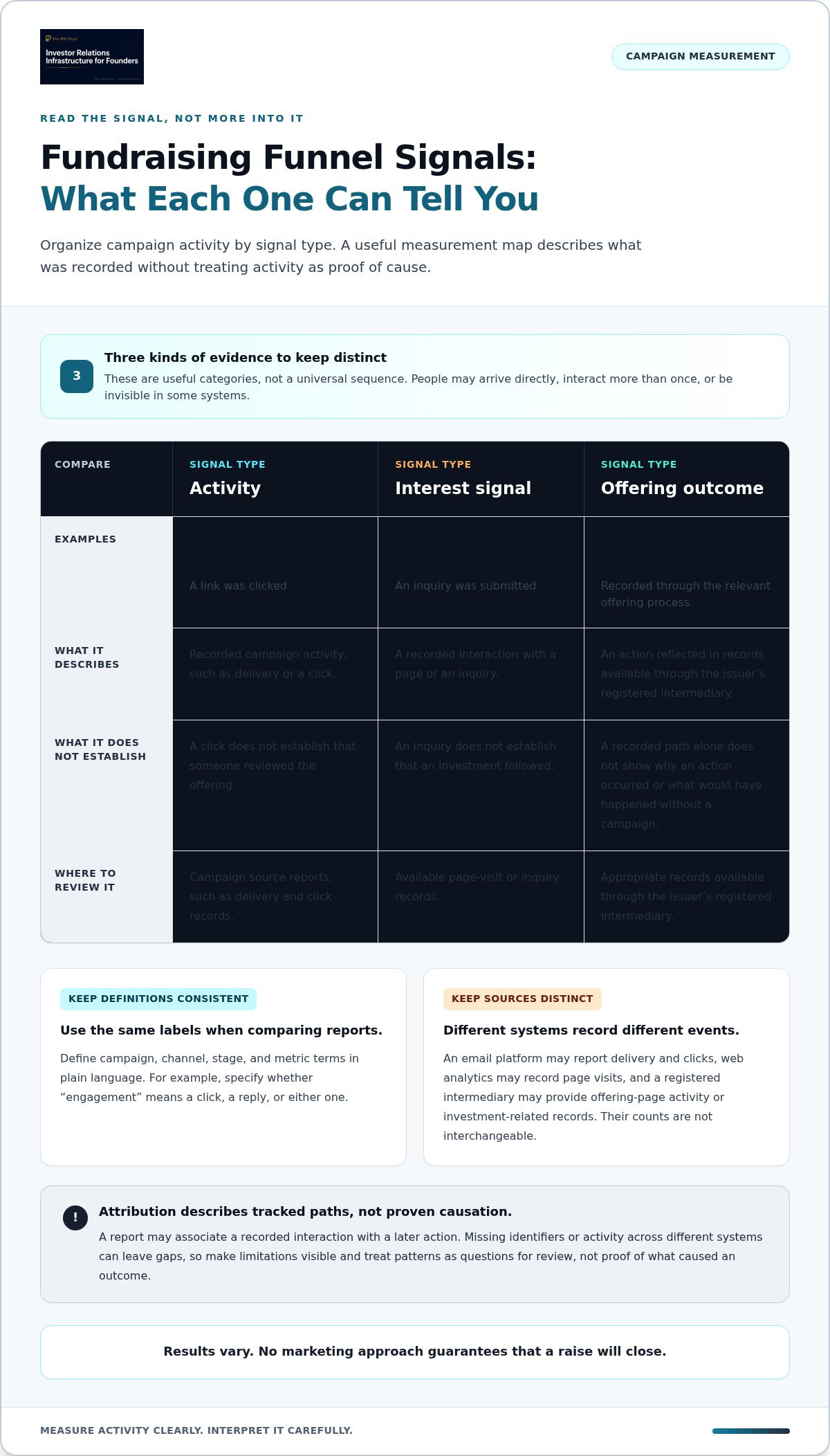
Clicks, visits, and inquiries are campaign activity or interest signals. They can help an issuer understand where people interacted, but they are not completed investment activity. A click doesn’t establish that a person reviewed the offering, and an inquiry doesn’t establish that an investment followed. Offering outcomes should be reviewed using the appropriate records available through the issuer’s registered intermediary, not inferred from marketing metrics alone.
- Activity: a message was delivered or a link was clicked.
- Interest signal: someone visited an offering page or submitted an inquiry.
- Offering outcome: an investment-related action is recorded through the relevant offering process.
Attribution describes tracked paths, not proven causation. A report may associate a recorded interaction with a later action, but it cannot by itself establish why that action occurred or what would have happened without the campaign. Use the data to identify patterns and questions for review, not to claim certainty. Results vary. No marketing approach guarantees that a raise will close.
Build a Fundraising Analytics Map for Data and Attribution
A useful analytics map starts with the evidence available, not with a dashboard. List each source used for campaigns done for the issuer, then note what it records and how its data can be interpreted. An email platform might report delivery and clicks; web analytics may record page visits; the registered intermediary may provide offering-page activity or investment-related records. These sources describe different events, so don’t treat their counts as interchangeable.
- Source: Name the platform, report, or system.
- Measure: State the event or activity it records.
- Owner and cadence: Identify who reviews it and how often it is updated.
- Limitations: Record missing identifiers, aggregate reporting, or other gaps that affect interpretation.
Create a consistent measurement dictionary
Before comparing channels, define campaign, channel, stage, and metric labels in plain language. For example, decide whether “engagement” means a click, a reply, or either one, and apply that definition consistently. Document what qualifies for each stage, who maintains the definition, and which source supplies the measure. If a source changes how it reports an event, note the change rather than silently comparing unlike data.
Keep this dictionary operational. It should explain how campaign activity is counted, not restate offering terms or become investor-facing language. For broader professional context, the Association of Fundraising Professionals (AFP) provides a reference point for fundraising practice; an issuer’s measurement definitions should still reflect its own campaign and reporting systems.
Use attribution tracking without overstating its meaning
Attribution tracking can connect recorded campaign interactions, such as a tracked link click followed by a page visit, when the available records support that connection. But the map may be incomplete. Someone may change devices, use a different browser, arrive directly at the offering page, or interact through a channel that doesn’t pass identifying information into another system. A report should make those gaps visible rather than imply it captures every step.
Use consistent labels for attribution records and retain the source of each observation. A sequence can show that certain interactions were recorded before another event; it cannot establish that one touchpoint caused an investment. Treat attribution as one view of campaign activity, not a finding about an individual’s intent.
Place lead scoring in context
Lead scoring can help organize follow-up by applying consistent criteria to recorded signals. It is a prioritization method, not proof that someone intends to invest. A score may reflect documented engagement, while leaving out interactions that weren’t captured. Keep the criteria clear, and don’t present a score as an investment decision or outcome.
A CRM can be one part of the wider measurement map. Our Custom Investor CRM supports lead scoring and attribution tracking. Issuers considering how CRM fits with their systems can review this fundraising technology stack discussion. For a focused conversation about structuring an analytics workflow, discuss your measurement needs.
Compare Fundraising Analytics Approaches Without Confusing Signals
Different analytics views answer different questions. Channel reporting shows activity within a source or campaign. Journey-based attribution connects interactions recorded across sources. A stage-level funnel view groups activity according to the issuer’s defined campaign stages. Full-funnel analytics for fundraising can use these views together, but adding more tracked touchpoints doesn’t automatically make the conclusions more reliable. The quality and coverage of the underlying records still matter.
Choose an approach based on the decision you need to inform and the campaign data you can reasonably review. A simple, consistently defined view can be more useful than a detailed report built from incomplete or inconsistent records.
| Approach | Question it helps answer | Useful inputs | Limitation |
|---|---|---|---|
| Channel-level reporting | What activity was recorded in a particular channel or campaign? | Source reports for email, advertising, social, or other issuer campaign activity | May summarize activity without showing interactions across other channels or later stages |
| Journey-based attribution | Which recorded interactions appear along a reported path? | Consistent campaign labels and linked interaction records across available sources | Can omit interactions that weren’t captured or connected; a recorded path doesn’t prove causation |
| Stage-level funnel view | How is recorded activity distributed across the issuer’s defined stages? | Agreed stage definitions and source measures mapped to each stage | Depends on consistent definitions and may not reveal why someone moved between stages |
Channel reporting versus journey-level attribution
Channel reporting is useful for reviewing what a source reports, such as clicks from a campaign or visits attributed to a channel. Journey-level attribution offers a broader view of interactions recorded across sources. That view can help identify paths for further review, but it may miss cross-device or otherwise unlinked activity. Neither view alone proves which activity caused an investment outcome. Treat patterns as observations, not causal findings.
What a fundraising dashboard should make clear
A dashboard should make its definitions and boundaries visible, not just display totals. Label the reporting period, data source, campaign and channel, and the stage assigned to each measure. Note whether a figure counts people, events, or sessions if that distinction is relevant to the source. Keep observed activity separate from interpretation and any decision made in response.
For example, a report might show that one channel recorded more visits than another during the same reporting period. That’s an observation. Concluding that the first channel caused more investment activity would require evidence the report may not contain. Add a short note on missing or incomplete data so readers understand the limits before comparing results.
Infrastructure choices can affect how campaign records are organized and reviewed. Issuers mapping those choices can use this fundraising technology stack resource as context. The appropriate setup depends on the issuer’s data sources, definitions, and reporting needs, not on how many touchpoints a dashboard can display.
How to Set Up a Repeatable Fundraising Analytics Workflow
A workable process begins with a decision, not a long list of metrics. Decide what the issuer needs to understand, such as whether campaign activity is reaching the intended stages or whether reporting sources show a consistent pattern. Then select only the measures that help address those questions. This keeps full-funnel analytics for fundraising focused on reviewable evidence rather than dashboard volume.
Set the measurement question and reporting rhythm
Choose a practical, consistent rhythm for reviewing available reports, based on the campaign and the decisions at hand. Assign an owner to collect reports, another reviewer if useful, and a place to document definitions and findings. The aim is a routine the issuer can maintain, not a universal schedule. Keep reporting focused on a small set of questions.
- State the decision or question. Write down what the review should inform, such as whether reported activity is consistent across campaign sources.
- Select relevant measures. Use only measures tied to that question. Record their stage definitions, source labels, and reporting dates so comparisons have a clear basis.
- Assign collection and review. Identify who gathers each source report, who checks that definitions remain consistent, and where notes are stored.
- Compare observations carefully. Compare periods only when the campaign setup, definitions, and source reporting are sufficiently consistent. If they changed, mark the comparison as limited.
- Document findings and next steps. Separate what the reports show from interpretations and decisions. Record open questions and who will follow up.
Review findings and record limitations
Each review should capture what was observed, what remains unknown, and what may explain a change. Note missing data, changes to campaign setup, reporting differences, and other plausible explanations before drawing conclusions. Keep these notes with the reports, so future reviews can distinguish a real shift in recorded activity from a change in how it was measured.
Include a clear handoff between campaign reporting, the issuer’s registered intermediary, and qualified securities counsel. Campaign reports can summarize marketing activity for the issuer. The intermediary’s records provide a separate view of offering activity. Bring discrepancies or questions with legal significance to qualified securities counsel for legal decisions. Keep those roles distinct; campaign analytics alone shouldn’t be used to interpret offering records or settle legal questions.
System-level choices affect how sources and reports fit together. Issuers considering that setup can review this fundraising technology stack resource as one reference point. The workflow should match the issuer’s reporting needs and available systems, with definitions and limitations documented in one accessible place.
A focused conversation can help an issuer think through measurement questions, reporting responsibilities, and the review process alongside its registered intermediary and qualified securities counsel. Schedule a fundraising workflow conversation.
Bring Full-Funnel Analytics into an Issuer’s Campaign Support
Analytics is most useful as a disciplined support process: it helps an issuer organize campaign observations, review reporting limits, and prepare clearer questions. It isn’t a funding outcome or a promise that any specific activity will lead to an investment. A defined workflow can support better-informed reviews while keeping campaign activity distinct from offering records and legal decisions.
Pre-IPO Hype is investor relations infrastructure for Regulation CF and Regulation A+ raises. We are not a broker-dealer, funding portal, or investment adviser, and we do not offer or sell securities or make investment recommendations.
Where campaign support fits in the issuer’s process
Campaign support is provided alongside the issuer’s registered intermediary and qualified securities counsel. The issuer can use campaign reporting to review outreach and engagement, while the registered intermediary’s offering page and records remain the reference point for offering-related investor activity. Keep these information sources distinct when preparing a campaign review, and direct investors with questions about the offering to the issuer’s registered intermediary or offering page.
For Regulation CF and Regulation A+ campaigns, analytics should also fit the issuer’s broader responsibilities. Campaign definitions and reports can help the team understand what its systems record. They don’t replace offering documents, intermediary processes, or legal review. Refer legal decisions and questions about offering communications to qualified securities counsel.
When sharing campaign reports with the issuer’s internal team or discussing them with its intermediary, include the reporting period and the purpose of the review. This context helps recipients interpret the information appropriately and keeps campaign observations separate from offering-related records. Questions about the meaning or treatment of offering communications should be directed to qualified securities counsel.
Choose a practical next step for the measurement workflow
Before the next review, bring together three items: the questions the issuer needs analytics to inform, the data sources that can help answer them, and known limits in those reports. For example, note where campaign records are incomplete, where source definitions differ, or where a handoff to the registered intermediary is needed. This gives the review a clear scope and helps keep conclusions tied to what the records actually show.
Then agree on who prepares campaign observations, how they’ll be documented, and which questions should be shared with the intermediary or counsel. Keep any interpretation separate from the underlying data. This makes the workflow easier to revisit as campaign activity and reporting needs change, without treating additional tracking as certainty.
If you’re preparing a Regulation CF or Regulation A+ raise, a conversation about measurement questions, available reports, and workflow responsibilities can help clarify a practical next step. Schedule a fundraising workflow conversation.
Make Measurement Part of the Raise’s Ongoing Discipline
A fundraising measurement process can evolve as an issuer’s questions and campaign data change. The goal isn’t to track everything. It’s to keep the evidence useful for the decisions ahead, while making uncertainty visible rather than smoothing it away. That discipline gives founders a grounded basis for reviewing campaign activity as a Regulation CF or Regulation A+ raise progresses.
Full-funnel analytics for fundraising is most valuable when it remains a working practice, not a one-time report. Revisit whether the information being collected still answers the issuer’s questions, and bring legal decisions to qualified securities counsel.
If you’re ready to discuss how measurement questions, reporting sources, and campaign support fit your issuer’s process, Schedule a fundraising workflow conversation. A thoughtful next step can start with a clear view of what you need to understand.
Frequently Asked Questions
Is full-funnel analytics useful before a Regulation CF or Regulation A+ campaign launches?
Yes. Before launch, full-funnel analytics for fundraising can help an issuer check whether planned labels and reporting sources will produce a usable baseline. For example, document how the team will distinguish a campaign link click from an offering-page visit, then note which system supplies each figure. This preparation can reveal missing access or unclear definitions early, so the first campaign review is less likely to rely on improvised comparisons.
How often should an issuer review fundraising campaign analytics?
There’s no single review frequency that suits every raise. Set a rhythm that matches the campaign’s activity and the decisions the team needs to make. A review may be useful after a campaign change or when reports are available, provided the team can collect and interpret the data consistently. Record the reporting dates and any setup changes so each review has a clear context.
Can email opens or page visits be treated as evidence of investor intent?
No. An email open or page visit shows that an interaction was recorded, not what a person intends to do. A recipient might open a message without reading it, or visit a page for reasons unrelated to investing. Treat these measures as limited engagement signals. Don’t describe them as commitment or investment intent, and rely on the issuer’s registered intermediary for offering-related activity.
What is the difference between fundraising analytics and financial reporting?
Fundraising analytics concerns campaign activity, such as engagement with issuer outreach or visits to an offering page. Financial reporting concerns the company’s financial information and reporting obligations, which are distinct from marketing measures. A campaign dashboard cannot stand in for financial records or financial disclosures. Keep the two workstreams separate, and direct questions about financial reporting or required disclosures to qualified securities counsel.
How should a team handle incomplete or inconsistent campaign data?
Preserve the original reports and mark fields or periods that are missing, defined differently, or affected by a system change. Don’t fill gaps with estimates unless the method is clearly documented and the result is labeled accordingly. If two sources count different events, report them separately rather than combining totals. This gives reviewers a clear record of what’s known and what needs caution.
Does fundraising analytics replace the issuer’s registered intermediary or securities counsel?
No. Analytics can help the issuer review campaign activity, but it doesn’t replace the registered intermediary’s role in the offering process or qualified securities counsel’s role on legal questions. Keep campaign reporting separate from offering records. Direct investors to the issuer’s registered intermediary or offering page, and refer legal decisions to qualified securities counsel.
Can an issuer compare campaign channels when their tracking methods differ?
Only with care. First identify whether the channels record comparable events, use consistent labels, and cover the same reporting period. If one source counts clicks while another counts visits, a direct comparison of totals may mislead. The issuer can still review each channel on its own terms, then document the differences and limit any cross-channel conclusions to measures that are genuinely comparable.
Disclaimer
Educational only. Not investment, tax, or legal advice. Pre-IPO Hype is investor relations infrastructure for Regulation CF and Regulation A+ raises. We are not a broker-dealer, funding portal, or investment adviser, and we do not offer or sell securities or make investment recommendations. Any securities offering is made only by the issuer, through its own offering documents and, where required, a registered intermediary.


