
How to Turn Customers into Investors: Strategic Guide
Customer confidence can signal market demand, but it is not the same as an investment commitment. Learning how to turn customers into investors starts with showing what their feedback reveals: which problems your product solves, what needs improvement, and whether customers continue to engage.
It makes sense to look to customers for support. They already know the product and can explain its value in practical terms. Still, customer investment works best when expectations, incentives, and the company’s long-term plans align. This guide explains how to use feedback as evidence for prospective investors, what customer investment may offer a company, and how to consider investment structures and potential conflicts. It also covers why clear communication matters before customers take on a new role as shareholders. Results vary. No marketing approach guarantees that a raise will close.
Key Takeaways
- Use customer feedback to show what the market values, where the product needs work, and how the company responds.
- Assess whether a customer’s goals and relationship with the business align with its long-term strategy before considering investment.
- Weigh the potential value of customer capital against concentration risk, restrictive terms, and possible conflicts.
- Understand how investment structures differ, including what each means for the customer’s role and the company’s obligations.
- For a Regulation CF or Regulation A+ raise, coordinate campaign communications with the issuer’s registered intermediary and qualified securities counsel.
Company benefits of customer investment
Customer investment can connect a company’s financing strategy with the people who use its product. Customers often encounter practical issues that founders may not see in sales data alone. A software customer, for example, can explain which workflow slows its team and why a product change matters. That perspective can inform development priorities and help the company explain the problem it aims to solve.
A clearer feedback loop is another benefit. A business can group customer comments by themes such as product quality, service, pricing, and user experience. It can then describe what it changed and how it assessed the change. For example, if customers repeatedly report difficulty using a feature, the company can explain how that feedback informed a redesign. This gives investors concrete context for understanding how the company makes decisions.
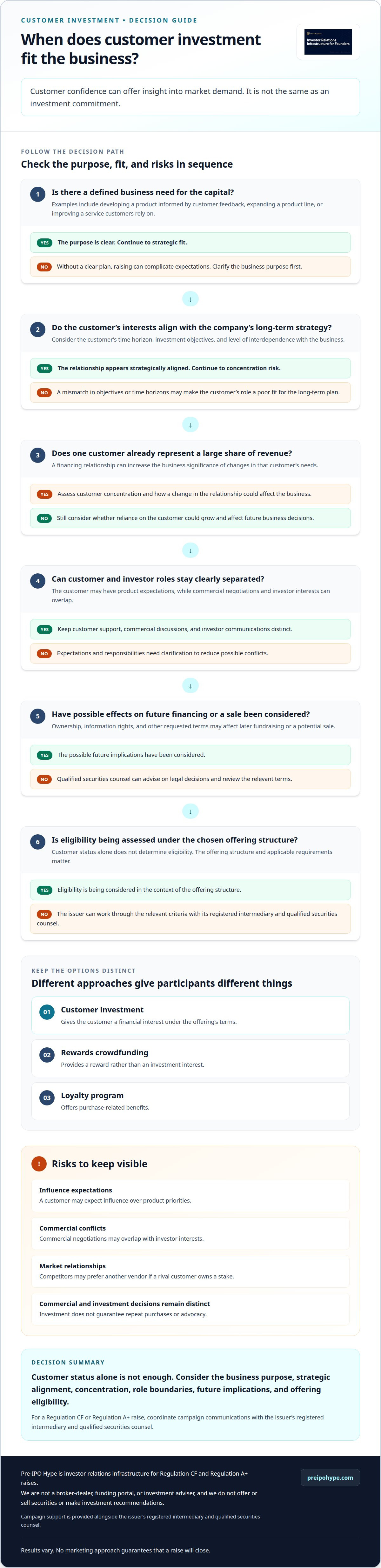
How do customer-investor programs compare with rewards crowdfunding and loyalty programs? An investment gives a customer a financial interest under the offering’s terms. Rewards crowdfunding provides a reward, while loyalty programs offer purchase-related benefits. These approaches have different purposes and give participants different things.
How can a company decide whether customers are eligible to invest? Eligibility depends on the offering structure and applicable requirements, not simply on customer status. The issuer can work through the relevant criteria with its registered intermediary and qualified securities counsel.
What are typical minimum investment amounts and fees for customer investment platforms? Platform and offering processes vary, so founders should review participation requirements and platform arrangements as part of planning. Qualified securities counsel can advise on legal decisions, while the issuer’s registered intermediary can explain its role in the offering process.
How can a business launch a customer investment program step by step? Define the business purpose, choose an appropriate offering structure with qualified securities counsel, and coordinate with the registered intermediary. Then prepare clear customer communications, explain how feedback informed business decisions, and keep investor discussions separate from customer service.
What are the risks and drawbacks of letting customers invest in a business? A customer may expect influence over product priorities, or commercial negotiations may overlap with investor interests. If a company relies heavily on one customer, changes in that customer’s needs can also carry greater business significance.
Set expectations before these relationships overlap. For example, clarify how the company handles product requests, customer support, and investor communications. A defined process helps the business use customer insight while keeping commercial decisions and investment discussions clear.
When considering these relationships, companies should seek investors whose time horizons, investment objectives, or interdependence align with the company’s long-term strategy. Keep strategic fit central when deciding which customers to approach.
Reasons to raise capital from customers
Customers can bring more than capital: they understand how a product performs in real operating conditions. A restaurant group using scheduling software, for example, can identify workflow needs that may shape the company’s product roadmap. That perspective can help founders connect financing plans with development priorities customers recognize.
Customer investment may also deepen a commercial relationship. An invested customer has a financial interest in the company, alongside its existing reason to buy the product. That alignment can support candid feedback and continued engagement, but it does not guarantee repeat purchases or advocacy. The customer’s investment decision and buying decisions remain distinct.
For a business considering new funding sources, customers may offer another route to explore alongside other financing options. Their familiarity with the product can make its use case easier to understand. But customer capital should support a defined business need, such as expanding a product line or improving a service customers already rely on. Raising without a clear plan can complicate expectations rather than clarify them.
A customer’s commercial position can also create strategic value. If a major company invests, that relationship may lend credibility in the market, especially when the investor is a recognized buyer. The same investment can create tension: competitors may prefer another vendor because a rival customer owns a stake. Founders should weigh that possibility before making a customer relationship central to their financing strategy.
There are practical reasons to proceed carefully:
- Clarify the purpose. Connect the proposed capital to a business objective, such as product development informed by customer feedback.
- Assess concentration. Consider whether one customer already represents a large share of revenue. A financing relationship can increase the impact of changes in that customer’s needs.
- Separate roles. Define how the company handles customer support, commercial discussions, and investor communications.
- Consider future financing. Review how ownership, information rights, or other requested terms could affect later fundraising or a potential sale.
Customer investment is not automatically a substitute for venture capital. Corporate investors may make an initial investment without participating in later rounds, while venture capital firms may invest multiple times. A founder planning for continued development should consider whether the customer’s role fits the company’s financing needs beyond the current raise.
Before choosing this route, map the customer’s business interests against the company’s long-term plans. A customer seeking influence over product priorities may have different expectations from one seeking a financial stake. A focused fundraising strategy discussion can help founders frame those questions before they approach customers.
What are common ways for customers to invest in a company?
A customer can invest directly in a company or participate in an offering available to eligible investors. The structure determines what the customer receives, how the investment is documented, and what relationship follows. For a founder, the central choice is whether the customer should become an owner or use another documented investment arrangement.
Equity shares give the customer an ownership interest in the company. The offering documents describe the rights attached to those shares, and the company records the customer as a shareholder. For example, a business customer investing in a software company may hold shares while remaining separately governed by its service contract. Keeping commercial agreements distinct from shareholder rights helps set clear expectations.
Convertible securities begin as an investment that may convert into shares under the instrument’s terms. This can defer some ownership decisions until a later event, but it adds terms customers need to understand. Founders should have qualified securities counsel review the structure and explain how conversion could affect the company’s ownership records and future financing.
Participation in a securities offering gives customers a defined way to consider investing alongside other eligible participants. Regulation CF and Regulation A+ are possible offering frameworks for issuers, each with its own process and requirements. The issuer’s registered intermediary and qualified securities counsel support the offering process. Investors should be directed to the issuer’s offering page or registered intermediary for information and participation.
These routes serve different purposes. Equity establishes ownership at the outset. A convertible security may establish ownership later, according to its terms. An offering gives the company a structured way to present its investment opportunity. These options are not interchangeable, and a customer relationship alone does not determine which structure fits.
Before selecting an approach, founders can map the decision across a few practical questions:
- What is the business purpose? Connect the investment to a defined plan, such as product development requested by customers.
- What rights will the customer receive? Clarify ownership, information, and decision-making provisions in the relevant documents.
- Could commercial interests conflict? A customer that also holds shares may have priorities beyond its purchasing relationship.
- How will the structure affect later financing? Review ownership and contractual terms in light of the company’s longer-term plans.
A customer advisory board is different. It can gather input from several customers, and companies may ask participating businesses to fund product development. That arrangement should not be described as an investment in shares unless the documents establish an actual securities investment. Qualified securities counsel can help founders distinguish advisory, commercial, and investment relationships before they communicate with customers.
How do Regulation CF and Regulation A+ apply when a company offers shares to customers?
A customer share offering is still a securities offering. The company must identify an available offering framework and follow its requirements, whether customers are existing buyers, business clients, or new participants. In the United States, Regulation CF and Regulation A+ are two frameworks founders may consider. Customer status alone does not determine which one fits.
Under Regulation CF, the issuer’s offering process involves a registered intermediary. That intermediary’s role is separate from the issuer’s marketing and customer communications. The issuer should coordinate campaign materials with the intermediary and qualified securities counsel before sharing offering information. Investors should be directed to the issuer’s registered intermediary or offering page for participation details.
Paid promotion has its own rules. Under Rule 205 of Regulation Crowdfunding (17 CFR 227.205), the issuer must take reasonable steps to make sure anyone it pays to promote the offering in the platform's communication channels discloses the payment with every communication. Outside those channels, paid promotion is limited to the notices Rule 204 allows. The issuer should run any paid promotion past qualified securities counsel and its registered intermediary.
Regulation A+ is another route founders may evaluate. It may suit a company able to manage the relevant offering and reporting obligations. The choice between Regulation CF and Regulation A+ depends on the issuer’s circumstances, objectives, readiness, and ability to meet the requirements. Having a customer base does not remove those considerations or create a separate exemption.
Before choosing a framework, the issuer should develop a clear sequence with its professional team:
- Define the offering purpose. State how the company plans to use the proceeds, such as funding a specific product development priority.
- Discuss the structure. Ask qualified securities counsel to evaluate the legal choices and explain the relevant requirements.
- Coordinate the process. Work with the registered intermediary where Regulation CF applies, and align issuer communications with the offering process.
- Review every communication. Check that customer-facing statements match the offering materials and disclose paid promotion when required.
Founders should not treat a customer conversation as a substitute for an offering process. For example, discussing a possible investment with a long-standing buyer does not establish that the buyer is eligible or that the proposed transaction meets securities requirements. Counsel can assess the legal implications of the issuer’s structure, communications, and terms.
These frameworks have different requirements, so the issuer’s decision should reflect its actual readiness and plans, not simply customer interest. Qualified securities counsel can advise on legal decisions. The registered intermediary can address its role in a Regulation CF offering. Keep this distinction clear in company materials, customer discussions, and investor communications.
Other exemptions exist. Qualified securities counsel picks the path that fits the company.
Pre-IPO Hype: Custom Investor CRM
Pre-IPO Hype / FWSC is a marketing agency, not a broker-dealer or investment adviser. We do not sell securities or take a percentage of any raise. We are not a funding portal and do not make investment recommendations.
For an issuer preparing a raise, Pre-IPO Hype provides campaign support alongside the issuer’s registered intermediary and qualified securities counsel. Campaign support is provided alongside the issuer’s registered intermediary and qualified securities counsel. Our Custom Investor CRM supports lead scoring and attribution tracking.
Founders may discuss campaign support alongside the issuer’s registered intermediary and qualified securities counsel. Legal decisions and securities requirements remain matters for qualified securities counsel.
Contact Pre-IPO Hype to discuss campaign support
Build a customer investment plan for the next stage
Treat the next phase as a planning exercise, not a conversion campaign. Decide what role customer capital should play in the company’s growth, which business priorities it supports, and what boundaries will keep commercial and investor relationships clear.
Then turn customer evidence into a credible account of the company’s direction. Identify which feedback shaped product or service decisions, what the company learned, and how management will assess progress. Separate demonstrated customer behavior from future projections. Clear distinctions make investor communications more useful without overstating what customer interest says about an investment.
A practical approach to how to turn customers into investors also requires someone to own communications and coordination with qualified securities counsel on legal decisions. Set this foundation before expanding conversations with customers.
Thoughtful preparation gives customers a clearer basis for deciding whether an investment fits their own objectives.
Frequently Asked Questions
How can businesses turn customer feedback into an investor attraction tool?
Businesses can present feedback as evidence of how they learn and make decisions, not as proof that customers will invest. For example, show a recurring product issue, the change made in response, and the customer behavior observed afterward. Separate direct customer comments from management’s interpretation, and get permission before identifying customers or using their words publicly. This gives prospective investors specific context for assessing customer needs and the company’s execution.
Why should you consider raising capital from your customers?
Customer capital may bring financing from people who already understand how the product is used in practice. It can also give a company access to informed feedback from an investor’s perspective. Consider it when the customer’s reasons for investing fit the company’s plans and do not undermine commercial relationships. For instance, a business buyer may value product continuity, while the issuer must still assess the investment structure and communicate its risks clearly.
What does it mean to turn customers into investors?
It means a customer makes a separate investment in the company and receives the rights described in the offering documents. Buying a product, renewing a contract, or giving positive feedback does not itself make someone an investor. For founders exploring how to turn customers into investors, the distinction matters: customer activity can inform outreach, but any investment requires a clear offering process and the customer’s consent.
Disclaimer
Educational only. Not investment, tax, or legal advice. Pre-IPO Hype is investor relations infrastructure for Regulation CF and Regulation A+ raises. We are not a broker-dealer, funding portal, or investment adviser, and we do not offer or sell securities or make investment recommendations. Any securities offering is made only by the issuer, through its own offering documents and, where required, a registered intermediary.