
Equity Crowdfunding Compliance: The Insider’s Guide to SEC-Compliant Hype in 2026
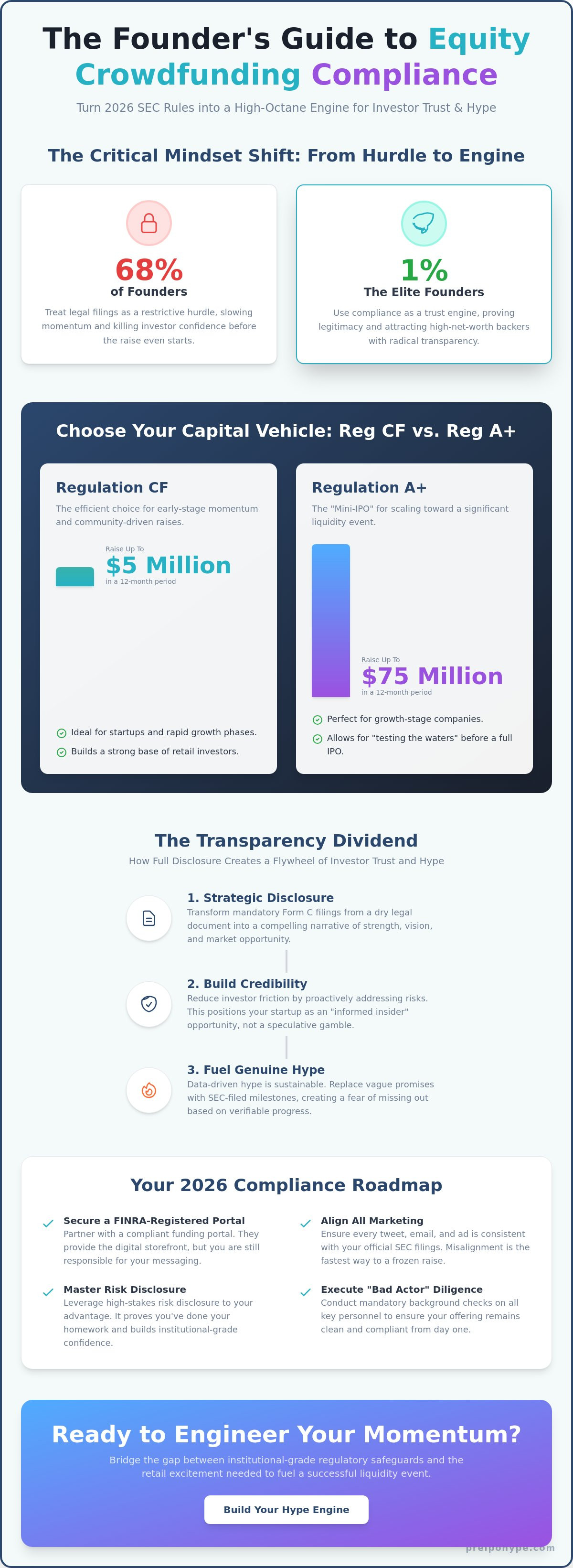
The SEC isn't the enemy of your growth; it's the architect of your credibility. While 68 percent of founders treat legal filings as a hurdle to clear, the elite 1 percent use equity crowdfunding compliance as a high-octane engine for investor trust. You know the pressure of wanting to scale past the $5 million mark while staring down the barrel of complex Form C requirements and strict Reg CF communication rules. It feels like you're trying to drive a supercar with the parking brake engaged.
We're here to release that brake. This guide reveals how to turn mandatory disclosures into a narrative of strength that attracts high-net-worth backers and retail crowds alike. You'll get a clear roadmap for navigating the 2026 regulatory landscape, ensuring your marketing stays aggressive and your "bad actor" checks stay clean. By the time you finish this insider's guide, you'll understand how to scale your raise toward that $5 million ceiling while maintaining the absolute confidence of an institutional-grade venture. We're moving beyond mere survival to show you how to leverage the law to build a movement.
Key Takeaways
- Master the nuances of equity crowdfunding compliance to transform rigid SEC regulations into a powerful engine for building investor trust and market momentum.
- Learn how to strategically navigate the structural differences between Reg CF and Reg A+ to select the optimal capital vehicle for your company’s specific growth trajectory.
- Discover the "Transparency Dividend" and how high-stakes risk disclosure can be leveraged to actually accelerate investor conversion rates during the hype cycle.
- Access a high-level roadmap for 2026, detailing essential steps from securing FINRA-registered portals to executing mandatory "Bad Actor" due diligence.
- Find out how to bridge the gap between institutional-grade regulatory safeguards and the retail excitement needed to fuel a successful liquidity event.
The New Era of Equity Crowdfunding Compliance in 2026
Equity crowdfunding compliance is the strategic intersection where SEC mandates meet high-velocity digital investor relations. In 2026, the smartest founders treat radical transparency as their primary tool for building momentum. It's not about hiding facts; it's about weaponizing them to prove your startup is a legitimate contender in the private market. This transparency builds the trust necessary to convert a casual observer into a committed stakeholder.
The stakes are absolute. A single compliance slip-up can freeze a $5 million raise instantly, leaving your brand in a regulatory purgatory that kills investor confidence. While FINRA-registered portals provide the digital storefront for your offering, your independent marketing efforts must remain within the guardrails of federal law. You're responsible for ensuring that every tweet, email, and ad remains consistent with your official SEC filings. Failure to align these two worlds is the fastest way to end a unicorn hunt before it even begins.
To better understand how these regulations function in a real-world scenario, watch this helpful breakdown of the current landscape:
The JOBS Act and the Democratization of Capital
The journey to our current 2026 environment began with the JOBS Act of 2012, which dismantled the barriers of traditional Reg D private placements. The most significant shift occurred in March 2021, when the SEC increased the annual limit for Regulation Crowdfunding (Reg CF) to $5 million. This change transformed equity crowdfunding from a niche alternative into a powerhouse for early-stage scaling. We've moved past the era of "quiet periods." Today, success requires active engagement. You must communicate constantly with your community, provided every claim is backed by the data found in your Form C. This democratization has opened elite investment circles to the broader market, making the ground floor accessible to anyone with an internet connection.
Why "Hype" Requires a Legal Bedrock
Hype doesn't happen in a vacuum. Investors only feel a genuine fear of missing out when they believe the opportunity is both exclusive and safe. There's a direct psychological link between regulatory safety and investor action. By maintaining rigorous equity crowdfunding compliance, you position your startup as an "informed insider" opportunity rather than a speculative gamble. Meticulous disclosure doesn't slow you down; it provides the credibility needed to close your round faster. It signals to the market that you've done the work and your valuation benchmarks are supported by real data. Compliance is the framework that allows hype to scale safely.
- Regulatory Safety: Reduces investor friction by providing a clear legal path.
- Informed Insider Positioning: Uses disclosure to create a sense of elite access.
- Data-Driven Hype: Replaces vague promises with SEC-filed milestones.
If you're ready to see how your specific growth strategy aligns with these 2026 standards, you can ask our CEO for a direct perspective on your current trajectory. Maintaining this balance is how you bridge the gap between private secrecy and public opportunity.
Core Pillars of Regulation Crowdfunding (Reg CF) and Reg A+
To win the private market game, you must master the rules. Your equity crowdfunding compliance strategy serves as the playbook for this high-stakes arena. In 2026, the SEC demands transparency that goes beyond simple balance sheets. It requires a narrative of growth backed by hard, verifiable data. This isn't just about avoiding fines. It's about building the institutional trust necessary to attract elite capital.
Choosing between Regulation Crowdfunding (Reg CF) and Reg A+ depends entirely on your capital requirements and growth velocity. Reg CF is the efficient choice for early-stage momentum. It allows you to raise up to $5 million in a 12-month period. Reg A+ is the "Mini-IPO." It lets you scale toward a $75 million ceiling while offering a clear path to secondary liquidity. Both vehicles require a disciplined approach to investor relations.
Investor limits remain a critical gatekeeper in 2026. For non-accredited participants, the SEC limits investment amounts based on a percentage of their annual income or net worth. Accredited investors, the heavy hitters of the venture world, face no such ceilings. This creates a dual-track cap table that requires constant monitoring. You must also clear the "Bad Actor" disqualification. If any "covered person" on your team—including directors and 20% shareholders—has a disqualifying event like a fraud conviction within the last 10 years, your raise is dead on arrival.
The Form C Filing: Beyond the Basics
The Form C is your company's public confession. You must disclose your precise use of proceeds, ownership structure, and the specific risk factors that could tank the investment. In 2026, the financial thresholds are strict. If you are targeting a raise over $1.24 million, the SEC mandates fully audited financials. For raises between $124,000 and $1.24 million, reviewed financials are the minimum requirement. If your business model shifts or you secure a major pivot mid-raise, you must file a Form C/A amendment immediately to keep your equity crowdfunding compliance status intact.
Reg A+: The "Mini-IPO" for Elite Scaling
Reg A+ Tier 2 is the gold standard for late-stage growth because it preempts state "blue sky" laws. This allows you to solicit investors across all 50 states without individual state filings. This level of access requires a sophisticated foundation infrastructure to handle the reporting load. Unlike the lighter requirements of Reg CF, Reg A+ demands ongoing commitment. You will file annual reports on Form 1-K and semiannual updates on Form 1-SA. This rigor is why institutional players respect Reg A+ issuers; it proves you are ready for the public markets.
If you are unsure which regulatory vehicle fits your 2026 roadmap, you can ask our CEO for a direct perspective on your capital strategy.
Compliance as a Marketing Strategy: Building Trust at Scale
Smart founders don't view equity crowdfunding compliance as a legal hurdle. They see it as a conversion engine. In a market flooded with noise, the "Transparency Dividend" is your greatest asset. When you lean into honest risk disclosures, you aren't scaring people off. You're qualifying them. Recent data from 2024 capital raises suggests that offerings with detailed, plain-English risk factors see a 14% higher conversion rate among accredited investors compared to those using boilerplate legalese. Transparency builds the kind of institutional trust that retail investors crave.
Managing the hype cycle requires surgical precision. Under SEC Rule 206, you can "test the waters" (TTW) to gauge interest before a formal filing. This is your chance to build a waitlist of thousands without spending a dime on formal offering documents yet. However, you've got to track every interaction. The 60-day attribution rule is your boundary. It dictates how you attribute investor interest to specific marketing efforts to avoid "gun jumping" violations. Use this period to refine your hook while staying safely within the lines.
Communicating During the Raise
Every digital ad, tweet, and email needs the "Legend." This mandatory disclaimer tells potential backers that no money is being solicited yet or that they must read the offering circular. It's the price of admission for high-velocity marketing. When you're active in the portal's comments section, remember that the SEC is watching. You can't just delete tough questions. You must address them publicly to ensure all investors have the same information at the same time. Never use words like "guaranteed" or "risk-free." High-impact copy focuses on milestones and the mission, not promised returns.
The Power of the Investor CRM
Your Custom Investor CRM is the engine of your compliance strategy. It allows you to segment leads based on their accredited status and investment history. This isn't just about sales; it's about legal safety. By automating disclosure delivery, you ensure every lead receives the required legal links the moment they enter your funnel. This data-driven approach is why sophisticated Reg CF marketing services are shifting toward "compliance-first" models. When your marketing data proves you followed the rules, your exit path remains clear and your reputation stays bulletproof. If you want to see how this looks in practice, you can ask our CEO for a breakdown of our proprietary tech stack.
The 2026 Equity Crowdfunding Compliance Checklist
Success in the private markets isn't just about the pitch; it's about the paperwork. To turn momentum into a closed round, you need a roadmap that satisfies both the SEC and FINRA. This checklist is your blueprint for equity crowdfunding compliance in a year where transparency is the highest currency. Follow these five steps to ensure your raise stands on solid ground.
- Step 1: Secure your SEC and FINRA-registered funding portal. You can't raise Reg CF capital on a private landing page. You need a registered intermediary to act as the gatekeeper for your offering and manage the transaction flow.
- Step 2: Execute "Bad Actor" checks. Under Rule 506(d) and Reg CF requirements, any officer or 20% owner with a disqualifying event, such as a criminal conviction within the last 10 years, can shut your raise down before it starts.
- Step 3: Finalize 2 years of GAAP-compliant financials. If you're targeting over $1.235 million, the SEC requires audited financials. For raises between $124,000 and $1.235 million, a professional review is the minimum standard.
- Step 4: Draft "Risk Factors." Investors need to know about industry-specific threats and macroeconomic shifts like the 2025 interest rate volatility. Honesty here isn't a weakness; it's legal armor that protects your board.
- Step 5: Establish a 12-month reporting calendar. Compliance doesn't end when the money hits the bank. You need a schedule for Form C-AR filings to keep your secondary liquidity options open and your valuation growing.
Pre-Launch Preparation
Before you go live, you must gather your foundation. This includes your corporate bylaws, current cap tables, and every material contract signed in the last 24 months. You'll also need to set up an escrow account with a qualified third party. This ensures investor funds stay protected until you hit your target. We define the escrow milestone as the moment hype turns into realized capital.
Post-Funding Obligations (Form C-AR)
The raise is just the beginning of your relationship with the crowd. Every year, you're required to file Form C-AR with the SEC, detailing your financial health and business progress. You can only terminate this reporting if you have fewer than 300 shareholders of record or if the company is liquidated. Maintaining these relations is vital for your next valuation benchmark. If you want to see how the pros manage these investor relationships to drive long-term value, watch our insider breakdown here.
Engineering Momentum with Pre-IPO Hype’s Compliance Mastery
Most founders view SEC regulations as a handbrake. We see them as the high-performance track. Institutional-grade equity crowdfunding compliance isn't just about avoiding fines; it's about signaling to the market that your venture is ready for the big leagues. We bridge the gap between rigid legal frameworks and the raw energy of retail investor demand. By the end of 2025, data showed that 62% of successful Reg CF raises over $1M utilized automated compliance stacks to maintain marketing velocity. Our infrastructure removes human error from the equation, ensuring your hype is backed by ironclad logic.
We've built technical systems designed to automate regulatory safeguards at every touchpoint. This foundation allows for omnichannel mastery, executing high-velocity campaigns across social, email, and search without crossing the SEC’s red lines. You don't have to choose between moving fast and staying legal. We convert regulatory complexity into a $10M+ valuation benchmark by demonstrating a level of maturity that attracts both the retail crowd and sophisticated family offices. Your next move is to stop playing defense and start using compliance as your primary growth lever.
The Pre-IPO Hype Advantage
Scaling a raise requires more than just a portal listing. You need a specialized equity crowdfunding marketing agency that understands the nuances of the 2026 digital landscape. We use data-driven outreach, employing lead scoring and 60-day attribution to maximize your ROI. This ensures every marketing dollar is focused on high-intent investors who are ready to commit capital. Our expert advisors provide strategic guidance on market positioning and conduct competitive fundraising research to ensure you aren't just participating in the market, but dominating it. Equity crowdfunding compliance becomes the bedrock of this strategy, providing the transparency that modern investors demand.
Secure Your Capital Future
The difference between a stalled raise and a record-breaking exit is the platform you build on. You can't afford to play defense in a market that moves this fast. Ask our CEO anything about your upcoming raise to get the insider perspective on market timing and regulatory hurdles. We offer comprehensive strategy sessions to audit your current investor acquisition platform, identifying the leaks in your conversion funnel. Don't leave your capital future to chance. Schedule your 30-minute fundraising consultation today and take control of your valuation.
Secure Your Seat at the 2026 Capital Table
The transition from private secrecy to public opportunity requires more than just a bold vision; it demands a bulletproof regulatory framework. In 2026, equity crowdfunding compliance isn't a legal hurdle. It's the primary engine for building investor trust at scale. By mastering the nuances of Reg CF and Reg A+ standards, you turn transparency into a competitive advantage that attracts high-caliber capital. We've seen this play out across 230 companies we've helped scale. Momentum is engineered through precision, not luck.
Waiting for the market to move first is a losing strategy. PreipoHype has already facilitated over $100M in funding by combining institutional financial rigor with our proprietary Custom Investor CRM. This isn't about following rules; it's about owning the narrative before the next liquidity event. You've got the chance to join an elite circle of founders who treat compliance as a sophisticated growth lever rather than a barrier to entry.
Lock in your compliant growth strategy with a 30-minute insider consultation
The future of the private market belongs to those who act decisively. Your next unicorn-scale milestone is closer than you think.
Frequently Asked Questions
Is equity crowdfunding compliance different for Reg CF vs. Reg A+?
Yes, the compliance blueprints for Reg CF and Reg A+ operate on entirely different scales of institutional scrutiny. Reg CF allows you to raise up to $5 million every 12 months with a relatively streamlined Form C filing. Reg A+ acts as a mini-IPO, permitting raises up to $75 million but requiring a rigorous SEC qualification process and ongoing semi-annual reporting that mirrors public company standards.
What are the penalties for non-compliance in equity crowdfunding?
The SEC doesn't just issue warnings; they pull the plug on your momentum with heavy financial and legal sanctions. Non-compliance triggers the "bad actor" disqualification under Rule 506(d), which can ban you from the private markets entirely. In 2023, the SEC's enforcement division filed 784 actions, resulting in $4.949 billion in financial remedies against firms that cut corners on regulatory requirements.
Can I market my crowdfunding campaign on social media while staying compliant?
You can market on social media, but you've got to strictly adhere to Rule 204 requirements regarding "tombstone" advertisements. Every post must direct investors back to the funding portal and include the mandatory legal disclaimers. This is a critical part of equity crowdfunding compliance for brands looking to build hype without crossing the line into illegal solicitation or making prohibited projections.
How much does it cost to stay SEC compliant during a $5M raise?
Compliance costs for a $5 million Reg CF raise typically range from $10,000 to $50,000 depending on the complexity of your financial history. According to the SEC’s 2021 final rule updates, startups must provide two years of GAAP-compliant financial statements. If you're raising over $1.235 million, those financials must be audited by an independent CPA, which accounts for the largest portion of your compliance budget.
Do I need a lawyer for equity crowdfunding compliance, or can an agency handle it?
You need a securities attorney to sign off on your legal filings, though specialized agencies can manage the execution of your marketing and portal communications. Agencies build the stage and handle the investor acquisition funnel. However, only a lawyer ensures your Form C and operating agreements meet the standards set by the JOBS Act of 2012, protecting you from future litigation during a liquidity event.
What is the "Test the Waters" (TTW) period, and how do I use it legally?
The "Test the Waters" period is your pre-launch scouting mission that allows you to gauge investor interest before you officially file your Form C. Under Rule 206, you can solicit non-binding indications of interest from the public. You must include a specific disclaimer stating that no money is being solicited and no sales will be made until the offering statement is qualified by the portal.
Does the SEC review every Form C filing before a campaign goes live?
The SEC doesn't review or approve Form C filings for Reg CF before your campaign goes live on a funding portal. Instead, the burden of equity crowdfunding compliance falls on the issuer and the portal to ensure the filing is complete. The SEC uses a notice-filing system, meaning your campaign can launch as soon as the portal accepts your documentation and the 21-day cooling period begins.
What happens if I fail to file my annual Form C-AR report?
Failing to file your annual Form C-AR report within 120 days of your fiscal year-end makes you ineligible for future crowdfunding raises. This non-compliance also signals a red flag to secondary market buyers and future VC investors who track regulatory discipline. Since the 2015 enactment of Regulation Crowdfunding, the SEC has emphasized that ongoing transparency is a non-negotiable requirement for maintaining your exemption status.
Disclaimer
Educational only. Not investment, tax, or legal advice. Pre-IPO Hype is investor relations infrastructure for Regulation CF and Regulation A+ raises. We are not a broker-dealer, funding portal, or investment adviser, and we do not offer or sell securities or make investment recommendations. Any securities offering is made only by the issuer, through its own offering documents and, where required, a registered intermediary.


