
Equity Crowdfunding for First-Time Founders: The 2026 Insider Playbook
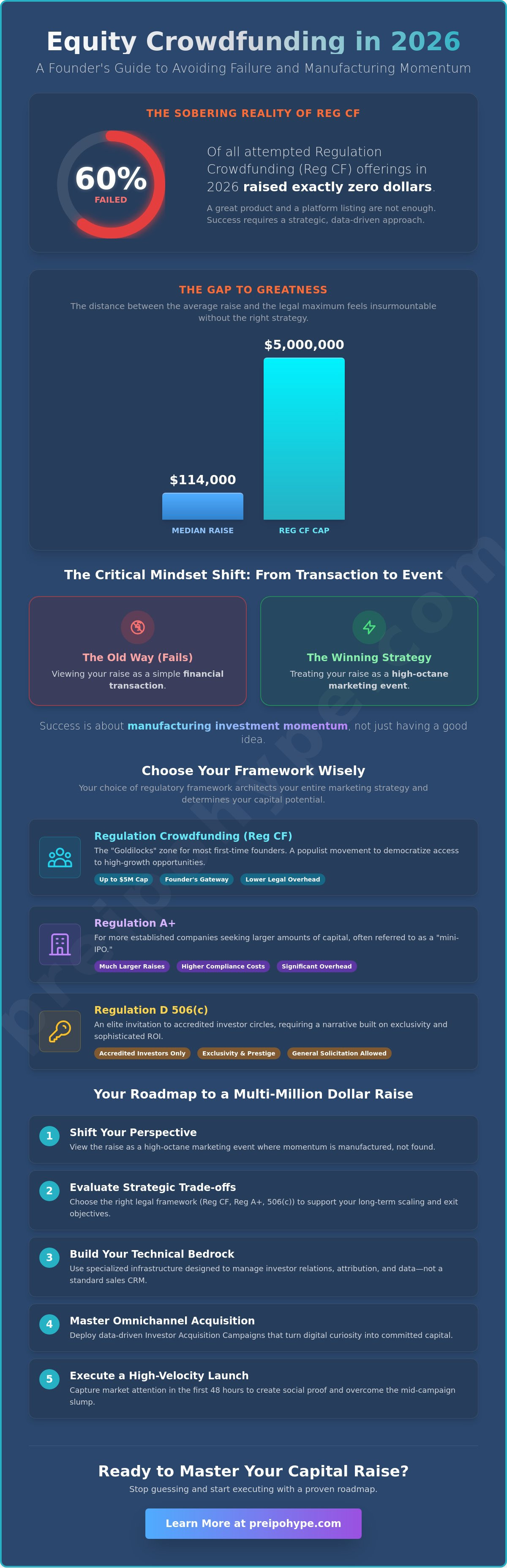
Did you know that 60% of all attempted Reg CF offerings in 2026 raised exactly zero dollars? It's a sobering reality for those who believe a great product and a platform listing are enough to secure capital. For most, equity crowdfunding for first-time founders feels like a black box of SEC Form C filings and shifting 12-month rolling limits. You're likely feeling the weight of information overload, wondering how to avoid becoming another "failed raise" statistic when you don't yet have an elite investor network at your fingertips.
We understand that the gap between a $114,000 median raise and the $5 million cap feels insurmountable without the right tools. You want a clear roadmap that turns public interest into committed capital without guessing which marketing channels actually drive ROI. This guide promises to help you master the technical infrastructure and omnichannel marketing strategies required to execute a multi-million dollar capital raise. We'll pull back the curtain on the exact technical stack needed for attribution, the 2026 regulatory nuances you need to know, and the insider roadmap for manufacturing market momentum that forces the crowd to take notice.
Key Takeaways
- Shift your perspective from viewing a raise as a mere financial transaction to a high-octane marketing event where momentum is manufactured, not found.
- Evaluate the strategic trade-offs between Reg CF, Reg A+, and 506(c) to ensure your legal framework supports your long-term scaling and exit objectives.
- Build a technical bedrock using specialized Foundation Infrastructure designed to manage investor relations more effectively than any standard sales CRM.
- Master the nuances of equity crowdfunding for first-time founders by deploying omnichannel Investor Acquisition Campaigns that turn digital curiosity into committed capital.
- Execute a high-velocity launch strategy that captures market attention in the first 48 hours and provides the leverage needed to overcome the mid-campaign slump.
The Reality of Equity Crowdfunding for First-Time Founders in 2026
Most founders treat a capital raise like a financial transaction. They're wrong. In 2026, equity crowdfunding for first-time founders is a high-octane marketing campaign that just happens to result in a funded balance sheet. The "build it and they will come" philosophy is the fastest way to join the 60% of companies that raised zero dollars in their Reg CF attempts this year. To succeed, you must stop thinking like a solicitor and start thinking like a media buyer. Success is no longer about having a "good idea"; it's about manufacturing Investment Momentum.
This momentum is the primary driver of retail investor psychology. Investors don't want to be the first person at the party; they want to join a movement that's already moving. To begin understanding equity crowdfunding in its modern form, you have to realize that data-driven investor acquisition has replaced generic social proof. If you can't track your attribution from a click to a commitment, you're just gambling with your marketing budget.
To better understand this concept, watch this helpful video:
The Platform Trap: Why Listing is Only 10% of the Battle
Major funding portals are powerful, but they're not magic. Their algorithms are designed to prioritize winners. If your campaign doesn't show immediate velocity and early capital, you'll be buried on page ten where organic traffic goes to die. Relying on "organic" platform discovery is a terminal mistake. You need an external marketing system to prime the pump. You must bring your own crowd to the portal to trigger the visibility that leads to the platform's crowd. Without a dedicated fundraising tech stack, you're flying blind.
The 2026 Funding Landscape: Reg CF vs. Reg A+
Choosing your legal framework is your first major strategic hurdle. Regulation Crowdfunding (Reg CF) is currently the "Goldilocks" zone for most raises, allowing you to secure up to $5 million in a rolling 12-month period. It's accessible, yet it provides enough runway to achieve significant milestones. Reg A+ allows for much larger raises, but the compliance costs and legal overhead often swallow the budgets of first-time teams. In 2026, the real winners in the Reg CF space are those using institutional-grade marketing to capture a retail-heavy environment. They don't wait for the market to find them. They use precise investor data to find the market.
Strategic Planning: Choosing the Right Regulatory Framework
Your choice of regulatory framework isn't just a legal box to check; it's the primary architect of your marketing strategy. In the world of equity crowdfunding for first-time founders, the framework you choose dictates who you can talk to, how loud you can shout, and how much capital you can ultimately capture. If you misalign your raise goal with your regulatory path, you're dead on arrival. You must let your capital requirements dictate the framework, never the other way around.
The "Story Framework" you build must pivot based on this choice. A Regulation Crowdfunding (Reg CF) raise is a populist movement; it's about democratizing access to a high-growth future. Conversely, a 506(c) offering is an elite invitation to accredited circles, requiring a narrative built on sophisticated ROI and exclusivity. Beyond the story, you have to face the strategic hurdle of the SEC Form C filing. This isn't just paperwork. It's a public disclosure of your financial health that retail investors will scrutinize. If you're unsure which path fits your current trajectory, you can book a strategy session to map out your regulatory architecture.
Reg CF: The Founder’s Gateway
Regulation Crowdfunding is the entry point for most early-stage startups because of its lower barrier to entry and reduced legal overhead. With the current $5 million limit in a rolling 12-month period, it's the perfect vehicle to build a "brand army." This isn't just about the money. It's about turning thousands of small investors into a decentralized marketing force. When setting your targets, be surgical. Set a "minimum" raise that you are 100% confident you can hit in the first 48 hours to trigger platform momentum, then use your "maximum" as the aspirational ceiling for your growth capital.
Reg A+ and 506(c): Scaling to Elite Circles
When your ambitions exceed the $5 million mark, you move into the territory of Reg A+ and 506(c). Reg A+ is effectively a "mini-IPO." It offers massive scale but comes with institutional-grade marketing complexity and significant audit requirements. It's a high-stakes game where your Foundation Infrastructure must be flawless to handle the volume. If you'd rather target high-net-worth individuals exclusively, 506(c) is your secret weapon. It allows for "general solicitation," meaning you can publicly advertise your raise, but only to accredited investors. This path is often the fastest route to large checks if you have the data to back up your claims.
Building Your Foundation Infrastructure: The Technical Bedrock
Most founders think they're ready to raise the moment they've signed up for cap table management software. They're wrong. For equity crowdfunding for first-time founders, the real battle is won in the data layer, not the legal one. You need Foundation Infrastructure in place before you ever go live. This isn't just about organizing names; it's about building a technical engine that tracks every touchpoint of a multi-million dollar raise. Standard sales CRMs are built for quick, transactional sales. Investor relations require a sophisticated architecture that understands the long-tail nature of capital commitment and the psychological weight of trust.
You can't optimize what you can't measure. In 2026, a 60-day attribution window is the industry standard for understanding which ads actually convert to hard capital. Retail investors rarely commit on the first click. They watch, they read, and they wait for visible momentum. Without precise tracking, you'll waste your budget on vanity clicks that never materialize into dollars. Effective infrastructure also includes automated lead scoring. This allows you to differentiate between the retail "fish" and the institutional-grade "whales" who have the capacity to anchor your round. Success in equity crowdfunding for first-time founders depends on your ability to prioritize these high-value leads while the crowd provides the volume.
The Custom Investor CRM: Engineering Momentum
A Custom Investor CRM acts as your central nervous system. It tracks the entire investor journey from that first social media impression to the final signed subscription agreement. This is where Omnichannel Mastery happens. By syncing your CRM with your outreach, you keep your startup top-of-mind for the critical 30 to 90 days it takes to close a lead. Data-driven re-engagement is the key. When you know exactly which "curious" leads have visited your offering page multiple times but haven't signed, you can deploy targeted content to push them over the line. It's about being present without being persistent.
The Technical Stack for 2026 Fundraising
Your stack must go beyond basic analytics. Integrating Google Tag Manager with custom tracking pixels across every platform gives you full-funnel visibility. This allows you to see the "path to purchase" for every dollar raised. If your current tools aren't providing this level of granularity, you should visit the Fundraising Tech Stack to audit your capabilities. Automated nurture sequences are the final piece of the puzzle. They ensure that no lead is left behind, systematically converting passive interest into the market momentum needed to hit your cap and propel your startup into its next phase of growth.
The Omnichannel Playbook: Turning Curiosity into Capital
If you're waiting for a platform to deliver your investors, you've already lost the game. Success in equity crowdfunding for first-time founders requires a shift from passive listing to aggressive, coordinated acquisition. In a market where 60% of Reg CF offerings raised zero dollars in 2026, you can't afford to leave your capital to chance. You need a technical marketing engine that surrounds your target audience, turning digital curiosity into hard commitments through a relentless five-step process.
First, develop a "Story Framework" that positions your startup as an exclusive, high-growth opportunity. This isn't a plea for help; it's an invitation to join an elite circle of early-stage winners. Second, deploy Investor Acquisition Campaigns across Meta, LinkedIn, and specialized financial networks to find the "cold" leads your competitors are missing. Third, leverage Newsletter Exposure through platforms like Invst Guru to tap into pre-vetted investor pools that already have an appetite for deal flow. Fourth, execute "Omnichannel Outreach" to ensure your message follows the investor across their digital life. Finally, use the real-time insights from your Investor Data dashboard to kill underperforming ads and double down on the channels that actually move the needle.
Manufacturing Hype: The Psychology of the Crowd
Investors are driven by two things: fear of missing out and the desire for momentum. Only 5 companies reached the $5 million cap in 2024. This rarity is your primary leverage. Use "Scarcity" and "Early Bird" terms to trigger immediate action in your first 48 hours. When retail investors see rapid funding progress, their internal risk assessment shifts from skepticism to a fear of being left behind. You must also proactively manage "Investor FAQ" sessions. Answering tough questions about your valuation or exit strategy doesn't just clear hurdles; it builds the institutional-grade trust required to close larger checks.
Newsletter and Email Mastery
High-net-worth individuals don't spend their days scrolling social feeds for deals. They rely on curated, high-authority newsletters. Strategic newsletter outreach is about connecting restricted information with broader opportunity. It's the difference between spamming a list and providing a "first look" at a gated financial world. Once they're in your ecosystem, your "Investor Update" becomes your most potent weapon. Don't just report status; sell the future. Each update should feel like a realization event, keeping current backers excited enough to share your raise with their own elite networks. Ready to build your acquisition engine? Schedule your 30-minute raise audit here.
Executing the Raise: From Launch to Closing the Round
Launch day is not a celebration; it's an execution event. For equity crowdfunding for first-time founders, the initial 48 hours dictate the entire ceiling of your success. If you don't hit 20% to 30% of your minimum goal in that window, platform algorithms will deprioritize your offering, burying it under more active campaigns. This is where your pre-launch work pays off. You aren't just opening the doors. You're triggering a pre-arranged influx of capital that signals to the broader market that your startup is a moving train they cannot afford to miss.
The mid-campaign slump is inevitable but manageable. Between the initial hype and the final "closing soon" rush, momentum often plateaus. This is when elite founders lean on Consulting and Advisory Services to inject fresh content and strategic pivots into their acquisition campaigns. Whether it's a new "Future Milestone" projection or a deep-dive performance metric update, you must keep the narrative moving forward. You are no longer just a founder. You are an informed insider guiding your backers toward a shared realization event.
Closing the round is about more than just hitting a number. It's about turning your investors into long-term brand ambassadors. These are the people who will generate hype for your product launches and defend your valuation in the public sphere. Transitioning from "Fundraising Mode" to "Execution Mode" requires a clear roadmap. Your backers expect to see the capital they provided turn into the growth milestones you promised, cementing the trust you've built during the raise.
The Role of the "Informed Insider"
Positioning yourself as an informed insider means providing transparency that goes beyond basic SEC requirements. You're opening the gates to a financial world that was previously closed to retail investors. Use your performance tracking to show, not just tell, how you're scaling. Projections should be data-driven and aspirational. When you treat your investors as partners in a movement, the capital becomes stickier and the community more vocal. Managing the transition post-close is about maintaining this steady pulse of opportunity through consistent, high-value updates.
Next Steps for the Elite Founder
The most successful raises are never handled in isolation. If you want to ensure your current plan is built for maximum velocity, you should Ask the CEO for a strategic audit of your raise plan. This is your chance to identify gaps in your technical stack or narrative before they cost you capital. For those looking for long-term support and internal access to elite investor relations strategies, joining the Pre-IPO Hype Club is the next logical step. Don't leave your momentum to chance. Book a strategy session today and engineer the raise your startup deserves.
Capture Your Market Momentum
The capital markets of 2026 don't reward the cautious; they reward those who build with precision. You've learned that successful equity crowdfunding for first-time founders is less about the platform and more about the technical marketing engine you deploy. By aligning your regulatory framework with a high-octane omnichannel strategy, you transform your startup from a quiet listing into a public movement. Infrastructure is your bedrock, and momentum is your primary currency.
Our team has facilitated over $100 million in funding for more than 230 high-growth companies. We leverage proprietary Custom Investor CRM technology to ensure no lead is left behind and every dollar of ad spend is accounted for. You don't have to navigate this gated financial world alone when you can have the keys to the insider playbook. The distance between where you are and a multi-million dollar raise is simply the right technical stack and a coordinated outreach plan.
Your journey toward becoming a market leader begins with a single, decisive step. We're ready to help you turn your vision into a funded reality.
Frequently Asked Questions
What is the most common mistake first-time founders make in equity crowdfunding?
The most common mistake is treating a raise as a "set it and forget it" platform play. Founders often assume that listing on a major portal will automatically attract investors. In reality, you must bring your own crowd to trigger the platform's algorithms. Without a technical marketing engine and a pre-funded "lead" amount, most campaigns fail to gain the visibility needed to hit their cap.
How much does it actually cost to run a successful Reg CF campaign in 2026?
Costs generally include legal disclosures, financial audits, and platform success fees. Beyond these fixed requirements, your primary investment will be in digital marketing and investor acquisition. While these figures vary based on your raise target—for instance, a healthcare education startup might discover more about Clinical Rotation Placement and Platform Access Fees to benchmark their own operational costs—you should budget for high-quality content creation and a robust advertising spend to maintain momentum throughout the campaign's duration.
Can I raise money through equity crowdfunding if I am still in the "idea" stage?
You can technically raise funds at the idea stage, but it's incredibly difficult to gain traction without a minimum viable product. Investors in 2026 prioritize companies that show tangible evidence of market demand or early revenue. Successful equity crowdfunding for first-time founders usually happens when there's a clear "proof of concept" that retail investors can easily understand and rally behind.
What is the difference between a crowdfunding platform and an investor acquisition agency?
A crowdfunding platform is the SEC-registered intermediary that hosts your offering and handles the legal transaction. An investor acquisition agency is the marketing powerhouse that actually drives traffic and capital to that listing. Think of the platform as the stadium and the agency as the promoter filling the seats. You need both to execute a multi-million dollar raise successfully.
How long does a typical equity crowdfunding raise take from setup to close?
Expect a timeline of three to six months from initial preparation to the final closing of the round. The first two months are typically dedicated to building your Foundation Infrastructure and completing legal filings like the Form C. Once the campaign goes live, it usually runs for 60 to 90 days, with most of the capital velocity occurring at the very beginning and end.
Is equity crowdfunding better than seeking traditional Venture Capital (VC)?
It depends on your long-term goals, but equity crowdfunding for first-time founders often provides better valuation terms and a decentralized army of brand ambassadors. While VCs offer institutional connections, crowdfunding allows you to maintain more control over your company's direction. It's particularly powerful for consumer-facing brands that want to turn their most loyal customers into shareholders.
What happens if I don’t reach my minimum funding goal?
If you fail to hit your stated minimum goal, all funds are returned to the investors and you receive nothing. This "all or nothing" nature of Reg CF makes your initial 48-hour strategy vital. It's strategically sound to set a lower, achievable minimum to ensure the raise closes, then use your maximum target to capture the full potential of the market's interest.
How do I protect my cap table from having thousands of small investors?
You protect your cap table by using a Special Purpose Vehicle (SPV) or a custodial arrangement offered by the platform. These structures roll all small investors into a single line item on your cap table. This keeps your corporate structure clean and manageable for future institutional rounds while still giving you the marketing leverage of a massive investor base.
Disclaimer
Educational only. Not investment, tax, or legal advice. Pre-IPO Hype is investor relations infrastructure for Regulation CF and Regulation A+ raises. We are not a broker-dealer, funding portal, or investment adviser, and we do not offer or sell securities or make investment recommendations. Any securities offering is made only by the issuer, through its own offering documents and, where required, a registered intermediary.


