Equity Crowdfunding Marketing for Fintech Startups: The 2026 Playbook
Most fintech startups raising capital through crowdfunding build a campaign. The ones that oversubscribe build a marketing engine. That distinction is everything. Equity crowdfunding marketing for fintech startups isn't a megaphone for your pitch deck; it's a precision system that converts curious browsers into committed investors, and it demands the same rigor you'd apply to your product roadmap.
You already know the challenge. The fintech sector is loud, the regulatory landscape is unforgiving, and your investor data is scattered across platforms that don't talk to each other. Every day your campaign runs without a structured acquisition pipeline is a day you're leaving capital on the table and handing momentum to competitors who've figured out the playbook.
This guide changes that. Drawing on hard-won experience supporting 230+ companies and facilitating over $100 million in funding, what follows is a practical, compliance-aware framework built specifically for the 2026 fundraising environment. You'll walk away with a clear picture of how to build an automated investor pipeline, stay on the right side of Reg CF and Reg A+ requirements, and create the kind of investor relations infrastructure that doesn't just close this round; it sets up the next one.
Key Takeaways
- Effective equity crowdfunding marketing for fintech startups requires choosing the right regulatory framework-Reg CF or Reg A+-before building a single campaign asset, as each pathway shapes your investor pool, raise limits, and compliance obligations differently.
- A Custom Investor CRM isn't optional infrastructure; it's the operational core that separates campaigns that stall at 40% from those that oversubscribe, using lead scoring to prioritize high-intent investors and automate follow-up at scale.
- Omnichannel outreach-coordinated across email, paid social, content, and newsletter placements-compounds investor touchpoints in ways that single-channel campaigns simply cannot replicate, driving both acquisition volume and conversion quality.
- The investor relationships you build during this round are the foundation of your next one; the data, trust, and communication infrastructure you establish now determines how fast future capital moves toward you.
- With over $100 million facilitated across 230+ companies, Pre-IPO Hype's proven systems give fintech founders a repeatable, compliance-aware playbook rather than a one-time campaign.
The Evolving Landscape of Equity Crowdfunding for Fintech Startups in 2026
The capital formation playbook has been rewritten. Venture capital, once the default gateway for ambitious fintech founders, is no longer the only path to serious funding. Equity crowdfunding has matured from a niche experiment into a legitimate institutional-grade channel, and fintech startups are positioned better than any other sector to exploit it. The combination of digital-native audiences, mission-driven narratives around financial inclusion, and a growing retail investor class hungry for early-stage exposure has created conditions that simply didn't exist five years ago.
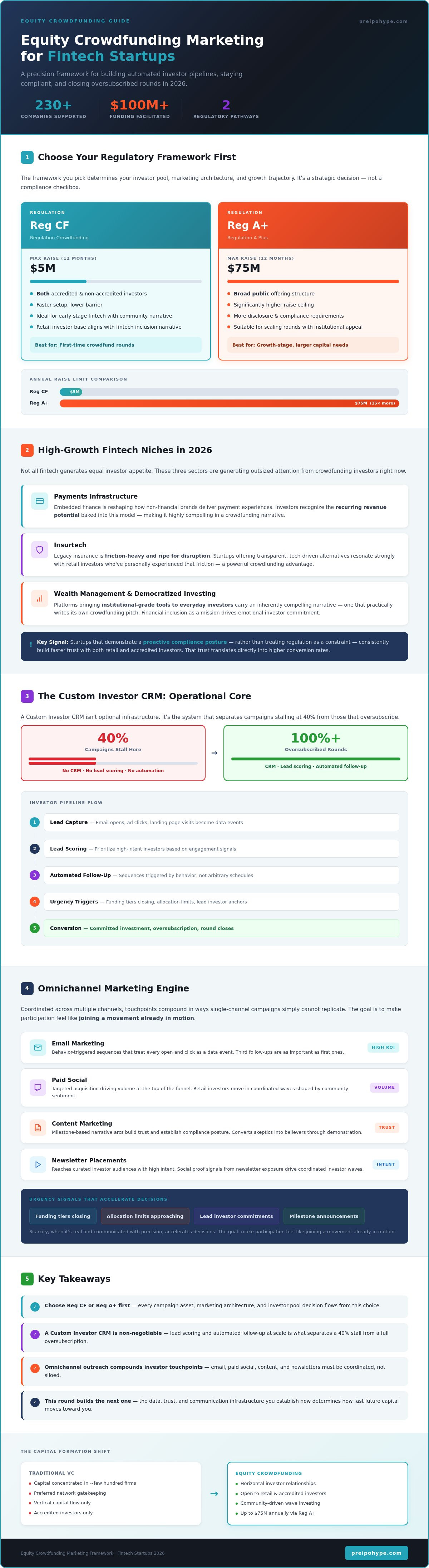
Traditional VC gatekeeping concentrated capital in the hands of a few hundred firms and their preferred networks. Equity crowdfunding dismantles that architecture. Under Reg CF, startups can raise up to $5 million in a twelve-month period from both accredited and non-accredited investors. Reg A+ extends that ceiling significantly, enabling raises up to $75 million annually with a broader public offering structure. These aren't just regulatory categories; they're strategic choices that shape every downstream marketing decision you'll make.
Identifying High-Growth Fintech Niches
Not all fintech is created equal in the eyes of the crowdfunding investor. Three sectors are generating outsized attention right now:
- Payments infrastructure: Embedded finance is reshaping how non-financial brands deliver payment experiences, and investors recognize the recurring revenue potential baked into that model.
- Insurtech: Legacy insurance is a friction-heavy industry ripe for disruption, and startups offering transparent, tech-driven alternatives are resonating strongly with retail investors who've personally felt that friction.
- Wealth management and democratized investing: Platforms that bring institutional-grade tools to everyday investors carry an inherently compelling narrative, one that practically writes its own crowdfunding pitch.
Investor sentiment in these niches is shaped heavily by regulatory clarity. Startups that can demonstrate proactive compliance posture, rather than treating regulation as a constraint to manage around, consistently build faster trust with both retail and accredited investor audiences. That trust translates directly into conversion rates.
The Shift to Digital Fundraising Models
Digital platforms have done something structural: they've made the investor relationship horizontal instead of vertical. Capital no longer flows exclusively downward from institutions. Retail investors now move in coordinated waves, influenced by community sentiment, newsletter exposure, and social proof signals. A fintech startup that understands this dynamic doesn't just list on a platform and wait. It engineers a distribution system.
Effective equity crowdfunding marketing for fintech startups means treating every touchpoint, from a first email open to a third follow-up, as a data event. The startups winning in 2026 are the ones creating genuine urgency through milestone-based narrative arcs: funding tiers closing, allocation limits approaching, lead investor commitments anchoring the round. Scarcity, when it's real and communicated with precision, accelerates decisions. The goal is to make participation feel less like a transaction and more like joining a movement that's already in motion.
Choosing the Right SEC Regulation: Reg CF vs. Reg A+
The regulatory framework you choose isn't a compliance checkbox. It's a strategic decision that determines your investor pool, your marketing architecture, and your growth trajectory for years after the round closes. Get this wrong and you're building a campaign on the wrong foundation. Get it right and the regulation itself becomes a competitive asset.
Two pathways dominate equity crowdfunding for fintech founders in 2026: Regulation Crowdfunding (Reg CF) and Regulation A+. They're not interchangeable, and treating them as such is one of the most expensive mistakes early-stage companies make. The synergy between your fintech business model and the right regulatory structure is precisely where most competitors fail to give founders clear guidance.
Advantages of Reg CF for Fintech Startups
Reg CF allows startups to raise up to $5 million in a twelve-month period from both accredited and non-accredited investors. For early-stage fintech companies, that ceiling is often a feature, not a limitation. It forces capital discipline and creates natural scarcity that drives campaign urgency. The compliance burden is comparatively lean: you'll file Form C with the SEC, provide financial disclosures scaled to your raise size, and conduct the offering through a registered intermediary.
The real advantage isn't the cap. It's the community-building mechanism baked into the structure. Reg CF investors become brand advocates. They share your campaign, validate your narrative, and seed the social proof that converts skeptical prospects into committed backers. Fintech startups with strong democratization narratives, think payments access, credit-building tools, or transparent investing platforms, are particularly well-positioned to activate this dynamic. Structured Reg CF marketing services that engineer the investor hype cycle from pre-launch through close can turn that community energy into oversubscription momentum.
Reg A+: Scaling Opportunities for Fintech Companies
Reg A+ operates in a different weight class. With raise limits up to $75 million annually, it functions more like a mini-IPO than a crowdfunding campaign. Fintech startups that have validated their model, demonstrated revenue traction, and are genuinely targeting institutional crossover should be thinking about Reg A+ as a bridge to public markets, not just a larger raise.
The compliance architecture is correspondingly heavier. Reg A+ requires SEC qualification, audited financials, and navigation of state-level Blue Sky laws, though Tier 2 offerings largely preempt state registration requirements. The operational infrastructure required to run a Reg A+ raise successfully, investor data management, automated follow-up systems, multi-channel acquisition pipelines, is substantial. The Foundation Infrastructure supporting a Reg A+ raise must be built before you launch, not assembled mid-campaign.
Choosing between these frameworks comes down to three variables: your current revenue stage, the size of your addressable investor audience, and your timeline to a liquidity event. A thoughtful conversation about that alignment is worth scheduling before a single campaign asset gets built. Book a strategy session to map your regulatory framework to your specific growth stage.
Effective equity crowdfunding marketing for fintech startups always starts here, with regulatory clarity, because every downstream decision about messaging, targeting, and conversion infrastructure flows from the framework you choose.
The Custom Investor CRM: Your Key to Investor Engagement
Most fintech founders treat investor management like a spreadsheet problem. It isn't. It's a pipeline problem, and the difference between a campaign that stalls at 60% and one that oversubscribes comes down to whether you have a system that converts interest into commitment at scale. The Custom Investor CRM is that system: the operational core that centralizes every investor interaction, from first click to funded position, into a single intelligence layer your team can act on in real time.
This isn't about contact management. It's about engineering momentum. When a prospective investor opens your third email, clicks your campaign page, and watches your founder video, those three behaviors tell a story. A properly configured CRM reads that story and triggers the right response automatically, whether that's a personalized follow-up, a calendar invite, or a priority flag for your outreach team. Equity crowdfunding marketing for fintech startups demands this level of precision because the investor journey is rarely linear, and manual follow-up at scale is a fantasy.
Lead scoring is the mechanism that makes this possible. It's a method of quantifying investor intent through behavioral data, assigning weighted values to actions like email opens, page visits, webinar attendance, and document downloads, so your team always knows exactly where to focus its energy.
The 60-day attribution window matters here more than most founders realize. Capital decisions in crowdfunding rarely happen at first contact. An investor who discovers your campaign on day one might not commit until day 47. Without attribution tracking that spans the full decision cycle, you're optimizing your acquisition spend based on incomplete data, cutting channels that are actually working and doubling down on ones that look good but convert late. The Custom Investor CRM closes that visibility gap.
Maximizing Momentum through Data Analytics
Integrating investor data into your outreach strategy transforms guesswork into a prioritization engine. High-net-worth individuals and repeat crowdfunding participants exhibit distinct behavioral signatures: longer page dwell times, multiple return visits, and engagement with financial disclosure documents rather than just the pitch summary. When your CRM surfaces these signals, your outreach team stops working through a cold list and starts engaging a ranked pipeline. Engagement velocity, how quickly a lead moves through behavioral triggers, functions as a real-time health indicator for your campaign's fundraising trajectory.
Nurturing Investor Relationships through Automation
An effective email cadence isn't a broadcast schedule. It's a conversation architecture. Milestone updates, traction announcements, and allocation warnings each serve a different psychological function in the investor journey. Personalization at this stage goes beyond first-name fields; it means segmenting your audience by investment history, geographic market, and declared interest tier, then delivering messaging that speaks directly to what each segment cares about. Automation handles the execution. Your team focuses on the relationships that need a human touch. That division of labor is what separates campaigns built for scale from those that plateau when the founder's personal network runs dry. Equity crowdfunding marketing for fintech startups, done right, means your system is working the pipeline even when you're not.
Omnichannel Marketing: Creating a Comprehensive Fundraising Strategy
Single-channel campaigns don't oversubscribe. They plateau. The fintech startups that consistently close above their targets aren't running louder campaigns; they're running coordinated ones, where every touchpoint reinforces the last and investor intent compounds across platforms rather than dissipating between them. That's the structural advantage of omnichannel execution, and it's the gap that separates campaigns built on PR instinct from those built on digital marketing and advertising infrastructure designed for investor acquisition.
The logic is straightforward. An investor who encounters your campaign through a newsletter, sees a retargeted ad two days later, and then receives a personalized email the following week has experienced three distinct trust-building moments. Each one reduces friction. By the time that investor reaches your campaign page, they're not evaluating you cold; they're confirming a decision they've already been moving toward. Equity crowdfunding marketing for fintech startups works precisely because the investor decision cycle is long enough for coordinated touchpoints to do their job.
Newsletter placement is one of the most underutilized levers in this stack. The Invst Guru newsletter delivers your campaign directly to an engaged, investment-oriented audience that's already primed for early-stage opportunity. That's not a cold audience you have to educate about crowdfunding; it's a warm one you have to convince about your specific deal. The conversion differential between cold acquisition and newsletter-driven traffic is significant, and newsletter outreach at this level functions as a credibility signal as much as a distribution channel.
A/B testing sits underneath all of this as the optimization mechanism that keeps your messaging sharp throughout the campaign lifecycle. Subject line variants, CTA placement, social proof sequencing, and offer framing all respond to testing in ways that gut instinct simply can't replicate. Run tests early, act on the data fast, and let the results reshape your spend allocation in real time.
Investing in Paid Acquisition for Growth
Paid acquisition isn't a budget line; it's a precision instrument. LinkedIn dominates for B2B-adjacent fintech narratives, particularly for startups targeting accredited investors, financial professionals, or enterprise buyers who might also be investor candidates. Retargeting campaigns that re-engage visitors who didn't convert on first contact are essential; they keep your campaign visible during the 30-to-60-day decision window without requiring repeated cold outreach. Budget allocation should follow performance signals weekly, not be set and forgotten at launch.
Developing a Compelling Content Strategy
Content that converts investors doesn't explain your product. It narrates your trajectory. Exclusivity framing, limited allocation windows, milestone announcements, and founder video updates each serve a specific function in building the authority and urgency that moves capital. Testimonials from early investors or industry validators add a layer of social proof that no amount of polished copy can manufacture. Pair that content architecture with structured newsletter outreach and you've built a visibility engine that works continuously, not just when you're actively pushing.
Ready to build the omnichannel infrastructure your raise actually needs? Schedule a strategy session to map a coordinated acquisition system to your specific campaign timeline and investor targets.
Pre-IPO Hype: Your Partner in Securing $100M+ in Funding
Execution separates intention from capital. Every framework, every CRM configuration, every omnichannel sequence discussed in this guide requires an operational partner who's built these systems under real campaign pressure, not theoretical conditions. That's precisely where Pre-IPO Hype operates: at the intersection of strategic clarity and deployment-ready infrastructure, with a track record that speaks in numbers rather than promises.
Over $100 million facilitated across 230+ companies since 2015. That's not a marketing claim; it's a proof-of-concept for the systems described throughout this playbook. Equity crowdfunding marketing for fintech startups demands this kind of verified, repeatable methodology, because the cost of learning by trial and error isn't measured in wasted ad spend. It's measured in missed closes and stalled momentum that's nearly impossible to recover mid-campaign.
The Pre-IPO Hype Approach to Fundraising
The approach starts with Foundation Infrastructure, the technical architecture that makes everything else scalable. Custom Investor CRM configuration, lead scoring calibration, attribution tracking, and automated nurture sequences are built before a single dollar of acquisition spend goes live. Campaigns that launch without this bedrock don't stall because of bad messaging; they stall because the pipeline can't handle the volume.
Omnichannel Mastery compounds that foundation. Coordinated investor touchpoints across email, paid social, newsletter placement through Invst Guru, and content distribution create the kind of cumulative trust that single-channel campaigns simply can't manufacture. Each channel reinforces the others, and the data flows back into the CRM to sharpen targeting in real time. The result is a fundraising engine that gets smarter as it runs.
The fastest way to understand how this maps to your specific raise is a direct conversation. Book a strategy session with Fuzzy Wenzel to align your regulatory framework, investor targets, and campaign timeline with a system that's already delivered at scale.
Building Sustainable Investor Relations
Closing a round is a milestone. What happens after determines whether your next raise moves faster or slower. The investor relationships built during your campaign, the communication cadence, the data infrastructure, the trust signals established through consistent updates, become the foundation of your Series A credibility or your next Reg A+ raise.
Professional investor relations isn't a post-campaign courtesy; it's an ongoing credibility asset. Investors who feel informed and respected become repeat participants and referral sources. That's compounding capital formation, not just a single transaction.
For founders who want continued access to exclusive insights, deal intelligence, and a community of serious early-stage investors, the Pre-IPO Hype Club provides exactly that environment. Equity crowdfunding marketing for fintech startups doesn't end at close. The infrastructure you build now determines how fast the next round moves toward you.
Your Next Raise Starts with the Right System
The fintech founders who close oversubscribed rounds in 2026 won't outspend their competitors. They'll out-engineer them. Equity crowdfunding marketing for fintech startups comes down to three decisions made early: choosing the regulatory framework that matches your growth stage, building the CRM infrastructure before acquisition spend goes live, and coordinating touchpoints across channels so investor trust compounds rather than resets with every interaction.
Those aren't abstract principles. They're the operational architecture behind $100 million facilitated across 230+ companies, with Custom Investor CRM systems built on 60-day attribution tracking and deep expertise in both Reg CF and Reg A+ dating back to 2015.
The campaign you build today shapes how fast capital moves toward you tomorrow. Don't leave that to chance. Schedule a strategy session with Pre-IPO Hype and map a proven, compliance-aware fundraising system to your specific raise. The founders who move decisively now are the ones who close first.
Frequently Asked Questions
What is the best SEC regulation for my fintech startup?
The right regulation depends on your revenue stage, investor targets, and raise size. Reg CF suits early-stage fintech companies raising up to $5 million from both accredited and non-accredited investors, with a lighter compliance burden. Reg A+ fits startups with demonstrated traction that need up to $75 million and are positioning toward a public market event. There's no universal answer, which is why regulatory alignment should happen before any campaign asset gets built.
How much does it cost to utilize a Custom Investor CRM?
Pricing for a Custom Investor CRM varies based on campaign complexity, raise size, and the level of automation and lead scoring configuration required. Rather than quoting a number that won't reflect your actual situation, the most accurate path is a direct conversation about your specific pipeline needs. Contact Pre-IPO Hype to get a clear picture of what infrastructure your raise actually requires before committing to a budget.
Can I raise more than $5 million using Reg CF?
No. Reg CF caps raises at $5 million within any twelve-month period. If your capital targets exceed that ceiling, Reg A+ is the appropriate pathway, allowing raises up to $75 million annually. Some founders run sequential Reg CF rounds to build investor community and momentum before transitioning to a Reg A+ structure, but that's a deliberate strategic sequence, not a workaround for the cap itself.
What does 60-day attribution mean for my fundraising efforts?
Sixty-day attribution means tracking the full chain of touchpoints that led an investor to commit, across a window that reflects how long crowdfunding decisions actually take. Without it, your acquisition data is misleading; channels that drive late conversions look ineffective because the first-touch data doesn't capture the full journey. Equity crowdfunding marketing for fintech startups requires attribution windows long enough to see the complete decision cycle, not just the last click before investment.
How can I find institutional investors for my fintech startup?
Institutional investor access comes through coordinated visibility, not cold outreach. Newsletter placements like the Invst Guru reach investment-oriented audiences already primed for early-stage deals. LinkedIn paid acquisition targets accredited investors and financial professionals with precision. The Pre-IPO Hype Club also connects founders with a community of serious investors actively seeking private market exposure. The common thread is building systems that put your deal in front of qualified capital repeatedly, not just once.
What are the differences between Reg CF and Reg A+?
Reg CF allows raises up to $5 million from both accredited and non-accredited investors through a registered intermediary, with financial disclosures scaled to raise size. Reg A+ supports raises up to $75 million, requires SEC qualification and audited financials, and functions structurally closer to a mini-IPO. The investor pool, compliance architecture, marketing infrastructure, and timeline to close differ significantly between the two, making framework selection one of the most consequential early decisions a founder makes.
How does Pre-IPO Hype assist with SEC compliance?
Pre-IPO Hype doesn't provide legal counsel or act as a securities attorney, but it does build campaign infrastructure that operates within the compliance boundaries of your chosen regulatory framework. That means structuring marketing communications, investor outreach cadences, and CRM configurations in ways that align with Reg CF and Reg A+ requirements. Founders are always advised to work with qualified securities counsel on legal filings; Pre-IPO Hype handles the marketing execution that runs alongside that process.
Is equity crowdfunding a better option than traditional VC funding?
It depends on what you're optimizing for. Traditional VC offers larger checks and institutional credibility, but it concentrates decision-making power in a small number of gatekeepers and often requires giving up significant equity and control. Equity crowdfunding marketing for fintech startups opens the investor pool to retail participants, builds a community of brand advocates, and preserves more founder autonomy. Many founders find that a successful crowdfunding round actually strengthens their position in subsequent VC conversations by demonstrating validated market demand.
Disclaimer
Educational only. Not investment, tax, or legal advice. Pre-IPO Hype is investor relations infrastructure for Regulation CF and Regulation A+ raises. We are not a broker-dealer, funding portal, or investment adviser, and we do not offer or sell securities or make investment recommendations. Any securities offering is made only by the issuer, through its own offering documents and, where required, a registered intermediary.


