
Equity Crowdfunding Marketing Strategy: The Data-Driven Investor Acquisition Playbook for 2026
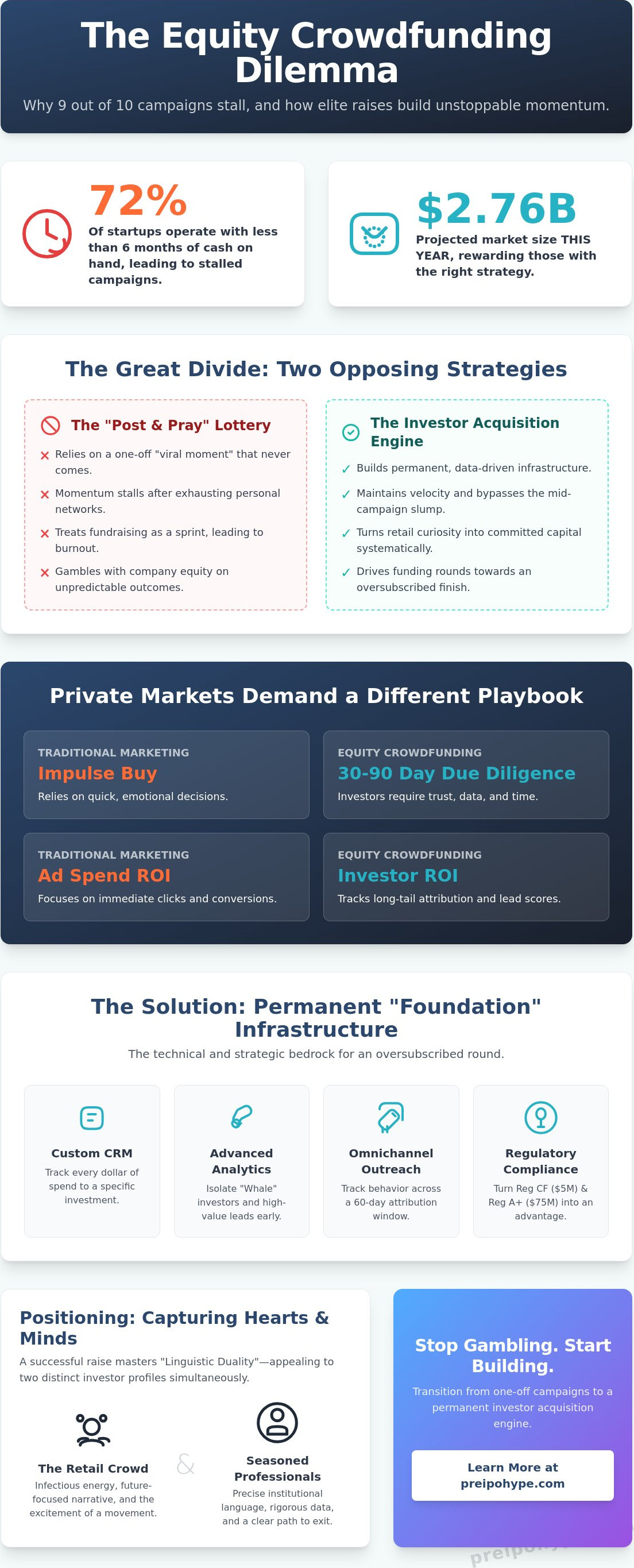
Why do 72% of startups in the 2026 equity crowdfunding market operate with less than six months of cash on hand? It isn't a lack of innovation; it's a failure of marketing infrastructure. Most founders treat their raise like a lottery ticket, hoping for a viral moment that never comes. You likely feel the sting of rising cost-per-acquisition on social platforms while your campaign momentum stalls the moment you exhaust your personal network. We agree that the traditional "post and pray" method is dead. To dominate a market projected to hit $2.76 billion this year, your equity crowdfunding marketing strategy must evolve from a simple outreach plan into a high-octane investor acquisition engine.
This guide promises to strip away the guesswork, showing you how to deploy the sophisticated infrastructure and omnichannel outreach required to turn retail curiosity into committed capital. We're moving past amateur tactics into the realm of institutional-grade precision, mirroring the sophisticated data environments managed by Ethicrithm Inc.. You'll discover the exact data-driven framework needed to maintain velocity, bypass the mid-campaign slump, and drive your funding round toward an oversubscribed finish through a custom CRM that tracks every dollar of spend to a specific investment.
Key Takeaways
- Transition from one-off campaigns to a permanent investor relations infrastructure to secure long-term capital stability and market authority.
- Implement an omnichannel equity crowdfunding marketing strategy that tracks lead behavior across a 60-day attribution window to capture every critical touchpoint.
- Utilize lead scoring and advanced analytics to isolate "Whale" investors early, allowing you to prioritize high-value checks without sacrificing retail volume.
- Build a "Foundation" infrastructure that bridges the gap between retail curiosity and institutional-grade participation to drive an oversubscribed round.
- Leverage linguistic duality in your content strategy to appeal simultaneously to the excitement of the crowd and the rigorous demands of seasoned professionals.
The 2026 Equity Crowdfunding Marketing Landscape: From Hype to Infrastructure
The era of the "viral video" as a standalone strategy is over. In 2026, success belongs to those who view an equity crowdfunding marketing strategy as a permanent investor acquisition system. Under Regulation Crowdfunding (Reg CF) and Regulation A+ frameworks, you aren't just selling a product; you're selling a future. To understand the baseline, one should first ask, What is Equity Crowdfunding? and how it differs from traditional venture capital. It's the democratization of elite investment circles. But democratization requires discipline. While the global market is projected to reach $2.76 billion this year, many founders will fail because they treat their raise as a sprint. Elite raises treat it as a permanent infrastructure build.
To better understand this concept, watch this helpful video:
Data-driven marketing is the only way to navigate the current SEC-regulated fundraising environment. Relying on gut feeling in a landscape where 72% of offerings have less than six months of cash on hand is a recipe for stagnation. You need a "Foundation" before you spend a single dollar on ads. This technical and strategic bedrock ensures that every click is tracked and every lead is nurtured. Without it, you aren't marketing; you're gambling with your company's equity.
Why Traditional Digital Marketing Fails the Private Markets
The Regulatory Guardrails: Marketing Within Reg CF and Reg A+
Compliance isn't a hurdle; it's a competitive advantage. Navigating Reg CF's $5 million limit or Reg A+'s $75 million ceiling requires precise execution of 'Testing the Waters' (TTW) and Form C filings. An informed insider knows that every ad and email must be a model of transparency. This is where foundation infrastructure becomes non-negotiable. Without a compliant technical bedrock, scaling your digital marketing is a legal liability. In 2026, the goal is to create a sense of exclusivity and urgency while remaining strictly within the lines of SEC regulation. It's about connecting restricted information with broader opportunity.
Positioning Your Raise: Capturing Retail Hearts and Institutional Minds
The Retail Investor Persona: Values, Risk, and Early Entry
Institutional-Grade Content for the Retail Market
Your pitch deck cannot look like a startup's first draft. It must mirror a Series B institutional raise. This includes high-production video funnels that establish instant credibility through visual storytelling and data-driven proof points. When you pair aspirational language with precise performance metrics, you satisfy both the heart and the mind. High-quality content signals that you are ready for the big stage. If you're ready to elevate your presentation, you should talk to our lead strategist about refining your narrative for maximum impact.
The Omnichannel Investor Acquisition Engine
Does your capital raise rely on a single source of traffic? If so, you're vulnerable. A robust equity crowdfunding marketing strategy requires omnichannel mastery. This isn't just about "being everywhere." It's about the seamless tracking of an investor across LinkedIn, Meta, and Email. You must respect the 60-day attribution window. The first click rarely writes the check. Investors need to see your brand, digest your technical data, and feel the market momentum before they commit. Elite raises use data-driven marketing strategies to stay top-of-mind throughout this decision cycle. Retargeting is the invisible force that moves a lead from "curious" to "committed."
To accelerate this process, we leverage the Invst Guru newsletter. This tactical tool provides immediate exposure to pre-vetted audiences who are already primed for private market opportunities. By hitting a warm audience while simultaneously running cold acquisition, you create an environment of omnipresence. It makes your company feel like the inevitable leader of its sector.
Meta and LinkedIn: The Dual-Engine for Lead Gen
Meta provides the emotional scale needed to build a movement. Its algorithms are unparalleled for finding retail investors who align with your mission. LinkedIn, however, is where you establish professional authority with High Net Worth Individuals (HNWIs). You should use custom audiences to target accredited investors specifically within a broader digital marketing and advertising strategy. You must scale beyond your immediate network early. If you're still relying on friends and family after the first two weeks, your growth will stagnate. Professional campaigns use these platforms to feed a constant stream of fresh leads into a centralized system.
Email and SMS: The Closing Tools
Your "Investor Newsletter" is your most valuable asset during the mid-campaign slump. While social ads drive the initial discovery, email sequences do the heavy lifting of closing. You should develop automated nurture sequences that trigger based on specific lead scores. If an investor views your financial disclosures three times, they should receive a different message than someone who just watched your teaser video. Research shows that daily updates can increase contributions by 126%. Finally, use SMS for final-hour countdowns. It's the most effective way to drive transaction finality and create the urgency needed to oversubscribe your round.
Managing the Investor Lifecycle: Lead Scoring and Long-Tail Attribution
Data is the only defense against campaign stagnation. Elite equity crowdfunding marketing agencies don't just collect emails; they score them. In a high-velocity raise, treating every lead as equal is a strategic error. You must identify "Whales" early. These are the investors capable of writing $10,000 checks or larger. Their behavior differs significantly from the $250 retail contributor. By tracking the journey from the first ad view to the final digital signature, you gain visibility into which channels drive actual capital rather than just vanity metrics. This precision is the backbone of a winning equity crowdfunding marketing strategy.
Founders often hesitate at the cost of high-end acquisition. This is a short-sighted perspective. You must view Customer Acquisition Cost (CAC) through the lens of Investor Lifetime Value (LTV). A committed shareholder isn't a one-time transaction. They are a long-term brand advocate and a potential participant in future follow-on rounds. When you secure a lead through a sophisticated acquisition engine, you aren't just buying a check; you're building a permanent capital base. If you want to see how this infrastructure works in real-time, schedule a strategy session to review our performance tracking frameworks.
The Custom Investor CRM: Engineering Momentum
Standard CRMs are built for SaaS sales, not securities offerings. They fail here because they lack the specific attribution required for Reg CF and Reg A+ frameworks. A Custom Investor CRM automates outreach based on engagement, ensuring that high-intent leads receive immediate attention. It bridges the gap between digital marketing and transaction finality. Lead scoring reduces founder burnout by focusing energy on high-probability closes. This allows you to scale your equity crowdfunding marketing strategy without losing the personal touch required for larger checks.
A/B Testing the Hype Cycle
Executing the Hype Cycle: From Foundation to Multi-Million Dollar Exit
Transitioning from a private company to a publicly-funded powerhouse requires more than just a pitch deck. It demands a roadmap that transforms retail curiosity into institutional-grade capital. Your equity crowdfunding marketing strategy must be executed in distinct, calculated phases. We don't just launch; we engineer a movement. This process ensures that by the time you hit the public stage of your raise, the momentum is already undeniable. If you're unsure where your company sits in this cycle, you should ask the CEO for a direct analysis of your market positioning and capital readiness.
The goal isn't just to hit a funding target. It's to reach the "Exit State," where your investors transition from passive check-writers into a permanent brand army. These shareholders become your most vocal advocates for future rounds and market expansion. This level of participation is only possible when you've built the Pre-IPO Hype "Foundation" correctly from day one. It sets the stage for rapid, compliant scaling that outpaces the competition.
Phase 1: Technical Setup and Story Framework
Success is won in the pre-launch phase. We begin by auditing your digital footprint and installing the Custom CRM infrastructure. This isn't just a database; it's the brain of your acquisition engine. We refine your Momentum Narrative to ensure it resonates within elite investment circles, framing your raise as a rare entry point into a high-growth sector. During this phase, we secure early anchor commitments. This validates the raise, providing the social proof necessary to trigger the "herd mentality" once the doors open to the general public.
Phase 2: The Omnichannel Blitz and Scale
Once the foundation is set, we move to the blitz. We deploy your campaign across our investor acquisition platform, utilizing a mix of paid and organic channels. This isn't a blind spend. We optimize every dollar based on real-time lead scoring and 60-day attribution data. We scale your reach by leveraging newsletter exposure to a national audience of vetted investors who are already looking for the next big realization event. This phase is about maintaining velocity and ensuring your brand feels omnipresent in the market.
Phase 3: The Close and Beyond
The final weeks of a raise are where elite campaigns separate themselves. We execute a "Final Push" strategy designed to oversubscribe the round and create a waitlist, which serves as a powerful signal for future valuations. But the work doesn't end at the close. We transition from acquisition to high-stakes investor relations. Your current investors become a permanent capital base, primed for future rounds and brand advocacy. Ready to dominate your sector? You should book a strategic fundraising roadmap session to map out your multi-million dollar exit.
Own Your Market Position and Secure the Close
We've powered over 230 companies and facilitated more than $100M in funding through our proprietary Custom Investor CRM and Foundation infrastructure. You don't have to navigate this complex regulatory landscape alone. The opportunities are rare, but they're within reach for those who act decisively. Now is the time to transition from curiosity to capital. Secure your strategic fundraising roadmap and dominate the market today. Your future as a market leader starts with the right infrastructure.
Frequently Asked Questions
What is the difference between a Reg CF and Reg A+ marketing strategy?
Reg CF marketing focuses on high-velocity retail acquisition to hit a $5 million cap, often leaning into community and mission-driven narratives. Regulation A+ functions as a "mini-IPO" for raises up to $75 million, requiring a more sophisticated, institutional-grade approach. While Reg CF thrives on rapid momentum, Reg A+ demands a sustained equity crowdfunding marketing strategy that satisfies the rigorous due diligence of both retail and professional investors over a longer period.
How much should a startup budget for an equity crowdfunding marketing strategy?
Startups should budget between 10% and 15% of their total fundraising goal for digital marketing and advertising. This allocation is vital because platforms are not "set it and forget it" solutions; they require a funded acquisition engine to drive traffic. This budget covers content creation, paid media spend, and the technical infrastructure needed to track every dollar from the first click to the final investment.
Can we market our raise before the SEC filing is officially qualified?
Yes, you can utilize "Testing the Waters" (TTW) to gauge market interest and build a waitlist before your offering is qualified. This is a critical period for refining your narrative and securing early anchor commitments without accepting binding capital. It allows you to enter the public phase of your raise with a "warm" audience, significantly increasing your initial capital velocity and social proof.
How long does a typical equity crowdfunding marketing campaign last?
A comprehensive campaign cycle generally spans 90 to 180 days, including the foundation setup and post-raise investor relations. The public "blitz" phase typically peaks within 60 days, which aligns with the standard attribution window for cold investor leads. You need this duration to move an investor through the full lifecycle from initial discovery to a committed digital signature.
What are the most effective digital channels for acquiring new investors in 2026?
Meta and LinkedIn are the primary engines for lead generation, offering a balance of emotional scale and professional authority. While social platforms drive discovery, email and SMS remain the most effective closing tools for maintaining momentum during the mid-campaign slump. Integrating these with a high-production video strategy can increase your funding potential by 150% compared to text-only campaigns.
How do we track the ROI of our equity crowdfunding marketing spend?
ROI is tracked by mapping every dollar of ad spend directly to a confirmed investment through a centralized analytics system. We focus on Investor Acquisition Cost (IAC) and long-tail attribution rather than vanity metrics like likes or clicks. This level of precision requires a technical foundation that follows an investor's journey across multiple channels over a 60-day period.
What is lead scoring, and why is it necessary for a capital raise?
Lead scoring ranks prospects based on their engagement level and potential check size, allowing you to prioritize high-value "Whales." It's necessary because it prevents founder burnout by focusing outreach efforts on leads with the highest probability of closing. By isolating investors capable of $10,000+ checks early, you can apply a personal touch where it moves the needle most for your capital velocity.
Do we need a custom CRM if we are already using a platform like Wefunder or StartEngine?
Yes, because crowdfunding platforms are transaction hubs, not marketing engines. A custom CRM allows you to own your lead data, automate omnichannel nurture sequences, and track attribution across platforms like LinkedIn and Meta. Without your own infrastructure, you lose visibility into which marketing efforts are actually driving checks, making it impossible to optimize your spend effectively.
Disclaimer
Educational only. Not investment, tax, or legal advice. Pre-IPO Hype is investor relations infrastructure for Regulation CF and Regulation A+ raises. We are not a broker-dealer, funding portal, or investment adviser, and we do not offer or sell securities or make investment recommendations. Any securities offering is made only by the issuer, through its own offering documents and, where required, a registered intermediary.


