
Equity Crowdfunding: The Elite Founder’s Guide 2026
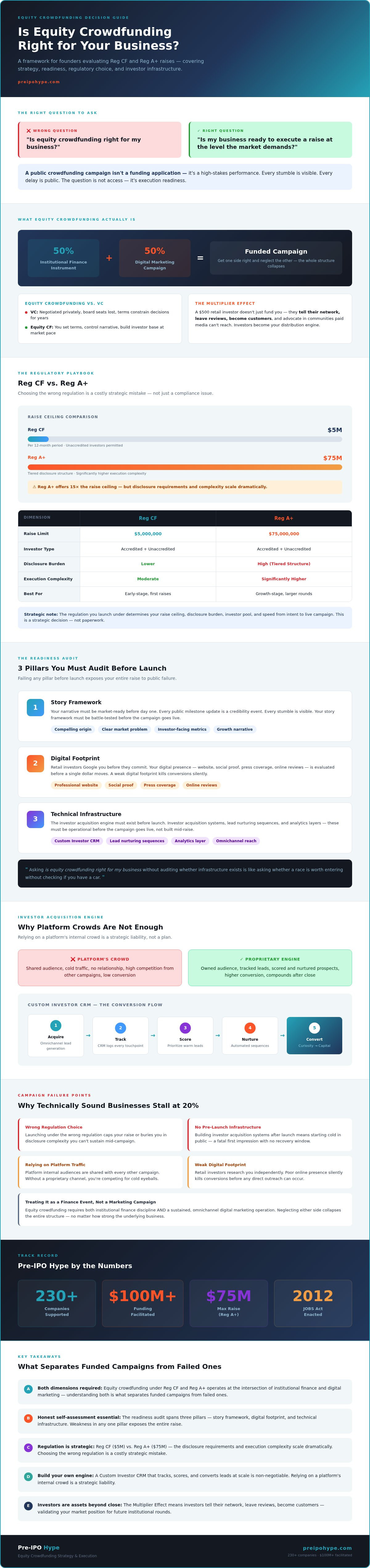
Most founders asking is equity crowdfunding right for my business are asking the wrong question. The real question is whether your business is ready to execute a raise at the level the market now demands, because a public crowdfunding campaign isn't a funding application. It's a high-stakes performance, and the audience is watching from day one.
You already sense the tension. The opportunity is real, the capital is out there, and the regulatory framework under Reg CF and Reg A+ has opened doors that were locked to most founders a decade ago. But the fear of launching publicly and falling short, the confusion around SEC compliance, the anxiety over how much equity you're actually giving up, and the sheer weight of the marketing machine required to sustain a raise, these aren't irrational concerns. They're the exact friction points that separate funded companies from forgotten campaigns.
This guide cuts through the noise. You'll get a clear go/no-go framework built for founders who take capital strategy seriously, a grounded look at what a digital raise actually costs versus what it returns, and an honest breakdown of the technical and marketing infrastructure that elite raises are built on. If you're ready to move beyond the hype and into execution, this is where that decision starts.
Key Takeaways
- Equity crowdfunding under Reg CF and Reg A+ operates at the intersection of institutional finance and digital marketing — understanding both dimensions is what separates funded campaigns from failed ones.
- Determining is equity crowdfunding right for my business requires an honest readiness audit across three pillars: your story framework, your digital footprint, and your technical infrastructure.
- Reg CF caps raises at $5M while Reg A+ unlocks up to $75M, but the disclosure requirements and execution complexity scale dramatically between the two — choosing the wrong regulation is a costly mistake.
- Relying on a platform's internal crowd is a strategic liability; elite raises are built on a proprietary investor acquisition engine driven by a Custom Investor CRM that tracks, scores, and converts leads at scale.
- Pre-IPO Hype has supported 230+ companies and facilitated over $100M in funding by deploying the exact marketing systems and omnichannel infrastructure that transform a compelling idea into a fully capitalized company.
Decoding Equity Crowdfunding: More Than Just a Capital Raise
Equity crowdfunding sits at a precise intersection that most founders misread: it's simultaneously an institutional finance instrument and a digital marketing campaign. Get one side right and neglect the other, and the whole structure collapses. That's the reality competitors won't tell you, and it's the reason so many technically sound businesses launch raises that stall at 20% of their target.
The mechanics are straightforward enough. In exchange for capital, you offer ownership stakes to a distributed pool of investors, ranging from first-time retail participants to seasoned angels who've learned to hunt early-stage deals through public channels. What's not straightforward is the strategic weight that comes with it. Every commitment is a public signal. Every milestone update is a credibility event. Every investor who joins your cap table through a crowd raise becomes a node in a network that either amplifies your momentum or quietly goes silent.
This is fundamentally different from how traditional VC and angel capital moves. In a conventional raise, you're negotiating in private, often ceding board seats or accepting terms that constrain your operating decisions for years. Equity crowdfunding flips the dynamic. You set the terms, you control the narrative, and you build your investor base at a pace the market dictates, not a gatekeeper. The tradeoff is exposure. Every stumble is visible. Every delay is public. That's not a reason to avoid it; it's a reason to enter prepared.
The JOBS Act Legacy and the 2026 Landscape
The Jumpstart Our Business Startups Act cracked open private capital markets in 2012, and the regulatory framework it produced, specifically Regulation CF and Regulation A+, has been iteratively refined since. Today, Reg CF permits raises up to $5 million annually from unaccredited investors, while Reg A+ extends that ceiling to $75 million with a tiered disclosure structure. In 2026, the compounding effect of maturing platforms, more sophisticated retail investors, and increasingly powerful digital distribution tools has created a fundraising environment with genuine velocity behind it. The infrastructure to execute at scale exists. The question of is equity crowdfunding right for my business now hinges less on access and more on execution readiness.
Capital vs. Community: The Dual Benefit
Here's what the capital-focused framing misses entirely: your investors don't stop being useful once the round closes. A retail investor who commits $500 to your raise doesn't just add a line to your funding total. They tell their network, leave reviews, and become customers. For a lifestyle-driven business like Tools & Grill, these investors become advocates in communities you'd never reach through paid media alone. This is the Multiplier Effect, and it's the reason a well-executed raise validates your market position for future institutional rounds in ways that a quiet angel check never could.
The foundation infrastructure that powers this community flywheel doesn't build itself. It requires a deliberate architecture: investor acquisition systems, lead nurturing sequences, and the analytics layer to understand which touchpoints are converting curiosity into committed capital. When that infrastructure is in place before launch, you're not just raising money. You're building a proprietary asset that compounds long after the campaign closes.
Asking is equity crowdfunding right for my business without auditing whether that infrastructure exists is like asking whether a race is worth entering without checking if you have a car.
The Regulatory Playbook: Reg CF vs. Regulation A+
Choosing between Reg CF and Reg A+ isn't a compliance decision. It's a strategic one, and founders who treat it as paperwork are the ones who watch their campaigns stall at the worst possible moment. The regulation you launch under determines your raise ceiling, your disclosure burden, your investor pool, and the speed at which you can move from intent to live campaign. Get this wrong and no amount of marketing firepower rescues you.
The structural differences are significant. Reg CF caps your raise at $5 million within a 12-month period, as outlined in the official Regulation Crowdfunding (Reg CF) rules published by the SEC. Reg A+ extends that ceiling to $75 million under Tier 2, but with substantially heavier disclosure requirements, including audited financials and a qualified offering circular that must pass SEC review before you go live. The gap between those two frameworks isn't just numerical. It's operational.
Regulation Crowdfunding (Reg CF) for Early Momentum
Reg CF is the entry point for most high-growth startups, and its primary advantage is speed. A well-prepared team can move from zero to a live campaign in a matter of weeks. You'll file a Form C with the SEC, disclose financials appropriate to your raise size, and launch through an SEC-registered intermediary platform. The investor pool is broad: both accredited and non-accredited investors can participate, which is precisely what fuels the community-building dynamic that makes equity crowdfunding structurally different from a private round.
That speed advantage only materializes if your marketing infrastructure is already primed. Effective Reg CF marketing services don't switch on at launch; they build the audience, the lead pipeline, and the conversion architecture before the campaign goes live. Founders who skip that step are essentially launching a product with no distribution strategy.
Regulation A+: The "Mini-IPO" for Scaling
When your capital requirements outgrow the Reg CF ceiling, Reg A+ becomes the logical next move. It's earned the "mini-IPO" label because the structural parallels are real: audited financials, SEC-qualified offering circulars, and securities that can be freely traded by non-accredited investors after the raise. That tradability creates a bridge to future public listing that Reg CF simply can't replicate.
The tradeoff is complexity and cost. Reg A+ demands significantly more preparation time, legal overhead, and ongoing reporting obligations. It's the right instrument when the capital target justifies that infrastructure investment, not before.
Answering is equity crowdfunding right for my business requires knowing which regulatory lane fits your current stage, not just your ambition. A Reg A+ launch for a company that needs $2 million is overkill. A Reg CF campaign for a company targeting $40 million is a ceiling problem waiting to happen. If you want a clear read on which framework aligns with your raise strategy, schedule a strategic session before you commit to either path.
The Readiness Audit: Is Your Business Built for the Crowd?
Most founders treat readiness as a legal checkbox. File the Form C, engage a securities attorney, open a platform account, and go live. That's not readiness. That's paperwork. The real readiness audit cuts across four dimensions that determine whether your campaign builds momentum or bleeds out publicly, and none of them appear in the Regulation Crowdfunding rules from the SEC.
This is where the question of is equity crowdfunding right for my business gets answered with precision rather than optimism. Work through each dimension honestly before you commit to a launch date.
Your Story Framework. Can you articulate your mission in a way that moves people, not just informs them? Retail investors don't fund balance sheets. They fund belief. If your pitch requires a financial model to generate excitement, your narrative isn't ready. The story has to be evocative enough that a first-time investor shares it without prompting. That's the bar.
Your Digital Footprint. An existing, engaged audience isn't a bonus. It's infrastructure. Campaigns that hit their targets in the first 72 hours do so because they arrive with a primed list, a warmed social following, and a content cadence already in motion. If you're planning to build that audience after launch, you've already lost the opening window that drives algorithmic momentum on every major platform.
Your Financial Transparency. Thousands of shareholders means thousands of people scrutinizing your numbers. Are your financials clean, clearly presented, and defensible under pressure? Vague projections and unexplained line items don't just confuse investors; they create the kind of public doubt that kills campaigns mid-run. Transparency isn't a vulnerability here. It's a conversion tool.
Your Technical Readiness. Can your systems handle the volume? Tracking thousands of leads, attributing conversions across channels, and scoring investor intent in real time requires infrastructure that most early-stage companies haven't built. This is precisely where a proprietary investor data system becomes the operational backbone of a successful raise, not a nice-to-have.
The 3 Pillars of a Successful Raise
Pillar 1: Social Proof. Testimonials, early traction metrics, and credible third-party validation aren't decoration. They're the primary trust signal for an investor who found your campaign through a newsletter or paid ad and has never heard of you. Without social proof, you're asking strangers to take a leap on faith alone. That's a conversion problem that no marketing budget fully compensates for.
Pillar 2: Scalability. The hype cycle that a well-executed raise generates can compress years of growth into months. If your operations, fulfillment, or team structure can't absorb that acceleration, the capital becomes a liability. Investors who see a business buckle under its own momentum don't stay quiet. They become a public credibility problem.
Pillar 3: Data Mastery. Elite raises are run on attribution data, not instinct. Which channels are converting leads into committed investors? Which email sequences are driving the highest intent signals? Which investor segments are most likely to increase their commitment? The teams that answer these questions in real time consistently outperform those operating on gut feel. Pre-IPO Hype's investor data infrastructure is built specifically to surface these signals at the speed a live campaign demands.
Common "Raise Killers" to Avoid
- The "build it and they will come" fallacy. Launching without a pre-built lead pipeline is the single most common reason technically strong campaigns fail. The crowd doesn't discover you organically. You engineer discovery, and that engineering happens before the campaign goes live.
- A weak "Use of Proceeds" narrative. Investors want to see their capital doing something specific and exciting. "General working capital" is not a use of proceeds. It's a trust destroyer. Map the capital to concrete milestones that create tangible forward momentum investors can visualize.
- Abandoning investor relations post-launch. The raise closes, and most founders go dark. That's a strategic error. Your crowd investors are advocates, customers, and referral sources. Treating post-close communication as optional means leaving the most durable asset of your raise sitting idle. Structured investor relations after the campaign closes is what converts a funding event into a long-term brand asset.
Answering is equity crowdfunding right for my business honestly means sitting with these dimensions before you ever pick a platform. The founders who skip this audit don't just struggle. They fail publicly, which is a different kind of costly.
The Investor Acquisition Engine: Why CRM and Omnichannel Matter
Here's the uncomfortable truth that platform providers won't volunteer: the internal crowd on any equity crowdfunding platform is not your audience. It's a shared resource, competed for by every other campaign running simultaneously, and it typically accounts for a fraction of the capital that actually closes a successful raise. The founders who understand this build their own acquisition engine before they ever go live. The ones who don't are essentially paying for shelf space in a store with no foot traffic.
Answering is equity crowdfunding right for my business is partly a question of whether you're prepared to drive your own investor demand, because the platform won't do it for you at the volume a funded campaign requires.
The operational center of that engine is the Custom Investor CRM. Think of it as the brain of your raise. It doesn't just store contact records; it tracks behavioral signals, scores lead intent in real time, and routes high-value prospects into personalized sequences calibrated to where they are in the investor journey. A retail supporter who clicked one ad gets a different experience than a repeat visitor who's opened six emails and watched your pitch deck twice. That differentiation is what converts interest into committed capital at scale.
The attribution layer matters just as much. Sixty-day attribution windows tied to specific campaign channels tell you exactly which ad dollar, which newsletter placement, and which social touchpoint drove each subscription agreement. Without that data, you're optimizing blind. With it, you're reallocating budget toward what's working in real time, compressing your cost per investor and extending your runway through the final stretch of the raise.
Newsletter exposure through targeted investor publications adds a distribution layer that paid social alone can't replicate. Engaged readers of investment-focused newsletters arrive with a pre-existing appetite for early-stage opportunities. That intent gap between a cold social impression and a warm newsletter reader translates directly into conversion rate differentials that show up in your campaign metrics.
Engineering the Hype Cycle
Momentum in a live raise isn't organic. It's engineered. Exclusive milestone updates, early-access tiers, and time-sensitive commitment windows create the kind of urgency that compresses the decision timeline for investors sitting on the fence. The investor journey from first touch to signed subscription agreement follows a predictable arc: awareness, credibility, urgency, action. Each stage requires a different message, a different channel, and a different trigger. Digital marketing and advertising that isn't mapped to this arc is spending without a strategy.
Lead Scoring and Conversion Automation
Not every lead is equal, and treating them as if they are is how high-value prospects go cold. Behavioral tracking separates the whale investors from the casual browsers: page depth, email open sequences, repeat visits to your offering page, and time spent on financial disclosures all signal intent at different levels. Automated follow-up sequences ensure no high-value lead sits uncontacted while your team focuses elsewhere. Personalized outreach, triggered by specific behavioral thresholds, consistently lifts final close rates because it reaches the right investor with the right message at the exact moment their intent peaks.
This is the infrastructure that separates campaigns that close oversubscribed from campaigns that limp to their minimum. If you're ready to build the acquisition engine before your launch window opens, schedule a strategic session and map out the system your raise actually needs.
Executing Your Vision with Pre-IPO Hype
There's a gap that kills more raises than bad timing or weak markets combined: the distance between a compelling idea and a fully capitalized company. That gap isn't filled by a great pitch deck. It's filled by systems, distribution infrastructure, and the kind of strategic execution that most founders have never had to build before. That's precisely where Pre-IPO Hype operates.
Since 2015, Pre-IPO Hype has supported 230+ companies and facilitated over $100 million in funding. Those numbers don't come from luck or a particularly active deal flow season. They come from deploying a repeatable architecture across every raise: the investor acquisition platform that converts cold traffic into committed capital, the omnichannel outreach infrastructure that keeps momentum alive through the full campaign arc, and the post-raise momentum systems that competitors consistently ignore. Most agencies declare victory when the campaign closes. Pre-IPO Hype treats the close as the beginning of a longer asset-building cycle.
That distinction matters more than founders realize. Your crowd investors don't expire when the subscription agreements are signed. They're advocates, referral sources, and brand amplifiers sitting idle if you don't have a structured engagement system waiting for them. The post-raise phase is where community capital compounds, and it's the phase most raise consultants never address because their engagement ends when their invoice is paid.
Our Strategic Outreach and Story Framework
Capital follows conviction, and conviction follows narrative. Pre-IPO Hype's story framework is built to resonate across both retail and institutional audiences simultaneously, translating your company's trajectory into the kind of belief that moves people to act. The Foundation Infrastructure anchors every raise before launch: audience development, lead pipeline construction, and the content architecture that primes investor intent before the campaign window opens. Our Campaign Management services function as the catalyst for ROI optimization, ensuring every dollar of marketing spend is mapped to measurable conversion outcomes throughout the raise lifecycle.
Your Next Move: From Curiosity to Capital
Deciding is equity crowdfunding right for my business is only the first gate. The second is whether you're ready to execute at the level the 2026 market demands. Both questions deserve a real answer, not a platform brochure.
Start by joining the Pre-IPO Hype Club for access to deal flow intelligence, raise strategy insights, and the kind of insider perspective that accelerates your decision timeline. When you're ready to map out your specific raise, book a strategy session with the advisory team and walk away with a clear picture of your capital roadmap.
Private markets reward the prepared and punish the passive. The founders who act decisively, who build their infrastructure before launch and sustain investor relationships after close, don't just raise capital. They build durable companies with community-powered momentum behind them. That's the long game. And it starts with one strategic move today.
Own Your Capital Future
The decision of is equity crowdfunding right for my business isn't a theoretical exercise. It's an operational audit. Success in the 2026 landscape demands more than a compelling product. It requires a sophisticated regulatory strategy, a primed investor community, and a data-driven acquisition engine that operates with institutional precision. The founders who win are those who build their foundation infrastructure before the first dollar is ever committed.
Pre-IPO Hype has refined this process since 2015, facilitating over $100M in funding for 230+ companies. We don't guess. We use our proprietary Investor CRM technology to track intent and engineer momentum from day one. You don't have to navigate the complexity of SEC regulations or omnichannel marketing alone. The tools to democratize your capital raise are within reach, provided you act with calculated ambition.
Ready to move from curiosity to a fully funded roadmap? Secure Your Capital Strategy: Book a 30-Minute Advisory Session. Your vision deserves a technical foundation that matches its scale. Let's build it together.
Frequently Asked Questions
Is equity crowdfunding better than venture capital?
Equity crowdfunding isn't necessarily better; it's a different strategic tool. While venture capital provides deep pockets and institutional mentorship, it often requires ceding board seats and operational control. Crowdfunding allows you to set your own terms and build a massive army of brand advocates. Many elite founders now use both, leveraging a crowd raise to prove market demand before negotiating with VCs from a position of strength.
How much does it cost to launch an equity crowdfunding campaign in 2026?
Launch costs are divided between legal compliance, platform fees, and marketing infrastructure. You will need to budget for SEC filings, financial reviews, and the digital marketing systems required to drive traffic. While fees vary based on the scale of the raise, treating these costs as a capital investment in your investor acquisition engine is the right mindset for success. The ROI comes from the speed of capital and the long-term value of the community you build.
What is the failure rate for equity crowdfunding raises?
Campaigns that fail typically do so because they lack a pre-launch strategy and an existing lead pipeline. While many companies don't reach their targets, those that invest in foundation infrastructure and audience development before going live have a significantly higher success rate. Failure is rarely about the product. It is almost always about a lack of engineered momentum and technical preparation.
Can B2B companies succeed in equity crowdfunding?
B2B companies often outperform B2C brands because their investors are frequently their own customers or industry peers. When you're asking is equity crowdfunding right for my business as a B2B founder, look at your ability to turn professional users into stakeholders. These investors don't just provide capital; they open doors to new contracts and provide high-level industry validation that retail consumers cannot offer.
How long does a typical Reg CF raise take from start to finish?
A successful Reg CF raise generally requires a four to six month window. This timeline includes roughly eight weeks of pre-launch preparation to build your narrative and lead lists, followed by a 60 to 90 day live campaign. Founders who try to shortcut the preparation phase often find themselves struggling to find momentum once the clock is ticking on the platform.
Do I lose control of my company if I have thousands of small investors?
No, you maintain operational control through the use of a Custodian or a Special Purpose Vehicle (SPV). This structure rolls thousands of retail investors into a single line item on your cap table, meaning you don't need a signature from every small investor for corporate actions. You get the benefit of a massive community without the administrative nightmare of a cluttered cap table.
What happens if I don't reach my funding goal?
Under Reg CF rules, if you don't reach your minimum funding goal by the deadline, all committed funds are returned to the investors. This "all or nothing" nature is why the first 48 hours of a campaign are so critical. If you're wondering is equity crowdfunding right for my business, you must be prepared to hit that minimum threshold quickly to signal stability to the rest of the market.
How do I track which marketing channels are actually driving investors?
Tracking requires a Custom Investor CRM that offers full-funnel attribution. You must be able to see exactly which social ad, email sequence, or newsletter placement resulted in a signed subscription agreement. Without this data layer, you are effectively guessing. Elite raises are won by founders who can see their cost per investor in real time and reallocate their budget to the highest-performing channels.
Disclaimer
Educational only. Not investment, tax, or legal advice. Pre-IPO Hype is investor relations infrastructure for Regulation CF and Regulation A+ raises. We are not a broker-dealer, funding portal, or investment adviser, and we do not offer or sell securities or make investment recommendations. Any securities offering is made only by the issuer, through its own offering documents and, where required, a registered intermediary.


