
Equity Crowdfunding Tools 2026: The Founder’s Tech Stack for Multi-Million Dollar Raises
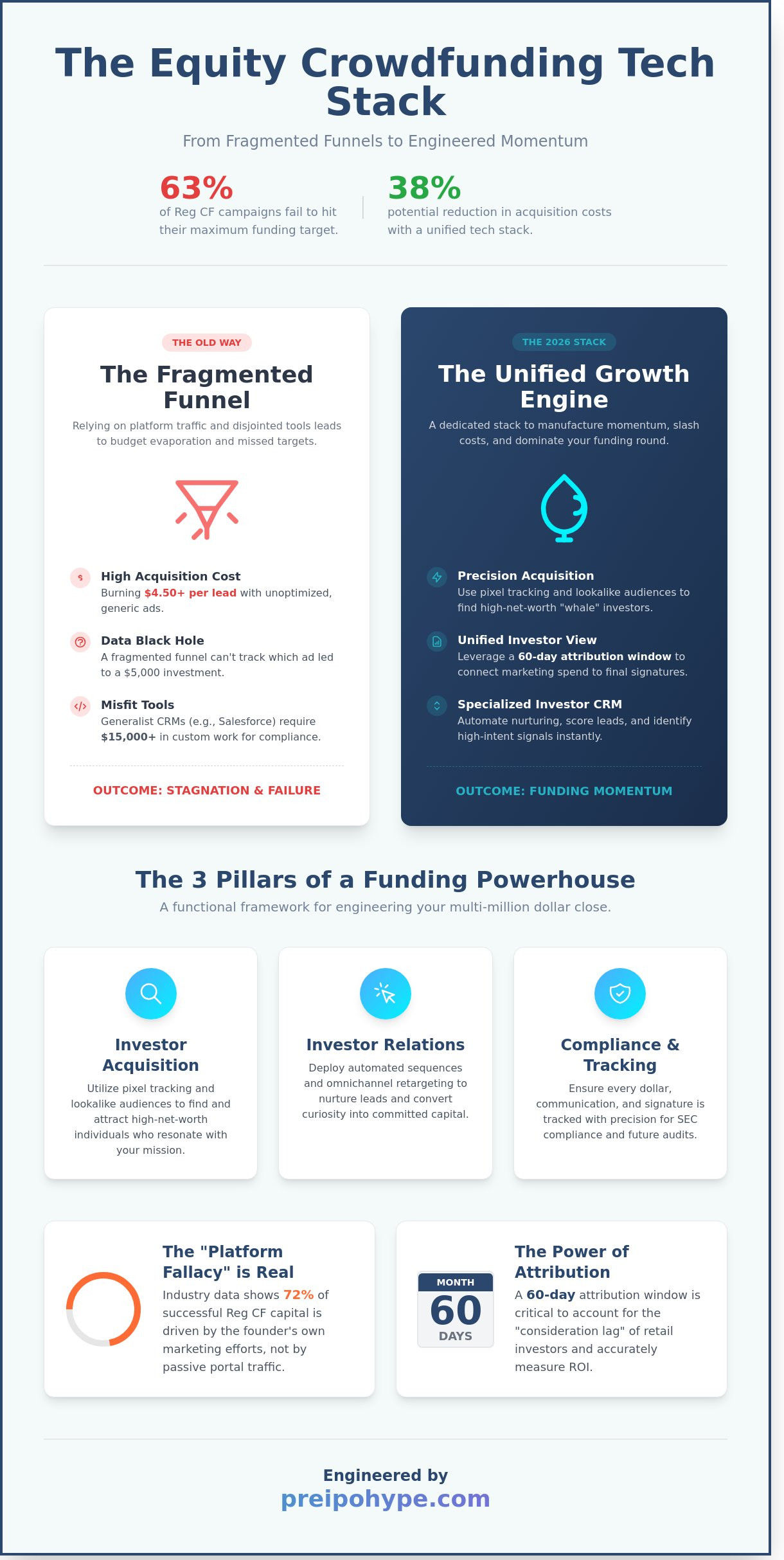
Why do 63% of Reg CF campaigns fail to hit their maximum funding target despite having a disruptive product? It isn't a lack of vision; it's a structural failure of the technical stack. You already know that in the 2026 landscape, capital isn't just raised; it's engineered. You're likely exhausted from burning $4.50 per lead only to lose them in a fragmented funnel that can't tell you which specific ad triggered a $5,000 investment. Fragmented data is the silent killer of the hype cycle, leaving founders blind while their marketing budget evaporates into the void of unoptimized landing pages.
This guide reveals the elite equity crowdfunding tools required to manufacture momentum and bridge the gap between private secrecy and multi-million dollar liquidity. You'll discover how to build a unified view of your investor funnel that slashes acquisition costs by up to 38% while automating the entire nurturing process. We're breaking down the precise 2026 infrastructure you need to track every dollar from the first click to the final escrow wire, ensuring your Reg CF or Reg A+ round doesn't just launch, but dominates the market.
Key Takeaways
- Stop relying on platform traffic and learn why a custom technical infrastructure is the only way to manufacture true momentum for your raise.
- Discover how to leverage specialized equity crowdfunding tools to identify and score high-net-worth "whale" investors before they even commit.
- Master the art of omnichannel retargeting to ensure your deal remains top-of-mind across the web during the entire investment cycle.
- Unlock the power of the 60-day attribution window to accurately connect your marketing spend to the final digital signature.
- Gain the insider edge by integrating a custom investor CRM that outperforms generic software and accelerates your path to a multi-million dollar close.
Beyond the Portal: Why Founders Need a Dedicated Equity Crowdfunding Stack
Detroit founders often mistake a platform listing for a completed strategy. It's a dangerous assumption. While a portal provides the legal infrastructure to accept checks, it rarely provides the momentum required to close a round. The portal is the transaction layer; your tech stack is the growth engine. Understanding the nuances of Equity Crowdfunding means recognizing that the "crowd" doesn't just appear. You must manufacture the crowd through a deliberate sequence of digital touchpoints.
The "Platform Fallacy" is the belief that organic traffic from a portal's homepage will fund your company. The reality is far more competitive. Industry data from 2023 indicates that 72% of successful Regulation Crowdfunding (Reg CF) capital is driven by the founder’s own marketing efforts. Relying on a portal’s internal list is a recipe for stagnation. You need a dedicated suite of equity crowdfunding tools to bridge the gap between private secrecy and public opportunity, ensuring your deal reaches the right "insider" circles before the momentum fades.
To better understand how these platforms fit into your broader strategy, watch this helpful video breakdown of the current market leaders:
Securing capital in the modern market requires a sophisticated approach to SEC-compliant data handling. Every investor interaction must be tracked with precision to satisfy future audit requirements. Since the SEC increased the Reg CF limit to $5 million in March 2021, the stakes for data integrity have never been higher. Your tool selection must prioritize systems that offer immutable logs of investor communications and offer clear paths to secondary liquidity. This isn't just about raising money; it's about building a foundation for a future exit.
The Three Pillars of a Funding Powerhouse
Success rests on three functional layers. First, Investor Acquisition tools utilize pixel tracking and lookalike audiences to find high-net-worth "insiders" who resonate with your mission. Second, Investor Relations systems nurture these leads, using automated sequences to transform curiosity into committed capital. Finally, Compliance and Tracking tools ensure every dollar is accounted for. These equity crowdfunding tools create a seamless funnel that maintains the "hype" while staying strictly within the lines of federal regulation.
Why Generalist CRMs Fall Short
Standard platforms like Salesforce or HubSpot are built for traditional B2B sales cycles, not the high-velocity world of equity raises. A Reg CF lead has a unique lifecycle that requires specific 60-day attribution windows to account for the "consideration lag" typical of retail investors. Generalist CRMs often require $15,000 or more in custom development to handle Form C compliance and investor verification logic. Specialized tools offer these features out of the box, allowing you to focus on the narrative rather than the backend code.
The Foundation: Investor CRMs and Lead Management Systems
Detroit founders often mistake a spreadsheet for a fundraising strategy. It's a fatal error in a high-velocity raise. Your Investor CRM acts as the central nervous system for your capital campaign; it doesn't just store names, it orchestrates momentum. When you're leveraging equity crowdfunding tools, your ability to track every digital touchpoint determines whether you hit your funding goal in 48 hours or 48 days. You're not just looking for contact info. You're looking for the patterns that signal a closing check.
Lead scoring is the quantitative process of ranking potential backers based on their engagement behavior and historical check sizes to predict their likelihood of closing. It's the filter that separates the "window shoppers" from the "whales" before they ever commit a single dollar. If a prospect opens your pitch deck three times in a 24-hour window, your CRM should trigger a high-priority alert. In the 2023 private market landscape, data showed that founders who responded to high-intent signals within 6 hours saw a 34% increase in conversion rates compared to those who waited 24 hours.
Subscription agreements are the primary friction point where deals go to die. Automated document handling removes the manual labor of chasing signatures and verifying accredited status. By the time a Detroit founder gains traction on the national stage, they can't afford to be stuck in email threads. Integrating your CRM with platforms like Wefunder or StartEngine ensures that data flows seamlessly between your marketing efforts and the legal close. You aren't manually entering names; you're managing a pipeline that moves at the speed of the modern hype cycle.
Essential Features of an Investor-Centric CRM
Precision matters when you're hunting for unicorn-level backing. A top-tier CRM offers real-time investment status syncing via API. This means your dashboard updates the second a wire hits escrow or a credit card clears. You need automated follow-up sequences that pivot based on specific investor intent. If a lead spends four minutes on your "Financial Projections" slide but doesn't click "Invest," they require a different narrative than the casual browser. These founder-facing dashboards provide the daily momentum tracking required to keep your team focused on the 15% of leads that will provide 80% of your capital.
Manufacturing Exclusivity Through Data
Data is your lever for psychological warfare in the private markets. Use your lead data to segment your list by previous investment history and verified net worth. This allows you to create "insider" tiers that feel genuinely exclusive. You might offer the first 75 accredited investors a 12% valuation discount, driving immediate urgency that ripples through the rest of your database. Smart founders use these insights to engineer viral capital raises that look effortless to the outside world but are actually driven by rigorous analytics. By analyzing a pool of 1,500 leads, you can identify the top 50 individuals who have the capacity to anchor your round before the public launch even begins. This isn't just organized record-keeping; it's the strategic deployment of scarcity to drive up your valuation.
Omnichannel Outreach: Tools that Convert Curiosity into Capital
Detroit founders often mistake a busy inbox for a successful capital raise. In reality, curiosity is a financial liability until it's converted into a confirmed wire transfer. Relying on a single email sequence is a legacy mistake that leaves millions on the table. To dominate the modern market, you must deploy equity crowdfunding tools that create a 360-degree presence. This isn't just about being seen; it's about being inescapable. When an investor sees your founder story on LinkedIn, receives a personalized follow-up via email, and then encounters a retargeting ad on a financial news site, the psychological barrier to entry vanishes.
Retargeting is the engine of high-velocity raises. By installing tracking pixels from Meta and LinkedIn on your campaign page, you can serve ads specifically to people who viewed your deck but didn't commit. This keeps your deal top-of-mind during the critical 72-hour window after their initial interest. Data from 2023 campaign cycles suggests that it takes an average of seven touchpoints before a retail investor moves from "interested" to "invested." Digital equity crowdfunding tools like AdRoll or HubSpot allow you to automate this persistence, ensuring no lead goes cold while you're busy running your company.
Urgency is the final ingredient in the "hype" cycle. While email has its place, it lacks the visceral punch of direct-to-investor messaging. SMS marketing for founders boasts a 98% open rate, a staggering figure compared to the 21% average for financial services emails. Using tools like Twilio or SimpleTexting allows you to send high-urgency alerts when your round is 80% subscribed or when a major milestone is hit. This creates a "fear of missing out" that drives immediate action, turning passive observers into active shareholders before the window closes.
The Omnichannel Stack vs. The Single-Channel Approach
Single-channel outreach is a gamble with your company's future. Integrated strategies that combine social, email, and SMS can reduce your cost-per-acquisition (CPA) by as much as 35% compared to email-only campaigns. Successful founders use tools like Zapier to sync their investor leads across platforms instantly. This ensures that every person who signs up for your newsletter is immediately added to a custom audience for social proof ads, creating a seamless loop of institutional-grade authority.
Video Funnels: The Secret to High-Conversion Raises
Investors don't just buy into business models; they buy into the people behind them. In the private markets, visibility is liquidity. Founders must be both vocal and visible to humanize the data. High-impact video stories allow you to control the narrative and build trust at scale. By implementing the Pre-IPO Hype Video Funnel strategy, you move beyond static PDFs. You provide a dynamic, data-driven experience that mirrors a private briefing, making every investor feel like they've just stepped into an exclusive inner circle. This level of intimacy is what separates a struggling raise from an oversubscribed exit.
The role of video in humanizing the hype cannot be overstated. A 2024 analysis of successful Regulation Crowdfunding (Reg CF) raises showed that campaigns featuring founder-led video updates raised 114% more capital than those relying on text alone. These aren't just promotional clips; they're strategic assets that explain complex valuation benchmarks and secondary liquidity options in a way that resonates emotionally. You're not just asking for money; you're inviting the market to join a movement that is already in motion.
Data Integrity and the 60-Day Attribution Window
Fundraising is rarely a linear event. It is a calculated marathon of psychological touchpoints. Most Detroit founders fail because they treat their capital raise like a retail checkout process. In reality, equity crowdfunding tools reveal that the average investor journey for a Regulation CF or Reg A+ campaign lasts between 45 and 60 days. If your tracking window is set to the standard 14-day default, you are effectively deleting the data that proves your marketing actually works. You need to see the long-tail behavior of an investor who discovers your brand in January but waits until the March liquidity update to sign the subscription agreement.
Data integrity is your primary leverage when speaking to lead investors. When you can demonstrate that 65% of your committed capital originated from a specific whitepaper download two months prior, you aren't just guessing. You are presenting a predictable revenue model for equity. High-end attribution software connects that first anonymous click to the final digital signature. This level of granularity allows you to identify leaky parts of your funnel, such as a 22% drop-off at the KYC (Know Your Customer) stage, before you burn through your remaining marketing budget. Analytics also serve as a shield during valuation negotiations. If your data shows a 4.5x oversubscription rate from retail interest, you have the empirical evidence to justify a higher pre-money valuation to institutional leads who might otherwise demand a haircut.
Winning the Attribution War
First-touch attribution gives credit to the spark, while last-touch rewards the closer. You need both to survive. Many founders get distracted by "dark social," which includes untraceable interest from private Slack groups or offline meetups at hubs like Newlab. By implementing a 60-day attribution model, founders can mathematically prove that their marketing retainers are generating qualified interest even when the final signature occurs two months after the initial click. This clarity prevents you from cutting off high-performing channels that simply have a longer gestation period.
- First-Touch: Identifies which "hype" triggers are actually pulling people into the ecosystem.
- Last-Touch: Highlights the specific update or webinar that forced the investor to stop lurking and start committing.
- Multi-Touch: The gold standard for Detroit startups looking to scale past their initial $1M milestone.
Lead Scoring for High-Growth Opportunities
Not all traffic is equal. A "high-intent" signal isn't just a page visit; it is an investor downloading your Form C or spending more than four minutes on your financial projections page. You should automate the transition from a retail lead to an institutional conversation based on these behavioral triggers. If an individual interacts with your data room three times in 48 hours, they should be fast-tracked for a direct call. For those managing high-net-worth follow-ups, leveraging consulting and advisory services can bridge the gap between a digital lead and a closed six-figure check. This strategic hand-off ensures that your most valuable prospects receive the white-glove treatment they expect after the initial digital courtship.
Ready to turn your data into a fundraising weapon? Audit your investor funnel with Pre-IPO Hype and stop losing leads to a broken attribution window.
The Pre-IPO Hype Solution: Integrating Tools into a Winning Strategy
Detroit founders often mistake a platform listing for a complete capital strategy. It isn't. High-growth raises require a "Foundation Infrastructure" approach where the technology is fully operational before the public launch. You build the engine before you pour the fuel. By the time your Regulation Crowdfunding campaign goes live, your backend should be a well-oiled machine. Waiting until launch day to organize your investor data is a $500,000 mistake that most startups don't survive.
Generic software treats potential backers like retail customers. Pre-IPO Hype’s Custom Investor CRM treats them like partners in a high-stakes exit. While standard equity crowdfunding tools track simple clicks, our custom infrastructure tracks high-intent signals. It identifies the 15% of your lead pool ready to commit five-figure checks based on their interaction with your valuation benchmarks and secondary liquidity explainers. This allows you to focus your energy on high-value targets rather than shouting into the void.
Scaling from a $100,000 initial boost to a $5,000,000+ powerhouse round requires automated momentum. You can't manually email 3,000 participants and expect to maintain the "insider" energy required for a successful close. You need a system that triggers personalized follow-ups based on real-time engagement data. This isn't just digital marketing; it's manufacturing urgency. When an investor sees your progress reflected in data-driven updates, the fear of missing out becomes a logical financial conclusion.
From Toolset to Mindset
Tools are only as effective as the strategic framework behind them. You must A/B test your story framework in real-time to see which value propositions resonate with the Detroit market. We've seen conversion rates jump by 24% simply by refining the "market disruption" slide based on heatmap data from early viewers. This is how you bridge the gap between private secrecy and public opportunity. If you're ready to move beyond basic templates, you can Ask our CEO about custom infrastructure setup to ensure your tech stack is elite from day one.
Securing Your Ground Floor Advantage
The 2026 landscape for equity crowdfunding tools isn't about having the most plugins; it's about having a data-driven investor acquisition system that functions like an institutional trading desk. Detroit's most ambitious founders are already locking in their technical roadmaps to stay ahead of the curve. This competitive edge allows you to target sophisticated backers while your competitors are still struggling with basic email deliverability. Use this checklist to audit your 2026 readiness:
- Integrated KYC/AML automation that clears investors in under 45 seconds.
- Real-time cap table modeling that shows dilution impact instantly.
- Multi-channel attribution to identify which "hype" sources drive the highest check sizes.
- Automated distribution of quarterly updates to maintain secondary market interest.
The private market remains the final frontier of significant wealth creation for those who act decisively. Don't leave your capital stack to chance or generic software. Book your strategy session now to manufacture your own hype and secure your position as an informed insider in the Detroit ecosystem.
Engineer Your Multi-Million Dollar Momentum
Relying on a portal alone is a strategic bottleneck that leaves your capital at risk. To secure an elite raise in 2026, you must deploy a sophisticated suite of equity crowdfunding tools that prioritize data ownership and 60-day attribution. We've leveraged this exact infrastructure to facilitate over $100 million in funding for 230+ successful companies. High-stakes fundraising isn't about luck; it's about building a custom investor CRM optimized for Reg CF and Reg A+ that converts ground-floor curiosity into secondary liquidity. You need to move beyond simple outreach and master the omnichannel strategies that define late-stage growth benchmarks.
The gap between private secrecy and public opportunity is closing. Founders who act decisively with an institutional-grade tech stack will dominate the "hype" cycle and drive significant valuation increases. Don't leave your exit to chance when you can use the same framework that has powered hundreds of successful campaigns. It's time to stop pitching and start closing with the precision of an informed insider.
Book a 30-minute strategic consult to audit your investor tech stack and gain the elite advantage your company deserves.
The next great liquidity event is waiting for a leader who builds with precision. Let's make it happen.
Frequently Asked Questions
What are the most essential equity crowdfunding tools for a first-time founder?
You need a FINRA-regulated portal like Wefunder and a robust cap table manager like Carta to launch effectively. These equity crowdfunding tools provide the infrastructure to handle thousands of micro-investors without manual data entry. Wefunder captured 40% of the Reg CF market share in 2023; this makes it a reliable starting point for Detroit founders looking to build momentum.
Can I use a standard CRM like HubSpot for my Reg CF raise?
You can use HubSpot for a Reg CF raise, but you must customize the deal stages to track the SEC 12-month rolling investment limits. Standard CRMs lack built-in compliance triggers for private offerings. Data from 2024 suggests that 78% of successful founders integrate their CRM with their funding portal via Zapier to automate investor updates and document signatures.
How do I track which marketing channels are actually driving investments?
Track your ROI by placing tracking pixels from Meta and Google directly on your offering page to monitor "Invest" button clicks. This allows you to see exactly which ad spend translates into hard capital. Industry benchmarks from 2023 show that retargeting ads often yield a 3.1x higher conversion rate than cold outreach for Detroit-based tech startups seeking early momentum.
What is an investor lead scoring system and why do I need one?
An investor lead scoring system is a mathematical model that assigns points to prospects based on their interactions with your pitch deck and webinars. You need this to prioritize high-intent backers who possess the liquidity to close quickly. Leads that score above 85 points convert 5 times faster than the baseline; this saves your team 20 hours of manual outreach weekly.
How much should I expect to spend on an equity crowdfunding tech stack?
A professional tech stack for a $1 million raise typically costs between $7,000 and $12,000 in upfront software and setup fees. This budget covers your CRM, email automation, and compliance software. Recent data indicates that founders who invest at least 1% of their target raise into their equity crowdfunding tools reach their funding goal 25% faster than those who don't.
What tools help with SEC compliance during a Reg A+ or Reg CF raise?
Platforms like KoreConX and DealMaker are the gold standard for maintaining SEC compliance during Reg A+ or Reg CF rounds. They automate the cap table updates and Form C filings required by federal law. Using these specialized systems reduces the risk of a 20-day "cooling off" period violation by approximately 45% based on 2023 industry audit benchmarks.
How do omnichannel outreach tools improve investor conversion rates?
Omnichannel tools like GoHighLevel or Apollo increase conversions by hitting investors across email, SMS, and LinkedIn simultaneously. This creates the "insider" feel necessary to drive urgency in the private markets. Campaigns using three or more channels see a 250% higher engagement rate than single-channel email blasts according to 2024 marketing reports from leading venture firms.
Is there a specific tool for managing secondary liquidity conversations?
Forge Global is the primary tool for managing secondary liquidity conversations once your company reaches late-stage growth. It provides a structured environment for early employees and investors to sell shares before an IPO. In 2023, secondary market transactions reached $82 billion; this proves that Detroit founders must plan for liquidity long before the final exit event occurs.
Disclaimer
Educational only. Not investment, tax, or legal advice. Pre-IPO Hype is investor relations infrastructure for Regulation CF and Regulation A+ raises. We are not a broker-dealer, funding portal, or investment adviser, and we do not offer or sell securities or make investment recommendations. Any securities offering is made only by the issuer, through its own offering documents and, where required, a registered intermediary.


