
Financial Modeling for Startups Raising Capital: The 2026 Founder’s Playbook
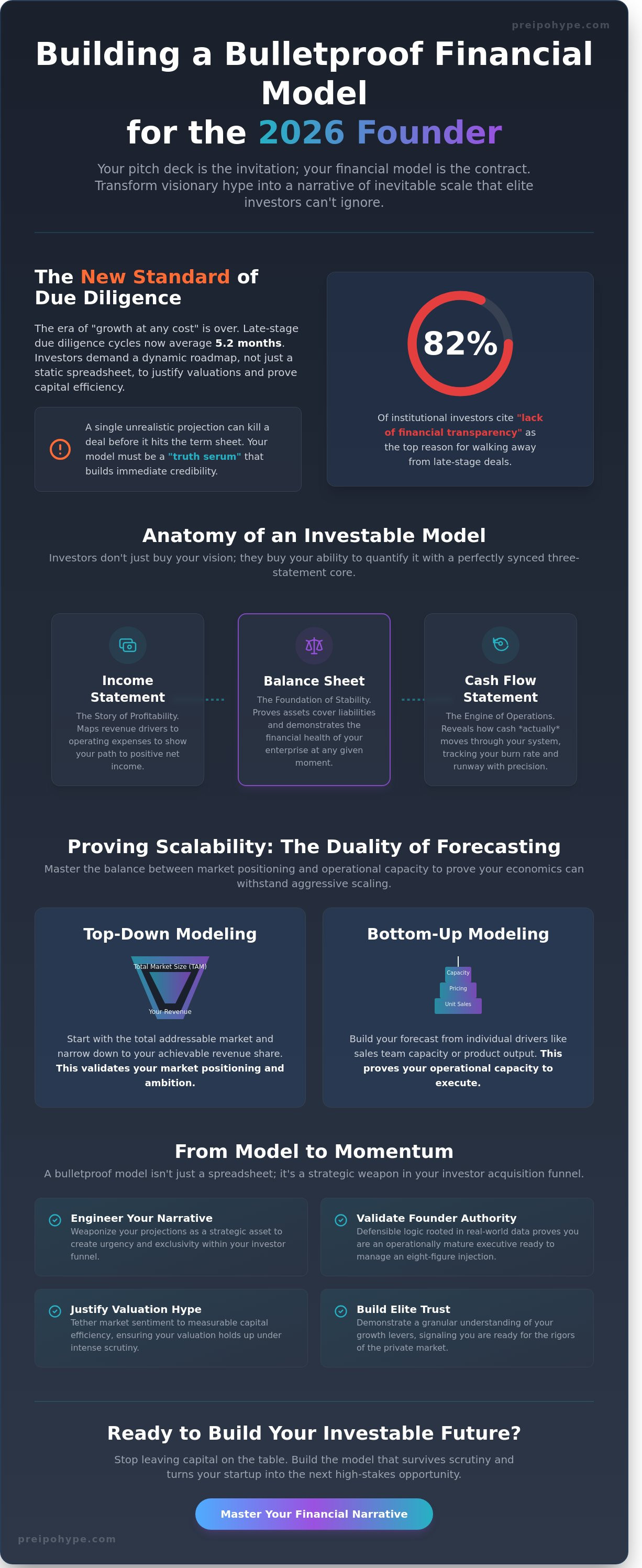
By 2026, your pitch deck is just the invitation; your financial model is the contract. With late-stage due diligence cycles now averaging 5.2 months, investors have moved past the era of growth at any cost. You've likely felt the pressure of trying to translate visionary "hype" into a spreadsheet that doesn't crumble under a partner's first question. Mastering financial modeling for startups raising capital isn't just about math. It's about engineering a narrative of inevitable scale that elite insiders can't ignore.
You know that a single unrealistic projection can kill a deal before it hits the term sheet. This guide is your roadmap to building a bulletproof model that survives the most rigorous scrutiny. We'll show you how to identify the specific 2026 KPIs that drive valuation benchmarks and how to allocate your capital for maximum post-raise momentum. By the end of this playbook, you'll have the confidence to defend your numbers and the tools to turn your startup into the next high-stakes opportunity.
Key Takeaways
- Transform your financial model into a dynamic "truth serum" that validates your growth narrative and builds immediate credibility with elite capital partners.
- Learn to engineer the three-statement core—Income, Balance Sheet, and Cash Flow—to ensure your financial modeling for startups raising capital demonstrates the sync required for institutional-grade scrutiny.
- Master the balance between top-down market positioning and bottom-up operational capacity to prove your unit economics can withstand rapid, aggressive scaling.
- Identify the specific growth levers and marketing spend assumptions that move the needle, turning your 2026 forecast into a roadmap for unicorn-level momentum.
- Unlock the ability to weaponize your financial projections as a strategic content asset, creating a sense of exclusivity and urgency within your investor acquisition funnel.
Beyond the Spreadsheet: Why Financial Modeling is Your Capital Raising Foundation
Is your spreadsheet a static tomb or a living engine? In the current venture landscape, a pitch deck might open the door, but your model closes the deal. Effective financial modeling for startups raising capital isn't about predicting the future with 100% accuracy. It's about demonstrating that you possess a granular understanding of your growth levers. In 2026, investors have moved past the era of "growth at any cost." They now demand a dynamic roadmap that accounts for shifting interest rates and fluctuating burn multiples.
Think of your model as the ultimate truth serum. It strips away the marketing gloss to reveal the underlying mechanics of your business. According to a 2024 report on venture trends, 82% of institutional investors cite "lack of financial transparency" as the primary reason for walking away from late-stage deals. By presenting a sophisticated approach to financial modeling, you signal that your startup is ready for the rigors of the private market. This transparency builds elite trust, positioning you as an insider who understands how to protect and multiply capital.
To master the mechanics of a professional-grade build, watch this walkthrough of a 3-statement model:
The 2026 founder must also model for the exit. Investors are no longer content with "paper gains." They want data-driven proof of secondary liquidity potential. Your model should highlight when and how early backers can achieve a partial exit before a formal IPO. This forward-thinking strategy transforms your financial document from a simple budget into a compelling narrative of wealth creation.
The Psychology of the Investor Model Review
When an investor audits your CAC/LTV ratios, they're looking for the source of your data. They want to know if your $150 customer acquisition cost is based on a limited $10,000 test or a scaled $1.2 million campaign. Defensible logic matters more than the final revenue number. If your assumptions are rooted in reality, it validates your founder authority. It proves you've transitioned from a visionary dreamer to an operationally mature executive capable of managing eight-figure capital injections.
Modeling for the Hype Cycle
High-growth sectors often trade on sentiment, but 2026 valuation benchmarks are increasingly tethered to capital efficiency. You must use financial data to justify the premium your "unicorn" status demands. Financial hype is the measurable momentum of capital efficiency. By aligning your market sentiment with hard projections, you bridge the gap between private secrecy and public opportunity. This ensures your valuation holds up under the intense scrutiny of a due diligence team looking for any reason to haircut your price.
The Anatomy of an Investable Financial Model: Proving Scalability and Momentum
Investors don't just buy your vision. They buy your ability to quantify it. Most founders treat a spreadsheet as a chore, but elite operators view it as a weapon. Effective financial modeling for startups raising capital requires a three-statement core where the Income Statement, Balance Sheet, and Cash Flow Statement are perfectly synced. If your projected revenue jumps by 300% in Q3 2026 but your balance sheet doesn't account for the increased accounts receivable or the hiring lag, your credibility vanishes. Institutional-grade models demonstrate that you understand how cash moves through your system before it ever hits the bank account.
- Revenue Drivers: Move beyond market share guesses. Identify the specific levers, such as lead-to-close ratios or viral coefficients, that trigger exponential growth.
- Operating Expenses: Model the physical and digital infrastructure needed to scale. This is your foundation infrastructure pillar, covering the tech stack and talent required to support a 10x surge in volume.
- Capital Allocation: Show exactly how every dollar of the raise fuels the hype. VCs want to see that $1 of investment yields at least $4 of enterprise value through aggressive, calculated deployment.
KPIs That Drive Investor Acquisition
The most overlooked metric in 2026 is Investor Acquisition Cost (IAC). While you track Customer Acquisition Cost (CAC) to prove product-market fit, tracking IAC proves you can scale your capital base. If your churn rate exceeds 2.5% monthly, your valuation takes a hit regardless of top-line growth. Investors prioritize a survival of the fittest status, which is defined by a burn rate that provides at least 24 months of runway post-raise. You can book a strategy session to stress-test these specific metrics against current market benchmarks before you hit the road.
Integrating CRM Data into Your Forecast
Static assumptions are dead. Modern financial modeling for startups raising capital relies on real-time data integration. Using 60-day attribution tracking allows you to inform future revenue projections with historical accuracy. By leveraging lead scoring from your Custom Investor CRM, you can predict funding velocity based on actual engagement levels. This turns soft metrics into defensible financial assumptions. When you can prove that a 15% increase in webinar attendance correlates to a $500,000 bump in committed capital, you aren't just guessing. You're engineering momentum and showing the market that your growth is a mathematical certainty.
Top-Down vs. Bottom-Up Modeling: Choosing the Right Framework for Your Raise
Your financial model is more than a set of projections; it's a statement of intent. In the 2026 private market, the distinction between "dreaming" and "doing" is defined by your choice of modeling framework. Financial modeling for startups raising capital requires a tactical balance between the macro vision and the micro reality. Investors no longer settle for broad strokes. They demand a narrative that connects the $50 billion global market to your specific cost per acquisition (CAC).
The top-down approach starts with the market. You identify a massive Total Addressable Market (TAM) and claim a small percentage. It's high-level and visionary. The bottom-up approach is the opposite. It builds from the ground floor, starting with your operational capacity, hiring plan, and conversion rates. For Regulation Crowdfunding (Reg CF) raises in 2026, 78% of successful campaigns prioritize bottom-up logic. These investors want to see the plumbing of your business before they fund the penthouse.
When to Use Top-Down Projections
Top-down modeling is your tool for capturing the imagination of unicorn-hunting venture capitalists. It defines the ceiling of your opportunity. If you aren't positioning your startup against late-stage growth benchmarks that show a path to a $1 billion valuation, you'll struggle to gain traction in elite circles. Use this to prove the market is large enough to justify the risk. However, beware of "market share dreaming." Claiming you'll capture 1% of a market without explaining how is a red flag that kills deals in minutes. A 2025 analysis of failed seed rounds showed that 64% were rejected due to "unrealistic top-down assumptions" lacking operational backing.
The Power of Bottom-Up Execution
Bottom-up modeling is where you prove the "engine" works. This framework relies on your actual digital marketing and advertising performance to project growth. If your current lead-to-close rate is 4.2%, your model should reflect that, not a hopeful 10%. This transparency builds immediate trust with sophisticated investors who value capital efficiency over raw burn.
- Unit Economics: Show that your Lifetime Value (LTV) is at least 3x your CAC.
- Milestone-Driven: Tie every dollar raised to a specific operational win, such as reaching 10,000 active users or hitting $2M in ARR.
- Scalability: Demonstrate how adding $500,000 to your ad spend specifically results in a predictable revenue climb.
The most effective financial modeling for startups raising capital uses a hybrid approach. Use top-down to set the vision and prove the exit potential. Use bottom-up to prove you can execute the plan. It's the difference between saying you'll be a leader in the industry and showing the exact steps you'll take to get there. This dual-layered strategy creates the "hype" necessary for a fast raise while maintaining the institutional-grade rigor that secures the check.
Step-by-Step: Building Your Startup’s Financial Forecast for 2026
Precision is the difference between a funded unicorn and a forgotten pitch deck. In the current market, financial modeling for startups raising capital isn't about guessing; it's about engineering a narrative through hard numbers. Investors in 2026 have moved past "growth at all costs" and now demand a clear path to secondary liquidity and sustainable unit economics.
- Step 1: Establishing the Baseline. Start with your last 12 to 18 months of actuals. If your LTV to CAC ratio is currently 2.5:1, don't model a 5:1 ratio without a documented shift in acquisition strategy. Your historical data is the anchor of your credibility.
- Step 2: Defining Growth Levers. Identify the specific inputs that move the needle. This includes your monthly marketing spend, lead conversion rates, and referral coefficients. If you increase spend by 25%, how does your CAC respond?
- Step 3: Layering in the Team. Tie every new hire to a revenue milestone or a specific product launch. A modular hiring plan allows you to scale headcount only when the cash flow or funding triggers are met.
- Step 4: Stress-Testing Scenarios. Build three distinct versions. Your Base case is the reality. Your Bull case is the "hype" scenario for aggressive expansion. Your Bear case is the survival plan if the market faces a 20% contraction.
- Step 5: Finalizing Use of Proceeds. For a Reg CF or Reg A+ filing, you must be surgical. Break down exactly how much capital goes to R&D, marketing, and operations. Transparency here is what closes the gap between private secrecy and public opportunity.
Setting Defensive Assumptions
Market volatility is the only constant in the 2026 landscape. You must handle seasonality by analyzing a 3 year trailing average of your specific sector. Conservative estimates often lead to more aggressive funding because they demonstrate a founder's grip on reality. If your model doesn't include "Sanity Checks" against the 15% to 20% industry standard for churn, sophisticated investors will flag it as a red flag during due diligence.
Visualizing the Growth Story
Your model needs to be more than a wall of numbers; it's a visual argument for your company's future. Create investor-ready dashboards that highlight the J-curve of your scalability. Use clean, modular sheet structures that allow an analyst to toggle a single variable and see the immediate impact on your valuation benchmarks. A well-structured sheet proves you're an informed insider ready for the big stage.
Ready to see how these numbers translate into a high-converting investor narrative? Watch our masterclass on framing your growth story for elite investors.
From Model to Momentum: Leveraging Financial Data in Your Investor Acquisition Funnel
Your financial model isn't a static document collecting dust in a digital data room. It's the pulse of your investor acquisition funnel. In 2026, elite founders use data to engineer the hype cycle rather than just reacting to it. By translating complex rows of projections into "Insider" opportunities, you turn cold outreach into a high-conviction movement. Use your CAC-to-LTV ratios or your 24-month burn-down charts as bite-sized content for your investor newsletter. This transparency builds the trust necessary to convert a casual observer into a lead investor.
Effective financial modeling for startups raising capital plays a pivotal role in Reg CF marketing services. It allows you to democratize access without sacrificing institutional sophistication. You aren't just selling shares; you're offering a seat at the table. By showcasing the data behind your projected 10x growth, you bridge the gap between private secrecy and public opportunity. It makes the investment feel like a logical, data-backed decision rather than a speculative gamble. This approach turns your spreadsheet into a content asset that fuels your entire marketing engine.
- Convert quarterly milestones into social proof for LinkedIn updates.
- Use sensitivity analysis to show investors you've de-risked their capital.
- Frame your "Use of Funds" as a roadmap for market domination.
The Founder-Investor Synergy
The model serves as the ultimate alignment tool. It lets you discuss valuation without dampening the energy that drives early-stage interest. When you anchor your valuation in rigorous logic, you earn the right to be bold about your future. It's about showing that your ambition is calculated, not chaotic. If you need a second pair of eyes on your numbers, you can Ask the CEO for a strategic review of your fundraising roadmap to ensure your narrative is bulletproof before you hit the market.
Scaling Beyond the Raise
Winning the round is just the start. Your model evolves into a management tool that dictates your post-funding execution. By integrating real-time CRM data, you maintain momentum and keep your board updated with precision. This level of operational maturity is what separates flash-in-the-pan startups from true unicorns. Don't leave your capital raise to chance. Book a 30-minute strategy session to engineer your elite capital raise and secure your place in the next generation of market leaders.
Master the Math of Momentum: Your 2026 Funding Roadmap
Success in the 2026 private market requires more than a visionary pitch deck; it demands a model that stands up to institutional scrutiny. By prioritizing a bottom-up framework, you transform static projections into a dynamic roadmap for scalability. Effective financial modeling for startups raising capital acts as the bridge between your current valuation and your next liquidity event. It's the engine that powers your investor acquisition funnel, turning raw data into a narrative of inevitable growth.
Precision is your greatest leverage when unicorn hunting. We've facilitated over $100M in funding by combining high-stakes financial authority with aggressive marketing systems. Our specialists utilize a custom Investor CRM to provide 60-day attribution, ensuring every dollar spent on Reg CF or Reg A+ campaigns translates into measurable momentum. You don't have to navigate this gated world alone. The tools to democratize your access to elite capital are ready for deployment.
Ready to engineer your investor hype? Book a strategy session with Fuzzy Wenzel.
The 2026 landscape is moving fast. Take control of your financial destiny and build the foundation your vision deserves.
Frequently Asked Questions
What is the most important metric in a startup financial model for 2026?
Net Dollar Retention (NDR) is the gold standard metric for 2026. Investors now prioritize 115% or higher NDR to prove product-market fit and long-term scalability. This shift reflects a move away from raw user growth toward sustainable, high-margin revenue cycles. High NDR signals that your existing customers spend more over time, which significantly de-risks the investment for late-stage growth funds.
How far into the future should a startup financial model project?
Standard practice for financial modeling for startups raising capital requires a three to five year projection. The first 18 months must be granular, showing monthly burn rates and specific headcount additions. Years three through five can shift to quarterly or annual views. This timeline allows founders to demonstrate a clear path to a 10x exit or a strategic IPO window within a realistic timeframe.
Do I need a CFO to build a financial model for a Reg CF raise?
You don't need a full-time CFO, but an interim financial lead is vital for Regulation Crowdfunding (Reg CF). SEC rules require GAAP-compliant financial statements for raises exceeding $124,000. Professional oversight ensures your model survives the intense scrutiny of the 50,000 retail investors who may view your Form C filing. It's about building institutional trust from the very first click.
How do I justify a high valuation in my financial model?
Justify your valuation by anchoring it to 2025 revenue multiples of comparable public companies or recent M&A exits in your sector. If the median SaaS multiple is 8x, demonstrate why your proprietary tech or 40% month-over-month growth warrants a 12x premium. Use bottom-up forecasting to prove that your market capture targets are grounded in realistic sales velocity rather than arbitrary top-down percentages.
What is the difference between a financial model and a budget?
A financial model is a dynamic, multi-scenario tool used for strategic decision-making and fundraising. In contrast, a budget is a rigid operational plan that tracks actual spending against a fixed limit over a 12-month period. Your model explores what-if scenarios like a 20% increase in customer acquisition costs. The budget simply ensures you don't overspend on cloud credits or office space during the fiscal year.
How often should I update my startup financial model during a capital raise?
Update your model every 30 days or immediately following a significant pivot in your go-to-market strategy. Real-time data is your strongest weapon during a 90-day roadshow. If your June sales exceed projections by 15%, your model should reflect that momentum to create urgency among lead investors. Stale data suggests a lack of operational control and can stall a deal in the final hour.
Can I use a template for my startup financial model?
You can use a template as a structural foundation, but you must customize every formula to reflect your unique unit economics. Professional financial modeling for startups raising capital requires more than a generic Excel sheet. Investors can spot a standard SaaS template instantly. Tailor your variable costs and revenue drivers to show you understand the specific levers that scale your business in a competitive market.
What happens if my startup misses the projections in the model?
Missing projections triggers a re-forecasting event where you must explain the variance to your board and investors. If you miss your Q3 revenue target by 10%, identify whether the cause was a longer sales cycle or a failed marketing channel. Honest communication and a revised plan maintain your insider credibility. Investors expect volatility, but they demand a founder who can navigate the data toward a recovery.
Disclaimer
Educational only. Not investment, tax, or legal advice. Pre-IPO Hype is investor relations infrastructure for Regulation CF and Regulation A+ raises. We are not a broker-dealer, funding portal, or investment adviser, and we do not offer or sell securities or make investment recommendations. Any securities offering is made only by the issuer, through its own offering documents and, where required, a registered intermediary.


