
Fundraising Campaign Analytics: Engineering Investor Momentum in 2026
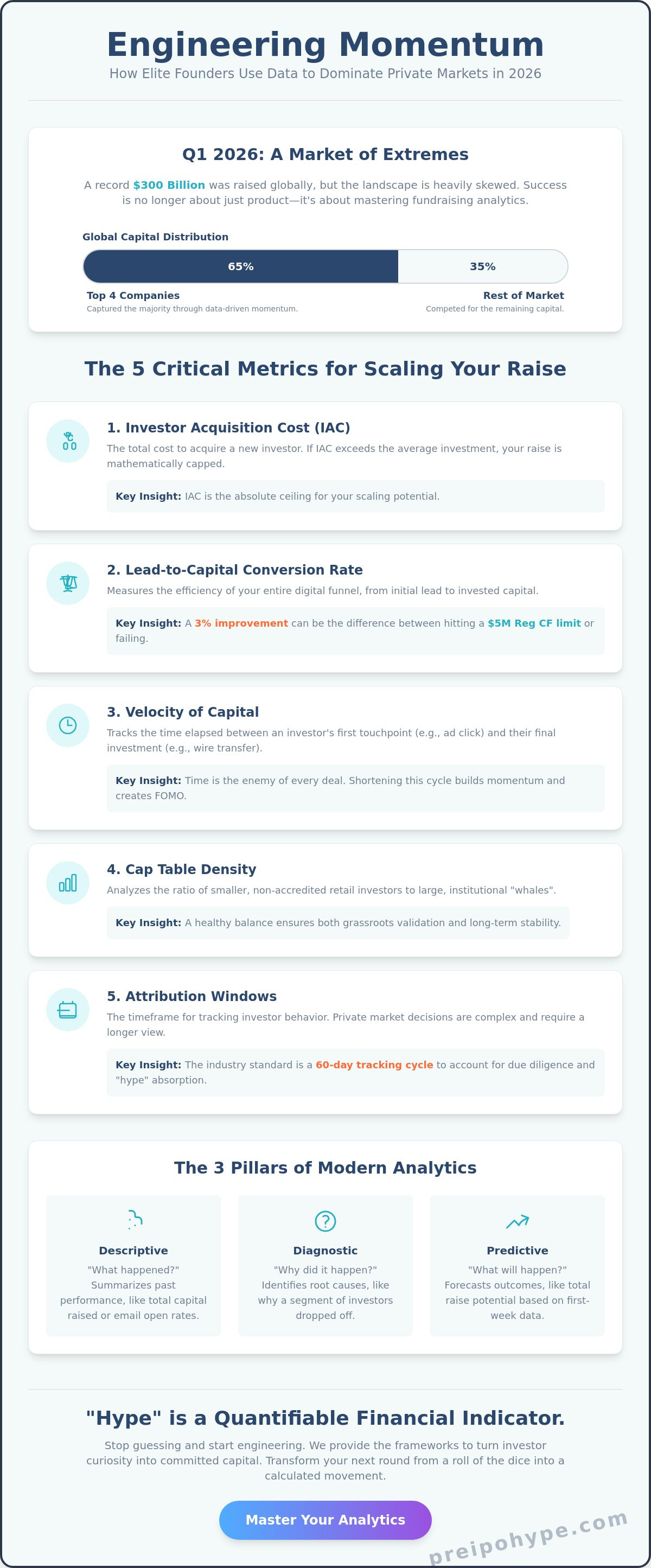
In Q1 2026, four companies captured 65% of the record $300 billion raised globally, leaving the rest of the market to fight for the remains. This isn't just a gap in product quality; it's a gap in how these elite founders leverage fundraising campaign analytics to manufacture momentum. You've likely felt the frustration of burning through ad spend on low quality leads while struggling to track the 60 day investor journey. It's a common pain point that keeps promising companies from reaching their full scaling potential and achieving the $75 million Reg A+ Tier 2 limits.
We're here to change that narrative. You'll learn the master frameworks used by the most successful private market players to track, predict, and scale capital raises with surgical precision. This guide provides a clear roadmap for investor acquisition and predictable scaling while ensuring your data reporting remains SEC compliant. We'll explore the specific metrics that prove your ROI to the market, turning your next round into a calculated movement rather than a roll of the dice.
Key Takeaways
- Transition from passive tracking to active momentum engineering by mastering the systematic flow of investor engagement and capital conversion.
- Identify why Investor Acquisition Cost (IAC) serves as the definitive ceiling for your scaling potential in the 2026 private markets.
- Leverage predictive modeling to forecast your total raise and exit velocity based on critical first-week data benchmarks.
- Establish a robust system for fundraising campaign analytics to ensure every digital lead is tracked through the full 60-day investor journey.
- Audit your foundation infrastructure to eliminate data silos and centralize your investor acquisition strategy within a custom CRM.
What are Fundraising Campaign Analytics in the Private Market?
Fundraising campaign analytics is the systematic engineering of investor behavior through the tracking of engagement, acquisition costs, and capital conversion rates. In 2026, the era of passive tracking is over. Founders who treat their raise like a "wait and see" experiment are losing ground to those who treat it like a high-stakes manufacturing process. While traditional fundraising principles often focus on broad donor sentiment, private market analytics focus on the cold, hard velocity of capital moving from curiosity to commitment.
To better understand how this shift from intuition to data-driven execution works, watch this helpful video:
High-stakes investor acquisition data differs fundamentally from retail donor metrics. You aren't just looking for a "gift." You're identifying sophisticated individuals who understand secondary liquidity and valuation benchmarks. In a market where Q1 2026 saw a record $300 billion in venture funding, the difference between a failed round and a unicorn-level exit is how you bridge the gap between private secrecy and public opportunity using verifiable data points.
The Three Pillars: Descriptive, Diagnostic, and Predictive
Modern fundraising campaign analytics rests on three distinct levels of insight. Descriptive analytics summarize the past; for example, did your last Reg CF email blast reach the $5 million rolling 12-month cap? Diagnostic analytics dig deeper into the "why," identifying why a specific segment of accredited investors dropped off at the foundation infrastructure stage. Finally, predictive analytics use early momentum signals to forecast whether your current trajectory will hit the $75 million Reg A+ Tier 2 limit or if you need to adjust your digital marketing spend immediately.
Why 'Hype' is a Quantifiable Financial Indicator
At Pre-IPO Hype, we reclaim "hype" as a legitimate financial indicator. It's the measurement of the velocity of curiosity turning into capital. By tracking "insider" sentiment through CRM engagement scores, we can quantify the emotional style of a raise. This isn't guesswork. It's about using specific engagement stats, such as a 40% increase in deck views within a 48-hour window, to build genuine FOMO during a live raise. When you can prove that 58% of CIOs are driving AI software spending, you use those numbers to create a sense of exclusivity and urgency that moves the needle.
The 5 Critical Metrics for Equity Crowdfunding Success
Elite founders don't guess; they engineer. To move the needle in a market where U.S. venture funding reached $274 billion in 2025, you need to look past vanity metrics like "likes" or "page views." True fundraising campaign analytics focus on the friction and flow of capital. If you aren't obsessing over these five KPIs, you're leaving your valuation to chance.
- Investor Acquisition Cost (IAC): This is the definitive ceiling for your scaling potential. If it costs more to acquire an investor than their average commitment, your raise is mathematically capped.
- Lead-to-Capital Conversion Rate: This measures the raw efficiency of your digital funnel. In 2026, a 3% shift in this rate can be the difference between hitting a $5 million Reg CF limit or falling short.
- Velocity of Capital: Time is the enemy of every deal. You must track how many days pass between the first ad click and the final wire transfer.
- Cap Table Density: High-performing raises balance retail volume with institutional weight. Tracking the ratio of non-accredited participants to "whales" ensures long-term stability.
- Attribution Windows: Private market decisions aren't impulsive. A 60-day tracking cycle is the industry standard because it accounts for the research, due diligence, and "hype" absorption required for a significant commitment.
Recent industry reports on AI in fundraising demonstrate that data-driven founders are now using machine learning to optimize these windows in real-time. By identifying patterns in how a $200,000-income accredited investor interacts with content, you can predict capital inflow weeks in advance.
Multi-Touch Attribution: Tracking the 60-Day Journey
First-click attribution is a relic of simple e-commerce. In private equity, an investor might see a LinkedIn ad, read your newsletter, and attend a webinar before committing. You must use a Custom Investor CRM to map every single interaction. This allows you to identify the "tipping point" interaction, the specific piece of content that finally triggers the wire transfer. If you're struggling to visualize this journey, it might be time to book a strategy audit to find your tracking gaps.
Investor Lead Scoring: Identifying the 'Whales'
Not all leads are created equal. Effective fundraising campaign analytics involve setting up automated scoring based on engagement. A lead who opens three consecutive newsletters and spends ten minutes on your pricing page is a "whale" in the making. Prioritize your omnichannel outreach for the top 5% of your engaged pool to maximize your time and capital efficiency. This system-led execution ensures you're hunting unicorns, not just chasing clicks.
Predictive Modeling: Forecasting Exit Velocity and Raise Totals
Predictive modeling isn't a crystal ball. It's a high-precision instrument that turns early engagement signals into a clear financial forecast. By leveraging historical Reg CF benchmarks, we can determine if your current trajectory will hit the $5 million 12-month limit or stall out before the finish line. This level of fundraising campaign analytics allows founders to move from hope to certainty within the first seven days of a launch. You aren't just watching numbers; you're measuring the heartbeat of your market demand.
The "Early Bird" effect is a critical indicator of long-term success. Data from the first quarter of 2026 shows that the velocity of capital in your first week predicts your final 30-day total with nearly 85% accuracy. If your momentum is sluggish during this window, you need to audit your Foundation infrastructure immediately. Friction at the tracking or landing page level can decimate your conversion rates before you've even reached your core audience.
Implementing a data-driven fundraising plan involves rigorous scenario planning. You must ask the hard questions now. If your Investor Acquisition Cost (IAC) increases by 20% due to rising competition in the AI sector, how does that impact your overall ROI? Understanding these variables allows you to adjust your digital marketing spend dynamically, ensuring your raise remains profitable even as market conditions shift.
Benchmarking Against the Market
We don't operate in a vacuum. We compare your campaign's hype metrics against industry-standard Reg A+ benchmarks to see how you stack up against the elite. This includes analyzing secondary liquidity signals to refine your investor targeting and ensure you're reaching those with the highest intent. Exit Velocity is the rate at which engagement converts to final-round capital. By monitoring this, you can determine if your "insider" framing is resonating or if your valuation benchmarks need a reality check.
Identifying and Plugging Funnel Leaks
Heatmap data often reveals the exact moment an investor loses interest. If 40% of your visitors abandon your pitch deck on the "Team" slide, your story isn't landing. We use A/B testing to determine if it's the valuation or the narrative that's failing to convert. Retargeting analytics then allow you to turn a "No" into a "Not Now," keeping your opportunity in front of sophisticated leads who haven't yet pulled the trigger. This systematic approach ensures no lead is left behind in the 60-day journey.
Building a Data-Driven Investor Acquisition System
Transforming raw data into a capital catalyst requires more than just a spreadsheet; it requires a machine. You've identified the metrics that matter, but without a centralized system, your fundraising campaign analytics will remain fragmented and unactionable. To capture your share of the $300 billion raised in Q1 2026, you must build an infrastructure that tracks every dollar from the first impression to the final closing.
Execution follows a rigorous five-step blueprint to ensure no momentum is wasted:
- Step 1: Audit your foundation infrastructure to identify tracking gaps that lead to wasted ad spend.
- Step 2: Implement a Custom Investor CRM to serve as your single source of truth for all lead data.
- Step 3: Deploy omnichannel tracking across social, search, and email to capture the full 60-day investor journey.
- Step 4: Establish a weekly "Hype Report" to monitor shifts in investor sentiment and capital velocity.
- Step 5: Scale the winners by reallocating your budget toward the high-ROI segments identified by your data.
This systematic approach moves you away from founder-led intuition and toward system-led execution. If you're ready to stop guessing and start scaling, contact our team to audit your current system.
Omnichannel Mastery: Syncing Social and CRM
In 2026, the gap between a Facebook click and a CRM entry is where most raises fail. You must bridge this divide by ensuring data integrity across your digital marketing and advertising efforts. Modern API conversions and advanced pixel tracking are no longer optional. They are the only way to accurately attribute a $50,000 commitment back to a specific LinkedIn whitepaper or a targeted newsletter blast. This connectivity allows you to see the "insider" path your most valuable investors take before they commit.
SEC Compliance and Transparent Reporting
Data isn't just for growth; it's for protection. Maintaining "Form C" readiness is simplified when your financial data is organized and accessible. In February 2026, the SEC issued new Compliance and Disclosure Interpretations (C&DIs) that clarified rules around calculating the 12-month fundraising cap and updating financial statements. By maintaining rigorous fundraising campaign analytics, you provide the transparency that sophisticated investors and institutional follow-on partners demand. High-quality data reporting doesn't just satisfy regulators; it builds the trust necessary to close eight-figure rounds.
Executing the Roadmap: Analytics as Your Capital Catalyst
The era of the "visionary founder" relying solely on intuition is over. In a private market where capital is increasingly concentrated into the top 1% of deals, your success depends on your ability to transition from gut-led decisions to system-led execution. Fundraising campaign analytics serve as the bridge between having a great company and manufacturing a successful movement. By the time you reach this stage, you aren't just looking for money; you're leveraging superior intelligence to claim your place in elite investment circles.
At Pre-IPO Hype, we don't just theorize about data. We've used these frameworks to facilitate over $100 million in funding for companies ready to dominate their sectors. This "Insider" advantage comes from knowing exactly which levers to pull when the market shifts. It's about moving with the speed of the Q1 2026 venture surge, where $300 billion was deployed with surgical precision. You don't just want to participate in the hype; you want to own the data that drives it.
The Custom Investor CRM: Your Command Center
Your raise needs a brain. Our proprietary CRM acts as a command center, tracking every interaction across the full 60-day investor journey. It provides real-time ROI optimization for active Reg CF marketing services, allowing you to see exactly which ad creative or newsletter blast is triggering the most significant commitments. We eliminate the fog of war by showing you which "whales" are circling and which leads need a final nudge to cross the finish line. The Pre-IPO Hype Advantage is the intersection of data-driven marketing and elite investor access.
Your Next Move: Consult the Insiders
Speed is a competitive advantage. Founders who try to build their own fundraising campaign analytics stack from scratch often find themselves six months behind the market cycle. You don't have time to reinvent the wheel when secondary liquidity and valuation benchmarks are moving this fast. The most effective way to scale is to plug into an existing infrastructure that is already battle-tested.
Your next step is simple but decisive. A 30-minute strategy session can reveal the tracking gaps that are currently costing you capital. We'll look at your foundation, your funnel, and your current momentum to see where the engineering is failing. Ready to scale? Ask our CEO how to engineer your raise and turn your private opportunity into a public movement.
The Future of Capital is Quantified
The private market is no longer a black box. By mastering fundraising campaign analytics, you've moved beyond the "ground floor" and into the control room of your capital raise. You now understand that tracking the 60 day investor journey and optimizing your acquisition costs are the only ways to survive the concentration of capital seen in Q1 2026. Momentum isn't a stroke of luck; it's an engineered outcome. Each data point is a strategic step toward your next major liquidity event.
We've spent years refining these frameworks, facilitating over $100 million in funding for 230+ companies. Our proprietary Custom Investor CRM is designed specifically for the complexities of Reg CF and Reg A+ compliance, providing the precise 60 day attribution needed to scale with confidence. You don't have to build this technical bedrock alone. Plugging into a battle-tested system is the fastest way to bridge the gap between private secrecy and public opportunity.
Take the insider's path to your next exit. Book your 30 minute capital raise strategy session with the insiders to audit your current infrastructure and find your scaling ceiling. The next unicorn is waiting for the founder who acts decisively today.
Frequently Asked Questions
What is the most important metric for a Reg CF fundraising campaign?
Investor Acquisition Cost (IAC) is the definitive metric because it determines your scaling ceiling. If your cost to acquire a lead exceeds the average capital commitment, your raise is mathematically capped. High-performing campaigns in 2026 use fundraising campaign analytics to maintain a lean IAC, ensuring that every dollar spent on digital marketing drives a predictable and profitable return on momentum.
How do I track investor attribution over a 60-day period?
You track the 60-day journey by deploying a multi-touch attribution model within a Custom Investor CRM. This setup captures every interaction from the initial LinkedIn ad click to the final wire transfer. Standard tracking models fail because they ignore the middle-of-funnel touchpoints. A dedicated system provides the data integrity needed to justify increased ad spend by showing exactly which content triggered the commitment.
Can predictive analytics really forecast the success of a capital raise?
Predictive analytics are highly effective; first-week capital velocity signals forecast final raise totals with roughly 85% accuracy. By analyzing early engagement against industry benchmarks, founders can pivot their strategy before wasting significant budget. This foresight allows you to adjust your valuation or narrative if the data suggests you won't hit your $5 million Reg CF limit based on current trajectory.
What is a 'good' Investor Acquisition Cost (IAC) in 2026?
A "good" IAC is relative to your average investment size, but it should typically stay below 10% of the total capital raised. In a market where 50% of venture funding is directed toward AI-related fields, competition for attention is high. Using fundraising campaign analytics to target "insider" segments helps keep these costs manageable while maximizing your scaling potential and protecting your valuation.
How does a Custom Investor CRM differ from a standard sales CRM like Salesforce?
A Custom Investor CRM is engineered for the unique 60-day decision cycle of private equity, prioritizing investor lead scoring and SEC compliance readiness. While standard CRMs are built for transactional sales, an investor-focused system tracks "hype" signals and capital velocity. It allows founders to bridge the gap between private secrecy and public opportunity by centralizing data that standard tools often overlook.
Why is multi-touch attribution necessary for equity crowdfunding?
Multi-touch attribution is necessary because investors rarely commit on the first interaction. They might encounter your brand via a newsletter, attend a webinar, and read several emails before moving. If you only track the last click, you'll misattribute your success and potentially cut funding to the top-of-funnel channels that actually started the movement and built the initial trust.
How can I use analytics to lower my cost of capital?
You lower your cost of capital by identifying high-efficiency acquisition channels and reallocating budget in real-time. Analytics reveal which investor segments have the highest conversion rates and lowest IAC. By cutting low-performing ads and focusing on "whales," you improve the overall ROI of your raise. This shift from intuition to system-led execution ensures your capital is deployed where it has the most impact.
What data points do institutional investors look for in a startup's pitch deck?
Institutional investors focus on capital velocity, lead-to-capital conversion rates, and cap table density. They want to see that your raise is a calculated movement supported by a robust foundation infrastructure. Providing transparent, data-driven reports proves that you have the technical bedrock to handle high-growth scaling. This level of professional reporting makes your company a more attractive target for follow-on institutional funding.
Disclaimer
Educational only. Not investment, tax, or legal advice. Pre-IPO Hype is investor relations infrastructure for Regulation CF and Regulation A+ raises. We are not a broker-dealer, funding portal, or investment adviser, and we do not offer or sell securities or make investment recommendations. Any securities offering is made only by the issuer, through its own offering documents and, where required, a registered intermediary.


