
Fundraising KPIs: 2026 Guide for Growth Companies
What if your biggest fundraising number is hiding the signal that matters? A large audience or a growing lead list can look like momentum, but neither shows whether qualified investors are moving closer to a commitment. The right fundraising key performance indicators connect outreach to investor intent and reveal where a campaign is gaining traction or losing it.
Investor activity is often spread across channels, while teams track different numbers at different stages. Without a consistent view, it’s hard to know which prospects need follow-up, where interest is fading, or whether campaign activity is contributing to fundraising progress.
This guide explains which fundraising KPIs to prioritize, how to interpret them from initial awareness through conversion, and how to build a practical tracking system. You’ll learn to spot funnel drop-offs, connect interactions across channels, and turn campaign data into useful next steps. The goal isn’t to track everything. It’s to recognize meaningful investor activity and act on it.
Key Takeaways
- Distinguish campaign signals from broad marketing activity and financial outcomes to focus on metrics tied to fundraising objectives.
- Use the investor acquisition funnel to identify which question each campaign stage should answer, from awareness to post-investment stewardship.
- Compare fundraising key performance indicators by the decisions they support, and account for interpretation limits before acting on the numbers.
- Build a practical dashboard by defining objectives, standardizing campaign events, and pairing core KPIs with diagnostic metrics.
- Connect investor interactions across channels with campaign analytics and a Custom Investor CRM that supports lead scoring and 60-day attribution tracking.
What fundraising key performance indicators reveal about campaign momentum
Reach, clicks, and lead counts show that a campaign is visible. On their own, they don’t show whether it’s attracting investors who are seriously considering the opportunity. Fundraising KPIs go beyond general marketing metrics by connecting campaign activity to investor interest and progress. They’re also different from financial outcomes, such as capital raised, which show what happened but not where or why momentum shifted.
A Key Performance Indicator (KPI) is a measure used to evaluate progress toward an objective. For fundraising, the useful question isn’t simply “How many people saw this?” It’s “What does this signal tell us about the campaign, and what should we do next?”
A useful fundraising KPI is a measurable signal tied to a specific campaign objective that helps the team choose its next action at a defined stage of the investor journey.
Fundraising KPIs versus fundraising outcomes
Qualified investor interest is a leading indicator. It can help show whether outreach is reaching relevant prospects before they make a commitment. Capital raised is a lagging outcome. It matters, but it doesn’t explain whether results came from a particular channel, where prospects disengaged, or which campaign activity deserves more attention.
Imagine a campaign has a weak response to its initial outreach. That’s a signal to investigate, not a complete diagnosis. Ask whether the audience was well matched, the message made the opportunity clear, and the follow-up path encouraged a next step. Then compare responses by channel or audience segment, if those interactions are recorded consistently. A high click count paired with little qualified interest may point to a different issue than low engagement across the board.
This distinction keeps the team from treating activity as progress. Track leading signals to make timely adjustments, then use outcomes to assess whether those decisions contributed to the campaign’s broader goal.
Why equity campaigns need investor-specific measurement
Nonprofit donor acquisition and investor acquisition both involve reaching people, building trust, and encouraging a financial commitment. But their goals and decision paths aren’t interchangeable. An equity campaign needs to track whether prospects engage with an investment opportunity and move toward its intended next step, not simply whether they respond to an appeal.
Investment consideration may involve repeated interactions: a prospect encounters campaign content, responds to outreach, returns with questions, and engages through another channel. Counting each interaction as a separate lead can inflate activity. Crediting only the last touch can hide what first created interest. Investor-specific measurement connects these touchpoints so teams can see how they relate to qualified interest.
Regulation Crowdfunding and Regulation A are examples of fundraising contexts in which companies may run equity campaigns. The offering context can shape campaign objectives and measurement needs, so define what progress looks like for the specific campaign. KPI tracking helps assess outreach and engagement; it isn’t legal or investment advice.
How fundraising KPIs map to the investor acquisition funnel
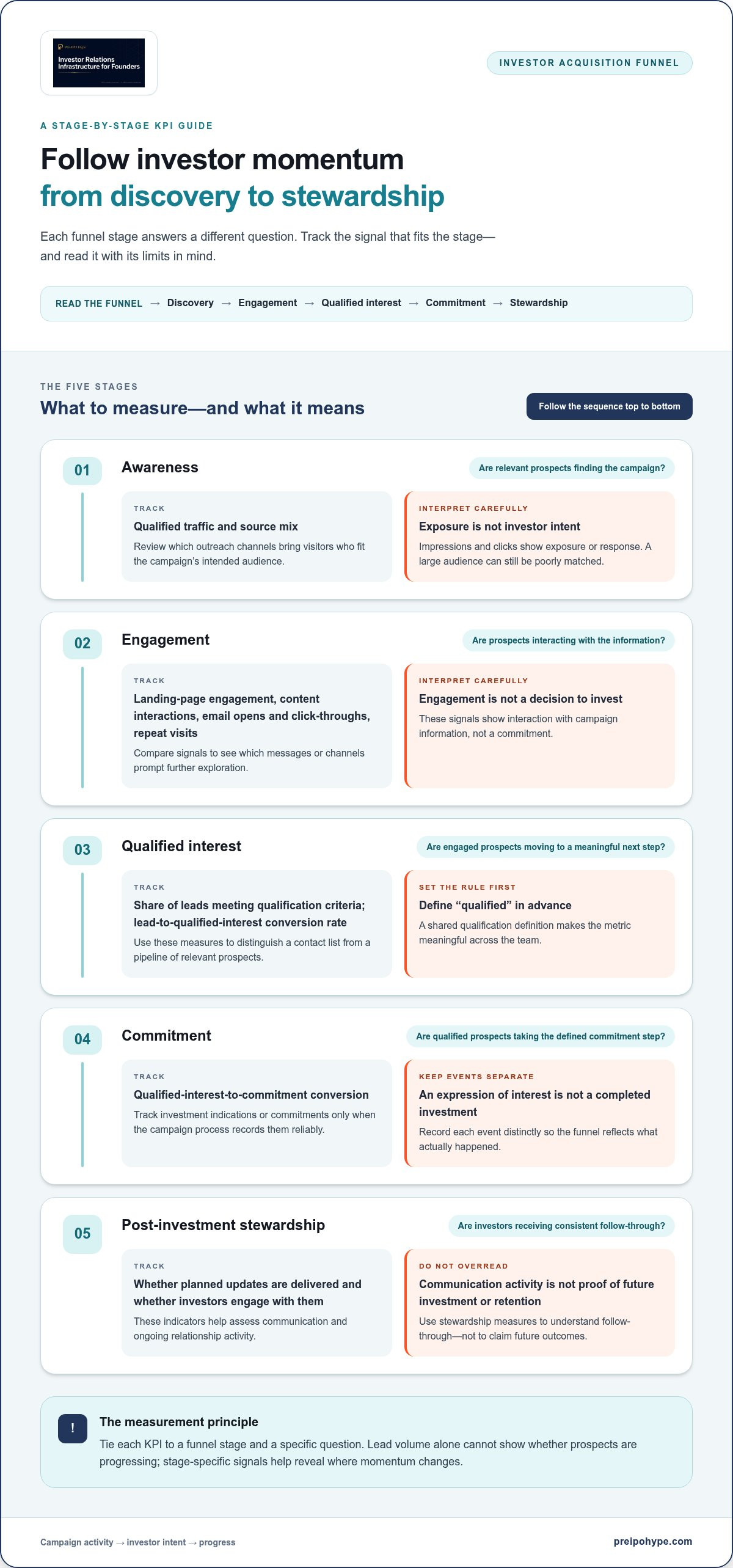
A funnel view turns campaign data into a sequence of questions: are the right people discovering the opportunity, engaging with it, showing qualified interest, making a commitment, and staying informed afterward? Fundraising key performance indicators are more useful when each one is tied to one of these stages. Lead volume alone can’t show whether prospects are progressing.
Funnel-stage KPIs diagnose where investor momentum changes, helping teams focus on the next bottleneck instead of treating every campaign number as equally important.
- Awareness: Are relevant prospects finding the campaign? Review qualified traffic and source mix, including which outreach channels bring visitors who fit the campaign’s intended audience. Impressions and clicks show exposure or response, but not investor intent. A large audience can still be poorly matched.
- Engagement: Are prospects interacting with the information? Consider landing-page engagement, campaign content interactions, email opens and click-throughs, and repeat visits. These signals can reveal which messages or channels prompt further exploration. They indicate engagement, not a decision to invest.
- Qualified interest: Are engaged prospects moving into a meaningful next step? Track the share of leads that meet the campaign’s qualification criteria and the lead-to-qualified-interest conversion rate. Define “qualified” in advance so the team can distinguish a large contact list from a pipeline of relevant prospects.
- Commitment: Are qualified prospects taking the campaign’s defined commitment step? Measure qualified-interest-to-commitment conversion, and track investment indications or commitments only when the campaign process records them reliably. An expression of interest isn’t the same as a completed investment, so record those events separately.
- Post-investment stewardship: Are investors receiving consistent follow-through? Monitor whether planned updates are delivered and whether investors engage with them. These indicators help teams assess communication and ongoing relationship activity. They shouldn’t be presented as proof of future investment or investor retention.
Make the funnel measurable by defining each transition as a specific event. Decide what action moves a lead into qualified interest and what documented step counts as a commitment. Apply those definitions consistently across channels and over time. Otherwise, a change in a conversion rate may reflect a change in counting rules rather than campaign performance.
Then compare adjacent stages. If qualified traffic is steady but engagement falls, review the landing-page experience or the relevance of the message. If engagement holds but few prospects qualify, revisit audience fit or the qualification criteria. This turns a funnel report into a diagnostic tool rather than a status update.
For campaigns running across multiple channels, connecting touchpoints can clarify where prospects enter and progress. A focused review of investor campaign measurement can help teams align funnel stages, event definitions, and the decisions each KPI should support.
Which fundraising KPIs should you compare, and what can each tell you?
A KPI earns its place on a dashboard when it supports a decision. Compare fundraising key performance indicators by the question they answer, not just by whether the number is rising. A low acquisition cost can look efficient while producing few qualified prospects. A strong engagement rate can show interest without indicating capital progress.
The table below pairs each metric with a practical calculation, the decision it can inform, and a caution against overreading it. Set campaign-specific baselines and compare similar periods, audiences, and channels. There’s no universal benchmark that makes a KPI meaningful in every campaign.
| KPI | Calculation | Decision supported | Interpretation caution |
|---|---|---|---|
| Cost per lead | Campaign acquisition spend ÷ leads captured | Assess the efficiency of lead generation and compare channels or audience segments. | A low cost can reflect high lead volume, not relevant investor interest. |
| Cost per qualified investor | Campaign acquisition spend ÷ qualified investors | Evaluate how efficiently activity is generating prospects that meet defined criteria. | Results depend on consistent qualification rules and complete campaign cost data. |
| Funnel conversion rate | People completing a defined next-stage event ÷ people in the prior stage | Locate where prospects are progressing or dropping off. | Keep transitions separate. A click-to-lead rate and a qualified-interest-to-commitment rate measure different actions. |
| Repeat engagement | Returning engaged prospects ÷ engaged prospects, using a consistent period | Identify whether campaign content or outreach is prompting continued attention. | Repeat visits or interactions indicate engagement, not intent to invest or a completed investment. |
| Attributed pipeline and capital progress | Summarize pipeline value, investment indications, and completed capital raised separately, by recorded source or touchpoint. | Review which channels are associated with prospect progression and campaign outcomes. | Attribution suggests a relationship. Channel overlap and delayed decisions make sole-source credit unreliable. |
Acquisition efficiency and conversion metrics
Cost per lead divides acquisition spend by the leads captured in the same campaign and period. Cost per qualified investor uses the same spend but divides by prospects who meet the campaign’s agreed qualification criteria. The second measure may be more useful when the team needs to assess audience quality rather than simply minimize the cost of collecting contacts.
For conversion, calculate each funnel transition on its own. Define the numerator as prospects who completed the next event and the denominator as prospects eligible to take that step. Don’t combine unlike events into one rate. Separate calculations make it easier to identify where a change in performance needs investigation.
Engagement, attribution, and capital progress
Repeat engagement and channel attribution are diagnostic signals, not proof that a specific touchpoint caused an investment. Attribution windows determine which interactions are counted. A short window may miss earlier campaign influence, while a longer one can include activity that’s less directly connected. Choose a consistent window, state it in reporting, and treat source credit as directional rather than exact.
Keep pipeline value, investment indications, and completed capital raised distinct. Pipeline reflects potential, an indication records expressed interest, and completed capital is an outcome. Separating them gives the team a clearer view of progress without presenting interest as money secured.
How to build a fundraising KPI dashboard your team will actually use
A dashboard works when it guides action, not when it displays every number the team can collect. Build it around a short sequence: define the fundraising objective, select measures that inform a decision, standardize how events are recorded, review the signals, and act. This keeps fundraising key performance indicators connected to campaign priorities instead of turning reporting into a weekly data dump.
Choose metrics around the next decision
Start with the objective. If the team needs to improve qualified interest, identify a decision that could influence that result, such as revising audience targeting or testing a message. Put a small set of core KPIs on the main dashboard, then keep diagnostic metrics available for follow-up questions. For example, a change in qualified-interest conversion may prompt a closer look at source mix or landing-page engagement.
Give every KPI an owner, a data source, a written definition, and a review cadence. Record the event being counted, the relevant audience or channel, and the reporting period. This prevents teams from comparing numbers built on different assumptions. Keep channel tags consistent across email, paid campaigns, content, and other outreach so interactions can be traced across the investor journey.
Choose a review rhythm the team can sustain and that matches campaign activity. A live, changing campaign may need more frequent checks than a slower outreach effort. Consistency matters: review the same measures on a predictable schedule, document decisions, and note when tracking definitions change. A well-organized fundraising technology stack can help bring campaign and investor activity into a more coherent measurement process.
Turn dashboard signals into campaign experiments
When a KPI shifts, form a testable hypothesis before changing several campaign elements at once. If a channel brings qualified prospects but few engage with the next step, the team might test a clearer message or a different landing-page prompt. If traffic rises but qualification weakens, test a narrower audience. A/B testing compares defined variations and can inform optimization, but it doesn’t guarantee improvement.
For each experiment, document the question, the element being changed, the audience, the success measure, and the review period. Keep other factors as stable as practical, then compare results with the campaign’s own baseline. Record what the team learned, including inconclusive results. This lets future decisions build on evidence instead of memory.
Dashboards also need basic data hygiene. Remove duplicate records where appropriate, use consistent channel and event names, and make ownership clear when data is entered or corrected. Without these foundations, even a polished dashboard can create false confidence.
If your team wants to align campaign objectives, KPI definitions, and review actions, schedule a fundraising KPI strategy conversation.
Pre-IPO Hype: Linking KPIs to Investor Campaigns
Fundraising KPIs become more actionable when campaign activity, investor interactions, and performance reviews are connected. Pre-IPO Hype supports equity fundraising through investor acquisition campaigns, omnichannel outreach, a Custom Investor CRM, and campaign analytics. Together, these tools and services help teams monitor how prospects interact with outreach and assess which campaign adjustments may be worth testing.
Connect investor interactions across campaign channels
Investor engagement rarely happens in just one place. A prospect might encounter campaign content, respond to an email, and later return through another channel. CRM records can organize those interactions alongside lead scoring and follow-up, giving teams a clearer view of prospect activity than disconnected channel reports.
Pre-IPO Hype’s Custom Investor CRM supports lead scoring and 60-day attribution tracking. These capabilities help teams assess prospect signals and connect campaign interactions within the stated attribution period. Attribution offers a structured way to review touchpoints, not proof that one message or channel caused a particular outcome. Consistent event definitions and thoughtful interpretation still matter.
Omnichannel outreach coordinates investor communications across channels, while CRM records help organize engagement and follow-up. The aim is a more coherent campaign view, not an automatic conversion. Teams can use the resulting information to spot where prospects are engaging, identify follow-up needs, and compare channel activity with campaign objectives. For an overview of investor data and related campaign measurement, explore investor data strategies.
Turn KPI review into a fundraising strategy conversation
A dashboard is a starting point. Campaign analytics and advisory can help teams interpret a KPI shift, form a testable hypothesis, and decide what to examine next. If qualified interest changes after a messaging update, for example, compare the relevant audience, channel, and campaign period before deciding whether to refine the message or test another approach. Monitoring and A/B testing can support this process, while results should be evaluated against the campaign’s own objectives and baseline.
This is where measurement connects to execution. A review can clarify whether the team needs better event tracking, a sharper audience definition, or a different follow-up sequence. Documenting the question, decision, and subsequent result builds a learning loop across campaign stages. It also keeps the focus on evidence rather than isolated numbers or assumptions about investor intent.
Pre-IPO Hype supports campaign measurement and optimization. Fundraising outcomes depend on factors beyond campaign activity, so KPI analysis can inform outreach decisions but can’t guarantee funding.
Founders can use a focused strategy conversation to align campaign goals, tracking definitions, and the next measurement steps. Discuss your fundraising measurement strategy.
Make your next campaign decision count
The strongest fundraising systems don’t just report what happened. They help teams decide what to test, where to focus attention, and what evidence to gather next. Treat fundraising key performance indicators as a learning loop: each review should sharpen the campaign’s next move, then show whether that move changed investor engagement.
Start with one decision your team needs to make. Align the relevant measures, owners, and data sources around it, then use the next review to assess what the campaign signals. A disciplined measurement process can bring greater clarity to investor acquisition and help your team move forward with intention, while recognizing that campaign data can inform decisions but can’t guarantee funding.
Ready to make your campaign measurement more useful? Plan your next fundraising measurement step with Pre-IPO Hype.
Frequently Asked Questions
What are fundraising key performance indicators?
Fundraising key performance indicators are measures that help a company assess whether fundraising activity is supporting a defined objective. For example, a team seeking to increase investor conversations might monitor qualified prospects who schedule a discussion, then examine which outreach source brought them in. The measure is useful when its definition is consistent and the result can guide a decision, rather than simply adding another number to a report.
Which KPIs should a startup track during a fundraise?
A startup should choose KPIs based on the immediate question its fundraising team needs to answer. If outreach is new, compare the sources bringing relevant prospects. If conversations are underway, review follow-through after each defined next step. Record the audience segment and campaign period alongside the result. That context helps prevent a change in prospect mix from being mistaken for a change in campaign effectiveness.
How do you calculate fundraising conversion rate?
Divide the number of prospects who complete a specified action by the number who began that stage, then multiply by 100. For example, if 8 of 40 qualified prospects complete a documented next step, the conversion rate is 20%. State the event, eligible group, and date range in the calculation so another team member can reproduce the result and understand what the percentage represents.
What is the difference between fundraising KPIs and fundraising goals?
A fundraising goal describes the result a company aims to reach; a KPI measures a signal that can help the team manage progress toward it. For instance, a team may set a capital objective and monitor how promptly qualified prospects receive follow-up. The goal gives the campaign direction, while the measure highlights an operational area to examine. Neither should be mistaken for a promise that the target will be achieved.
Can fundraising KPIs show which marketing channel performs best?
KPIs can compare channel-related signals, but the “best” channel depends on the outcome being assessed. One source may generate more initial responses, while another may be associated with prospects who progress further. Review source tags and interactions across the campaign, and be cautious about assigning sole credit when a prospect sees several messages. Use channel comparisons to inform allocation and testing, not as proof of what caused an investment.
How many fundraising KPIs should a campaign dashboard include?
There’s no fixed number that suits every campaign. A practical test is whether each displayed measure answers a current question or supports a decision. If a KPI has no clear owner or follow-up action, move it to a diagnostic report or remove it from the main view. Revisit the dashboard when objectives change so the primary view stays relevant as the campaign moves into a new phase.
Why do fundraising leads not always turn into investments?
A lead may have limited information, a timing mismatch, or questions that haven’t been addressed, so initial contact alone doesn’t establish readiness to invest. Record meaningful follow-up outcomes, such as whether a prospect requested more information or stopped responding, using consistent categories. Reviewing those patterns can help identify where communication or qualification needs attention. It can inform campaign improvements, but it can’t guarantee that a prospect will invest.
Disclaimer
Educational only. Not investment, tax, or legal advice. Pre-IPO Hype is investor relations infrastructure for Regulation CF and Regulation A+ raises. We are not a broker-dealer, funding portal, or investment adviser, and we do not offer or sell securities or make investment recommendations. Any securities offering is made only by the issuer, through its own offering documents and, where required, a registered intermediary.


