
Fundraising Pitch Deck Essentials: The 2026 Insider Playbook for Elite Capital Raises
Why did global VC investment hit a staggering $330.9 billion in Q1 2026 while your inbox remains a silent graveyard of "we'll pass" templates? The market isn't dry. It's just more aggressive and data-driven than ever before. If you're tired of low engagement from cold outreach, you're likely missing the fundraising pitch deck essentials that separate elite raises from the also-rans. You already know that a standard presentation isn't enough to secure a $3.1 million median seed round in this high-stakes climate.
We're going to fix that. This playbook shows you how to master a high-conversion framework that transforms static slides into psychological engines for investor acquisition. You'll learn how to align your narrative with a sophisticated digital marketing strategy to generate undeniable FOMO. We're diving into the exact roadmap needed to bridge the gap between your current traction and the $78.7 million Series A valuations currently defining the top tier of the market.
Key Takeaways
- Transform your deck from a static presentation into a high-stakes conversion vehicle designed for the aggressive 2026 capital markets.
- Master the 10 fundraising pitch deck essentials to establish immediate authority and frame your solution as an urgent market necessity.
- Leverage psychological triggers like social proof and tranche-based scarcity to accelerate investor decision-making and generate genuine FOMO.
- Integrate your deck with a custom investor CRM to track real-time engagement and identify which specific slides are driving conversion.
- Coordinate your deck launch with a structured omnichannel marketing strategy to ensure maximum visibility across both institutional and retail channels.
The Evolution of Capital Acquisition: Why Your 2026 Pitch Deck Must Be Different
The days of the passive slide deck are dead. In 2026, capital isn't just raised; it's engineered. The modern pitch deck has evolved from a simple summary into a high-stakes conversion vehicle for capital. While traditional gatekeeper VCs still hold significant weight, the rise of omnichannel investor acquisition means your narrative must now resonate across a fragmented landscape of institutional funds, family offices, and retail syndicates. It's a fundamental shift from asking for permission to building a movement.
Static PDFs are rapidly being abandoned for interactive, trackable assets. These digital-first tools allow you to see exactly when a lead lingers on your financials or skips your team slide. While the foundational elements of a presentation still apply, the 2026 environment demands a level of transparency and engagement that a flat document cannot provide. Your fundraising pitch deck essentials must now include these performance-tracking capabilities to stay competitive in a market where global VC investment reached $330.9 billion in Q1 2026 alone.
To better understand how the world's most successful firms view this evolution, watch this helpful video:
The Institutional vs. Retail Divide
Balancing technical rigour with aspirational storytelling is no longer optional. The Division of Corporation Finance's February 17, 2026, updates clarified rules for moving offerings between platforms and calculating the rolling 12-month cap, further democratizing the $5 million Reg CF limit. Institutional investors look for a "moat," but retail participants often respond to "investor hype" as a legitimate indicator of market momentum. You must adjust your tone based on the regulatory framework. A Reg CF raise requires a democratic, community-focused voice, while a Series A round demands the precision of a surgical strike.
Data-Backed Storytelling in 2026
Investors have replaced gut feeling with verifiable performance metrics. With the median post-money valuation for seed-stage companies hitting $24 million in late 2025, the stakes are too high for ambiguity. Your fundraising pitch deck essentials must include real-time market data to establish credibility within the first two minutes. If your narrative doesn't survive a rapid scan, it won't survive the due diligence process. We focus on stories anchored in unit economics, specifically targeting the $3 million to $5 million ARR benchmarks that Series A investors now demand. You can see how this data integrates into a broader strategy by exploring our video funnel architecture for high-growth raises.
The 10 Fundraising Pitch Deck Essentials for High-Growth Rounds
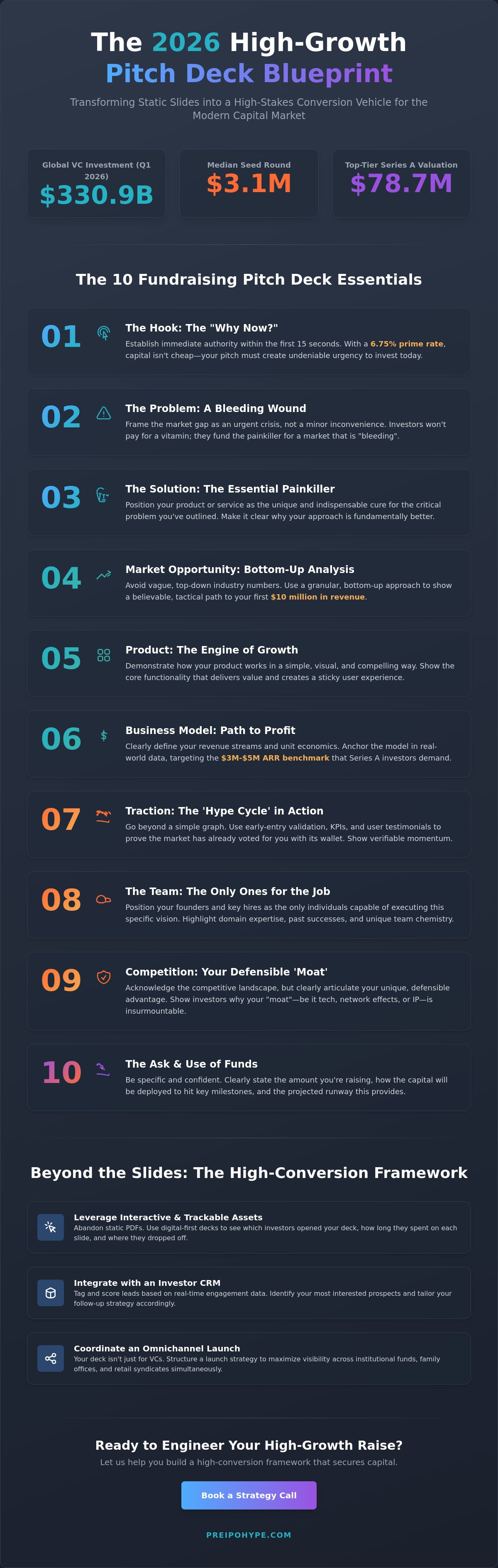
Your deck isn't a story. It's a blueprint for profit. In a market where global VC investment surged to $330.9 billion in Q1 2026, the competition for attention is fierce. To secure a piece of that capital, your fundraising pitch deck essentials must go beyond aesthetic appeal. It starts with The Hook. You have roughly 15 seconds to establish immediate authority and answer the "Why Now" question. With the WSJ Prime Rate at 6.75% as of May 2026, capital is no longer cheap. Investors need a reason to move their money from safe havens into your high-growth opportunity today.
Next, you must frame the Problem and Solution as an urgent crisis rather than a minor inconvenience. If the market isn't bleeding, investors won't pay for the bandage. This leads directly into Market Opportunity. Avoid the "top-down" trap of citing massive, vague industry numbers. Instead, use a "bottom-up" analysis. Show exactly how you capture your first $10 million in revenue. This granular approach proves you understand the mechanics of scale. When you reach the Traction slide, you're not just showing a graph; you're showcasing the "Hype Cycle" in action. Use early-entry validation to prove that the market has already voted for you with its wallet. Finally, the Team slide must position your founders as the only individuals capable of executing this specific vision. You aren't just selling a product. You're selling the execution of a rare opportunity.
The Business Model and Unit Economics
Investors in 2026 have zero patience for academic fluff. They want to see how you reach profitability at scale. Your LTV/CAC ratios are the heartbeat of this section. In an environment where the median Series A check for software companies sits between $18 million and $22 million, your unit economics must be bulletproof. Visualizing complex revenue streams is vital. Use clear, impactful graphics to show how money flows through your ecosystem. If you need to refine your narrative before hitting the market, our consulting and advisory services can help align your metrics with investor expectations.
The Strategic 'Ask' and Use of Funds
The "Ask" slide is where most founders stumble. You must frame the raise as fuel for growth, not a survival mechanism. Be transparent about capital allocation. Whether you're targeting the $5 million Reg CF limit or a larger institutional round, show that every dollar is tied to a specific milestone. This transparency builds institutional trust. By highlighting that the current valuation is a "last chance" entry point before a significant realization event, you create the scarcity necessary to accelerate decision-making. Don't just ask for money; offer a seat on a rocket ship that's already leaving the pad.
Engineering Momentum: Psychological Triggers and the 'Hype' Slide
Logic opens the door, but momentum closes the deal. While we've established the technical fundraising pitch deck essentials, this is where we weaponize psychology. Investors don't just want a return; they want to avoid being left behind. This is the "Barbell Effect" in action. Top-tier startups with visible traction are vacuuming up capital, while the middle market thins out. To land in that elite group, your deck must project an aura of inevitability. It's about connecting restricted information with a rare, time-sensitive opportunity.
Social proof is your strongest lever. If you've already secured 20% of your round, don't bury that fact in the back. Lead with it. Seeing other sophisticated capital already committed triggers a powerful fear of missing out. You can further amplify this by using tranche-based raises. By structuring your round so that early participants receive more favorable terms or lower entry valuations, you force a decision. It's a calculated move that turns a "maybe" into a "yes" before the window closes. You aren't just raising funds; you're managing a high-velocity event.
The "Hype" slide isn't about empty promises. It's about reclaiming market excitement as a legitimate indicator of momentum. It shows that your brand is becoming a movement. This leads directly to the exit strategy. You aren't just building a company; you're building an acquisition target or a future IPO candidate. Paint a clear picture of the realization event. Whether it's a strategic buyout in the AI sector or a public listing, investors need to see the finish line to justify the start. They want to know how their capital eventually exits at a premium.
Visualising the Future State
Elite raises require elite aesthetics. High-impact design signals that you belong in the same room as the $267.2 billion US VC investments seen in Q1 2026. Use "What if" scenarios to showcase potential growth, but keep them grounded in conservative data. You want to invite the investor to dream about the $78.7 million Series A valuation that could be their next milestone. This makes the current entry feel like a rare, exclusive opportunity that won't last. It's about framing the future as something that is already happening.
Addressing Objections Before They Arise
Skepticism is the default setting for any seasoned professional. A dedicated "Risk Mitigation" slide allows you to be candid without killing the momentum. Proactively answer why this hasn't been done before. Highlight your unique execution strategy and your foundation infrastructure. By addressing hurdles head-on and using social proof to neutralize doubt, you position yourself as a founder who is both visionary and pragmatic. If you're struggling to frame these psychological triggers, our video funnel architecture offers a roadmap for automating this sense of urgency.
Beyond the Slides: Integrating Your Deck with an Omnichannel Strategy
A masterful deck is useless if it sits in a vacuum. In the hyper-competitive 2026 market, your fundraising pitch deck essentials must extend beyond the PDF and into a broader distribution engine. Most founders treat their deck as a static document for a meeting. We treat it as the high-conversion centerpiece of a multi-channel investor acquisition campaign. Without a custom investor CRM to manage the flow, you're essentially flying blind in a market where global VC investment reached $330.9 billion in Q1 2026.
The real power lies in tracking engagement. Sophisticated capital leaves digital footprints. Knowing exactly which slides an investor lingers on allows you to tailor your follow-up with surgical precision. If a lead spends five minutes on your unit economics but skips the team slide, your next conversation shouldn't be about founder history. By integrating your deck into a digital marketing and advertising funnel, you turn a passive asset into an active lead magnet. This is how you build an investor pipeline that operates while you sleep.
The Technical Bedrock of the Raise
Your narrative is only as strong as the foundation infrastructure supporting it. This isn't just tech jargon; it's the mechanism that ensures every view is attributed to a specific source. Whether the lead came from a targeted LinkedIn ad or a direct outreach campaign, you need to know. Automating follow-ups based on slide engagement ensures no high-intent investor slips through the cracks. It's about maintaining momentum through every stage of the funnel. This level of technical rigour is what separates elite raises from those that fizzle out after two weeks.
Omnichannel Outreach Mastery
Don't let your best content die in a single file. Repurpose your deck's "Hype" slides for LinkedIn posts, email sequences, and newsletter exposure. This creates a cohesive narrative across all touchpoints, making your raise feel like a dominant market event. The modern fundraising funnel often starts with a "Video Pitch," a 90-second high-energy summary that drives traffic to the full deck. This omnichannel approach ensures you're visible wherever elite capital resides. Ready to see how this looks in practice? Explore our investor acquisition strategy to start building your own engine.
Launching Your Raise: From Pitch Deck to Capital Realisation
Timing is the razor's edge between a stalled raise and an oversubscribed round. Once you've mastered the fundraising pitch deck essentials, the transition from a digital asset to a live capital acquisition campaign must be seamless. In the current 2026 landscape, a successful Reg CF marketing campaign typically requires a 90-day high-velocity window. This isn't just about posting a link. It's about a synchronized strike across PR, digital advertising, and direct outreach that forces the market to take notice of the $5 million offering limit before the rolling 12-month clock resets.
Measuring Success Beyond the Raise
Capital is the immediate goal, but the long-term value lies in your investor database. Every view tracked in your custom investor CRM is a potential lead for future rounds. Post-raise communication is where you turn a one-time transaction into a movement. By keeping the hype alive through consistent performance tracking and newsletter exposure, you build the institutional interest necessary for a $78.7 million Series A valuation. You aren't just closing a round; you're warming up the room for your next realization event.
Final Audit Checklist
Before hitting the market, put your deck through a final, cold-blooded audit. If it doesn't pass these three tests, it isn't ready for the $267.2 billion US VC arena:
- The 2-Minute Scan: Can an associate identify your moat and your "Ask" in under 120 seconds?
- Technical Compliance: Are your unit economics and regulatory disclosures (Reg CF vs. Reg A+) bulletproof?
- Psychological Friction: Does the deck actively solve investor objections before they are even voiced?
The window for elite capital raises is open for those who act decisively. If you're ready to engineer your raise and move beyond static presentations, ask our CEO directly or book a strategy session to align your deck with a dominant market entry.
Master the Momentum: Your Path to Capital Realisation
The landscape of 2026 demands more than just a polished presentation. It requires a conversion engine. By mastering the fundraising pitch deck essentials we've discussed, you're no longer just pitching; you're orchestrating a high-velocity market event. You've seen how tracking slide engagement through an elite Custom Investor CRM and integrating your narrative into an omnichannel strategy can transform cold outreach into oversubscribed rounds. The shift from static PDFs to interactive, data-driven assets is the hallmark of founders who lead the market rather than follow it.
We've facilitated over $100M in funding by redefining Reg CF and Reg A+ marketing for companies ready to scale. The difference between a stalled raise and a landmark exit often comes down to the infrastructure behind the slides. It's about creating a sense of inevitability that seasoned investors cannot ignore. Your journey from a vision to a fully funded realization event starts with the strategic integration of these frameworks. The opportunities are rare, but they are within reach for those who act with precision and speed.
Watch our Video Funnel to see how we scale capital raises and turn your vision into an investable movement. The market is moving fast. It's time to capture your share of the momentum and secure the future your company deserves.
Frequently Asked Questions
How many slides should a fundraising pitch deck have in 2026?
Aim for a lean 10 to 12 core slides. Investors typically spend less than three minutes on an initial review, so your narrative must be high-velocity. Use an appendix for deep-dive technical data to ensure you hit the fundraising pitch deck essentials without slowing down the momentum of your primary pitch.
What is the most important slide in a pitch deck?
Should I include financial projections in my initial deck?
Yes, but focus on the underlying unit economics rather than just top-line "hockey stick" growth. Include a three to five year summary that highlights your path to profitability and LTV/CAC ratios. In a world where the WSJ Prime Rate is 6.75%, capital is expensive; investors need to see a disciplined approach to capital allocation.
How do I make my pitch deck stand out for a Reg CF campaign?
Focus on community momentum and the "Why Now" factor. Reg CF is a democratic movement, so your deck must trigger investor FOMO by highlighting the $5 million offering limit. Use high-impact design and aspirational language to turn your raise into an exclusive event within your digital marketing and advertising funnel.
Do I need different decks for angel investors and VCs?
You should tailor the technical density of your deck for each group. Angels often move on the infectious energy of early-stage opportunity and vision. VCs require more technical rigour and institutional finance terminology. Maintain a consistent brand voice but use your analytics and performance tracking to see which data points resonate most with each segment.
How often should I update my pitch deck during a raise?
Update your deck the moment you hit a significant milestone or secure a lead investor. A raise is a live event, not a static snapshot. Reflecting new traction immediately in your foundation infrastructure ensures your investor CRM always presents the most current version of your market momentum.
What is the biggest mistake founders make with their pitch decks?
The most common error is over-complicating the narrative with academic fluff. If an investor can't identify your "moat" and the core fundraising pitch deck essentials within a two-minute scan, they'll pass. Professional content creation and strategy should focus on clarity and directness to ensure your value proposition is unmistakable.
Should I use a professional agency for my pitch deck design?
Professional design is a non-negotiable signal of elite status. In a quarter where global VC investment hit $330.9 billion, looking "un-investable" due to poor structure is a terminal risk. High-end aesthetics paired with strategic consulting and advisory services position your company as a sophisticated vehicle for wealth creation.
Disclaimer
Educational only. Not investment, tax, or legal advice. Pre-IPO Hype is investor relations infrastructure for Regulation CF and Regulation A+ raises. We are not a broker-dealer, funding portal, or investment adviser, and we do not offer or sell securities or make investment recommendations. Any securities offering is made only by the issuer, through its own offering documents and, where required, a registered intermediary.