
Fundraising Project Management: A Practical Workflow for Founders
What if a fundraising delay comes not from the opportunity itself, but from a task no one owns? For founders preparing a Regulation CF or Regulation A+ raise, fundraising project management makes the work visible: who is responsible, what depends on another task, and which decisions belong elsewhere.
Materials, approvals, and follow-ups can easily spread across people, tools, and conversations. A shared workflow clarifies execution without turning project coordination into legal or investment decision-making. Qualified securities counsel should guide legal decisions, while the issuer’s registered intermediary manages its role in the offering process.
This article lays out a practical sequence for scoping and organizing fundraising work, assigning owners, tracking dependencies, and setting decision boundaries. It also explains how to assess tools and campaign support within the issuer’s workflow, without treating either as a guarantee of results.
Results vary. No marketing approach guarantees that a raise will close.
Key Takeaways
- Use fundraising project management to track issuer-owned tasks, owners, dependencies, and status.
- Build the plan around issuer objectives and constraints, then define deliverables, assign owners, and map dependencies.
- Choose a shared task list, project-management software, spreadsheet, or CRM based on workflow needs and complexity.
- Review progress regularly and document the reason, owner, impact, and revised plan when work changes.
- Keep execution distinct from legal and investment decisions, with qualified securities counsel and the registered intermediary in their respective roles.
What Fundraising Project Management Means for an Issuer
A Regulation CF or Regulation A+ raise can involve several workstreams at once: preparing materials, coordinating reviews, planning campaign activity, and keeping contributors informed. When tasks sit in separate documents, inboxes, and conversations, it can be hard to tell what is complete, what is waiting on input, and who needs to act next.
Fundraising project management organizes issuer-owned tasks, accountable owners, sequence, dependencies, and status. It gives the team a shared view of execution. It does not decide whether to pursue a particular offering strategy, interpret securities requirements, or recommend an investment. Those decisions belong with the issuer and its qualified professional advisers in their respective roles.
The broader idea of Fundraising includes different methods and participants. For an issuer, a project plan makes operational work visible without shifting responsibility for offering decisions or investor-facing materials away from the issuer.
Which workstreams belong on a fundraising project plan?
Group tasks to reflect how work moves from preparation through review and ongoing coordination. For example:
- Preparation: identify internal contributors, gather existing company information, and assign responsibility for draft materials.
- Offering readiness: track document preparation and review steps. Route legal questions to qualified securities counsel and intermediary-related questions to the issuer’s registered intermediary.
- Campaign coordination: plan content, review schedules, and campaign tasks performed for the issuer. Keep approval status visible before materials are used.
- Ongoing review: record status updates, open questions, blockers, and items that need a decision or follow-up.
For each task, record what “complete” means, who owns the next action, and whether another person or review must come first. A content review, for example, might require a draft from one contributor, issuer approval, and a separate review by qualified counsel when legal questions arise. The plan tracks that handoff; it does not make the approval decision.
Why ownership and boundaries matter
Give each task one accountable owner. List contributors who provide input and approvers who make the relevant decision separately. When several people are jointly responsible, each may assume someone else is moving the task forward. That can lead to duplicate drafts, missed handoffs, or uncertainty about which version is ready for review.
Clear boundaries matter just as much. The issuer remains responsible for its offering decisions and investor-facing materials. Project coordination can show that a question is open, identify who should address it, and record its status. It cannot replace qualified securities counsel’s advice or the registered intermediary’s role. Keep legal decisions with counsel, and use the project plan to coordinate the work around them.
How to Build a Fundraising Project Plan Step by Step
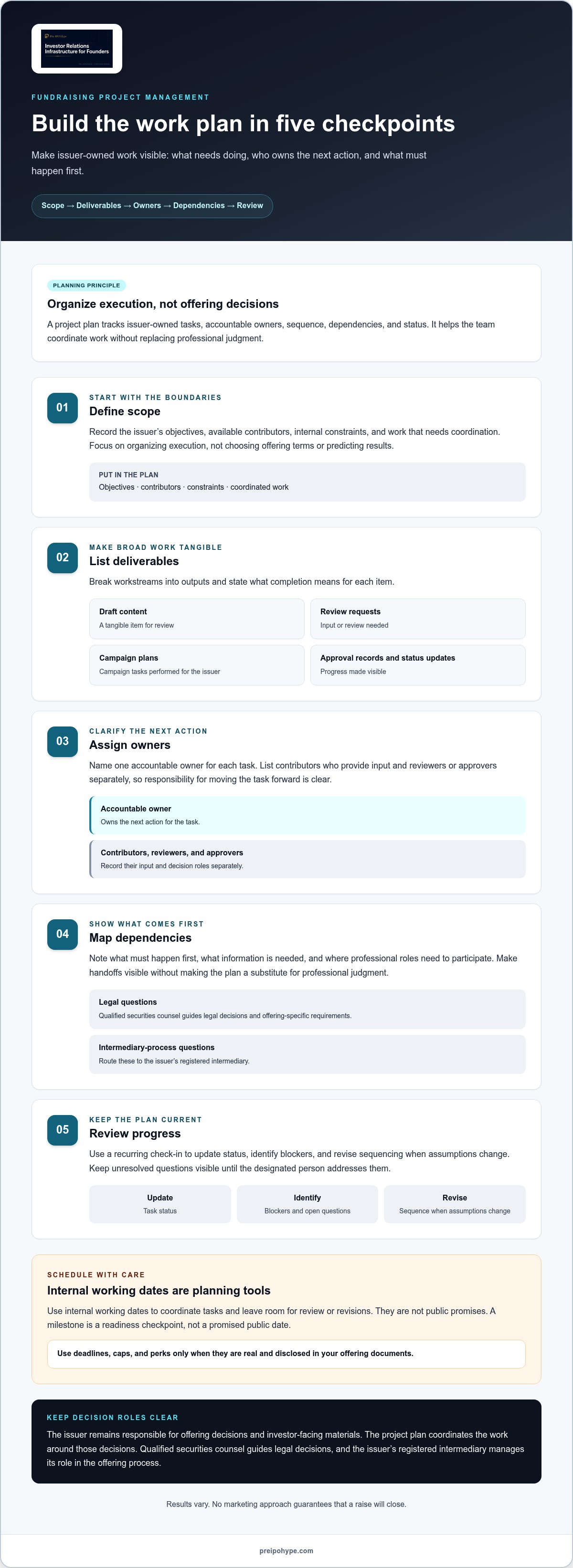
A useful plan starts with work the issuer can control. In fundraising project management, sequence matters: a draft may need company input before review, while campaign activity may depend on approved materials and coordination with the registered intermediary. Treat each step as a planning checkpoint, not a prediction about launch or closing.
- Define scope. Record the issuer’s objectives, available contributors, internal constraints, and work that needs coordination. Focus on organizing execution, not choosing offering terms or predicting results.
- List deliverables. Turn broad workstreams into tangible outputs, such as draft content, review requests, campaign plans, approval records, and status updates. State what completion means for each item.
- Assign owners. Name one accountable owner for each task. Record contributors who provide input and reviewers or approvers separately, so responsibility for the next action is clear.
- Map dependencies. Note what must happen first, what information is needed, and where qualified securities counsel or the registered intermediary needs to participate. Counsel should guide legal decisions and offering-specific requirements.
- Review progress. Set a recurring check-in to update task status, identify blockers, and revise sequencing when assumptions change. Keep unresolved questions visible until the designated person addresses them.
Turn fundraising milestones into owned tasks
A milestone is a checkpoint that helps the team assess readiness, not a promised public date. Break it into deliverables and link each one to its owner, contributors, reviewer, and prerequisite. For example, a campaign-planning checkpoint might depend on issuer-approved content and a review step. Assign questions about legal requirements to qualified securities counsel, and route intermediary-process questions to the issuer’s registered intermediary.
For each handoff, note the input needed and who receives it. This makes delays easier to locate without treating the plan as a substitute for professional judgment. Boston University’s Fundraising Management Graduate Certificate describes study areas including strategic planning and budgeting, useful context for how planning disciplines can support fundraising work.
Set a usable schedule and decision process
Use internal working dates to coordinate tasks and leave room for review or revisions. They help the team plan, but they are not public promises. Use deadlines, caps, and perks only when they are real and disclosed in your offering documents. Keep a decision log with the question, current status, person responsible for resolving it, and any task sequence affected by the answer.
Choose a shared system that makes owners, dependencies, and updates easy for the team to see. A fundraising technology stack should support the workflow rather than create duplicate tracking. The founder planning conversation is one way to discuss how to structure a plan around an issuer’s workflow.
How to Choose Tools for Fundraising Project Management
The right setup lets the issuer see task ownership, dependencies, and current status without maintaining the same information in several places. For fundraising project management, start with the workflow, not the software. A small team with few parallel tasks may be able to coordinate in a shared task list. More contributors and separate kinds of records may call for different tools.
Compare options by what they need to track and how the team collaborates:
| Tool | Strengths | Limitations | Collaboration needs | Suitable complexity |
|---|---|---|---|---|
| Shared task list | Quick to set up and easy to scan | May offer limited ways to group work or show dependencies | Team members need a shared view and clear update habits | Simple workflows with few parallel tasks |
| Spreadsheet | Flexible fields, filters, and status views | Separate copies can drift, and updates may be duplicated | Agree on one working file and consistent field definitions | Lightweight plans that need a tailored tracker |
| Project-management software | Can organize tasks, owners, workflow stages, and dependencies | Setup and upkeep can become extra work if the structure is too complex | Contributors need a shared process for updates and handoffs | Multiple workstreams and recurring coordination |
| CRM | Organizes relationship and lead records | Doesn’t replace task planning, approvals, or dependency tracking | Define how records are maintained and who uses them | Workflows that require organized relationship information |
When a shared task list or spreadsheet may be enough
A lightweight tracker can work when the team can see active tasks in one place and updates are straightforward. Use the same fields for every item: owner, due date, status, dependency, and approval. A row might track a content draft, identify who owns the next revision, and show whether review is pending. Keep field definitions consistent so contributors can interpret status without needing a separate explanation.
As work spreads across separate files, people may update one copy but not another. That creates conflicting status and makes handoffs harder to follow. Consider a more structured tool when maintaining the tracker becomes a task in itself.
When project software and CRM serve different needs
Project-management software tracks work: assignments, stages, and dependencies. A CRM organizes relationship and lead records. They address different operating needs, and one should not be treated as a replacement for the other. A CRM also does not provide legal or investment advice. Keep legal decisions with qualified securities counsel, and choose tools that reflect the issuer’s actual workflow rather than adding complexity for its own sake.
Start with the simplest setup that gives contributors a reliable status view. Add another tool only when a distinct workflow need is difficult to manage in the existing system.
How to Run the Fundraising Workflow and Manage Changes
A project plan stays useful when the team updates it as work moves. Set a recurring review to check task status, blockers, dependencies, and decisions that need escalation. Keep the discussion focused on what changed, what is waiting, and who owns the next step. This gives the issuer a practical view of execution without turning internal progress into a claim about the offering.
Keep progress visible without overstating it
Use consistent, factual labels such as not started, in progress, awaiting review, and complete. Add a brief note when a status needs context, such as “awaiting issuer edits” or “review question sent to counsel.” Avoid labels that imply a result or level of investor interest.
Keep internal planning dates separate from statements made to prospective investors. A working date helps the team coordinate tasks, but it is not automatically appropriate for public communication. Do not manufacture momentum, urgency, scarcity, demand, or social proof. If a status update depends on an unresolved approval or review, show that clearly instead of presenting the item as finished.
Coordinate campaign work with professional review
For each campaign item, identify what the issuer needs to review, who approves the material for use, and whether a question should go to qualified securities counsel or the issuer’s registered intermediary. Outreach and campaign activity are done for the issuer. The task tracker can record that a review is pending and who owns the follow-up; it should not be used to make legal decisions or replace professional review.
For Regulation Crowdfunding promotion, anyone the issuer pays to promote the offering on the platform must disclose that compensation each time under Rule 205. Build the disclosure step into the workflow for each paid promotion, and direct questions about legal requirements to qualified securities counsel.
Changes are easier to manage when the record explains what happened, not just that a task moved. For each changed task, document:
- Reason: What new information, review, or dependency prompted the change?
- Owner: Who is responsible for the next action, and who needs to contribute?
- Impact: Which other tasks, reviews, or handoffs may be affected?
- Revised internal plan: What sequence or working date has the team adjusted?
At the next review, confirm that affected owners have seen the update and that the plan reflects the current status. This simple change record helps prevent outdated instructions from circulating across conversations and files.
The fundraising workflow conversation provides an opportunity to discuss how these steps fit an issuer’s workflow.
How Pre-IPO Hype Fits into Fundraising Project Management
Pre-IPO Hype is investor relations infrastructure for Regulation CF and Regulation A+ raises. We are not a broker-dealer, funding portal, or investment adviser, and we do not offer or sell securities or make investment recommendations.
Pre-IPO Hype provides campaign support alongside the issuer’s registered intermediary and qualified securities counsel. An issuer can include campaign tasks in its execution plan with owners, review steps, dependencies, and current status. This keeps coordination visible while preserving the intermediary’s role and the role of qualified counsel in legal decisions.
Describe the permitted role without implying outcomes
Keep the distinction clear in the plan and in team conversations. Campaign support does not replace qualified securities counsel or the issuer’s registered intermediary. It does not make offering decisions or investment recommendations. The issuer remains responsible for its offering decisions and investor-facing materials, and legal questions should go to qualified securities counsel.
Label work by its purpose. A campaign task might track the preparation or coordination of issuer communications. Record a legal question as a question for counsel, not as an approval a project coordinator can provide. Questions about the intermediary’s process should go to the issuer’s registered intermediary. Clear routing helps the team identify the next step without assigning decisions to the wrong person.
Use the CRM feature in context
Our Custom Investor CRM supports lead scoring and attribution tracking. This feature is not a promise about campaign performance or a replacement for the broader project plan. Keep relationship records distinct from task execution: the plan coordinates project work, while the CRM supports lead scoring and attribution tracking.
As the workflow develops, keep responsibilities and decision boundaries visible. Record who owns each campaign task, what review is needed, and where legal or intermediary questions should be routed. Campaign support remains alongside the issuer’s registered intermediary and qualified securities counsel.
The fundraising workflow conversation can address how campaign support fits alongside an issuer’s existing workflow.
Put the Next Workstream in Motion
Make the plan useful in the team’s day-to-day decisions by testing it against an upcoming workstream. Note where a handoff needs clarification, where a decision is waiting, or where the team is maintaining the same information in multiple places. These observations can guide small adjustments before the workflow becomes harder to manage.
Keep the plan focused on coordination. As new questions arise, assign them to the right decision-maker rather than leaving them as unowned tasks. This gives founders a practical way to adapt the process while keeping legal and investment decisions with the appropriate professionals.
Fundraising project management is most useful when it reflects the issuer’s actual workflow and stays current as work changes. To discuss campaign support alongside your registered intermediary and qualified securities counsel, schedule a fundraising workflow conversation.
Frequently Asked Questions
Is fundraising project management the same as fundraising strategy?
No. Strategy sets direction and priorities; project management organizes the work needed to carry out an agreed plan. For example, a team can track who drafts a communication and which reviews are pending without using the task tracker to decide whether an offering is suitable. Project coordination does not provide investment advice. Founders should take legal decisions and questions about offering requirements to qualified securities counsel.
Can first-time founders use a fundraising project management framework?
Yes. A first-time founder can start with a short task plan instead of adopting a complex methodology. For each item, note the owner, contributors, dependencies, needed approvals, and open questions. A draft that needs company information, for instance, can be assigned to one person with the missing input recorded. Send unfamiliar legal or offering questions to qualified securities counsel rather than trying to resolve them with a template.
Can one project plan work for both Regulation CF and Regulation A+?
A shared planning structure can organize work for either path, but the offering-specific tasks and review checkpoints need to fit the issuer’s circumstances. A team might use the same fields for owners and status while maintaining separate task details for work that differs by offering. Do not use a generic template to choose the offering path or determine its requirements. Ask qualified securities counsel to guide those decisions.
Does a fundraising project plan replace an offering document?
No. A project plan is an internal coordination aid, not an offering document or a substitute for required issuer materials. It can help the team track who is preparing a document, which version is under review, and whether follow-up remains open. It does not establish what materials are required or approve their content. Work with qualified securities counsel and the issuer’s registered intermediary on offering-related documents and decisions.
How can a remote founding team keep fundraising work coordinated?
Use one shared working system as the team’s current reference for task owners, status, dependencies, and decisions. If a review changes a task, record the update there rather than leaving it only in a chat thread. A consistent check-in rhythm, whether live or written, gives contributors a regular point to flag blockers and confirm handoffs. No particular tool guarantees accurate information, compliance, or fundraising results.
Should every employee have access to fundraising project files?
Not necessarily. Set access according to each person’s role and the information needed to complete assigned work. For example, a contributor drafting a specific item may need that material without needing access to every project file. Follow the issuer’s information-handling policies, and seek qualified advice about sensitive or offering-related materials. Share investor information only through the issuer’s authorized process, not simply because a team member can access the project system.
Disclaimer
Educational only. Not investment, tax, or legal advice. Pre-IPO Hype is investor relations infrastructure for Regulation CF and Regulation A+ raises. We are not a broker-dealer, funding portal, or investment adviser, and we do not offer or sell securities or make investment recommendations. Any securities offering is made only by the issuer, through its own offering documents and, where required, a registered intermediary.