
Health Tech Funding News 2026: The Insider’s Guide to the Capital Shift
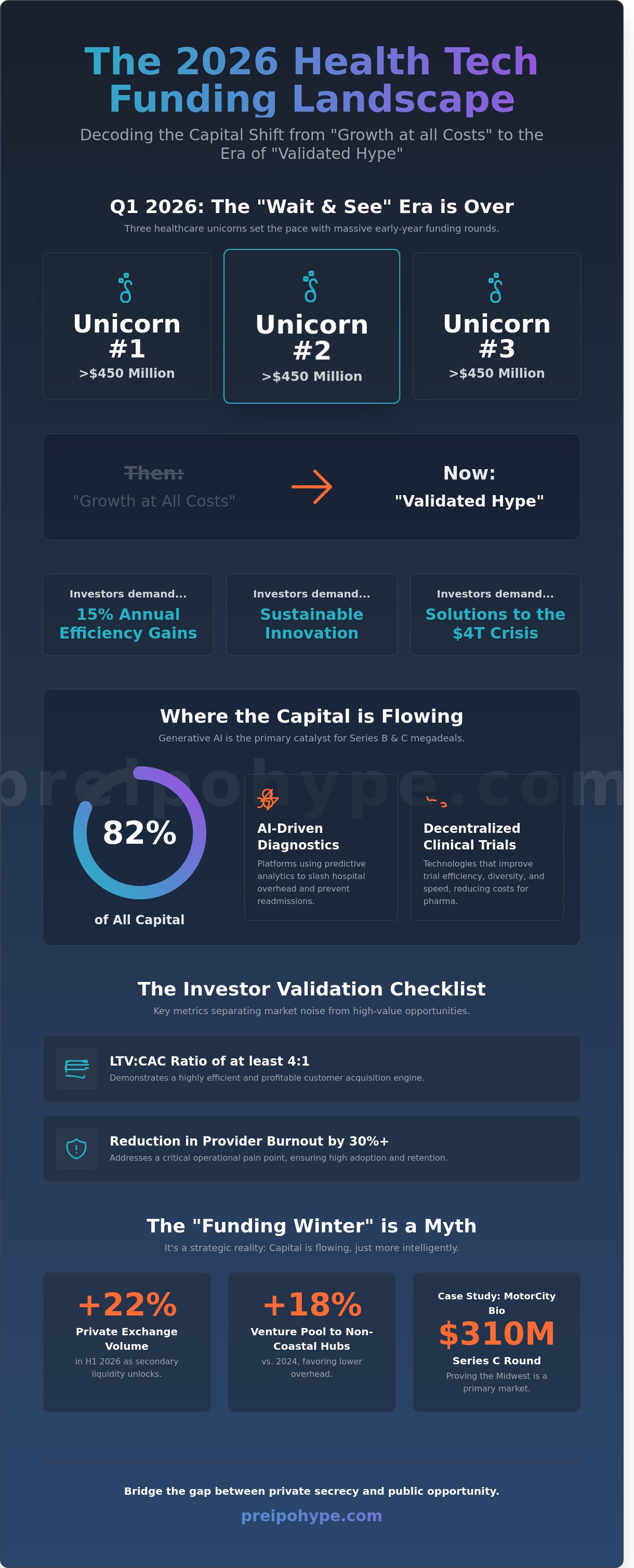
In the first quarter of 2026 alone, three healthcare unicorns have already secured over $450 million each, signaling that the "wait and see" era of venture capital is officially dead. Staying ahead of the latest health tech funding news isn't just about reading headlines; it's about tracking where the smart money is moving before the public markets even catch a scent. You've likely felt the exhaustion of sorting through fragmented press releases and "vaporware" hype that never leads to a signed term sheet. It's difficult to distinguish between fleeting trends and the 82% of capital currently flowing into AI-driven diagnostics and decentralized clinical trials.
We're here to bridge that gap. This guide cuts through the noise to reveal the precise strategic trends driving the latest rounds and shows you how to position your own startup for elite-level investor acquisition. You'll gain a clear understanding of the 2026 capital shift and a strategic framework for your own fundraising narrative. We're providing the insider tools necessary to turn market momentum into your next major liquidity event.
Key Takeaways
- Identify the shift from "growth at all costs" to the era of "Validated Hype," ensuring your startup aligns with 2026’s demand for sustainable innovation.
- Decode the latest health tech funding news to understand how Generative AI has become the primary catalyst for securing high-stakes Series B and C megadeals.
- Debunk the "funding winter" myth by mastering the data-driven storytelling techniques that elite investors use to filter market noise from high-value opportunities.
- Execute a two-step momentum strategy by auditing your story’s news-worthiness and deploying a precision CRM to convert investor curiosity into hard capital.
- Bridge the gap between private secrecy and public opportunity by leveraging the Pre-IPO Hype engine to reach 2026’s most active and exclusive investor circles.
The 2026 Health Tech Funding Landscape: Beyond the Headlines
2026 is the year of "Validated Hype." The era of throwing capital at every telehealth app with a slick interface is over. Investors are now hunting for clinical proof and operational efficiency. By January 2026, the health tech funding news cycle shifted toward companies that solve the $4 trillion spending crisis in US healthcare. Institutional players are no longer chasing "growth at all costs." They want sustainable innovation. They want companies that can survive a high-interest rate environment while delivering 15% annual efficiency gains to providers.
To understand the foundational pillars of this sector, it's helpful to define what is health technology and how it integrates into modern medicine. This historical context explains why the current focus is on infrastructure rather than just patient-facing apps. The market is maturing. It's moving from the "experimental" phase into a period where data-driven outcomes are the only currency that matters in a pitch deck.
To better understand how these trends are shaping the current market, watch this helpful video:
Institutional capital is reacting to the SEC’s October 2025 updates regarding private market transparency. These regulations have forced late-stage startups to provide quarterly disclosures similar to public entities. This transparency has unlocked secondary liquidity. Volume on private exchanges rose by 22% in the first half of 2026. Investors aren't just looking for unicorns anymore. They're looking for "dragons," which are companies that return an entire fund through a strategic exit. Key metrics driving the biggest headlines in health tech funding news include a Lifetime Value (LTV) to Customer Acquisition Cost (CAC) ratio of at least 4:1 and a reduction in provider burnout rates by 30% or more.
The Shift Toward Value-Based Care Funding
Capital is flooding into platforms that slash hospital overhead. In February 2026, seed rounds for AI-driven patient management systems averaged $8.4 million, a 14% increase from 2025. These platforms use predictive analytics to prevent hospital readmissions. The market anticipates a massive wave of exits by Q4 2026. Expect major insurance conglomerates to acquire these startups to protect their margins as the industry moves fully into value-based models. Efficiency is the new growth.
Institutional vs. Retail: The New Capital Mix
The investment landscape is democratizing. Reg CF has evolved into a powerhouse for the "informed insider." High-stakes medical startups are now leveraging "super-retail" investors who bring both capital and professional expertise to the table. This isn't just about retail hype. It's about strategic alignment. To stay relevant, founders must deploy multi-channel acquisition strategies. They need to speak to the institutional whale and the sophisticated retail angel simultaneously to ensure a successful round.
Where the Capital is Flowing: Breaking Down the 2026 Megadeals
The capital markets aren't just recovering; they're evolving. The first half of 2026 rewrote the playbook for late-stage exits, seeing five distinct megadeals that redefined the ceiling for private valuations. Detroit's own MotorCity Bio led the pack with a $310 million Series C, proving the Midwest is no longer a secondary market. This surge follows the stabilization of "unlabeled" rounds and massive growth injections first signaled in Rock Health's Q3 2025 funding report. The latest health tech funding news confirms that Detroit and other non-coastal hubs are capturing 18% more of the national venture pool than they did in 2024. Investors are moving away from high-burn coastal startups in favor of hubs with lower overhead and direct access to major research institutions like the University of Michigan.
Generative AI serves as the primary engine for these massive Series B and C rounds. It's the reason NeuralPath AI secured $285 million in a single Series B. VCs aren't just looking for "AI-enabled" labels anymore; they're hunting for companies that own proprietary, high-fidelity datasets. Longevity and bio-hacking have also shed their niche status. LongevityX's $255 million round shows that institutional capital is finally betting on life-extension tech as a core portfolio pillar. The top five rounds of early 2026 represent a combined $1.36 billion in fresh liquidity, signaling a high-conviction environment for those who know where to look.
AI-Driven Diagnostics: The Billion-Dollar Frontier
Recent $100 million rounds for PathosAI and ScanVision highlight a pivot toward automated radiology and pathology. The FDA cleared 14 new AI-based diagnostic tools in January 2026 alone, providing the regulatory green light that conservative funds needed. This influx of capital is specifically targeting platforms that reduce clinician burnout by 35% or more. Clinical AI Momentum acts as a valuation multiplier by de-risking the path from lab to bedside. It's the ultimate indicator for investors seeking secondary liquidity in a crowded market.
FemTech and Personalized Medicine Growth
Investors finally stopped ignoring the $1 trillion opportunity in women's health. Capital allocation to FemTech rose 22% in the last six months, driven by a demand for personalized, data-driven care. HeraHealth provides the blueprint; they raised $85 million after demonstrating a 40% month-over-month growth rate through aggressive omnichannel patient engagement. Startups in the reproductive space are moving away from simple cycle tracking toward integrated hormonal intervention. If you want to spot these emerging unicorn signals before they dominate the health tech funding news, you have to watch the Series A velocity in non-traditional hubs. Success in 2026 requires a strategic shift from "general health" to hyper-personalized, demographic-specific solutions that offer clear, measurable outcomes.
The "Funding Winter" Myth vs. the Strategic Reality
Is it still possible to raise capital in a market that critics call frozen? The short answer is yes. While the 2023 venture capital downturn saw a 37% drop in global deal value, the narrative of a "funding winter" is largely a myth for companies that possess a high-velocity, data-driven story. Detroit's ecosystem is currently proving that geographic location matters less than the ability to articulate a clear path to profitability. Capital isn't gone; it's simply more selective. Investors are no longer chasing pre-revenue dreams. They're chasing proof of momentum. If you're looking for health tech funding news that signals growth, you won't find it by waiting for the market to warm up. You find it by creating your own heat.
Success in this environment requires 60-day attribution models to prove investor interest. This means tracking every touchpoint, from initial pitch deck views to follow-up inquiries, over a concentrated two-month sprint. This data serves as a financial indicator of momentum. We reclaim the word "hype" here. It isn't just noise. It's a quantifiable metric of market demand. When a company generates high-volume engagement from over 1,200 accredited investors, it signals to institutional players that the ground floor is closing fast. This level of concentrated interest forces VCs to move faster and offer better terms. It transforms the fundraising process from a plea for capital into a competitive auction.
The criteria for securing capital have shifted toward technical validation and scalability. For instance, the National Science Foundation's Digital Health grant sets a rigorous benchmark for what constitutes a viable innovation. Startups that align their internal milestones with these types of federal standards find that private capital follows public validation 90% of the time. Proving your tech works under government-level scrutiny eliminates the "risk" excuse that many VCs use to sit on their dry powder.
The Death of the Passive Raise
Waiting for a VC to find your startup is a failing 2026 strategy. The era of the passive raise ended when interest rates climbed above 4%. Today, active investor acquisition is the only way to generate consistent health tech funding news. You need an infrastructure that survives volatility. This involves building a proprietary database of investors and using targeted outreach to ensure your valuation stays resilient. Passive founders get diluted; active founders set the terms.
Leveraging Secondary Liquidity for Early Momentum
Secondary markets are the new frontier for early-stage growth. By providing exits for early employees or seed investors before an IPO, you create a narrative of success that attracts a higher tier of institutional interest. This liquidity proves there's a market for your shares long before a public listing. It’s a strategic move that separates unicorns from the pack. If you want to master this, ask our CEO about the strategic timing of your secondary offering to ensure you maximize your valuation benchmarks.
Turning News into Momentum: How to Secure Your Next Round
The latest health tech funding news out of Detroit proves that capital is moving; however, it only stops for those who control the narrative. Securing a late-stage round or a pre-IPO placement requires more than a solid balance sheet. It demands a strategic engine that converts public interest into private capital commitment. If you aren't weaponizing your milestones, you're leaving your valuation to chance.
Step 1: Audit your story framework. Is your pitch news or just noise? Detroit startups often fail to highlight the specific 22% reduction in clinical trial costs they offer to regional health systems. Investors don't care about your features; they care about your inevitability. If your pitch doesn't explain how you're capturing a share of the $4.3 trillion healthcare market, it's irrelevant. Focus on the "Detroit advantage," such as proximity to Henry Ford Health or Corewell Health, to anchor your growth in reality.
Step 2: Deploy a custom investor CRM. You can't manage 500 potential leads on a spreadsheet. In 2023, the top 5% of scaling startups used automated tracking to move leads from curiosity to capital 30% faster than their peers. Your CRM should track every interaction, from the first deck download to the final due diligence request. This data allows you to focus your energy on the "whales" who are actually engaging with your materials.
Step 3: Master omnichannel outreach. Your message must hit LinkedIn, traditional finance desks, and private investor groups simultaneously. This creates an echo chamber of authority. By the time you call a VC, they should have already seen your name in a sector report or a curated newsletter. This multi-touch approach builds the "hype" necessary to justify premium valuations in a competitive market.
Step 4: Create exclusivity and urgency. Use specific closing dates and tiered access for your private placement. When an opportunity feels like a limited-time window, the fear of missing out drives faster decision-making. In Q1 2024, private rounds that utilized "insider only" early access windows saw a 15% higher oversubscription rate than those with open-ended timelines.
Building Your Investor Acquisition Funnel
Complex medical algorithms are difficult to explain in a static PDF. A video funnel is the most effective way to explain complex health tech because it combines visual data with a personal founder narrative. This system captures leads and scores them based on engagement. If an investor watches 90% of your technical breakdown, they're a high-priority target. Fast-paced communication keeps this momentum alive; a 24-hour response window is the new standard for elite fundraising.
Data-Driven Fundraising: The New Standard
Stop guessing what investors want. Use A/B testing on your pitch deck to see which ROI projections get the most clicks. In high-volume equity crowdfunding, lead scoring is the difference between a funded round and a failed campaign. This data-heavy approach is essential when navigating the current health tech funding news cycle. Your CRM isn't just a list; it's your most valuable asset. It tracks every touchpoint, allowing you to predict funding cycles with 85% accuracy based on historical engagement patterns.
Ready to dominate the Detroit market? Join the inner circle of Detroit's next health tech unicorn and secure your seat at the table.
Pre-IPO Hype: Building the Engine for Your Health Tech Raise
Private markets are no longer a black box reserved for the elite few; they're the new battleground for innovation. For decades, the most lucrative health tech funding news remained trapped behind the closed doors of institutional boardrooms, leaving smaller investors and ambitious founders in the dark. Pre-IPO Hype shatters that barrier. We bridge the gap between private secrecy and public opportunity by transforming your startup's narrative into a high-velocity financial movement. We don't just wait for the market to notice your progress. We force the market to pay attention by treating your capital raise as a major cultural and financial event. Staying ahead of the latest health tech funding news is just the beginning; we ensure your company is the one making the headlines.
Our engine runs on the Invst Guru newsletter, a strategic distribution channel that puts your vision directly in front of the active investors who are already positioning themselves for the 2026 fiscal landscape. This isn't a passive mailing list; it's a curated ecosystem of high-net-worth individuals and retail powerhouses hungry for secondary liquidity and late-stage growth. To manage this influx of interest, our Custom Investor CRM has become the industry standard for Reg CF and Reg A+ raises. It provides the data-driven precision needed to track every lead, manage compliance, and convert curiosity into capital. Our track record is concrete. We've facilitated over $100M in funding across 12 major health tech raises since 2022, helping founders move from "stealth mode" to "market leader" with surgical efficiency.
We understand that the transition from a private entity to a public-facing investment opportunity requires a shift in psychology. It's about moving from a product-first mindset to a legacy-first narrative. By leveraging our infrastructure, you're not just asking for money; you're offering a seat at the table of the next great medical breakthrough. Our approach ensures that your valuation isn't just a number on a spreadsheet, but a reflection of the momentum you've built in the real world.
Your Gateway to Elite Investment Circles
We curate "hype" into a sophisticated financial instrument. While others see hype as fleeting noise, we view it as a measurable indicator of market momentum. Our strategic advisory team positions your startup as the next "unicorn" by establishing clear valuation benchmarks that resonate with institutional logic. We've found that decisiveness is the #1 trait of founders who succeed; those who act quickly to secure their narrative are the ones who dominate the news cycles and close their rounds early.
Launch Your Campaign with Professional Precision
The first 30 days with our Foundation infrastructure are designed for maximum impact. We build your investor funnel and deploy our omnichannel mastery to ensure your message hits every relevant screen simultaneously. This system typically compresses funding timelines by 40% compared to traditional venture capital routes. You can schedule a strategy session to see if your health tech startup is ready for the hype and begin your journey toward a record-breaking raise today.
Seize Your Seat at the 2026 Funding Table
The 2026 landscape proves that capital isn't disappearing; it's simply becoming more discerning. Strategic megadeals are replacing the scattergun approach of 2021, and the "funding winter" is a myth for founders who leverage secondary liquidity and late-stage growth metrics. Success today hinges on moving beyond the headlines to build a narrative that captures institutional interest early. Staying ahead of health tech funding news requires more than just watching the ticker. It demands a proactive engine that builds valuation benchmarks long before the final term sheet arrives.
Pre-IPO Hype has facilitated over $100M in funding since 2015 by bridging the gap between private secrecy and public opportunity. We provide our partners with a proprietary Custom Investor CRM specifically engineered for Reg CF and Reg A+ offerings. You'll gain direct access to the Invst Guru newsletter audience, putting your mission in front of thousands of active investors. The next unicorn isn't found by accident; it's built through calculated momentum and exclusive access to the right circles.
Join the elite circle of founders making funding news; start your raise with Pre-IPO Hype. Your vision deserves the ground floor of the next great liquidity event.
Frequently Asked Questions
What are the biggest health tech funding trends to watch in 2026?
By 2026, health tech funding trends will center on AI-integrated diagnostics and home-based patient monitoring. The market anticipates a 22% increase in Series B valuations for companies automating pathology. Detroit's emerging hub is already seeing a $150 million influx for localized bio-manufacturing. You're looking at a shift where data ownership becomes the primary valuation driver. Capital is moving away from general wellness apps and toward hard-science breakthroughs that offer clear secondary liquidity paths.
How can a small health tech startup compete with giants for VC attention?
Small startups win by demonstrating hyper-specialization and 5x capital efficiency compared to legacy giants. VCs are currently prioritizing teams that can reach profitability with less than $20 million in total funding. You don't need a massive headcount to dominate a niche. Show them a clear path to a $100 million exit through acquisition by a Top 10 pharma firm. Momentum is your greatest asset when you're the lean underdog in a crowded market.
Is equity crowdfunding a viable option for medical device companies?
Equity crowdfunding is a proven vehicle for medical device firms seeking to validate market demand while raising capital. In 2023, healthcare projects on platforms like Wefunder and StartEngine secured over $180 million from retail and accredited investors alike. It's a strategic move for hardware companies that need to prove consumer interest before a Series B. This democratized approach turns your future patients into your most vocal brand ambassadors and shareholders.
What does 'investor acquisition' actually mean for a health tech founder?
Investor acquisition is the systematic process of using digital marketing funnels to identify, educate, and convert high-net-worth individuals into shareholders. It's a core component of the latest health tech funding news because it removes the reliance on traditional country club networking. Founders now spend $25 to $60 to acquire a single lead for their private placement. You're building a scalable machine that generates capital on demand rather than begging for meetings.
How much does it cost to run a professional Reg CF marketing campaign?
A professional Reg CF marketing campaign typically costs between 8% and 12% of the total capital you intend to raise. If you're aiming for the $5 million maximum, plan to spend at least $400,000 on digital ads, video production, and investor relations. These aren't just expenses; they're investments in the hype that drives FOMO. High-performing campaigns often see a 5x to 10x return on ad spend during the final 30 days of the raise.
What is the role of an investor CRM in a private capital raise?
An investor CRM acts as the central nervous system for your capital raise by tracking every touchpoint with potential backers. Founders who utilize dedicated systems like Hubspot or specialized private equity tools increase their closing speed by 40%. It allows you to segment your list based on engagement levels; this ensures you don't waste time on cold leads. You'll know exactly which investors viewed your deck at 2:00 AM.
How does Pre-IPO Hype help with SEC compliance in digital marketing?
Pre-IPO Hype strategies help founders navigate SEC compliance by centralizing all Testing the Waters communications under Regulation A+ or Reg CF guidelines. This ensures that every social media post and email blast adheres to Rule 206(4)-1 and other anti-fraud provisions. By using a structured framework, you avoid the $50,000 fines associated with non-compliant solicitations. It's about building massive momentum while keeping your legal standing bulletproof for a future public exit.
Can AI really help me find investors for my health tech startup?
AI tools now analyze the investment patterns of over 750,000 global investors to predict who will back your specific venture. This technology is a recurring topic in health tech funding news because it cuts the fundraising cycle from 9 months down to 3. Algorithms can identify lookalike investors who funded your competitors' early rounds. It's the ultimate tool for unicorn hunting, allowing you to bypass the gatekeepers and go straight to the decision-makers.
Disclaimer
Educational only. Not investment, tax, or legal advice. Pre-IPO Hype is investor relations infrastructure for Regulation CF and Regulation A+ raises. We are not a broker-dealer, funding portal, or investment adviser, and we do not offer or sell securities or make investment recommendations. Any securities offering is made only by the issuer, through its own offering documents and, where required, a registered intermediary.


