
Healthtech Startup Fundraising: A 2026 Founder’s Guide
What makes a healthtech startup fundable when a promising product is only the beginning of the investor conversation? In 2026, healthtech startup fundraising calls for a clear link between clinical value, commercial potential, and a credible path through regulatory and reimbursement challenges. Investors need to understand what the evidence supports, what risks remain, and how the business could grow.
If you’re deciding which milestones to reach, how to explain your opportunity concisely, or how to keep investor conversations moving, a structured plan can help. This guide covers how to choose a fundraising route, prepare evidence and materials, and organize outreach, follow-up, and engagement tracking.
We’ll connect the factors investors assess, from clinical validation and commercial traction to regulatory strategy and reimbursement, with practical steps for preparing an investor outreach process. The aim is to make your opportunity easier to understand, evaluate, and engage with.
Key Takeaways
- Build your healthtech startup fundraising case around clinical evidence and commercial proof, and clarify which investor questions each milestone answers.
- Compare venture capital, strategic investment, grants, and securities-based crowdfunding against your company’s stage, readiness, and control priorities.
- Set a focused raise objective, organize supporting evidence, and prepare a concise deck and clear data room before outreach begins.
- Use coordinated messaging and a structured follow-up process to keep investor engagement organized and measurable.
- Use CRM lead scoring and attribution tracking to understand outreach activity and engagement patterns, without assuming they guarantee conversion.
Why healthtech startup fundraising requires more than a strong product idea
A compelling product can open the door. Investors also need evidence that it addresses a meaningful problem, fits a real care or research setting, and has a plausible path to adoption. Healthtech startup fundraising means securing capital to develop, validate, and commercialize a health-related product or service. The investment case often needs to connect clinical or operational value with the practical realities of implementation and purchasing.
The category spans devices, information technology, and services. The broad scope of health technology helps explain why one fundraising template won’t suit every company. A consumer health app may need to show engagement and willingness to pay. A provider-facing tool may need to demonstrate workflow fit, buyer demand, and a practical implementation plan. A payer-focused solution may center on measurable value, while a life-sciences company may need evidence suited to its product and development stage.
In plain English: Healthtech fundraising means raising capital by showing investors what health-related problem you solve, who uses and buys your solution, what evidence supports its value, and which milestone the funding will help you reach next.
What makes healthtech fundraising different from general startup fundraising?
In healthtech, the user, customer, and payer may be different people or organizations. A clinician might use a tool, a health system might buy it, and another party might influence reimbursement. Even strong user interest may not translate into adoption if a product disrupts clinical workflows, requires complex implementation, or lacks a clear purchasing case.
Not every company needs clinical trials or the same route to market. The evidence should fit the product, claims, customer, and stage. Distinguish what’s been demonstrated from what remains an assumption, then show how the next milestone could reduce a meaningful uncertainty.
What should a founder establish before approaching investors?
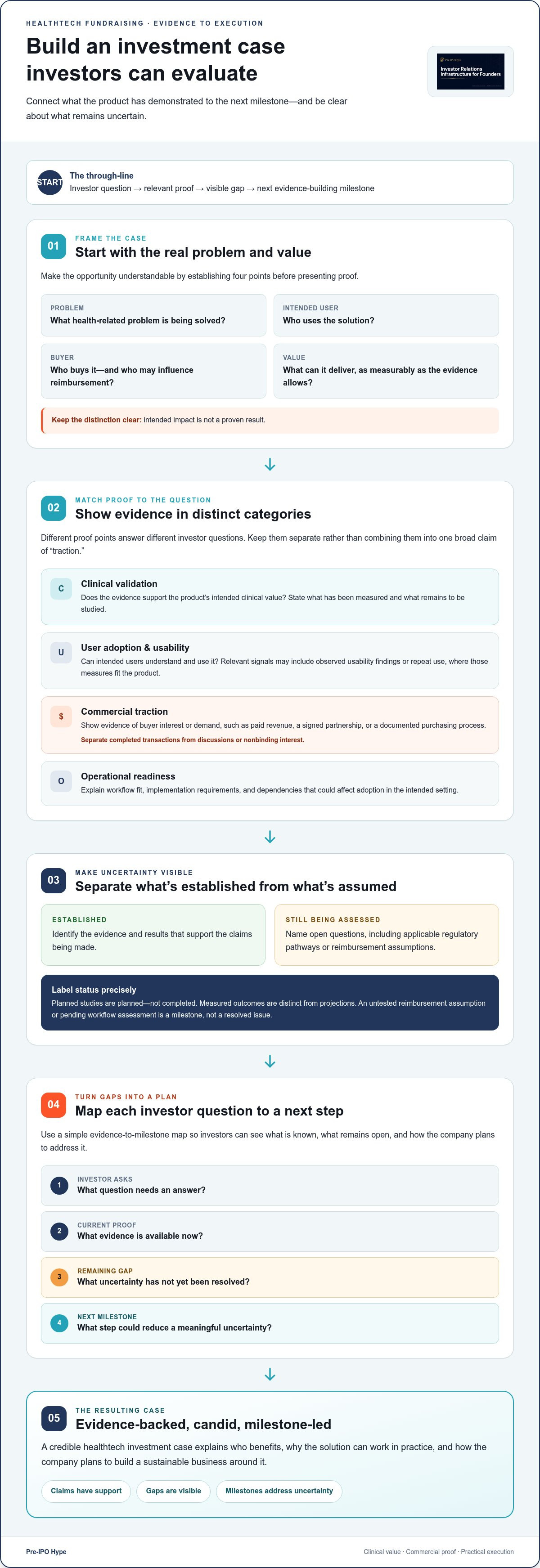
Start with four points: the problem, the intended user, the buyer, and the value the solution can deliver. Make that value as measurable as the available evidence allows, such as time saved, a workflow improved, or an outcome the product is designed to affect. Don’t present intended impact as a proven result.
Next, define the company’s current stage and its next evidence-building milestone. A prototype, early usage, commercial traction, and operational readiness answer different investor questions. Match your story to what you can substantiate, not simply what sounds exciting. For a practical look at the systems behind organized investor outreach, explore this guide to investor relations infrastructure for Regulation CF and Regulation A+ raises as you prepare your approach.
Build a healthtech investment case from clinical evidence and commercial proof
Investors need to understand what your product has demonstrated so far, what it could do, and what you plan to prove next. A credible healthtech investment case connects evidence to execution: each claim has support, each gap is visible, and each milestone is tied to a specific uncertainty.
A healthtech investment case is the evidence-backed explanation of who benefits from a solution, why it can work in practice, and how the company plans to build a sustainable business around it.
Which evidence can strengthen a healthtech fundraising narrative?
Different proof points answer different questions. Keep them distinct rather than blending them into a single claim of “traction”:
- Clinical validation: Does the evidence support the product’s intended clinical value? Identify what has been measured and what remains to be studied.
- User adoption and usability: Can intended users understand and use the product? Relevant signals might include observed usability findings or repeat use, where those measures fit the product.
- Commercial traction: Is there evidence of buyer interest or demand, such as paid revenue, a signed partnership, or a documented purchasing process? Separate completed transactions from discussions or nonbinding interest.
- Operational readiness: Can the product be introduced into its intended setting? Explain workflow fit, implementation requirements, and dependencies that could affect adoption.
The right evidence depends on the product, business model, and stage. A company early in development may be working toward a defined validation milestone, while a company selling to providers may be able to show buyer conversations or deployment progress. Label planned studies as planned, not completed, and distinguish measured outcomes from projections. In healthtech startup fundraising, precise claims build credibility; overstated traction puts it at risk.
How should founders discuss regulatory and reimbursement uncertainty?
Describe a regulatory pathway or reimbursement assumption only when it applies to the product and business model. Explain what’s established, what’s still being assessed, and how the team plans to address open questions. For example, identify a pending workflow assessment or an untested reimbursement assumption as a milestone rather than presenting either as resolved.
Keep a simple evidence-to-milestone map: investor question, current proof, remaining gap, and next step. This makes uncertainty easier to assess and helps investors distinguish plans from results. Have qualified professionals review references to FDA, HIPAA, or CMS requirements. This framework isn’t legal or investment advice.
To discuss how your evidence and milestones fit into an investor narrative, connect about your fundraising strategy.
Choose a fundraising route that fits your healthtech startup’s stage
The right capital source depends on what you’re building, what you’ve proved, and what the next milestone demands. Healthtech startup fundraising can take several forms, including venture capital, strategic investment, grants, and securities-based crowdfunding. These routes differ in readiness expectations, control implications, and preparation. Compare the trade-offs, and have qualified professionals review applicable eligibility and legal requirements.
When might venture capital or strategic investment fit?
Venture capital may suit a company pursuing substantial growth supported by a scalable business model and evidence aligned with its stage. Investors assess the opportunity, risks, and milestones ahead. Equity financing can bring capital and investor involvement, so founders should understand the ownership and governance implications of the terms.
Strategic investment may be relevant when an investor’s expertise, market position, or potential commercial alignment connects to the company’s goals. That alignment can also involve trade-offs, including expectations around partnerships or strategic priorities. Treat expertise and access as possibilities to evaluate, not promised outcomes.
When should founders assess grants or securities-based crowdfunding?
Grants may fit projects that align with a funder’s stated priorities and eligibility criteria. They can involve application timelines, defined uses of funds, and reporting obligations, so assess whether those demands fit your development plan. Securities-based crowdfunding is a distinct route involving a public-facing capital raise and its own preparation and compliance considerations. Have qualified counsel review Regulation Crowdfunding and Regulation A+ references for current applicability before using them.
The comparison below is a starting point, not a universal ranking. Actual terms and requirements vary by opportunity and company.
| Route | Potential fit | Readiness and preparation | Control considerations |
|---|---|---|---|
| Venture capital | Companies pursuing a substantial growth opportunity | Clear evidence, scalable model, and defined milestones | Equity and governance terms require review |
| Strategic investment | Companies with relevant potential strategic alignment | Strong case for both business value and fit | Consider partnership expectations and priorities |
| Grants | Projects aligned with a funder’s priorities | Eligibility review, application, and reporting preparation | Funding may be restricted to defined purposes |
| Securities-based crowdfunding | Companies prepared for a public-facing raise | Campaign readiness and expert review of applicable rules | Assess investor communications and ongoing obligations |
Choose based on fit, not fashion. Map each route to the evidence you have, the milestone you need to reach, and the obligations you’re prepared to manage. Legal, tax, eligibility, and securities questions call for qualified professional review, not assumptions.
Prepare a practical healthtech fundraising plan before investor outreach
A disciplined plan makes healthtech startup fundraising easier to manage and your investor story easier to follow. Build the process in sequence so each step supports the next:
- Define the raise objective. State how much capital you’re seeking, what it will fund, and which milestone it is intended to reach. Connect the objective to the company’s current stage and evidence.
- Assemble the evidence. Gather the clinical, product, operational, and commercial materials that support your claims. Label completed results, current assumptions, and planned work clearly.
- Prepare the materials. Create a concise pitch deck explaining the problem, solution, market, business model, evidence, risks, and funding objective. Organize a data room so investors can find supporting documents easily.
- Map investor outreach. Segment prospective investors by stage, sector interest, thesis fit, and relationship context. Set a consistent follow-up cadence and record each meaningful interaction.
What should a healthtech fundraising data room contain?
Organize the room into clear folders for corporate documents, financials, product information, clinical evidence, commercial activity, and key risks, as applicable to your company. Use simple file names and keep materials current. Make sure claims align across your deck, website, and investor communications. Apply appropriate access controls to sensitive information, and seek professional guidance on what to share and how.
How can founders structure investor outreach and follow-up?
Track each investor’s source, fit, outreach history, engagement, next step, and follow-up date in a CRM. Record concrete signals, such as a request for materials or a scheduled conversation, rather than treating opens or clicks as investment intent. A custom investor CRM can support lead scoring, omnichannel outreach automation, and attribution tracking. These tools organize activity and help assess engagement; they don’t predict or guarantee a funding outcome.
For a closer look at the infrastructure behind coordinated investor outreach, explore this guide to investor relations infrastructure for Regulation CF and Regulation A+ raises. Consistent messaging and accurate records help the team learn from the process without overstating what each interaction means.
To bring your materials and outreach plan into sharper focus, schedule a fundraising strategy conversation.
Turn healthtech fundraising activity into a measurable investor outreach system
A strong fundraising narrative needs an organized process behind it. In healthtech startup fundraising, coordinated messaging, thoughtful investor targeting, and consistent follow-up help founders manage outreach and learn which approaches earn meaningful engagement. Measurement brings discipline to the process, but it doesn’t make investor decisions predictable.
What should founders measure during investor outreach?
Track the stages of engagement, not just the number of messages sent. A practical dashboard can include:
- Outreach activity: Investors contacted, source of each lead, and fit with your stage and thesis.
- Responses and meetings: Replies, introductory conversations, and progression to follow-up discussions or diligence.
- Follow-through: Materials requested, next steps agreed, and follow-ups completed or due.
- Source attribution: Campaign or channel associated with an investor’s engagement, plus the timing of key interactions.
Review these signals regularly. If a message earns few relevant responses, test a clearer subject line or a sharper explanation of the opportunity, then document the change and compare results. Treat clicks, replies, and meetings as engagement signals, not evidence that an investment will follow. Attribution can show which touchpoints were associated with activity, but it can’t establish with certainty why an investor chose to engage.
How can Pre-IPO Hype support a fundraising workflow?
Pre-IPO Hype provides investor relations infrastructure for Regulation CF and Regulation A+ raises, bringing together campaign infrastructure, digital marketing and content strategy, analytics, and a custom investor CRM. The CRM supports lead scoring, omnichannel outreach automation, and attribution tracking, giving founders tools to organize investor data, monitor campaign activity, and manage follow-up. The system supports the fundraising strategy; it doesn’t guarantee investor conversion or funding.
For a closer look at how technology can support fundraising operations, review the fundraising technology stack.
Start by defining the outreach stages you’ll track, assigning clear owners for follow-up, and reviewing campaign performance regularly. A structured investor outreach workflow can help keep those activities organized as your fundraising plan moves forward.
Turn your evidence into a focused fundraising plan
Strong healthtech startup fundraising connects three elements: evidence that supports your solution’s value, a capital route suited to your company’s stage, and a clear plan for reaching and engaging investors. Keep clinical, commercial, and operational claims distinct. Set a specific next milestone, then make your materials and outreach explain how funding will help you reach it.
Execution matters, too. A structured investor process helps your team track sources, follow-ups, and engagement signals without mistaking activity for a guaranteed outcome. Pre-IPO Hype’s custom investor CRM supports lead scoring, omnichannel outreach automation, and attribution tracking.
Your next step is practical: clarify the milestone your raise will fund, identify the evidence investors need to assess it, and organize outreach around that story. To discuss a disciplined approach for your fundraising plan, schedule a fundraising strategy conversation.
Frequently Asked Questions
What is healthtech startup fundraising?
Healthtech startup fundraising is securing capital for a company developing technology for healthcare delivery, operations, research, or related markets. The process involves presenting a credible opportunity, the evidence supporting it, and the risks still to address, not simply pitching a product idea. A founder might consider venture capital, strategic investment, grants, or securities-based crowdfunding. The suitable route depends on the company’s business model, stage, evidence, and goals.
How do healthtech startups raise funding?
Healthtech startups typically begin by defining what the capital will fund and which milestone it should support. Next, assess readiness, organize relevant evidence and fundraising materials, identify investor groups that fit the company’s stage and focus, then manage outreach and follow-up consistently. The best sequence and capital source vary by business model and development stage. For securities-related decisions, seek qualified legal and financial guidance; this overview isn’t investment advice.
What do investors look for in a healthtech startup?
Investors may assess the problem, intended user and buyer, evidence of clinical or operational value, market opportunity, business model, team, risks, and next milestones. Their priorities vary by investor and company stage. Support claims with relevant evidence, distinguish measured results from projections, and describe material uncertainties clearly. For example, report completed user testing separately from planned validation, and explain how the next milestone could address an important open question.
Can a pre-revenue healthtech startup raise capital?
Being pre-revenue doesn’t automatically determine whether a healthtech company can raise capital or attract investor interest. Founders may need to show other relevant signals, such as validated problem demand, product progress, a clinical rationale, user feedback, partnerships, or a credible development plan. Which signals matter most depends on the product, investor, and stage. Present evidence accurately and avoid treating any milestone as a guarantee of funding.
How important is clinical evidence in healthtech fundraising?
Clinical evidence can help investors assess whether a product addresses a meaningful healthcare need, but the appropriate evidence depends on its intended use, design, and development stage. It’s distinct from commercial traction, such as revenue, and user feedback, such as usability findings. Keep these proof points separate, describe what has actually been measured, and qualify claims carefully. Seek expert review when interpreting clinical findings or making claims with regulatory implications.
Does a healthtech startup need FDA approval before fundraising?
There isn’t one answer for every healthtech company. Whether FDA requirements apply depends on the product, its intended use, and its claims, so don’t assume approval is universally required or unnecessary. Describe the company’s current regulatory status precisely, separating confirmed facts from plans and assumptions. Qualified regulatory counsel can assess product-specific questions. Clear disclosure helps investors understand the pathway and open issues without presenting a fundraising discussion as regulatory advice.
How can a healthtech founder track investor outreach?
Use a consistent system to record investor fit, contact source, communications, engagement, follow-up dates, and next steps. A CRM can organize the pipeline and help connect outreach sources with subsequent activity. Treat replies, meetings, and material requests as process signals, not predictions of funding. Keep messaging consistent across channels, update records after meaningful interactions, and apply appropriate access controls to sensitive company information.
Disclaimer
Educational only. Not investment, tax, or legal advice. Pre-IPO Hype is investor relations infrastructure for Regulation CF and Regulation A+ raises. We are not a broker-dealer, funding portal, or investment adviser, and we do not offer or sell securities or make investment recommendations. Any securities offering is made only by the issuer, through its own offering documents and, where required, a registered intermediary.


