
How to Attract Angel Investors: Engineering Investor Gravity in 2026
Why are you still chasing capital when you should be engineering it? By 2026, the traditional "spray and pray" pitch deck is officially obsolete, replaced by a new era of algorithmic momentum and strategic scarcity. Learning how to attract angel investors in this hyper-competitive market requires more than a polished slide deck; it demands a data-driven framework that creates a natural gravity around your valuation. The days of hunting for checks are over. Now, you build the ground floor opportunity that elite insiders cannot afford to miss.
You likely know the frustration of a 0.02% response rate on cold emails or the looming anxiety of SEC compliance for early-stage raises. It's easy to feel invisible when over 5.5 million new business applications are filed annually, making it harder than ever to stand out in a crowded private market. We're going to change that. This guide delivers the blueprint to master investor gravity, allowing you to transition from a seed idea to a high-momentum capital raise with total authority. We'll explore the specific systems for generating elite leads and the tactical steps to bridge your startup toward a successful Series A or Reg CF liquidity event.
Key Takeaways
- Shift from traditional "warm intros" to digital discovery frameworks that turn your startup into a high-visibility beacon for data-driven capital.
- Engineer "Investor Gravity" by learning how to attract angel investors through a story framework focused on massive investment upside rather than simple product features.
- Master the 2026 pitch deck architecture that strips away vanity metrics to prioritize institutional-grade data points and team-led execution proof.
- Deploy an omnichannel outreach strategy using custom CRM tracking to transform one-off meetings into a high-conversion, 60-day funding funnel.
- Position your seed-stage success as the foundation for future liquidity, bridging the gap between private secrecy and public-market momentum.
The New Landscape of Angel Investing in 2026
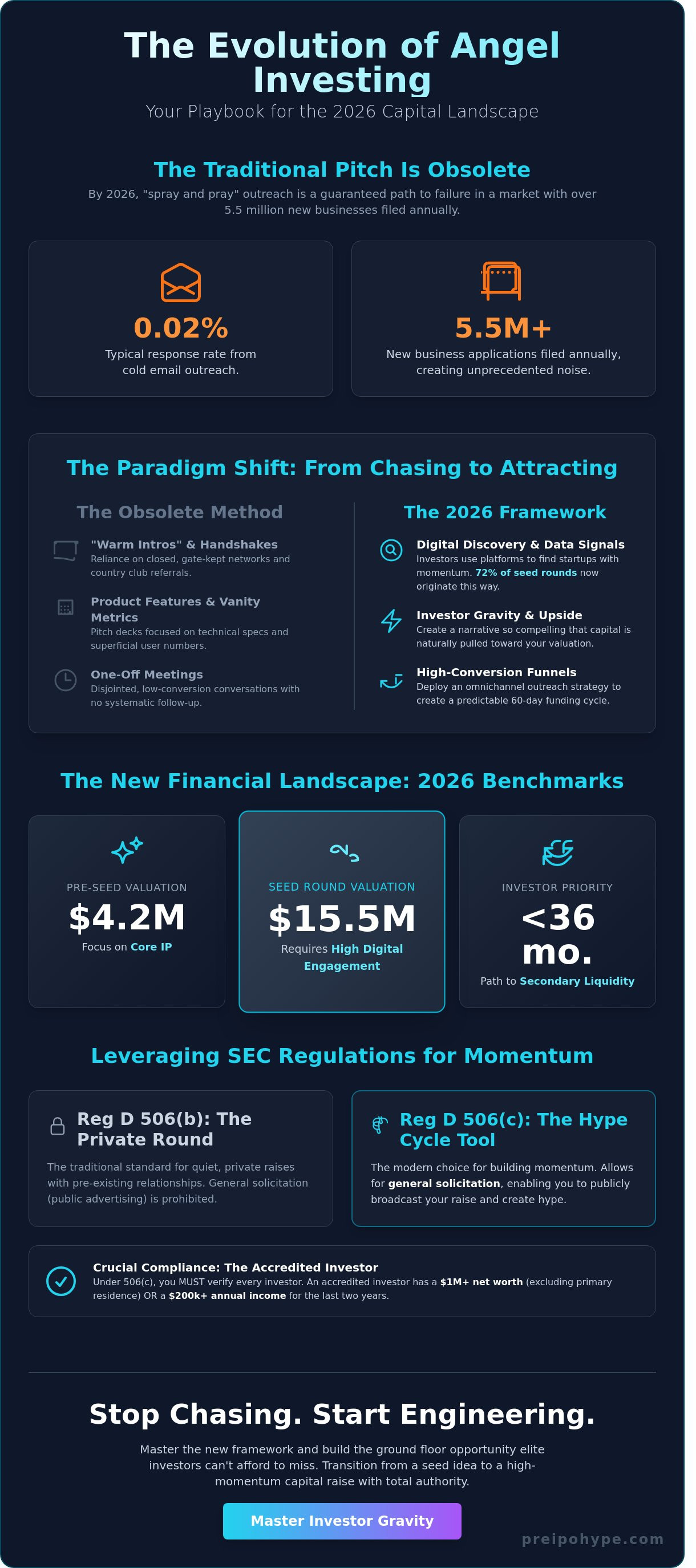
The era of the "warm intro" as a gatekeeper is officially over. By January 2026, data-driven discovery platforms have largely replaced the closed-door networking of traditional venture capital. If you want to master how to attract angel investors, you must recognize that the private market has shifted toward transparency and rapid digital verification. Investors aren't just looking for a solid business plan; they're hunting for momentum signals that indicate a company is ready to dominate the "hype" cycle. This shift has democratized access, allowing founders from any geography to capture the attention of elite capital.
An Angel investor in this new era operates as an "Informed Insider" who values digital proof over a country club handshake. Data from the first quarter of 2025 indicated that 72% of successful seed rounds originated through digital outreach or social signal platforms rather than personal referrals. This evolution means the ground floor is open to those who can project authority and scale through their online presence. It's about bridging the gap between private secrecy and public opportunity.
To better understand this concept, watch this helpful video:
Beyond the Country Club: The Digital Angel
Accredited investors now use social signals to filter through the noise. They look for "hype" as a legitimate financial indicator of future secondary liquidity. Your digital footprint isn't a supplement to your pitch; it's the pitch itself. In 2026, a founder's ability to build a public narrative determines their valuation ceiling. Current market data shows specific shifts in what angels expect:
- Pre-seed benchmarks: Average valuations have stabilized at $4.2 million with a focus on core IP.
- Seed benchmarks: Rounds frequently touch $15.5 million for companies demonstrating high digital engagement and community "buy-in."
- Secondary Liquidity: Angels now prioritize deals that offer clear paths to secondary markets within 36 months.
The Role of SEC Regulations in Early Outreach
Building public momentum requires a surgical understanding of SEC frameworks. Reg D 506(b) remains the standard for private, quiet rounds, but 506(c) is the tool of choice for the modern "hype" cycle. This regulation allows for general solicitation, meaning you can publicly broadcast your raise to attract accredited insiders. To stay compliant, you must verify every investor's status through third-party services before closing the deal. In 2026, an accredited investor is defined as an individual with a net worth exceeding $1 million, excluding their primary residence, or an annual income over $200,000 for the last two years. Mastering how to attract angel investors today means leveraging these rules to create a sense of elite, urgent opportunity while maintaining total regulatory integrity.
Engineering "Investor Gravity": Positioning Your Startup as a Prize
Investors don't buy products; they buy future cash flows wrapped in a compelling narrative. To master how to attract angel investors, you must stop acting like a founder and start acting like a prize. This transition requires "Investor Gravity," a state where your startup's momentum pulls capital toward it. It's not about desperate outreach. It's about being the most lucrative option in the room. When you position your venture as an exclusive opportunity, the power dynamic shifts in your favor.
The Story Framework: Authority Meets Ambition
Your narrative should position your company as the final frontier of wealth creation. While early-stage pitches often get bogged down in technical specs, elite raises focus on market momentum. We view hype as a legitimate financial indicator. If 20,000 users joined your waitlist in under 45 days, that isn't just noise; it's a validation of future scale. You need to showcase how your current early-stage entry leads directly to late-stage dominance. You're offering a seat on a rocket that's already ignited. Use data to prove that the market is pulling your product out of your hands.
Establishing Technical Credibility
Hype gets them to the table, but infrastructure closes the deal. You need a clean cap table and robust foundation infrastructure to prove you're ready for institutional-grade capital. Industry reports from 2023 suggest that 64% of deals fail during due diligence because of messy documentation or unclear legal structures. Your valuation can't be a guess. It must be a defensible number backed by unit economics and a 12-month milestone map. If you want to see how your current setup compares to elite standards, you can ask our CEO for a direct audit of your raise-readiness.
- Precision in the Ask: Define exactly how a $750,000 injection scales operations.
- Milestone Mapping: Connect every dollar to a specific valuation inflection point.
- Defensible Data: Use cohort analysis to prove your customer lifetime value (LTV) is at least 3x your acquisition cost.
Exclusivity is your greatest leverage. When an angel perceives they're competing for a limited allocation, their internal calculus shifts from risk-assessment to fear of missing out. A transparent data room is the ultimate closing tool. It signals that you have nothing to hide. By providing instant access to contracts, IP filings, and financial audits, you eliminate friction. Speed is a signal of competence. In the fast-moving world of private equity, the founders who provide the clearest path to "yes" are the ones who get funded first. This is the most effective strategy for how to attract angel investors who are ready to write significant checks.
The High-Stakes Pitch: Blending Authority with Viral Momentum
The 2026 fundraising environment demands a departure from the "visionary fluff" of previous cycles. Today, mastering how to attract angel investors means delivering an "Insider" narrative backed by cold, hard execution metrics. Investors aren't just buying your product; they're buying into a 10-slide roadmap that proves you understand the path to secondary liquidity. You aren't just asking for capital; you're offering entry into an exclusive growth vehicle.
The "Insider" Pitch Deck Structure
Modern angels expect a lean, high-velocity deck. By Q1 2026, the standard has shifted to a strict 10-slide format focusing on unit economics and AI-integrated moats. You must present a valuation calculator result early to justify your price and show you aren't guessing at your worth. This transparency builds instant credibility. Your slides should cover: Problem, Solution, Market Size, Product, Traction, Team, Competition, Business Model, Financials, and The Ask.
Focus heavily on your competitive moat. In an economy where 65% of startups face threats from rapid AI commoditization, your unique data set or proprietary distribution is your greatest asset. The team is your ultimate execution engine. Don't just list degrees; highlight specific "wins" where your leadership pivoted or scaled under pressure. You must also address the most critical objection: Why now? Investors need to see why this specific window, before the 2027 market shift, is the optimal time for this specific exit.
Scaling Your Outreach with Video
Founders can't be in 1,000 rooms at once, but your personality can. Ambitious founders are now using video funnels to pre-qualify angel interest before a single Zoom call is ever booked. This creates a strategic filter that ensures you only spend time with high-intent capital. It's about maintaining an elite tone that feels both professional and urgent, positioning the opportunity as a fast-moving train that won't wait for indecision.
The "Founder Memo" has emerged as a high-authority alternative to the traditional deck. It's a 3-page, data-heavy document that reads like an institutional research report. This format signals that you're an informed insider who values substance over style. It ditches the flashy graphics for sophisticated analysis, proving you've mastered how to attract angel investors who prioritize logic over hype. This approach builds a sense of exclusivity, making the act of investing feel like joining a gated financial movement rather than just executing a transaction.
Omnichannel Outreach: Captured Interest and CRM Mastery
The era of the "one-and-done" pitch deck email is dead. If you want to master how to attract angel investors in a saturated market, you have to play the long game. Elite capital raises now rely on 60-day attribution tracking. This means you aren't just looking for an immediate "yes." You're tracking the journey from the first LinkedIn impression to the final wire transfer. Most founders quit after the second touchpoint, but data shows that 80% of significant capital commitments require at least five to seven interactions. This is the Rule of 7 in action. Consistency always beats intensity when you're engineering momentum.
Building Your Investor Funnel
Step 1 involves identifying accredited leads through data-driven marketing. You aren't guessing; you're using verified lists and intent signals to find those with a high liquidity profile. Step 2 requires scoring these leads based on their engagement. An investor who opens your private newsletter three times in 48 hours is a high-priority target. Step 3 is the execution of omnichannel outreach. This is a synchronized presence across LinkedIn, direct email, and exclusive newsletters. It keeps your brand in their peripheral vision without becoming a nuisance, ensuring you're the first person they think of when they're ready to deploy capital.
The Power of the Investor CRM
Managing this complexity requires a Custom Investor CRM designed for elite capital raises. Generic sales tools won't cut it for unicorn hunting. You need to track every touchpoint to see which channels are actually driving liquidity. Sixty-day attribution is critical for tracking investor ROI because it reveals the true origin of a lead, proving that a LinkedIn post from two months ago was the actual catalyst for today's investment. By using lead scoring, your team can prioritize high-net-worth follow-ups while automated retargeting keeps the "hype" alive for the rest of your funnel. This level of precision is how to attract angel investors who value professional, data-backed execution over desperate pitching.
Retargeting angels is about staying top-of-mind through value, not just reminders. You share secondary liquidity updates, valuation benchmarks, and milestone wins. This creates a sense of exclusivity and urgency. When an investor sees your progress across multiple platforms, they stop viewing your startup as a risk and start seeing it as a movement they need to join before the ground floor closes.
Ready to stop guessing and start scaling your outreach? Get direct insights from our CEO on building your elite investor pipeline.
From First Angel to $100M: Scaling the Hype Cycle
The first angel check is the ultimate catalyst. It transforms a private vision into a validated market opportunity. Learning how to attract angel investors is the prerequisite for the larger game. It isn't just about the capital; it's about engineering a momentum that carries your brand through to a $100M valuation. Once you secure that lead investor, the "soft circle" phase begins. This is where you collect verbal commitments to fill the remaining 30% to 45% of your round. Success here hinges on the term sheet nuances. You need a clean structure that avoids "toxic" clauses. These can stall future Series A institutional interest and kill a deal before it matures.
The transition from private secrecy to public opportunity is a tactical shift. You're moving from a handful of high-net-worth individuals to a broader, more vocal audience. This shift requires a controlled narrative. You want to maintain the "insider" feel while opening the gates to the masses. Data from 2024 shows that companies successfully bridging this gap saw their valuations increase by an average of 2.2x within eighteen months. It's about moving from the "quiet period" to a loud, strategic market presence.
Bridging to Equity Crowdfunding
Angel validation is the social proof that powers a high-velocity Reg CF marketing campaign. When retail investors see that sophisticated insiders have already de-risked the deal, the "hype cycle" accelerates. It creates a powerful synergy. The $50,000 check from a tech veteran gives the $1,000 retail investor the confidence to click "invest." You must maintain active investor relations as your cap table grows. Use digital portals to keep your 500+ new advocates informed and excited. This turns your investors into a marketing army that drives secondary interest.
Consulting for the Elite Raise
Scaling toward a unicorn hunt requires a professional engine. Knowing how to attract angel investors gets you off the ground, but hitting the $100M mark often requires an equity crowdfunding marketing agency. These specialists manage the complex funnel of modern fundraising. They ensure your brand stays elite while reaching a global audience. If you're ready to map your roadmap, schedule a 30-minute strategy session to discuss your specific trajectory. We focus on positioning your company as the next major liquidity event. The goal is to move from individual angels to the kind of institutional momentum that defines an entire industry.
Claim Your Seat at the Table of Elite Capital
The 2026 investment landscape doesn't reward the desperate. It rewards the engineered. To win, you've got to stop pitching and start positioning your startup as an inevitable exit. You've learned how to attract angel investors by blending viral momentum with institutional authority. It's about shifting from the "ask" to the "offer." We've seen this play out for 230+ companies where we facilitated over $100 million in capital. Success in this market requires a calculated mix of high-stakes energy and rigorous compliance.
Scaling the hype cycle requires more than just a deck. You need a proprietary system to track leads and ensure total Reg CF and Reg A+ compliance. Our Proprietary Custom Investor CRM turns raw interest into a strategic asset. The private market remains the final frontier of significant wealth creation. It's time to stop chasing and start leading the movement toward your next liquidity event.
Ready to engineer your investor hype cycle? Schedule a strategy session with Pre-IPO Hype.
The next big exit is waiting for the founder who acts decisively today. Let's build your momentum together.
Frequently Asked Questions
What is the difference between an angel investor and a venture capitalist?
Angel investors are high net worth individuals who invest their own personal capital into early stage startups, while venture capitalists manage pooled money from institutional sources. Angels typically write checks between $25,000 and $100,000 during the seed phase. Venture capital firms usually wait until the Series A round to deploy larger sums, often exceeding $2 million, and demand more rigorous governance and board seats.
How much equity should I give an angel investor in 2026?
You should expect to relinquish 10% to 25% of your company's equity during a typical angel round in 2026. Data from the 2024 Halo Report indicates that median pre-money valuations for angel-backed startups hover around $4.5 million. Diluting your ownership by more than 25% this early can complicate your cap table and make the company less attractive to institutional VCs during future unicorn hunting phases.
Do I need a warm introduction to meet an angel investor?
You don't strictly need a warm introduction, but referrals increase your probability of securing a meeting by 80% compared to cold emails. Research shows that 90% of closed angel deals originate from a trusted source within the investor's existing network. Mastering how to attract angel investors involves building this social capital through industry events and LinkedIn networking to ensure you aren't just another name in a crowded inbox.
What is an "accredited investor" under current SEC rules?
An accredited investor is an individual with a net worth exceeding $1 million, excluding their primary residence, or an annual income over $200,000 for the last two years. Under SEC Rule 501, people holding Series 7, 65, or 82 licenses also qualify regardless of their income. These regulations ensure that only sophisticated "insiders" with the financial capacity to absorb potential losses can participate in private placement opportunities.
Can I use digital marketing to find angel investors for my startup?
You can use digital marketing to reach investors if you follow SEC Rule 506(c) guidelines, which permit general solicitation to accredited individuals. Platforms like AngelList reported a 15% growth in active investor accounts in 2023, signaling a shift toward digital discovery. Using targeted campaigns to showcase your growth metrics is a modern strategy for how to attract angel investors who are looking for the next big exit in the private market.
What documents should be in my investor data room before pitching?
Your data room must include your pitch deck, 3 year financial projections, articles of incorporation, and a detailed cap table. You should also include intellectual property filings and key employment contracts to prove the company is legally sound. A 2023 DocSend study found that investors spend less than 4 minutes reviewing a pitch deck, so your data room must be organized to provide instant validation of your claims.
How long does it typically take to close an angel investment round?
Closing an angel round usually takes 3 to 6 months from the first pitch to the final wire transfer. The initial 60 days are typically spent building momentum and securing a lead investor to set the terms. Once you have a signed term sheet, the legal due diligence and closing process takes another 20 to 45 days. Speed is essential because maintaining the "hype" around your round prevents the deal from stagnating.
What are the pros and cons of using convertible debt vs. equity?
Convertible debt allows you to delay company valuation until a later date, whereas equity requires an immediate agreement on the price per share. Debt is faster to execute and often costs less than $5,000 in legal fees; however, it can create a debt burden if the company fails to raise a subsequent round. Equity provides permanent capital and aligns the investor's interests with yours, but it involves more complex negotiations over voting rights and control.
Disclaimer
Educational only. Not investment, tax, or legal advice. Pre-IPO Hype is investor relations infrastructure for Regulation CF and Regulation A+ raises. We are not a broker-dealer, funding portal, or investment adviser, and we do not offer or sell securities or make investment recommendations. Any securities offering is made only by the issuer, through its own offering documents and, where required, a registered intermediary.


