
How to Build a Waitlist of Investors: Engineering Momentum for Your 2026 Capital Raise
In a 2026 market where venture capital funding reached $300 billion in just the first quarter, the difference between a record-breaking round and a quiet failure isn't your pitch deck. It's your velocity. Learning how to build a waitlist of investors has evolved from a marketing tactic into a critical engineering requirement for any serious capital raise. If you're launching without a queue of verified interest, you're already trailing the market.
You know the anxiety of a "cold" launch. It's frustrating to watch potential leads stall because you lack the data to track their engagement or the system to convert curiosity into hard capital. You need a process that creates exclusivity and urgency, turning a standard transaction into a high-stakes movement that elite circles want to join.
This article will help you master the strategic architecture of investor waitlists to secure firm indications of interest and ensure your raise launches with unstoppable momentum. We will break down how to build a "soft-circled" round, leverage high-quality data on potential lead investors, and implement a repeatable system for investor acquisition that scales with your ambition.
Key Takeaways
- Eliminate the risk of a "cold launch" by securing firm Indications of Interest (IOIs) long before your campaign officially goes live.
- Discover how to build a waitlist of investors using a five-step "Intent Ladder" designed to move prospects from passive curiosity to high-conviction commitment.
- Replace generic marketing tools with a custom investor CRM to capture granular engagement data and identify your most likely lead investors.
- Leverage omnichannel digital marketing and advertising to dominate the attention of specific investor personas across multiple high-traffic channels.
- Implement a high-velocity activation playbook to convert your waitlist momentum into a fully funded round within the first 24 hours of launch.
The Strategic Necessity of an Investor Waitlist in 2026
In the high-stakes arena of 2026 capital markets, hope is not a strategy. An investor waitlist serves as a high-precision pre-launch mechanism designed to secure Indications of Interest (IOIs) before a single dollar is officially requested. Learning how to build a waitlist of investors is no longer optional; it is the foundation of a successful raise. Mastering the strategic management of investor relations through a waitlist ensures that your offering doesn't just sit on a portal; it launches as a proven commodity with built-in momentum.
A "cold launch" is the primary reason why many Reg CF and Reg A+ campaigns fail to reach their targets. Without a pre-existing queue of eager participants, your public launch lacks the immediate social proof required to trigger the herd mentality of the broader market. Investors rarely want to be the first into a deal, but they're desperate to join a moving train that’s already picking up speed. By the time you open your round, the waitlist should already represent a significant portion of your funding goal.
To better understand how a high-volume queue transforms a raise, watch this breakdown:
This strategy effectively de-risks the raise for institutional lead investors. When a venture partner sees a massive, verified waitlist, they aren't just looking at potential capital. They're looking at market validation and a reduced cost of acquisition. It changes the power dynamic, shifting the conversation from a plea for capital to an exclusive opportunity to join a round that's already halfway to the finish line.
De-Risking the Raise: Why Data Beats Hope
Waitlist numbers are the leading indicator of Day 1 funding velocity. In 2026, the market has shifted away from the "hype-only" lists of 2022 that were filled with low-intent email addresses. Today's elite founders prioritize "intent-verified" lists where prospects have engaged with multiple data points. This granular data allows you to negotiate from a position of power, using real-time demand to dictate valuation and terms with venture partners who value certainty over speculation.
The 2026 Funding Environment
The current landscape is defined by a flight to quality where investors demand more touchpoints and deeper transparency before committing. You can't expect a single ad to close a check in a world where AI-driven deals dominated 61% of VC activity last year. The Investor Hype Cycle is the critical, time-compressed period between an investor's first digital touchpoint and their final execution of a capital commitment. Understanding how to build a waitlist of investors allows you to manage this cycle with surgical precision, building trust through early engagement and consistent updates that turn passive observers into committed backers.
Engineering the Investor Intent Ladder: A 5-Step Framework
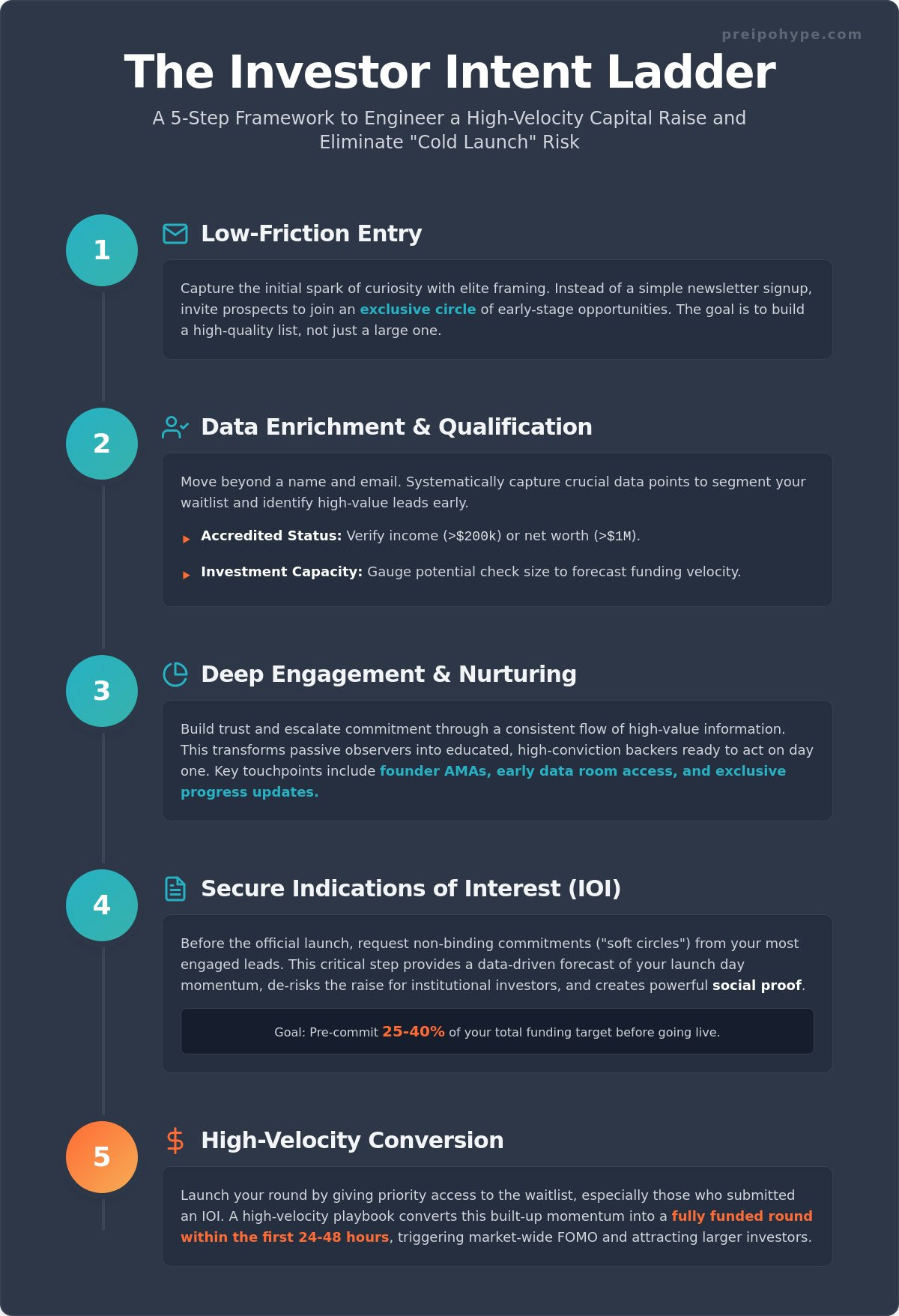
Most founders treat a waitlist like a static spreadsheet of email addresses. In the 2026 market, that approach is a liability. To secure a piece of the $300 billion venture capital pie, you must view your waitlist as a dynamic "Intent Ladder." This framework is the structural backbone of your acquisition strategy, designed to filter out the noise and identify the high-conviction capital waiting for your round to open. Understanding how to build a waitlist of investors starts with engineering a journey that escalates from casual interest to a firm indication of interest (IOI).
- Step 1: The Low-Friction Entry. Capture the initial spark of curiosity by using elite framing. Don't just ask for an email; invite them to join an exclusive circle of early-stage opportunities. This is about attracting potential investors by signaling that your company is already a moving train.
- Step 2: Data Enrichment. Move beyond names. Capture accredited status, such as the $200,000 income threshold or $1 million net worth requirement, and gauge their investment capacity early.
- Step 3: Engagement Milestones. Use "founder's notes" or invitation-only webinars to build rapport. Every interaction is a data point that signals who is leaning in.
- Step 4: The Soft Circle. This is the critical transition. Secure a non-binding commitment of a specific dollar amount. It turns a "maybe" into a quantifiable asset for your Day 1 velocity.
- Step 5: Final Verification. Ensure your leads are ready to execute. This step prepares your most committed backers for the 24-hour launch window.
From Curiosity to Commitment
Success in 2026 relies on micro-conversions. You need to identify your "whale" investors long before they sign a term sheet. By tracking investor journeys across a 60-day attribution window, you can see exactly which content triggers a move up the ladder. It's vital to link this activity to your foundation infrastructure to ensure a seamless transition from the waitlist to the closing table. If you're struggling to map this journey, book a strategy session to audit your current funnel.
Psychological Triggers of Elite Investing
Elite investing thrives on scarcity and insider access. When you're figuring out how to build a waitlist of investors, the "Founding Member" designation is a powerful tool for early signups. It creates a sense of belonging to a gated financial world that was previously out of reach. Remember that curiosity is the top of the funnel, but conviction is the only metric that clears the bank. Use exclusivity to drive that conviction, making participation feel like joining a movement rather than just executing a transaction.
The Technical Bedrock: Why Your CRM Is Your Most Valuable Asset
Generic marketing tools are the silent killers of high-growth capital raises. While competitors might suggest using simple email platforms or basic spreadsheets, these tools lack the sophisticated tracking required for elite investor relations. When you're mastering how to build a waitlist of investors, your infrastructure must do more than just store names. It needs to act as a high-velocity engine that identifies commitment before it's even voiced. A custom investor CRM is essential because it captures the multi-channel engagement signals that standard CRMs simply ignore.
Lead scoring in this environment isn't about "marketing qualified leads." It's about identifying high-net-worth individuals who meet the 2026 accredited investor thresholds, such as an annual income over $200,000 or a net worth exceeding $1 million. Your CRM should automatically prioritize these prospects based on their interactions across your digital ecosystem. By integrating your waitlist directly with your technical fundraising stack, you eliminate data silos that cause "waitlist rot" and ensure that your most valuable leads never fall through the cracks.
Beyond the Email List: Tracking Engagement
In 2026, an email open is a weak signal. True intent is found in document views, webinar attendance duration, and repeated click-through rates on specific performance metrics. Your system should monitor these actions in real time, triggering automated, personalized follow-ups that feel like a white-glove service rather than a mass broadcast. Use a 60-day attribution window to understand which specific acquisition campaigns are driving the most capital. This allows you to double down on the channels that actually fill your waitlist with high-conviction backers.
Security and Compliance in 2026
Data integrity is a non-negotiable requirement for any raise involving Reg CF, Reg A+, or Rule 506(c) offerings. Your waitlist infrastructure must meet rigorous SEC standards for investor data handling to maintain credibility with institutional partners. This means moving beyond static PDFs and into "Investor-Ready" data rooms that are linked directly to your CRM. For founders who want to ensure their pipeline is backed by verified, high-quality prospects, leveraging a dedicated investor data page is the most effective way to maintain compliance while scaling your outreach. Secure data handling doesn't just protect you; it builds the long-term trust necessary to turn a one-time investor into a lifelong advocate for your brand.
Omnichannel Mastery: How to Fill Your Waitlist with High-Value Leads
Single-channel strategies are relics of a slower investment era. If you're targeting a raise over $1 million, relying on a single source of traffic is a recipe for stagnation. You must be present wherever the capital lives, creating a surround-sound effect that builds familiarity and trust. Learning how to build a waitlist of investors in 2026 requires a shift from passive posting to aggressive, multi-touch attribution. This is where digital marketing and advertising intersect with high-level networking to create a dominant market presence.
Tapping into pre-vetted capital pools is the fastest way to accelerate your momentum. Exposure in elite circles, such as the Invst Guru network, places your opportunity directly in front of active participants who are already looking for the next breakout. Combine this with founder-led outreach on LinkedIn and X to build personal authority. Investors don't just back companies; they back leaders who command the narrative in the public square. By the time a prospect joins your list, they should have seen your narrative across at least three different platforms. This is the only way to ensure you're mastering how to build a waitlist of investors that actually converts when the round opens.
Paid Acquisition for Private Markets
Paid media for capital raises is a surgical operation. You aren't just buying clicks; you're targeting specific investor personas based on their professional networks and high-intent search behavior. Focus your spend on platforms where you can verify accredited status, reaching individuals who meet the $200,000 income or $1 million net worth thresholds. A/B testing your story framework is essential to see which value proposition resonates most with these high-value leads. Constant optimization allows you to calculate your "Cost Per Investor Lead" with precision, ensuring that every dollar spent on acquisition contributes to a positive campaign ROI.
Content Strategy: Building the Narrative
Content is the fuel for your momentum engine. You need to create "Insider" content that makes waitlist members feel like they've gained access to a gated financial world. Short, punchy video updates and founder interviews are highly effective at humanizing technical data and explaining complex moats. Leveraging the Invst Guru newsletter serves as a primary engine for top-of-funnel awareness, providing the social proof needed to move prospects from curiosity to conviction. To see how these channels can be integrated into your specific raise, design your omnichannel acquisition strategy with our consulting team.
Converting Waitlist Momentum into a Sold-Out Raise
Launch Day is the definitive climax of your engineering efforts. It isn't just an opening; it's a calculated release of the pressure you've built throughout your pre-launch phase. While you've mastered how to build a waitlist of investors, the true test is your ability to convert those digital indications of interest into hard capital. In 2026, where early-stage funding reached $41.3 billion in Q1 alone, the fastest rounds are those that treat the first 24 hours as a high-velocity closing event rather than a start date.
Transitioning from a "soft circle" to a "hard check" requires more than just an email announcement. You need automated closing technology that reduces friction at the point of commitment. This is why elite founders utilize a dedicated investor acquisition platform to manage the inevitable surge of traffic and documentation. Without this infrastructure, you risk losing high-conviction backers to technical delays or complex subscription agreements.
Success also depends on how you've managed "waitlist rot" during your build-up. Keeping leads warm for 90+ days requires a steady cadence of "insider-only" updates that emphasize progress and scarcity. If your list goes cold, your Day 1 velocity will stall. Your goal is to enter the public market with a significant portion of your round already spoken for, creating a visual of success that compels new observers to act quickly before the opportunity vanishes.
The Activation Sequence
The 48-hour countdown is your most powerful tool for creating a sense of inevitable success. Provide an "Early Access" window exclusively for waitlist members, allowing them to claim their stake before the general public. Use real-time funding bars on your portal to trigger immediate FOMO. When an investor sees a round moving toward a $75 million Reg A+ Tier 2 limit in real time, the psychological pressure to join a winning movement becomes irresistible.
Scaling Beyond the Waitlist
The initial surge from your waitlist does more than just fill your bank account; it triggers the internal algorithms of leading investment portals. High early volume signals to these platforms that your deal is "trending," which pushes your offering to their massive databases of retail and accredited investors. Once your early backers are in, turn them into brand advocates who drive viral growth across their own professional networks. To architect a raise that captures this level of momentum, book a strategy session with Jeff 'Fuzzy' Wenzel and secure your place in the 2026 market.
Engineer Your 2026 Exit Velocity
The 2026 capital landscape rewards those who treat fundraising as a precise engineering discipline. You've seen that mastering how to build a waitlist of investors isn't about collecting emails; it's about constructing a high-fidelity intent ladder backed by a custom investor CRM. By deploying an omnichannel strategy and leveraging proprietary 60-day attribution tracking, you transform passive interest into a sold-out launch day. The difference between a stalled round and a record-breaking raise is the technical bedrock you build today.
We've facilitated over $100M in funding by navigating the complexities of Reg CF and Reg A+ frameworks with surgical precision. Don't leave your public launch to chance. It's time to bridge the gap between restricted information and broader opportunity. Scale your capital raise with a Custom Investor CRM and ensure your company has the fuel to reach its next milestone. The market moves fast, but with the right system, you'll be the one setting the pace.
Frequently Asked Questions
How many investors do I need on my waitlist before launching?
You should aim for a waitlist that represents 2x to 3x your target funding goal in soft-circled dollar commitments. Since not every signup converts to a hard check, this buffer ensures you hit your minimum funding threshold within the first 24 hours. If your goal is to raise $1 million, your list should ideally show $2 million to $3 million in indicated interest before you go live.
What is the average conversion rate from a waitlist to an actual investment?
Conversion rates typically range between 10% and 30% based on the depth of your pre-launch engagement. High-intent lists that require prospects to specify an investment amount or verify accredited status usually convert at the higher end of this range. Lists that only capture low-friction email addresses often struggle to break a 10% conversion rate when the round officially opens.
Is a waitlist legally binding for investors in a Reg CF raise?
No, an indication of interest (IOI) on a waitlist is not a legally binding commitment for investors. Under SEC regulations for Reg CF and Reg A+, these signups are non-binding expressions of interest that allow founders to "test the waters" and gauge market demand. Investors retain the right to change their minds or withdraw their interest until they execute the final subscription agreement and wire funds.
How do I keep my investor waitlist engaged during a long SEC filing period?
Maintain momentum by providing exclusive "insider" updates that highlight company milestones, key hires, or new product developments. Use this time to humanize the brand through brief founder video updates and invitation-only webinars. Consistent communication prevents leads from cooling off and ensures your brand remains top-of-mind while you navigate the regulatory process.
What data points should I collect on my investor signup form?
Collect the prospect's full name, email address, accredited status, and a non-binding "intended investment amount." Knowing if an individual meets the $200,000 income or $1 million net worth threshold allows you to prioritize high-value outreach. Mastering how to build a waitlist of investors requires segmenting your list by these financial capacity markers to identify your potential lead investors early.
Can I use a waitlist for a Rule 506(c) private placement?
Yes, using a waitlist for a Rule 506(c) offering is a highly effective way to build a pool of verified accredited investors before closing. Because Rule 506(c) permits general solicitation, you can use digital advertising to drive targeted traffic to your waitlist. This strategy ensures you have a queue of high-conviction backers ready to execute as soon as your private placement memorandum is finalized.
How do I prevent 'waitlist rot' if my raise is delayed?
Prevent rot by implementing a "momentum cadence" that delivers high-value content every 10 to 14 days. If your launch timeline shifts, be transparent with your list while doubling down on traction reports or new partnership announcements. Stagnation is the primary killer of interest; keeping the narrative moving toward future milestones maintains the sense of urgency needed for a successful launch.
What is the best way to handle 'soft circle' commitments?
Log soft circle commitments immediately into a custom investor CRM and assign a dedicated follow-up sequence to each lead. Treat these individuals as your inner circle by providing them with direct access to the founding team or early looks at your data room. Understanding how to build a waitlist of investors involves moving these prospects into a "ready-to-close" state so they can execute their investment with a single click on Day 1.
Disclaimer
Educational only. Not investment, tax, or legal advice. Pre-IPO Hype is investor relations infrastructure for Regulation CF and Regulation A+ raises. We are not a broker-dealer, funding portal, or investment adviser, and we do not offer or sell securities or make investment recommendations. Any securities offering is made only by the issuer, through its own offering documents and, where required, a registered intermediary.


