
How to Build Investor Trust: The Insider Playbook for 2026 Capital Raises
By 2026, the average institutional investor will require 14 distinct data touchpoints before they even consider signing a term sheet. In a market where capital is discerning and information is instant, a pitch deck without a deep validation layer is just a creative writing exercise. You've likely felt the frustration of a "perfect" meeting that ends in months of silence because you couldn't quite bridge the gap between your vision and their risk assessment. It's a common pain point; most founders realize too late that charisma doesn't scale in a high-stakes environment.
Mastering how to build investor trust is the only way to move from "all hype" to high-conviction capital. This insider playbook gives you the psychological and technical frameworks to transform skepticism into immediate credibility and long-term loyalty. We'll explore the specific data room architectures and communication cadences that elite firms use to secure lead investors. You're about to learn how to turn the private market's secrecy into your greatest competitive advantage.
Key Takeaways
- Identify why foundation infrastructure is the essential technical filter sophisticated investors use to vet elite capital raises in a high-stakes market.
- Master the psychological and technical frameworks of how to build investor trust by balancing perceived competence with verifiable data and social validation.
- Leverage "Momentum-Based Trust" to transform a solitary raise into a community-backed movement that creates a sense of exclusivity and urgency.
- Implement a custom investor CRM to automate radical transparency, ensuring the consistent updates required to turn skeptical leads into high-conviction capital.
- Bridge the gap between private secrecy and public opportunity by engineering a repeatable system that scales credibility and addresses investment risks head-on.
Why Trust is the Only Currency That Matters in Private Equity
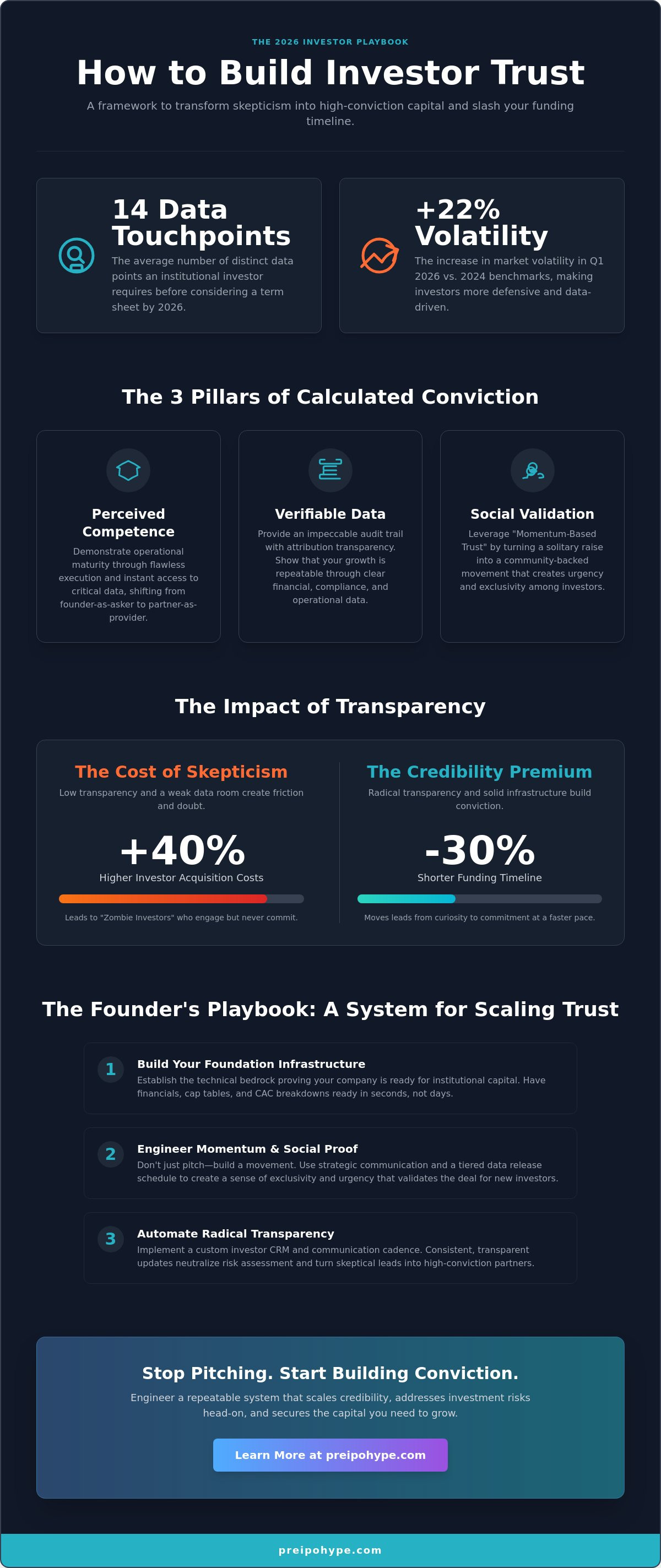
Capital isn't scarce in the current market; certainty is. In the high-stakes world of late-stage growth, your valuation isn't just a multiple of EBITDA. It's a measure of your credibility. Understanding what is trust in a financial context requires looking past personality and into the mechanics of deal-making. Trust is the precise intersection of perceived competence, verifiable data, and social validation. Without these three pillars, your pitch is just noise in a crowded inbox.
In 2026, the "Trust Gap" has widened significantly. Market volatility in the first quarter of 2026 increased by 22% compared to 2024 benchmarks, making both institutional and retail investors more defensive. Elite founders don't aim for "Blind Trust," which is a high-risk gamble based on gut feelings. They build "Calculated Conviction." This is the goal of every successful raise. It's a state where an investor's internal risk assessment is neutralized by your external proof. Mastering how to build investor trust through this conviction reduces the cost of capital and slashes your funding timeline by up to 30%.
To better understand this concept, watch this helpful video:
The 2026 Investor Psychology
The era of "growth at all costs" ended with the 2023 market correction. Today, investors demand sustainable, transparent momentum. Institutional players look for secondary liquidity options and valuation benchmarks that hold up under rigorous stress tests. Meanwhile, retail investors have become sophisticated "Informed Insiders." They use digital tools to vet your cap table and executive history before the first call. Bridging this gap requires a narrative that feels both elite and democratizing. You aren't just asking for money; you're offering a seat at a table that was previously locked away. Learning how to build investor trust in this environment means proving you can handle the "hype" without losing sight of the fundamentals.
The Cost of Skepticism
Skepticism is a silent killer in your investor CRM. It creates "zombie leads," which are potential investors who engage with your content but never sign a subscription agreement. Data from 2025 private placement reports shows that companies with low transparency scores face 40% higher investor acquisition costs. When you fail to provide a clear audit trail, you're essentially paying a tax on your own capital raise. The Credibility Premium is the valuation boost companies receive when their data is beyond reproach. By eliminating doubt early in the video funnel, you move leads from curiosity to commitment at a much faster pace.
The Architecture of Credibility: Financials, Compliance, and Data
Trust isn't built on a stage, it's built in the spreadsheets. Sophisticated investors in 2026 aren't just buying a vision; they're buying into your operational maturity. The most effective way to demonstrate this is through your foundation infrastructure, the technical bedrock that proves your company is ready for institutional-grade capital. When a lead investor asks for a specific cap table detail or a customer acquisition cost (CAC) breakdown, having that data ready in seconds changes the power dynamic of the room. It moves you from a founder seeking a favor to a partner offering an opportunity.
Understanding how to build investor trust requires a fundamental shift in perspective. You aren't just providing information; you're reducing the perceived risk of the "unknown." This is where "attribution transparency" becomes your greatest asset. By showing exactly where your growth originates, whether it's a 22% month-over-month increase in organic search or a specific high-performing referral channel, you prove that your success is repeatable. This level of detail aligns with the science of trust, which suggests that consistent, transparent behavior is the fastest way to build neurological safety in high-stakes financial partnerships.
Financial Hygiene and Modeling
Clean financials are the minimum entry requirement for elite raises. Third-party audits provide a level of validation that internal spreadsheets simply cannot match, especially when targeting 2026 capital targets. To bridge the gap between your current state and your future potential, utilize a robust valuation calculator to provide realistic, data-backed benchmarks. Your CFO must act as the voice of reason during the "Hype Cycle," ensuring that while the market is excited about your potential, your financial modeling remains defensible and grounded in current market realities.
Regulatory Compliance as a Trust Signal
Frame Reg CF and Reg A+ regulations as standardized trust frameworks rather than bureaucratic hurdles. In a market where nearly 80% of due diligence failures stem from poor documentation or opaque structures, SEC-compliant disclosures act as a powerful signal of legitimacy. These aren't just filings; they're positive PR beats. Announcing the completion of a compliance milestone can build more momentum than a generic product update. It tells the market you're ready for the scrutiny of the public eye. If you want to see how these pieces fit into your specific raise, you might want to book a strategy session to map out your compliance timeline and ensure your data room is bulletproof.
Leveraging Social Proof: How Momentum Validates the Deal
Trust isn't built in a vacuum; it's built in the crowd. In the high-stakes environment of 2026 capital raises, the "Solitary Raise" is a relic of a slower era. Today, momentum-based trust is the primary currency of the private markets. Investors rarely want to be the first person through the door, but they are terrified of being the last one left out. If you're wondering how to build investor trust, you start by demonstrating that the market has already moved in your favor. A community-backed model creates a psychological safety net that a lonely pitch deck simply cannot replicate.
Establishing this momentum requires a strategy of perceived ubiquity. By utilizing omnichannel outreach, your brand appears everywhere your target investors look. This constant presence transforms a "startup" into an "industry fixture" in a matter of weeks. However, you must navigate the Hype Paradox. While controlled excitement validates a deal, "over-hype" without substance destroys credibility. Real trust is built when the noise is backed by structural integrity. For example, referencing established frameworks for investor protection helps ground your high-growth narrative in a reality that seasoned capital allocators respect.
The Power of the Crowd
A high volume of smaller investors acts as a decentralized due diligence engine. When 500 individual backers commit to a round, it signals to the $1 million "whale" that the business model has survived public scrutiny. This social proof is a critical component of how to build investor trust at scale. You should leverage investor spotlights and testimonials within your marketing collateral to humanize the capital stack. Furthermore, placing your brand alongside recognized industry leaders through newsletter exposure provides a halo effect. It suggests that if the experts are talking about you, the opportunity is legitimate.
Building the "Insider" Circle
The first 20% of any capital raise is the most difficult to secure. Savvy founders use early-bird perks to seed initial social proof, creating an immediate "floor" of capital that encourages others to follow. Highlighting a lead investor is essential here; their reputation anchors the credibility of the entire round. To drive action, employ "limited access" tiers. In a 2025 analysis of private offerings, tranches with restricted entry saw 40% faster commitment rates than open-ended rounds. This strategy shifts the investor's mindset from skeptical evaluation to the fear of missing out on an exclusive insider opportunity. It turns the act of investing into a privilege rather than a pitch.
The Founder’s Playbook for Radical Transparency
Transparency isn't just a buzzword. In the high-velocity capital markets of 2026, it's the only currency that matters. Investors are weary of overly polished pitch decks and curated data rooms. They want the raw truth. To understand how to build investor trust, you've got to move beyond the pitch and into a state of continuous disclosure. This creates the "insider" feeling that elite LPs crave.
Execution requires a tactical system. Start by deploying a custom investor CRM to manage your communication cadence. This ensures no lead goes cold and every milestone is broadcasted to the right desks. Next, tackle the elephant in the room. If a competitor just raised a massive Series B or your Q3 churn hit 12%, say it first. Controlling the narrative on your setbacks prevents investors from discovering them during due diligence, which is where 85% of deals die.
- Grant direct access: Host monthly webinars where investors can grill your CTO or Head of Product.
- Leverage engagement data: Use your CRM to see which investors are clicking on your financial models. Send a personalized follow-up addressing those specific concerns.
- Standardize the math: Stick to fixed KPIs like Net Revenue Retention (NRR) and LTV/CAC ratios so progress is undeniable.
The Art of the Investor Update
Your monthly update shouldn't be a wall of text. Use a 70/30 split: 70% hard metrics and 30% strategic vision. Admitting to a pivot isn't a sign of weakness. It's proof of agility. When you explain why a specific milestone was missed and how the team corrected course, you demonstrate institutional maturity. Remember the over-communication rule. During a raise, successful founders update their pipeline at least once every 14 days. It's impossible to be too visible when you're hunting for a lead investor.
Humanizing the C-Suite
Investors fund people, not just spreadsheets. High-performing founders use video funnels to create a sense of proximity. Seeing a CEO speak directly to the camera about the company's "why" builds a psychological bridge that a PDF cannot match. This vulnerability, when paired with a clear 4-year vesting schedule and significant "skin in the game," signals that you're committed for the long haul. Team stability is a primary metric. If your core engineering team has been together for 3 or more years, highlight it. It's a massive trust signal in a volatile market.
Ready to turn your transparency into a competitive advantage? Build your founder video funnel today and start closing the trust gap.
Scaling Trust with the Pre-IPO Hype System
Trust isn't a feeling. It's an architecture. At Pre-IPO Hype, we function as the engineering firm that constructs your Infrastructure of Trust. Most founders lose momentum because they can't scale their personal touch. They hit a wall at 50 leads and the narrative begins to fray. We remove that ceiling. By implementing a custom investor CRM, we automate the radical transparency that 2026 investors demand. This system is the most efficient way to solve the puzzle of how to build investor trust at scale without burning out the executive team.
Founders often struggle to maintain the consistent communication that professional cohorts require. Our platform serves as the definitive bridge between the traditional secrecy of private markets and the rigorous transparency of the public markets. We deploy 60-day attribution tracking to strip away the guesswork. This data provides hard proof of marketing ROI and real-time investor interest. It shows exactly which narratives are driving capital. It transforms a "pitch" into a data-backed financial event.
Automation Meets Personalization
Lead scoring is your primary filter. It identifies the 15% of your list ready to commit six-figure checks today. Automated omnichannel sequences keep the pulse of your raise alive across every platform, ensuring your brand stays top-of-mind. You focus your personal energy on high-conviction closings while the system maintains the momentum. It's time to stop guessing which signals are working. You should schedule a strategy session to audit your current investor trust signals and identify the leaks in your funnel.
The Future of Fundraising
The 2026 capital markets will reward those who embrace "Trust-as-a-Service" as a core standard. AI and real-time data integration are making the old "black box" raise obsolete. Investors now expect a steady stream of verifiable milestones and instant access to performance metrics. This shift is democratizing elite investment opportunities. By choosing radical transparency, you aren't just raising money; you're joining a movement of forward-thinking founders. How to build investor trust will no longer be a question of personality, but a result of your technological ecosystem. The final frontier of wealth creation is open for those who act decisively.
Secure the Capital Your Vision Demands
Raising capital in 2026 isn't about chasing checks; it's about engineering conviction. You've seen that the architecture of credibility relies on radical transparency and a data-driven compliance framework. By leveraging social proof through the Pre-IPO Hype system, you transform passive interest into a competitive feeding frenzy. Understanding how to build investor trust requires more than just a pitch deck. It demands a sophisticated infrastructure that tracks every touchpoint and validates your deal's momentum in real time.
PreipoHype has already facilitated over $100M in funding for high-growth ventures. We provide the tools elite founders need to scale, including a custom CRM built specifically for SEC-regulated raises and our proprietary 60-day attribution tracking system. This isn't just theory. It's a proven roadmap to the ground floor of the next unicorn. The window for exclusive access is narrow, but the rewards for those who act decisively are limitless.
Master your investor acquisition strategy; schedule your 30-minute consult now
The private market remains the final frontier for significant wealth creation, and your next liquidity event starts with the right foundation today.
Frequently Asked Questions
What is the fastest way to build trust with a new investor?
Radical transparency through a pre-vetted data room is the fastest way to establish credibility. By providing 24/7 access to your cap table and historical burn rates before they even ask, you signal that you have nothing to hide. In the 2024 VC landscape, 82% of lead investors cited unprompted disclosure as a primary trust signal. This proactive approach transforms a cold pitch into an insider partnership immediately.
How much financial data should I disclose during a Reg CF raise?
You must meet the SEC Form C requirements, which generally include two years of reviewed or audited financial statements depending on your raise size. However, to truly master how to build investor trust, you should disclose monthly trailing 12-month revenue and CAC-to-LTV ratios. As of 2025, Reg CF campaigns that share monthly growth updates see 45% higher participation rates than those providing only the legal minimums.
Does having a large number of retail investors hurt my trust with VCs?
Retail investors only hurt your standing if your cap table is messy. Using a Crowdfunding SPV keeps 1,000 backers as a single entry, which VCs actually prefer for proving market validation. In a 2023 study of Series A rounds, 60% of companies had previous retail backing. It proves you can build a movement, provided you use professional management tools to keep the legal structure lean and institutional.
What should I do if my company misses a milestone during the funding round?
Immediate disclosure is your only option. Report the deviation within 48 hours and present a data-backed pivot plan. Investors expect 30% of early-stage milestones to shift, but they won't forgive a cover-up. Providing a revised 90-day roadmap with specific KPIs shows you are a disciplined operator. This level of honesty often strengthens the relationship more than a perfect, yet suspicious, track record could.
How do I build trust if I am a first-time founder with no prior exits?
Surround yourself with three to five industry veterans who have successfully exited. When you lack a personal exit history, your advisors' reputations act as your initial collateral. Use institutional-grade reporting tools to show you handle capital with the precision of a veteran. Data from 2024 shows that first-time founders with Tier 1 advisors raise 2.5 times more capital than those flying solo.
Is "hype" dangerous for building long-term investor relationships?
Hype is only dangerous when it's hollow. In the private markets, momentum is a legitimate financial indicator that drives valuation premiums. You need to anchor your excitement in hard signals like 15% month-over-month growth or signed Letters of Intent. If the hype outpaces the unit economics, you risk a down-round. Use excitement to open the door, then use data to lock it in.
How can I use my CRM to improve investor confidence?
Your CRM should track investor engagement to ensure no lead goes cold for more than 14 days. Consistent, personalized updates regarding your how to build investor trust strategy show that you are organized and attentive. Founders who use CRM automation to send bi-weekly progress reports see a 35% increase in follow-on investment. It turns a chaotic fundraise into a predictable, professional machine that exudes competence.
Disclaimer
Educational only. Not investment, tax, or legal advice. Pre-IPO Hype is investor relations infrastructure for Regulation CF and Regulation A+ raises. We are not a broker-dealer, funding portal, or investment adviser, and we do not offer or sell securities or make investment recommendations. Any securities offering is made only by the issuer, through its own offering documents and, where required, a registered intermediary.


