
How to Convince Your Board to Crowdfund: The Strategic Founder’s Playbook
What if your most skeptical board member discovered that a retail investor army isn't a liability, but your most potent competitive advantage? If you're currently strategizing how to convince my board to crowdfund, you're likely facing deep-seated fears regarding "low signal" stigmas or the perceived nightmare of a messy cap table. It's a valid concern in an era where institutional gatekeepers once held all the keys. However, the landscape has shifted. With the SEC's 2026 updates and the Reg CF limit at $5 million, equity crowdfunding is no longer a fallback. It's a strategic weapon for elite founders who refuse to be sidelined.
You've likely felt the tension between wanting community-driven capital and fearing the compliance burden of thousands of shareholders. This guide provides the high-stakes narrative required to transform board anxiety into a mandate for a record-breaking raise. You'll master a framework that proves crowdfunding builds brand equity while learning how to manage retail investors with institutional precision. We're diving into the Foundation Infrastructure needed to de-risk your raise and turn participation into a sophisticated marketing engine that weaponizes your customer base.
Key Takeaways
- Reframe equity crowdfunding as a high-velocity capital vehicle that aligns retail synergy with institutional standards.
- Master the strategic narrative on how to convince my board to crowdfund by leveraging data-driven market validation and a proven technical stack.
- Neutralize fiduciary anxiety using Special Purpose Vehicles (SPVs) to keep your cap table clean and your governance undisputed.
- Weaponize your investor base into a marketing engine that builds long-term brand equity and slashes Customer Acquisition Costs.
- Deploy a Custom Investor CRM to automate lead scoring and attribution, ensuring institutional-grade management of your retail investor army.
Reframing the Narrative: Why Crowdfunding is a Strategic Signal, Not a Last Resort
The board room often treats crowdfunding as a dirty word. They envision a desperate founder begging for $50 for a prototype that doesn't exist. This misconception is the primary hurdle when strategizing how to convince my board to crowdfund. In 2026, equity crowdfunding has evolved into a regulated, high-tech vehicle where institutional sophistication meets retail synergy. It isn't a fallback for companies that can't get VC attention. It's a strategic choice for leaders who want to weaponize their cap table.
To build a winning case, you must first clarify what is crowdfunding in the context of Regulation Crowdfunding (Reg CF) and Regulation A+. Unlike donation-based models where backers receive a t-shirt or a thank-you note, equity crowdfunding involves the issuance of actual securities. This creates a powerful "Customer-to-Owner" pipeline. Industry data suggests that these investor-owners are significantly more valuable than standard customers. They often provide three times the lifetime value through increased loyalty and organic referrals.
To better understand this concept, watch this helpful video:
The Shift from Kickstarter to Reg A+
The era of amateur crowdfunding is over. SEC updates in February 2026 have streamlined compliance and clarified disclosure requirements, making it a viable pre-IPO warm-up for Tier 1 companies. This professionalization allows you to frame the raise not as a plea for help, but as a calculated "Hype Cycle" that serves as a measurable metric of market demand. By the time you reach the public markets, you already have a battle-tested army of advocates rather than a single, silent VC check.
Countering the 'Low Signal' Myth
The most dangerous board objection is that retail capital is a "low signal" event. In reality, a successful Reg CF raise provides undeniable proof of concept for future Series B and C rounds. Venture capitalists are no longer just leading rounds. They are increasingly following the momentum generated by high-velocity crowdfunding campaigns. When you present this to the board, frame the raise as an omnichannel marketing event that happens to generate capital. It's a dual-purpose strategy that lowers your Customer Acquisition Cost (CAC) while simultaneously securing the Foundation Infrastructure needed for long-term growth. This isn't just about the money. It's about building a high-velocity network of 1,000+ brand advocates who have a vested interest in your eventual realization event.
The Strategic Advantage: Building a Marketing Engine Through Capital
Traditional fundraising is often a silent, sterile exchange of equity for capital. Strategic crowdfunding is different. It's an explosive marketing event that happens to fund your balance sheet. When considering how to convince my board to crowdfund, the most persuasive argument you can make is the creation of a permanent marketing engine. By deploying Omnichannel Outreach, you don't just find investors; you create omnipresence. Your brand begins to occupy the digital real estate where high-growth opportunities are discussed, making your company appear as the inevitable leader in its sector.
This isn't just about visibility. It's about efficiency. A successful raise uses investor data to lower Customer Acquisition Cost (CAC) across your entire operation. Every dollar spent on investor acquisition doubles as a brand awareness play. Unlike a venture check that sits quietly in a bank account, a retail raise turns thousands of strangers into a community of owners who are psychologically incentivized to promote your product. This creates a competitive moat through community ownership that no amount of venture capital can buy.
Omnichannel Mastery and Investor Acquisition
Success in 2026 requires more than a simple listing on a portal. It demands a sophisticated investor acquisition platform that mirrors high-end e-commerce funnels. We use lead scoring to identify high-net-worth participants, ensuring your team focuses on high-signal opportunities. This level of precision is exactly what boards need to see to feel confident that the raise is a controlled, professional execution rather than a scattershot attempt at funding.
Data-Driven Momentum Tracking
Boards crave predictability and performance metrics. By utilizing Analytics and Performance Tracking, you can show 60-day attribution for every investor lead. We leverage newsletter exposure through channels like Invst Guru to reach seasoned professionals who are ready to act decisively. This data-driven approach proves the raise is a repeatable process. If you want to see how these metrics look in a live environment, you can review our recent performance benchmarks during a high-level strategy session.
Does your board understand the power of a "Valuation Anchor"? A successful crowdfunding campaign acts as a price floor. It establishes a public, market-validated price for your shares that private investors cannot ignore. In future private rounds, this public validation prevents predatory down-rounds and gives your board the fiduciary confidence they demand. You aren't just raising money; you're setting the terms for every future negotiation.
Addressing the Board's Fiduciary Fears: De-risking the Raise
Board members often suffer from "Cap Table Anxiety." Their primary fiduciary concern isn't usually the capital itself, but the perceived chaos of managing thousands of minor shareholders. When you're mapping out how to convince my board to crowdfund, your technical defense is just as vital as your growth narrative. You must demonstrate that equity crowdfunding in 2026 is a controlled, high-precision operation that protects the company's governance and future exit potential.
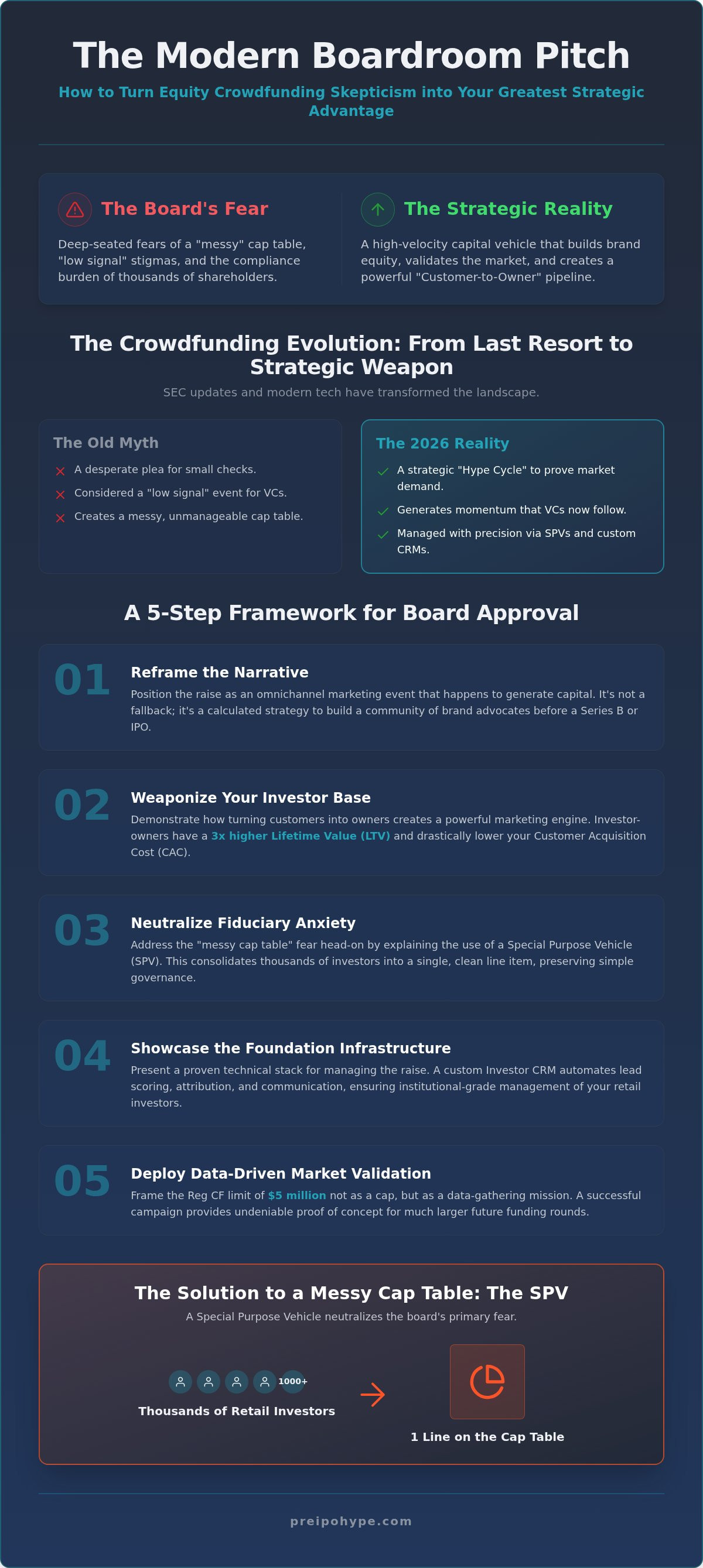
The most effective way to neutralize these fears is by implementing a Special Purpose Vehicle (SPV). Instead of 5,000 individual names appearing on your cap table, the SPV bundles these participants into a single legal entity. To the board and future Series B investors, this appears as one line item. Furthermore, governance remains entirely in your hands. Most equity crowdfunding structures utilize non-voting shares or proxy voting, ensuring that retail investors have zero impact on board seats or operational control. You gain the capital and the community without sacrificing a shred of authority.
Compliance shouldn't be a manual burden. We utilize Foundation Infrastructure to automate the legal heavy lifting, from SEC filings to ongoing disclosure requirements. While boards may fear the transparency required by Reg CF or Reg A+, you should frame this as a "trust asset." The rigorous reporting standards of a successful raise serve as a professional rehearsal for an eventual IPO. It proves to the market that your company is already operating with the transparency and discipline of a public-ready entity.
Cap Table Hygiene and SPVs
Modern transfer agents have revolutionized investor management. They automate communications, tax documentation, and dividend distributions, removing the operational load from your internal team. In your board review, compare the "Direct Ownership" model with the "Bundled SPV" model. The latter ensures that your legal structure remains lean and attractive to institutional gatekeepers who might lead your next round. It turns a potential liability into a streamlined asset.
Cost vs. Capital: The ROI Calculation
Don't let the board get stuck on setup fees. You need to present the ROI calculation that accounts for the long-term value of a decentralized investor base. Every dollar spent on the marketing of the raise is actually brand-building spend in disguise. You're acquiring owners who act as permanent, unpaid brand ambassadors. To execute this with elite precision, you need a robust foundation infrastructure that scales with your ambition. This technical bedrock ensures that the cost of capital is offset by the massive surge in brand equity and market validation.
The Boardroom Pitch: A 5-Step Framework for Approval
The board doesn't want a theory. They want a roadmap. When you're finalizing how to convince my board to crowdfund, your presentation must transition from "why" to "how." This is the moment to replace conceptual benefits with a tactical execution plan that leaves no room for hesitation. By following this 5-step framework, you position the raise as a low-risk, high-velocity growth engine.
- Step 1: Present the Market Validation. Show the data. With the global crowdfunding market projected to reach $23.82 billion in 2026, and equity crowdfunding maintaining a robust 20% success rate, the numbers support your ambition.
- Step 2: Detail the Technical Stack. Boards fear operational overwhelm. Explain how your Foundation Infrastructure and Custom Investor CRM will automate lead scoring and attribution without taxing internal resources.
- Step 3: Show the Omnichannel Roadmap. Outline the Newsletter Exposure (Invst Guru) and digital marketing campaigns that will create industry omnipresence.
- Step 4: Address the Exit Strategy. Explain how a Reg CF or Reg A+ raise acts as an IPO warm-up. It builds the public profile and shareholder base required for a high-value realization event.
- Step 5: Propose a Pilot Phase. Use the "Test the Waters" provision. This allows the company to gauge investor interest before filing formal paperwork, effectively de-risking the entire venture.
Visualizing the Momentum
Numbers on a slide are one thing. Live momentum is another. Use lead scoring dashboards to show the board "pre-commit" interest from your existing community. This visualization aligns the board's vision with the public's excitement. When they ask the inevitable "Why now?" question, your answer is simple. Market demand is measurable, the infrastructure is ready, and the window for early-mover advantage is closing. If you're ready to present a bulletproof case, book a strategic boardroom audit today to refine your narrative.
Leveraging External Authority
Sometimes the founder's voice needs an institutional echo. This is when you bring in consulting and advisory services to validate the strategy. Conservative board members often find comfort in external track records. Mentioning that Pre-IPO Hype has facilitated over $100 million in funding and managed 230+ successful company raises provides the social proof necessary to push the mandate through. You aren't asking them to experiment. You're asking them to follow a proven, elite blueprint for capital acquisition.
Execution: Scaling the Raise with a Custom Investor CRM
The final pillar of a successful boardroom strategy isn't just about the "why" or the "how much." It's about the "how." Most boards are rightfully wary of the operational burden that comes with managing thousands of retail participants. When you're finalizing the details of how to convince my board to crowdfund, the technical execution plan is your closing argument. You must prove that you have the infrastructure to scale without a linear increase in overhead or founder burnout.
A standard sales CRM fails in this environment. Sales tools are built for linear customer journeys, not the complex, multi-touch attribution required for securities offerings. You need a custom investor CRM designed specifically for the high-stakes world of equity crowdfunding. This proprietary technology allows you to score leads and track 60-day attribution with surgical precision. It turns a chaotic crowd into a structured, high-conversion funnel. By positioning Pre-IPO Hype as your technical partner, you're bringing in a team that has facilitated over $100 million in funding and managed 230+ successful company raises.
Automation is the secret sauce that de-risks the raise for the board. By automating the nurture cycle, you can turn curiosity into capital while you sleep. The system handles the heavy lifting of investor relations, from initial interest to the final signature. This ensures that your team stays focused on high-level strategy and growth, rather than getting bogged down in the minutiae of individual retail inquiries. It's the difference between a frantic scramble and a calculated, elite execution.
The Custom Investor CRM Advantage
Visibility is everything. Our system tracks engagement across email, social, and SMS to provide a unified investor view. This allows you to identify "Whales" within your retail pool. While crowdfunding is democratized, not all investors are equal. Lead scoring identifies the high-net-worth participants who can anchor your round, allowing you to prioritize high-signal outreach. This level of technical sophistication is often the final piece of evidence needed to secure a board mandate.
Next Steps: From Approval to Launch
The first 30 days are critical. This discovery and setup phase establishes the Foundation Infrastructure required to sustain hype throughout the entire raise. You'll move from boardroom approval to a live, omnichannel marketing engine that creates industry omnipresence. The momentum you build here doesn't just fund your current round; it sets the stage for every future milestone. If you're ready to transform your board’s skepticism into a mandate for growth, book a strategy session with Jeff 'Fuzzy' Wenzel today to map out your record-breaking raise.
Seizing the Market Mandate
You now possess the tactical narrative required to pivot your board from hesitation to high-velocity action. By reframing equity crowdfunding as a strategic marketing engine and neutralizing fiduciary fears through SPVs and automated infrastructure, you've moved beyond the "last resort" stigma. The path to a record-breaking raise is paved with technical precision, not guesswork. Mastering the nuances of how to convince my board to crowdfund is ultimately about presenting a vision where retail capital and institutional discipline coexist to build a dominant market moat.
Execution is the final differentiator. We've facilitated over $100 million in funding across 230+ successful company raises using our proprietary lead scoring CRM technology. This isn't an experiment; it's a proven blueprint for market dominance that turns community ownership into a permanent competitive advantage. Your board needs to see that the operational risk has been engineered out of the equation. Secure your board's buy-in with a custom fundraising roadmap from Pre-IPO Hype by scheduling your strategy session below.
The window for elite early-stage opportunity is open for those who act decisively. It is time to lead your board into the future of capital.
Frequently Asked Questions
Will equity crowdfunding mess up our cap table for future VC rounds?
No, equity crowdfunding does not mess up your cap table when structured correctly through a Special Purpose Vehicle (SPV). This legal structure bundles thousands of retail investors into a single line item, appearing to future VCs as one entity. It maintains the cleanliness required for Series B or C rounds while providing the capital and community you need now. Most institutional investors in 2026 recognize SPVs as the standard for managing a decentralized shareholder base.
How much does it actually cost to market a Reg CF or Reg A+ campaign?
Marketing costs for a Reg CF or Reg A+ campaign vary based on your funding target and the complexity of your industry. You should budget for digital marketing, content creation, and technical infrastructure to ensure high-velocity momentum. This spend is often reclaimed through lower Customer Acquisition Costs (CAC) because your investors become your most loyal brand advocates. It's a dual-purpose investment in both capital and brand equity.
Does the board lose any control or voting rights to retail investors?
The board retains full control and voting rights because most equity raises utilize non-voting shares or proxy voting. Retail investors participate in the financial upside without having a seat at the table or a say in daily operations. This is a critical point when strategizing how to convince my board to crowdfund, as it eliminates the fear of outside interference in your corporate governance or long-term strategy.
How do we handle the ongoing communication with thousands of small investors?
Ongoing investor relations are managed through automated Foundation Infrastructure and a Custom Investor CRM. These tools handle lead scoring, updates, and compliance reporting without taxing your internal team. You provide a unified, professional experience for thousands of owners while maintaining the same operational footprint as a company with only a few institutional investors. Automation ensures your founder's time remains focused on scaling the business.
What is the difference between Reg CF and Reg A+ for a mid-stage startup?
Regulation Crowdfunding (Reg CF) is capped at $5 million in a 12-month period and involves lower legal overhead and faster filing. Regulation A+ is designed for larger raises, offering a mini-IPO structure that allows for higher capital intake and more flexible trading. Mid-stage startups often use Reg CF to validate market demand and build a "valuation anchor" before scaling into a full Reg A+ offering later.
How long does the entire process take from board approval to money in the bank?
The timeline from board approval to a successful close typically spans three to six months. This includes a 30-day discovery and setup phase, followed by filing with the SEC and a 60 to 90 day active marketing period. Using "Test the Waters" provisions can significantly de-risk this timeline by gauging investor interest before you commit to the formal filing process.
Can we crowdfund if we already have institutional investors on the board?
Yes, you can crowdfund with institutional investors on your board, and many sophisticated VCs actually encourage it. Crowdfunding provides market validation and a public price floor that protects existing investors from predatory down-rounds. It proves there is broad market demand for your shares, which often increases the perceived value and liquidity of the institutional stake during future realization events.
What happens if we don't reach our minimum funding goal?
If you don't reach your minimum funding goal, all funds are returned to the investors by the funding portal. This is why a strategic pre-launch and a "Test the Waters" phase are essential components of how to convince my board to crowdfund. You ensure the demand is there before you ever flip the switch on a formal, public offering, protecting the company's reputation and resources.
Disclaimer
Educational only. Not investment, tax, or legal advice. Pre-IPO Hype is investor relations infrastructure for Regulation CF and Regulation A+ raises. We are not a broker-dealer, funding portal, or investment adviser, and we do not offer or sell securities or make investment recommendations. Any securities offering is made only by the issuer, through its own offering documents and, where required, a registered intermediary.


