
How to Create a Fundraising Marketing Plan for Equity Crowdfunding in 2026
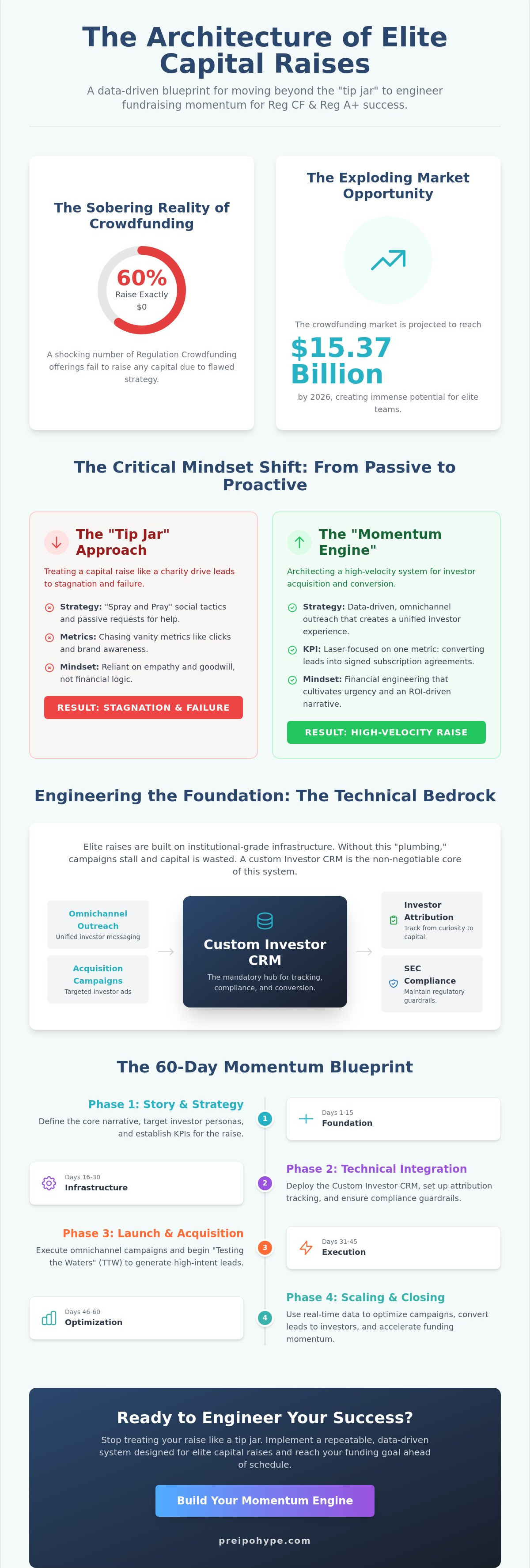
Did you know that 60% of all Regulation Crowdfunding offerings since the inception of the JOBS Act raised exactly zero dollars? It's a sobering reality in a market projected to reach $15.37 billion in 2026. Most founders treat their raise like a tip jar, but elite teams understand that learning how to create a fundraising marketing plan is actually an exercise in financial engineering. You aren't just asking for capital; you're orchestrating a high-velocity momentum play that turns passive observers into committed stakeholders. This is your gateway to elite investment circles that were previously inaccessible.
It's exhausting to watch your dashboard stagnate while you struggle to track investor attribution across a 60-day cycle or worry about compliance with the SEC's February 2026 C&DI clarifications. You need a repeatable system that provides clear visibility into the investor journey. This guide will help you master the high-stakes architecture of investor acquisition with a data-driven plan designed for Reg CF and Reg A+ success. We'll break down the specific foundation infrastructure and performance tracking required to reach your funding goal ahead of schedule.
Key Takeaways
- Learn how to create a fundraising marketing plan that functions as a high-velocity momentum engine rather than a passive request for capital.
- Discover why institutional-grade foundation infrastructure and a custom investor CRM are mandatory for tracking attribution and maintaining SEC compliance.
- Shift from "spray and pray" social tactics to an omnichannel outreach strategy that creates a unified, high-touch experience for potential investors.
- Master a precise 60-day execution blueprint that moves your raise from initial story framework to technical integration and rapid scaling.
- Understand the strategic advantage of using data-driven systems to convert retail curiosity into committed investment capital through specialized acquisition campaigns.
Beyond the Donation: Defining the Investor Fundraising Marketing Plan
Most founders confuse a capital raise with a charity drive. If you're looking for donors, go to a gala. If you're looking to scale a unicorn, you need to master how to create a fundraising marketing plan that targets high-intent investors. This isn't a "please help us" campaign. It is a strategic roadmap for investor acquisition. You are architecting a transaction where the product is equity and the buyer is an investor looking for a specific ROI. To understand the mechanics of this market, it helps to first define What is Equity Crowdfunding? and how it differs from traditional finance.
To better understand this concept, watch this helpful video:
The ROI-Driven Mindset of the 2026 Investor
Regulatory Guardrails: Reg CF, Reg A+, and Marketing Compliance
Engineering the Foundation: Data, Compliance, and the Investor CRM
Why do most equity crowdfunding campaigns hit a structural ceiling at $100,000? It isn't usually a lack of ambition. It's a lack of plumbing. When you are mapping out how to create a fundraising marketing plan, your first priority isn't the ad copy. It is the foundation infrastructure. This technical bedrock ensures that every dollar spent on acquisition is tracked, measured, and optimized. Without this, you're flying blind in a high-stakes financial storm.
A standard email tool won't cut it here. A Custom Investor CRM is mandatory for any serious raise. This system allows you to manage the complex interplay of retail interest and institutional commitment. You need to see exactly when a prospect moves from "curious browser" to "committed lead." This level of visibility is what separates the elite 5% of successful raises from the thousands that fail to gain traction. If you want to see how this looks in practice, you can watch our technical breakdown here.
Tracking Curiosities to Capital
The path to a capital commitment is rarely linear. Investors don't just click an ad and drop $5,000. It is a multi-touch reality that often spans weeks. You must use server-side tagging and pixel tracking to maintain data integrity across a 60-day attribution window. This window is vital because it reveals the true cost of acquisition. Lead scoring in a capital raise is the quantitative ranking of prospective investors based on their behavioral engagement with your campaign assets. By identifying high-intent leads early, you can focus your omnichannel outreach where it actually converts.
Building Your Investor War Room
Your raise needs a central command center. This "War Room" relies on real-time analytics to adjust ad spend on the fly. If one channel is driving traffic but zero signed subscription agreements, you need to know immediately. Integrating your CRM with your technical infrastructure allows for seamless scaling as momentum builds. It also ensures you stay within the SEC rules for equity crowdfunding by keeping your communications organized and auditable.
Data ownership is your most valuable asset once the raise concludes. You aren't just building a list; you're building a proprietary database of backers for this round and every future milestone. If you're ready to engineer this level of precision into your next round, you might want to book a technical strategy session to review your current stack.
Omnichannel Mastery vs. Single-Channel Dependence
True digital marketing and advertising in the private sector requires a "Surround Sound" effect. Your target audience should encounter your opportunity across their favorite news feeds, in their professional inboxes, and through high-authority financial analysis. This creates an aura of ubiquity and institutional validation. By layering multiple equity crowdfunding marketing strategies, you ensure that your startup isn't just another ad. It becomes a movement that feels impossible to ignore.
The Power of Retargeting and Sequential Messaging
Investors rarely commit on the first encounter. You need to move them from initial awareness to deep due diligence through sequential messaging. If a prospect visits your offering page but doesn't sign the subscription agreement, your retargeting ads should pivot from "opportunity" to "education." Use targeted content to address common risk objections or highlight your sector's growth metrics. A 14-day automated email sequence can warm up these cold leads, providing the data they need to feel confident in their capital commitment. This methodical approach ensures no high-intent lead is left behind.
Leveraging High-Authority Newsletters
The 60-Day Momentum Blueprint: Executing the Raise
Investor momentum isn't a happy accident; it is an engineered sequence. While generic marketing guides suggest starting your promotion a few weeks before an event, the reality of the private capital markets is far more demanding. With equity crowdfunding success rates hovering around 20% as of early 2026, your timeline must be a calculated acceleration. Understanding how to create a fundraising marketing plan means mastering the "Investor Hype Cycle" across a strict 60-day window. This blueprint moves your raise from a quiet launch to a high-velocity capital event.
- Step 1: The Discovery & Story Framework (Days 1-15): Identify your core "movement" and the specific investment sector you will dominate.
- Step 2: Technical Setup & CRM Integration (Days 16-30): Deploy your foundation infrastructure to ensure every lead is captured and scored.
- Step 3: The "Pre-Hype" & TTW Phase (Days 31-45): Utilize the SEC "Testing the Waters" period to build a massive, high-intent waitlist before the first dollar is even committed.
- Step 4: The Live Launch & Momentum Surge (Days 46-60): Convert your waitlist in a 48-hour surge to trigger platform algorithms and social proof.
- Step 5: The "Closing" Scarcity Play (Final 14 Days): Deploy aggressive retargeting to capture the procrastinators before the round officially sunsets.
Phase 1: Crafting the Elite Opportunity Narrative
Stop talking about product features. Sophisticated investors care about the future valuation and the eventual realization event. Your narrative must position the company as an elite opportunity that was previously restricted to institutional insiders. The most effective vehicle for this message is a high-production video funnel. This is the highest-leverage asset in your entire strategy. It does the heavy lifting of due diligence in under three minutes. You can see how we architect these assets in the Pre-IPO Hype video funnel strategy.
Phase 2: Mastering the Mid-Campaign Slump
Every raise hits the "Valley of Death." This is the mid-campaign slump where the initial excitement fades and the daily capital inflow slows. Success depends on your ability to refresh ad creative and maintain a low Cost Per Lead (CPL) through rigorous A/B testing. Use this period to highlight "Social Proof." Share your growing investor count and remaining percentage of the round to trigger a sense of FOMO. This keeps the narrative moving forward toward the next milestone. If your current trajectory is stalling, you should ask our CEO for a direct audit of your momentum metrics.
Scaling Your Raise with Pre-IPO Hype’s Custom Frameworks
Pre-IPO Hype has engineered the frameworks that move startups from retail curiosity to institutional-grade capital. Our data-driven systems have been trusted by over 230 companies to raise more than $100 million in aggregate. This isn't a theory; it's a repeatable system for investor acquisition. By utilizing specialized Reg CF marketing services, you gain access to the same high-velocity momentum plays used by the top 5% of successful raises. We provide the keys to a gated financial world that was previously inaccessible to the broader market.
Your Investor Acquisition Engine
Success in 2026 requires more than a simple pitch deck. You need a Custom Investor CRM and foundation infrastructure that tracks every engagement with surgical precision. Our omnichannel mastery promise ensures your opportunity reaches the right investors at the exact moment they're ready to act. We eliminate the guesswork by providing clear visibility into the investor journey, allowing you to scale what works and cut what doesn't. If you're ready to stop guessing and start scaling, you should schedule a 30-minute strategy session with our team today.
Decisive Action: The Founder’s Next Step
Timing is everything in a capital raise. Market momentum is a perishable asset, and the window for the 2026 funding cycle is already moving. Founders who act decisively are the ones who secure their future valuations and reach their funding goals ahead of schedule. Our "Ask the CEO" philosophy gives you direct access to elite fundraising strategy without the gatekeepers. You don't have to figure out how to create a fundraising marketing plan in a vacuum. You can ask our CEO anything about your upcoming raise and get the insider perspective you need to dominate your sector. Secure your spot now before the momentum shifts toward your competitors.
Secure Your Seat at the Elite Investment Table
We've already scaled 230+ companies and facilitated over $100M in funding using these exact data-driven frameworks. This is your opportunity to join an elite circle of founders who dictate their own market terms. Don't leave your capital raise to chance. Book Your 30-Minute Fundraising Strategy Session today to audit your current trajectory and engineer your path to success. The market is moving fast. It's time to lead the charge.
Frequently Asked Questions
How long does it take to create a fundraising marketing plan for a Reg CF raise?
You should allocate 30 to 45 days for the technical and strategic architecture before your campaign goes live. This period is essential for building your foundation infrastructure and integrating a custom investor CRM to track attribution. Rushing this phase is why 60% of Regulation Crowdfunding offerings raised zero dollars between 2016 and 2024. A disciplined timeline ensures your narrative is institutional-grade and ready for high-velocity momentum.
What is the typical budget for an equity crowdfunding marketing campaign?
Can I use standard Google Analytics for my investor acquisition tracking?
Standard analytics tools often fail to capture the 60-day attribution window required for private securities. You need server-side tagging and performance tracking that integrates directly with your investor CRM to prevent data loss. This setup allows you to see exactly which ad or newsletter drove a signed subscription agreement weeks after the initial click. Relying on basic tools leaves you blind to your true return on ad spend.
How do I maintain SEC compliance in my social media marketing?
Compliance requires following the SEC's February 2026 C&DI clarifications and ensuring all communications are balanced and non-predictive. You must avoid any language that suggests a "guaranteed" return or uses unsupported valuation claims. When you're learning how to create a fundraising marketing plan, remember that all marketing materials must be filed with the SEC through your registered intermediary. Protecting your future IPO path starts with rigorous adherence to these rules.
What is the difference between a "lead" and a "committed investor" in your CRM?
A lead is a prospect who has entered your ecosystem by joining a waitlist or downloading a pitch deck. A committed investor has moved through the entire funnel and signed a legal subscription agreement to transfer capital. Lead scoring in your CRM helps identify which prospects are showing high-intent behaviors. This allows your team to focus omnichannel outreach on the leads most likely to become committed backers before the round closes.
What happens if my fundraising marketing plan doesn’t hit the target in the first 30 days?
Do I need a video for my fundraising marketing plan to be successful?
How does an omnichannel strategy differ from just running Facebook ads?
An omnichannel strategy creates a "Surround Sound" effect that makes your startup appear ubiquitous to your target audience. Instead of relying on a single traffic source, you integrate digital ads, high-authority newsletters like Invst Guru, and sequential email automation. This approach builds institutional-grade trust and ensures you reach investors across multiple touchpoints. It prevents the fragility of single-channel dependence and creates the gated, exclusive feel required for elite capital raises.
Disclaimer
Educational only. Not investment, tax, or legal advice. Pre-IPO Hype is investor relations infrastructure for Regulation CF and Regulation A+ raises. We are not a broker-dealer, funding portal, or investment adviser, and we do not offer or sell securities or make investment recommendations. Any securities offering is made only by the issuer, through its own offering documents and, where required, a registered intermediary.


