
How to Create a Fundraising Video: Guide for Founders
What should a fundraising video explain, and what belongs in official offering materials? Founders often know their company’s story but aren’t sure what to include, how to sound natural, or whether to speak on camera or use narration. Learning how to create a fundraising video starts with a clear distinction: use the video to explain the company and its work, then direct viewers to the issuer’s official offering page for offering details.
This guide shows you how to set a communication goal, write and review a factual script, choose a format that fits your message, and check the finished video before sharing it. You’ll also learn how to give viewers a clear next step without relying on vague claims or pressure.
Results vary. No marketing approach guarantees that a raise will close.
Key Takeaways
- Learn how to create a fundraising video with a clear script that moves from company context and problem to approach, evidence, and next step.
- Choose founder-led, narrated, or mixed-format video based on your message, comfort on camera, and available footage.
- Use specific, supportable company details, and keep formal offering information on the issuer’s official offering page.
- Follow a practical production sequence, then check audio, framing, captions, and the final edit before publication.
- Have qualified securities counsel review offering-related statements and platform-specific promotional language before sharing the video.
What a fundraising video should explain before you press record
Before choosing a camera or writing a script, decide what viewers should understand after watching. For a Regulation CF or Regulation A+ raise, a fundraising video can introduce the company, explain the context for its work, and direct viewers to the issuer’s registered intermediary or official offering page. It should help viewers follow the company’s story, not carry every detail of the offering.
A fundraising video for an offering is a concise explanation of the company, its work, and the next step for viewers, with formal offering information provided through the issuer’s official materials. That distinction matters. Fundraising takes different forms, as the overview of Fundraising describes, but a securities-offering video needs a clear boundary between company storytelling and offering information.
Clarity matters more than cinematic polish. A founder speaking plainly in a quiet room can explain the business more effectively than elaborate visuals that obscure the message. Specific, supportable details are more useful than broad claims about market potential or future success. The goal is a clear introduction, not a production showcase.
Identify the audience and the single communication goal
Picture a viewer who has encountered the company but doesn’t yet know what it does. What should they understand before visiting the offering page? Choose one primary objective, such as introducing the company’s model or explaining the problem it addresses. Trying to cover the founding story, product details, market, team, and every campaign point at once can leave viewers without a clear takeaway.
Write the objective in one sentence before drafting. For example: “After watching, viewers should be able to describe who the product serves and what problem it addresses.” Then state the next step plainly: review the issuer’s official offering materials on its registered intermediary’s page. Don’t make viewers guess where to find current offering information.
Set the boundaries between a video and offering materials
The video supplements the formal offering documents and official offering page. It shouldn’t replace them or become a separate source for details that belong in those materials. Avoid unsupported performance claims, implied guarantees, and personal investment recommendations. If a statement relates to the offering, make sure it is accurate and reviewed through the issuer’s process before publication.
Keep a simple boundary: the video introduces the company and directs viewers to official materials; those materials provide the offering information. A video can describe a product in concrete terms, but don’t present projections or aspirations as established facts. Avoid adding offering-specific wording simply because it sounds persuasive. Send legal decisions and questions about what may be said to qualified securities counsel.
As you plan how to create a fundraising video, prepare a short message brief with the intended audience, one communication goal, the facts that support the story, and the official destination for viewers. This keeps scripting focused and gives reviewers a clear basis for checking the message.
How to script a fundraising video with a clear, factual story
A useful script gives viewers a clear path through the company’s story without trying to answer every question about the offering. For founders learning how to create a fundraising video, the work starts with a sequence of simple points, each supported by current company information. Draft for clarity first. A natural speaking voice matters more than polished slogans.
Build the script around a simple narrative sequence
Use this framework to organize the message. Treat each point as a prompt, not a line to recite. Include only details the company can support, and trim anything that doesn’t help viewers understand the business or its next step.
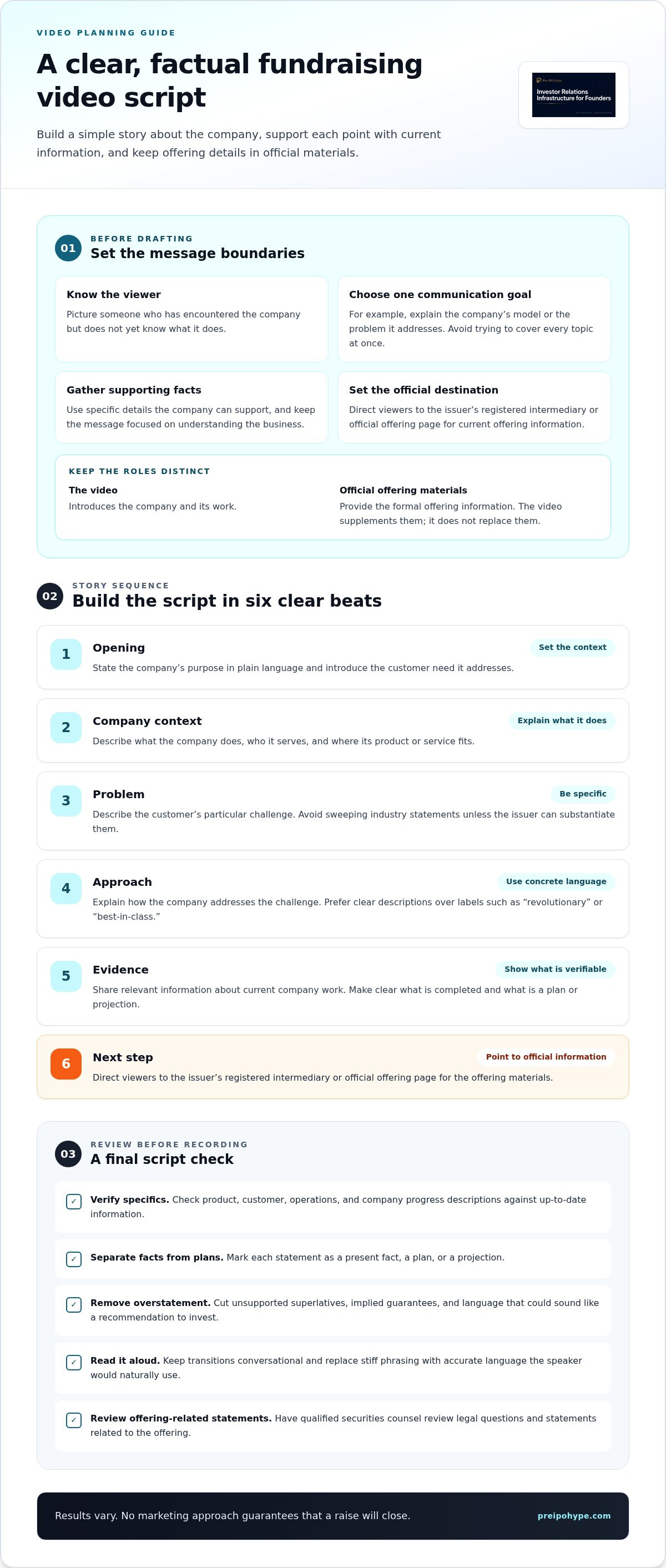
- Opening: State the company’s purpose in plain language and give viewers a reason to keep listening, such as the customer need the company addresses.
- Company context: Explain what the company does, who it serves, and where its product or service fits.
- Problem: Describe the customer’s specific challenge. Avoid sweeping statements about an entire industry unless the issuer can substantiate them.
- Approach: Explain how the company addresses that challenge. Use concrete descriptions rather than labels such as “revolutionary” or “best-in-class.”
- Evidence: Share relevant, verifiable information about the company’s current work. Distinguish completed activity from plans or projections.
- Next step: Direct viewers to the issuer’s registered intermediary or official offering page for the offering materials.
Keep transitions conversational. A founder might say, “Here’s the problem we set out to address,” then explain the approach in their own words. Read the draft aloud and replace phrases that sound stiff with accurate language the speaker would naturally use.
Review claims, evidence, and language before recording
Check the script line by line against current company information and relevant offering materials. Mark each statement as a present fact, a plan, or a projection. This pass can reveal where a future intention is being presented as an existing result, or where a broad claim needs evidence or clearer wording.
- Verify specifics: Confirm descriptions of the product, customers, operations, and company progress against up-to-date records.
- Remove overstatement: Cut unsupported superlatives, implied guarantees, and language that could sound like a recommendation to invest.
- Flag forward-looking statements: Identify projections and other statements about future plans for qualified securities counsel to review before publication.
This video is not a substitute for the issuer’s official offering materials.
Legal decisions and questions about offering-specific wording belong with qualified securities counsel. To discuss how the script fits into a broader campaign for the issuer, use this campaign planning conversation to organize the messaging alongside the review process.
Which fundraising video format fits your message and resources?
The right format is the one that helps viewers follow the company’s explanation. A direct-to-camera founder can make the story personal. Narration can give visuals more room to explain a product or process. A mixed format can combine both. None is inherently more effective for a raise, and cinematic production isn’t required. Use comprehension as the test: can viewers follow the message and identify where to find official offering information?
Founder-led, narrated, and mixed-format approaches
Compare the options against the message you need to communicate, your comfort on camera, the footage available, and the review process. Every format needs a factual script, and visuals should support rather than expand on the claims being made.
| Format | Works well when | Considerations |
|---|---|---|
| Founder-led | The company story is straightforward and the founder can explain it naturally on camera. | Direct and personal, but requires the founder to feel comfortable speaking on camera. A simple background may be enough. |
| Narrated with visuals | The explanation benefits from product footage, diagrams, or other relevant imagery. | Useful when a founder prefers voiceover, but visuals must accurately represent the company and its current work. |
| Mixed format | Viewers need both founder context and visual explanation to understand the story. | Can balance personal explanation with supporting footage, though each element adds material to review for consistency. |
Let the message guide the choice. If the company can be explained clearly in a direct introduction, founder-led may be sufficient. If showing a product in use clarifies how it works, narration or a mixed format may help. If the founder is uneasy on camera, a voiceover can keep the explanation in their own words without requiring an extended on-screen appearance.
Choose production elements that support comprehension
Connect each visual to a point in the script. Show the product, a real work setting, or a simple diagram only when it makes the explanation easier to follow. Avoid decorative footage that could suggest capabilities, customers, or results the company hasn’t established. Captions can help viewers follow spoken content, while clean audio makes the message easier to understand.
Before editing, make a short shot list that pairs each visual with the sentence it supports. For example, a product demonstration should illustrate the function described in the narration, not imply broader performance. Use readable captions, check that they match the spoken words, and keep text on screen long enough to read. Don’t put essential meaning in visuals that disappear too quickly.
Apply the same review discipline to images, captions, charts, and narration. If a graphic introduces a new fact or makes a claim appear stronger than the script, revise it or remove it. During final playback, check that the video communicates one consistent account of the company. As you decide how to create a fundraising video, choose the format that keeps that account clear with the resources and footage available.
How to record, review, and publish the fundraising video
A simple production process makes the video easier to review and revise. Treat recording, editing, and offering review as separate steps. A clean take is useful, but accuracy and a clear route to official materials matter more than a complicated setup.
Prepare and record a usable first version
Choose a quiet space, silence notifications, and place the camera at eye level on a stable surface. Keep the background uncluttered and the speaker well lit. Test the microphone by recording a short sample, then listen for room echo, background noise, and clear speech before recording the full script.
Rehearse for meaning rather than memorization. If a sentence sounds unnatural, revise it without changing the substance. Record the script in short sections if that makes delivery easier or gives the editor cleaner cuts. Leave a brief pause before and after each take to make editing simpler.
Complete review and direct viewers to official materials
After editing, review the video from start to finish, including captions and on-screen text. Check names, product descriptions, charts, and other visuals against the approved script and current company information. Captions should match the spoken words and remain readable on a small screen. Listen with headphones, then watch the final version on a phone to catch audio or display issues.
Before publication, have qualified securities counsel review offering-related statements and any platform-specific promotional language. For Regulation Crowdfunding, anyone the issuer pays to promote the offering on the platform must disclose that compensation with each communication under Rule 205. Plan the sharing route with the issuer’s registered intermediary, and direct viewers to the issuer’s registered intermediary or official offering page for offering materials.
Use separate production and offering-review checks
A useful final checklist separates what the production team can verify from what requires counsel’s review. This keeps editing decisions distinct from legal decisions and makes it easier to identify who should resolve an open question.
- Production check: Confirm stable framing, clear audio, accurate captions, readable text, consistent visuals, and a complete final playback.
- Counsel review: Review offering-related statements, claims, and platform-specific promotional language before publication.
- Publication check: Confirm the approved video is paired with a clear direction to the issuer’s registered intermediary or official offering page.
In short, record for clarity, check every edit, send offering language to qualified securities counsel, and direct viewers to official materials. These steps turn how to create a fundraising video into a manageable workflow without treating production polish as a substitute for careful review.
For help organizing campaign steps for the issuer alongside its registered intermediary and qualified securities counsel, use this fundraising workflow conversation.
Connect the fundraising video to a responsible campaign workflow
A fundraising video is one part of the issuer’s communication workflow. Its message should align with written campaign materials and the issuer’s official offering destination, while each channel serves a clear purpose. The video introduces the company and its story. Written materials add context. The registered intermediary’s offering page is where viewers can review official offering information.
Coordinate video content with the broader campaign
Use the same verified company facts across the video, campaign materials, and official offering destination. If the video describes a product, for example, written materials should not describe its capabilities differently. Before sharing, compare key terms, product descriptions, and company updates across each item. If a detail changes, identify which materials need review and revision.
Keep the viewer’s path consistent, too. Campaign communications done for the issuer can point to the same official destination, rather than asking viewers to search for offering details or rely on a separate summary. A broader campaign support workflow can sit alongside the issuer’s registered intermediary and qualified securities counsel. Our Custom Investor CRM supports lead scoring and attribution tracking.
Before a video or related campaign material is published, check that the version being shared matches the reviewed version. Keep a record of the current script and video file, and coordinate changes with the people responsible for the issuer’s campaign materials and official offering destination. Send legal decisions and questions about offering-specific language to qualified securities counsel.
Give founders a clear next step
Map the handoff from each campaign item to the issuer’s official offering page. A viewer who watches the video should be able to find the same destination from the accompanying written materials. Keep that route direct, and make sure any description around the link is consistent with the reviewed content.
If you’re planning a Regulation CF or Regulation A+ campaign, a workflow conversation can help you consider how video, written materials, and campaign support fit alongside the issuer’s registered intermediary and qualified securities counsel. Schedule a fundraising workflow conversation to discuss the process.
Make the next step part of the plan
As you apply how to create a fundraising video, plan the handoff after the edit is complete. Decide who will maintain the approved version, where viewers will find the issuer’s official materials, and how future campaign updates will stay aligned with the video. A clear process helps keep the company’s communication consistent as its story develops.
Pre-IPO Hype is investor relations infrastructure for Regulation CF and Regulation A+ raises. We are not a broker-dealer, funding portal, or investment adviser, and we do not offer or sell securities or make investment recommendations. Campaign support is provided alongside the issuer’s registered intermediary and qualified securities counsel.
For founders preparing a Regulation CF or Regulation A+ raise, a workflow discussion can help clarify how the video fits with other campaign materials and review responsibilities. Legal decisions and offering-specific wording should go to qualified securities counsel. Schedule a fundraising workflow conversation to discuss your campaign workflow.
Frequently Asked Questions
How long should a fundraising video be?
There’s no single length that fits every company or message. Keep the video only as long as needed to explain its main point without rushing key context. During editing, remove repeated ideas, long introductions, and details that belong in written materials. Ask a reviewer unfamiliar with the script to describe the company’s purpose after watching. If they can’t, simplify the video before trying to shorten it further.
Can a fundraising video replace an offering page?
No. A video can introduce the company, but it doesn’t replace the issuer’s official offering page or formal offering materials. Someone who wants to review offering information should be directed to the page on the issuer’s registered intermediary, not asked to rely on a video description. Keep the video’s closing direction and any accompanying post clear so viewers know where to find the official materials.
What happens if details in the video change after publication?
If a company fact or description changes, pause further sharing while the issuer reviews the video and related campaign materials. Identify which statements are outdated, then coordinate updates to the video, captions, and accompanying copy. For example, a revised product description should be checked wherever it appears. Ask qualified securities counsel about offering-related changes before publishing a replacement or deciding how to handle the earlier version.
Can I use customer or investor testimonials in a fundraising video?
Don’t assume a testimonial is suitable just because the speaker has agreed to appear. Check that the statement is accurate, current, and presented with enough context to avoid a misleading impression. If someone is paid to promote a Regulation Crowdfunding offering on the platform, that compensation must be disclosed with each communication under Rule 205. Ask qualified securities counsel to review testimonials and related disclosures before use.
Should a fundraising video include financial projections?
Only consider projections after discussing the proposed language with qualified securities counsel. A projection is different from a statement about current company activity, so viewers should not confuse a plan with an achieved result. If counsel approves including forward-looking information, make sure the wording matches the issuer’s relevant materials and clearly reflects its status. Avoid adding forecasts simply to make the video seem more persuasive.
Can I reuse a fundraising video across social channels?
You can consider sharing the same core video across channels, but review each version’s surrounding text, captions, and destination link before posting. A shortened clip may remove context or leave a claim unsupported, so check it as a complete communication. For Regulation Crowdfunding promotion on the platform, anyone the issuer pays to promote the offering must disclose that compensation each time under Rule 205. Have qualified securities counsel review platform-specific language.
Disclaimer
Educational only. Not investment, tax, or legal advice. Pre-IPO Hype is investor relations infrastructure for Regulation CF and Regulation A+ raises. We are not a broker-dealer, funding portal, or investment adviser, and we do not offer or sell securities or make investment recommendations. Any securities offering is made only by the issuer, through its own offering documents and, where required, a registered intermediary.


