
How to Crowd Fund Your Business: A Strategic Guide
What if the crowd wasn't just a group of strangers, but a high-velocity capital engine waiting for the right signal? For most founders, the attempt to crowd fund a business feels like shouting into a void, hoping that retail curiosity somehow transforms into a seven-figure bank balance. The traditional venture capital gates are thinning, yet the complexity of SEC regulations like Reg CF and Reg A+ can feel like a brick wall. It's frustrating to see massive engagement on social media that never translates into actual investment because you lack a system to track and nurture thousands of potential leads.
We understand that you're looking for more than just likes; you're looking for market validation and a clear roadmap to a $1M+ raise. This guide promises to show you how to apply institutional-grade marketing and investor CRM systems to your raise, turning a generic concept into a calculated financial movement. We'll explore the latest 2026 SEC updates, including the $5 million Reg CF limit, and provide a systemized way to manage investor relations at scale. From mastering omnichannel outreach to leveraging proprietary data infrastructure, you're about to discover the blueprint for converting market momentum into permanent growth.
Key Takeaways
- Redefine the crowd as a high-velocity capital engine rather than a generic pool of donors to unlock institutional-grade momentum.
- Master the 2026 regulatory landscape of Reg CF and Reg A+ to secure up to $75 million in a single rolling 12-month period.
- Strategically position your crowd fund raise to achieve higher valuations and maintain total board control compared to traditional venture capital.
- Implement a sophisticated technical infrastructure to manage thousands of investor relationships with the precision of a private equity firm.
- Anticipate the shift toward secondary market liquidity and tokenization to offer your investors a clear path to realization events.
What Does it Mean to Crowd Fund in the 2026 Private Market?
The crowd is no longer a chaotic mass of retail curiosity; it's a precision-engineered capital source. In the 2026 private market, the decision to crowd fund a business represents a shift from seeking "help" to orchestrating a decentralized venture capital pool. This isn't about small donations or altruism. It's about high-stakes financial authority. Today's founders view the collective market as the ultimate validator of product-market fit, where the "wisdom of crowds" provides a more accurate momentum indicator than a single partner at a traditional VC firm. By the time a raise hits its stride, the crowd has already signaled whether a company is destined for elite growth or stagnation.
To see how the collective search for opportunity has shifted over the years, watch this perspective on market sentiment:
Modern raises rely on the "Informed Insider," a tier of sophisticated retail investors who lead sentiment and drive early entry. These aren't just passive observers. They are active participants in a movement that has matured significantly since the early days of Crowdfunding. As regulations have evolved, so has the sophistication of the tech used to manage these raises, often requiring a strategic fundraising stack to handle the velocity of incoming capital.
The Evolution from Kickstarters to Equity Raises
The "Retail Revolution" of 2026 has officially moved past the era of pre-ordering gadgets. While platforms once focused on rewards, the current landscape is dominated by equity. Investors aren't buying a product; they're buying a piece of the future. With the SEC's Regulation Crowdfunding (Reg CF) limit now at $5 million per 12-month period, the stakes have shifted from creative projects to scalable enterprises. Digital accessibility has democratized elite investment circles, allowing anyone with a smartphone to participate in early-stage opportunities that were once gated behind institutional walls.
Why Founders are Choosing the Crowd Over Traditional VC
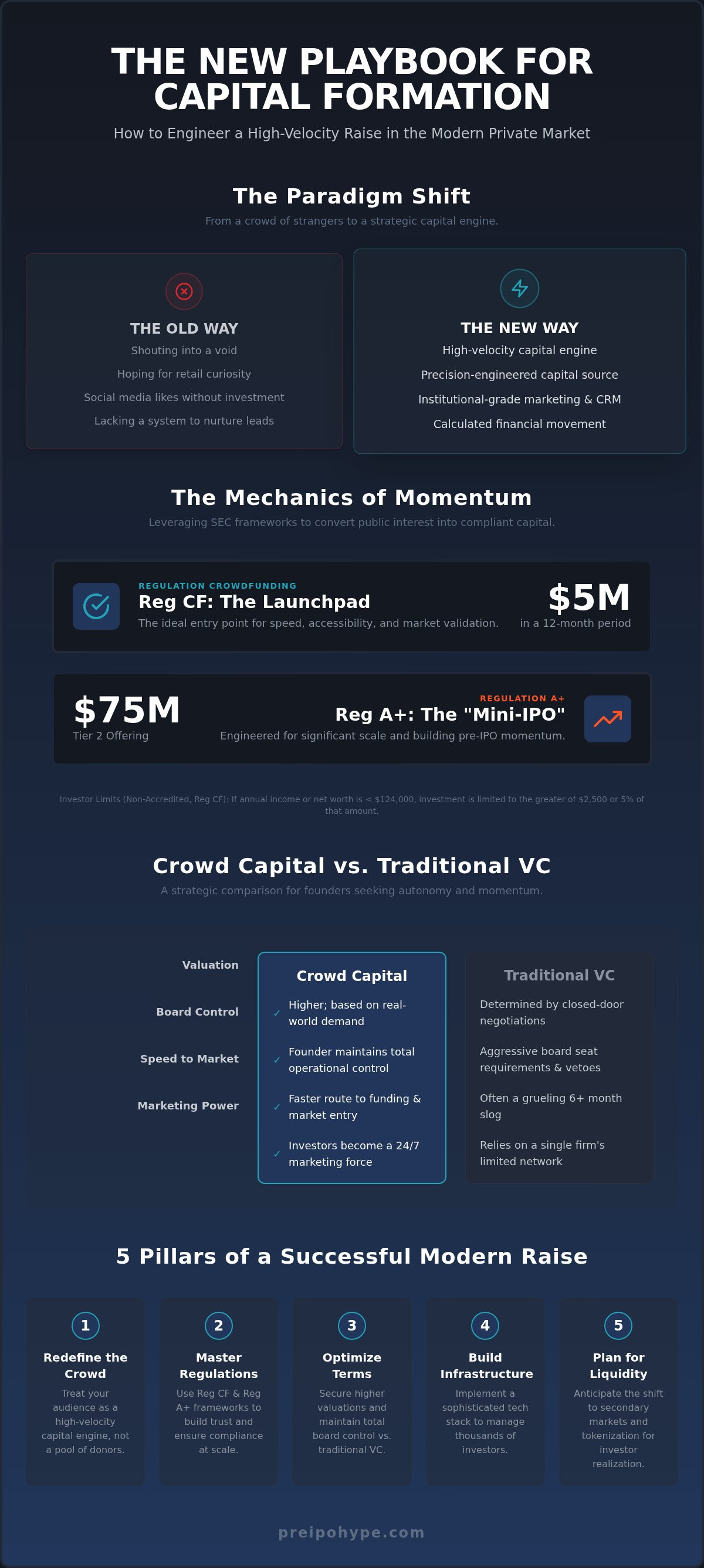
Founders are increasingly opting to crowd fund to preserve their autonomy. Traditional VC often comes with aggressive board seat requirements and the "veto" problem. In contrast, managing 5,000 small investors through a systemized CRM allows a founder to maintain total operational control. These investors become a 24/7 marketing force, acting as brand ambassadors who are financially incentivized to see the company succeed. This public momentum often beats the grueling six-month VC slog, providing a faster route to market and a more aggressive valuation based on real-world demand rather than closed-door negotiations.
The Mechanics of Momentum: Reg CF and Reg A+ Explained
Momentum isn't accidental. It's engineered through the rigorous application of SEC frameworks. When you choose to crowd fund, you aren't just launching a campaign; you're building a legal architecture that converts public interest into compliant capital. For most high-growth startups, this journey begins with Regulation Crowdfunding, a powerful tool that has matured into a cornerstone of the private market. Compliance isn't a hurdle here. It's the ultimate trust builder that signals to the market that your company is ready for institutional-grade scrutiny.
Reg CF: The $5M+ Launchpad
In 2026, Regulation Crowdfunding allows companies to raise a maximum of $5 million within a rolling 12-month period. This entry point is designed for speed and accessibility. The process moves from the initial filing of Form C to a "Sold Out" status through a series of strategic milestones. Almost anyone can participate, though non-accredited investors face specific limits. If an investor's annual income or net worth is less than $124,000, they can invest the greater of $2,500 or 5% of that amount. This framework ensures that while the opportunity is democratized, the raise remains grounded in responsible financial participation.
Reg A+: Engineering the Pre-IPO Hype
For companies ready for significant scale, Regulation A+ serves as a "Mini-IPO." Tier 2 offerings allow for raises up to $75 million, providing a massive capital runway without the immediate burdens of a full public listing. One of the most potent features of this path is the "Testing the Waters" phase. This allows founders to gauge market appetite and collect non-binding indications of interest before committing to the full expense of a Tier 2 filing. It acts as a bridge to traditional exchanges, creating the liquidity and brand awareness required for a future Nasdaq or NYSE listing. If you're unsure which tier fits your current growth trajectory, you can schedule a strategy session to map out your regulatory path.
Accredited vs. Retail Investors: Managing the Mix
A sophisticated cap table balances the raw energy of retail participants with the stability of institutional players. While retail investors drive the brand's social momentum, targeting high-net-worth individuals within the same offering provides the "anchor" capital that validates the raise for others. Managing this mix requires a systemized approach to ensure that 5,000 small voices don't create administrative chaos. In 2026, an Accredited Investor is defined as an individual with a net worth exceeding $1 million, excluding their primary residence, or an annual income surpassing $200,000 (or $300,000 with a spouse) for the last two years.
Crowd Capital vs. Institutional VC: A Strategic Comparison
Why subject your vision to the rigid constraints of a single board seat when you can command a decentralized army of advocates? Choosing to crowd fund your growth isn't just a pivot in capital sourcing; it's a strategic move to optimize valuation and maintain founder autonomy. While traditional venture capital often relies on conservative, closed-door models to determine worth, the crowd tends to value innovation through the lens of market momentum. This aggressive valuation dynamic allows founders to secure capital while preserving a larger equity stake for the team that actually builds the value.
The "Veto" problem is perhaps the most significant differentiator. A single institutional VC partner can stall operations or force a premature exit to satisfy their fund's internal timeline. In contrast, 5,000 retail investors provide the same capital without the friction of a board seat. Managing these participants through a sophisticated CRM is an administrative task, not a political one. Furthermore, the due diligence process in an equity raise is public and transparent. This open scrutiny builds a level of trust and brand authority that behind-closed-doors interrogations simply cannot replicate. A successful raise also sets the stage for future liquidity, positioning the company as a prime candidate for emerging secondary markets.
The Cost of Capital: Fees, Dilution, and Time
VC money is never free. It often comes with a 20% carry, liquidation preferences, and anti-dilution clauses that can haunt a cap table for years. When you compare these long-term costs to the upfront marketing and infrastructure spend of a crowd raise, the ROI becomes clear. You aren't just paying for capital; you're investing in customer acquisition. Investor-users typically demonstrate a significantly higher customer lifetime value (CLV) because they are financially incentivized to promote your brand. You're essentially weaponizing your cap table to drive revenue.
Market Validation and the 'Hype Cycle'
Before you ever step into a room with a Tier 1 firm, a successful equity raise proves that real-world demand exists. Ten thousand retail investors create a defensive moat that institutional VCs find irresistible. It transforms your company from a "maybe" into a market leader with proven velocity. To maximize this advantage, you must have the right tools to track your investor ROI and ensure every marketing dollar is converting curiosity into capital. This data-driven approach turns the hype cycle into a permanent foundation for growth, making your next institutional round a formality rather than a struggle.
Engineering the Raise: 5 Steps to Crowd Fund Success
Engineering a successful raise requires more than a compelling vision. It demands a systematic approach to technical infrastructure and narrative deployment. If you intend to crowd fund a business at scale, you must move beyond the amateur territory of manual tracking. High-velocity capital engines are built on data, not hope. This section breaks down the tactical steps required to transform retail curiosity into a high-performance funding round.
Step 1: The Foundation Infrastructure
You cannot manage a $1M+ raise on a spreadsheet. To handle the volume of retail interest, you need a Custom Investor CRM that integrates directly with your offering page. This infrastructure allows you to track 60-day attribution. You need to know exactly which ad, tweet, or newsletter mention actually drove the wire transfer. With over 50,000 leads often generated in a high-growth campaign, lead scoring becomes your most valuable asset. It allows your team to prioritize outreach to high-intent "Informed Insiders" while automating the nurture process for the broader crowd.
Step 2: Omnichannel Mastery
Scaling a raise is a game of visibility and frequency. Relying on a single channel is a recipe for stagnation. Effective Digital Marketing and Advertising ensures your message remains omnipresent across social and search platforms. This is complemented by high-authority newsletter exposure through channels like Invst Guru, which taps into pre-vetted investor communities. Most retail investors require a 30-day decision window. Retargeting strategies are essential to stay top-of-mind during this period, gently pushing curiosity toward a completed investment.
Step 3: The Investor Hype Cycle
The most successful funding rounds operate with a sense of exclusivity and urgency. When prospective investors see a round quickly approaching its cap, the fear of missing out transforms passive interest into immediate capital commitment. This is the power of social proof in action. However, every campaign faces a mid-campaign slump once the initial excitement of the launch fades. Managing this plateau requires a steady stream of fresh content, strategic milestones, and transparent updates that maintain the narrative pulse. Closing a round isn't the end of the journey; it's the beginning of your relationship with a strategic community.
If you're ready to engineer your own market momentum, book a 30-minute consultation to audit your raise infrastructure and optimize your path to capital.
The Future of the Crowd: Secondary Markets and Beyond
Liquidity was once the missing piece of the equity crowdfunding puzzle. That changed in 2026. The rise of robust secondary trading platforms has transformed Reg CF shares from illiquid paper into dynamic assets. This evolution allows your investors to seek realization events without waiting a decade for an acquisition. When you decide to crowd fund, you aren't just locking in capital; you're entering an ecosystem that increasingly mirrors the flexibility of public markets. It's a shift from static investment to active market participation.
Tokenization is accelerating this shift. By 2026, the crowd will fund Real World Assets (RWA) through blockchain-backed structures that offer unprecedented transparency and fractional ownership. This isn't just about technology; it's about trust. The crowd-to-IPO pipeline is now a reality. A successful Reg A+ offering serves as a high-stakes dress rehearsal for a NASDAQ listing, allowing you to build a loyal shareholder base and prove market demand long before the first bell rings. Your relationship with this crowd is your most valuable post-funding asset. They are your moat against competitors and your first line of defense in the public eye.
Managing Post-Raise Investor Relations
Maintaining momentum requires a systemized approach to communication. You've already built the technical foundation; now you must use your CRM to keep investors engaged for Series B and beyond. Quarterly updates don't need the overhead of a public company, but they do require professional precision. These investors are your most dedicated focus group. Use them to validate new product launches or to drive viral growth. When 5,000 people are financially incentivized to see you win, your marketing costs drop while your brand authority skyrockets. It's about turning a transaction into a movement.
Your Strategic Partner in the Hype
The complexity of modern raises means you cannot afford to go it alone. Founders need a specialized equity crowdfunding marketing agency that understands the intersection of SEC compliance and high-velocity digital marketing. At Pre-IPO Hype, we've facilitated over $100 million in funding and served more than 230 companies since 2015. We provide the proprietary Foundation infrastructure and investor acquisition campaigns needed to convert retail curiosity into permanent capital. Ready to engineer your momentum? Book a 30-minute strategy session with Fuzzy Wenzel to claim your place in the next generation of elite investment circles.
Claim Your Place in the New Era of Private Capital
The gatekeepers of the past are losing their grip as the retail revolution takes center stage. When you choose to crowd fund your vision, you aren't just raising capital; you're building a defensive moat of brand advocates and a foundation for future liquidity. We've explored how 2026 regulations like Reg CF and Reg A+ provide a clear path to $75 million, provided you have the institutional-grade infrastructure to manage the momentum.
Success in this market isn't a matter of luck. It's a matter of engineering. Since 2015, we've helped over 230 companies scale their raises using our proprietary Investor CRM technology and data-driven marketing systems. With over $100 million in funding facilitated, we understand exactly what it takes to turn public curiosity into high-velocity capital. The opportunity to bypass the traditional venture capital slog is here for those who act with precision.
Don't leave your raise to chance. Secure your fundraising roadmap; schedule a 30-minute strategy session now. Your future as a market leader starts with a single, decisive move.
Frequently Asked Questions
Is equity crowdfunding better than venture capital for my startup?
It depends on how much control you want to keep. Equity crowdfunding allows you to maintain your board autonomy and avoid the aggressive veto power often demanded by institutional VCs. It also lets you set more aggressive valuations based on market momentum rather than closed-door negotiations. Choosing to crowd fund builds a decentralized army of brand advocates who are financially incentivized to see your company succeed.
How much does it cost to crowd fund a Reg CF campaign?
Costs typically include portal fees, legal filings, and marketing expenses. Major equity portals often charge between 7% and 8% of the total capital raised as a success fee. You'll also need to budget for the preparation of SEC documents like Form C and independent financial reviews. Beyond these baseline costs, successful raises require a strategic investment in digital marketing to drive high-velocity traffic to your offering.
Can anyone invest in my company under Regulation Crowdfunding?
Yes, the SEC allows both accredited and non-accredited investors to participate in these raises. However, there are specific limits based on an individual's financial status. For example, if an investor's annual income or net worth is less than $124,000, they can invest the greater of $2,500 or 5% of their income. This structure democratizes access to elite investment circles while maintaining responsible financial guardrails.
What is the maximum amount I can crowd fund in 2026?
The current SEC limit for Regulation Crowdfunding (Reg CF) is $5 million within a rolling 12-month period. If your capital requirements are higher, Regulation A+ offers a Tier 2 path that allows you to raise up to $75 million. These limits were established to provide high-growth companies with a powerful alternative to traditional private equity rounds, allowing for significant scale without the traditional VC slog.
What happens if my crowd fund campaign doesn't reach its goal?
Most equity platforms operate on an all-or-nothing basis. If you don't reach the minimum funding goal specified in your legal filings, all committed funds are returned to the investors. This is why engineering early momentum is so critical. A strategic pre-launch phase ensures you hit your minimum target quickly, which creates the social proof needed to attract the Informed Insider and surpass your maximum cap.
How do I manage thousands of small investors on my cap table?
Sophisticated raises use legal structures like a Special Purpose Vehicle (SPV) to keep the cap table clean. This allows thousands of retail investors to appear as a single entry on your cap table, preserving your ability to raise future institutional rounds. Managing the relationship with these participants requires a Custom Investor CRM. This technology automates updates and engagement, turning a large group into a systemized marketing force.
Do I need a special platform or CRM to run a crowd fund raise?
You must use an SEC-registered funding portal to host the offering, but a proprietary CRM is what actually scales the raise. You need a system that handles lead scoring and 60-day attribution to see which marketing channels are delivering capital. Relying only on a platform's internal traffic is a common mistake. A dedicated infrastructure is essential to convert retail curiosity into a high-velocity capital engine.
How long does a typical equity crowdfunding campaign take to close?
A typical raise spans 90 to 120 days from the public launch to the final close. However, the most successful campaigns include a 60-day Foundation phase before going live. This lead-up time is used for legal preparation, financial reviews, and building a high-intent waitlist. Starting with immediate velocity the moment your portal opens is the best way to ensure the crowd fund reaches its maximum cap quickly.
Disclaimer
Educational only. Not investment, tax, or legal advice. Pre-IPO Hype is investor relations infrastructure for Regulation CF and Regulation A+ raises. We are not a broker-dealer, funding portal, or investment adviser, and we do not offer or sell securities or make investment recommendations. Any securities offering is made only by the issuer, through its own offering documents and, where required, a registered intermediary.


