
How to Find Family Office Investors: A Practical 2026 Guide
What if the best family-office prospect isn’t the name with the biggest profile, but the one whose investment mandate already aligns with your company? Learning how to find family office investors can feel like searching behind closed doors: many offices keep a low public profile, broad lists mix relevant and poor-fit prospects, and generic cold outreach rarely explains why a particular investor should care.
A focused process can replace guesswork with evidence. Before asking for access, show why your company may fit. Its sector, stage, capital needs, and the office’s investment preferences all matter. A relevant introduction or a concise, specific message gives the recipient a clearer reason to consider a conversation than a pitch sent to every contact on a list.
This guide explains how to identify potential family offices, assess mandate and relationship signals, and prioritize outreach. You’ll learn how to use research sources thoughtfully, build a shortlist worth pursuing, and begin professional conversations without overstating fit or expecting a guaranteed outcome. The aim isn’t access at any cost. It’s a clear, disciplined route from research to relevant investor dialogue.
Key Takeaways
- Distinguish single-family offices from multi-family offices, then account for how their mandates and decision processes differ.
- Before researching how to find family office investors, define your raise purpose and target profile, including sector, stage, investment thesis, and decision-maker role.
- Compare referrals, portfolio research, professional networks, events, and specialist databases by relevance, effort, freshness, and relationship potential.
- Make direct outreach more credible by verifying fit, contacting the appropriate role, personalizing your message, and making a clear ask.
- Use a repeatable tracking process to record each prospect’s source, fit rationale, contact role, status, and next follow-up date.
How to Find Family Office Investors by Starting With the Right Fit
How to find family office investors starts with a sharper question: which offices have a credible reason to consider your company? A family office manages wealth and related financial affairs for one or more wealthy families. A single-family office serves one family, while a multi-family office serves multiple families. Both can invest, but their mandates, priorities, and decision processes vary. For a foundational overview of what a family office is, look beyond the label to how each office operates.
A contact record is not proof of investor fit. Investor fit is evidence that a prospect’s mandate, sector interests, investment stage, geography, and decision process plausibly align with your company, not simply access to someone’s contact details. Family wealth or public visibility alone doesn’t establish investment appetite, suitability, or authority to make a decision.
For a broader view of the tools that can support investor sourcing and follow-up, explore our fundraising technology stack guide.
For a closer look at how family offices are structured, watch Family Offices From Scratch by Bridger Pennington:
What makes a family office a plausible investor?
Build a case from observable signals, not assumptions. Look for evidence that the office has invested in companies or assets related to your sector, at a stage comparable to yours, and in a geography relevant to your business. Public portfolio information, investment announcements, and the office’s own materials can help establish a rationale. Check the dates and context of those sources: preferences can shift, and an old investment doesn’t prove a current mandate.
Then test the practical alignment. Does the office appear to make direct investments, or primarily allocate through funds? Do disclosed deals or other reliable indicators suggest an investment scale compatible with your capital need? If key details are unavailable, mark them as unknown rather than treating wealth, prominence, or a shared industry connection as proof.
Family offices versus funds, angel investors, and wealth managers
Funds generally invest within a defined vehicle and mandate, while angel investors typically make individual investments. Family offices may invest directly or through funds, with decisions shaped by the family’s priorities and the office’s structure. Their public visibility also varies; some share portfolio details, while others keep a low profile.
Wealth managers may advise families on financial matters, but they aren’t automatically authorized or positioned to choose company investments. Identify the person responsible for private investments or venture activity before treating an adviser as a decision-maker. This distinction keeps your research precise and your first approach relevant.
How to Build a Target Profile Before Searching for Family Offices
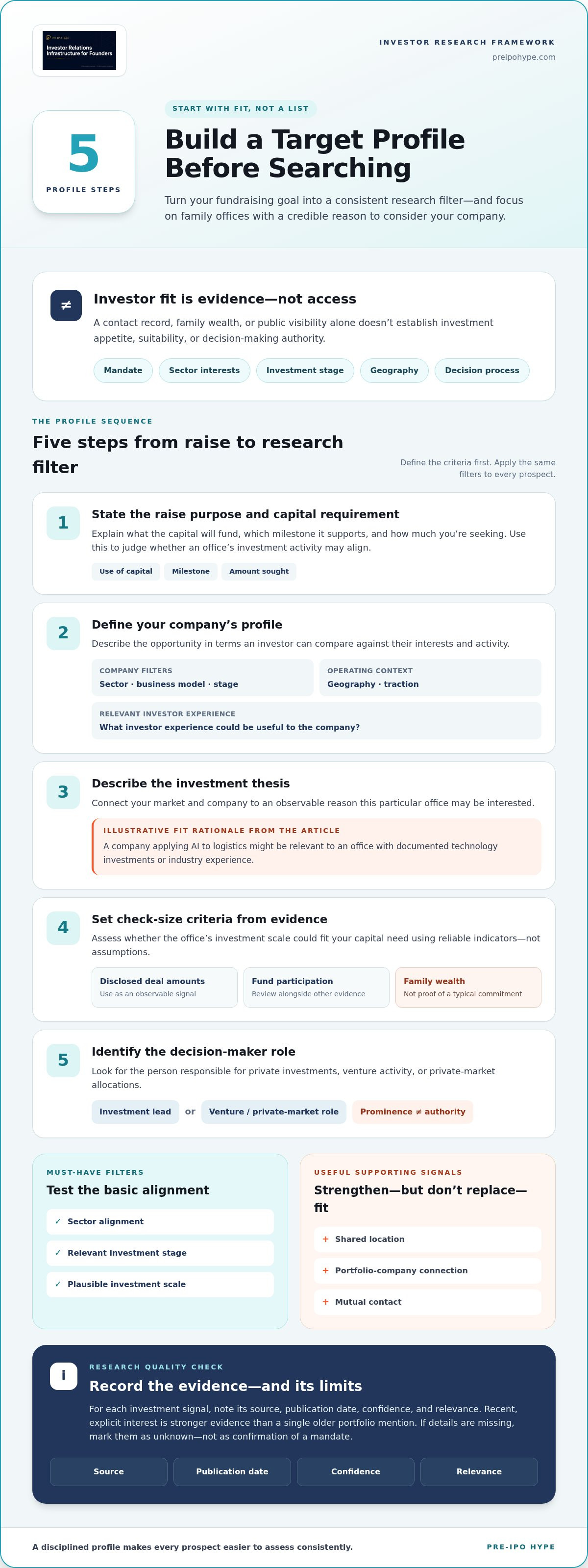
A target profile turns a fundraising goal into a practical research filter. Without one, a search can collect impressive names without showing why any of them might consider your company. Define your criteria first, then use the same filters to assess each prospect.
Build the profile in this order:
- State the raise purpose and capital requirement. Explain what the capital will fund, what milestone it supports, and how much you’re seeking. This gives you a basis for assessing whether a prospect’s investment activity may align with the opportunity.
- Define your company’s profile. Specify sector, business model, stage, operating geography, traction, and the type of investor experience that could be relevant.
- Describe the investment thesis. Identify why your market and company may interest a particular family office. For example, a company applying AI to logistics might be relevant to an office with documented technology investments or industry experience.
- Set check-size criteria from evidence. Look for disclosed deal amounts, fund participation, or other reliable indications of investment scale. Don’t treat an estimate or a family’s wealth as proof of the office’s typical commitment.
- Identify the decision-maker role. Determine whether the relevant contact leads direct investments, venture activity, or private-market allocations. A prominent family member or adviser isn’t automatically the person who evaluates opportunities.
Separate must-haves from useful signals. Sector alignment, relevant stage, and a plausible investment scale may be essential filters. A shared location, portfolio-company connection, or mutual contact can strengthen a prospect, but shouldn’t compensate for a basic mismatch.
Which investment signals should founders prioritize?
Review public portfolio companies, stated interests, interviews, and disclosed investment activity. For every signal, record its source, publication date, confidence, and relevance to your company. A recent, explicit statement about a sector is stronger evidence than a single older portfolio mention. Treat gaps as unknowns, not confirmation of a mandate.
How to turn your fundraising case into a target thesis
Summarize your company, market, traction, funding purpose, and investment rationale in a few clear sentences. Then connect each target criterion to a specific reason that office may care. “Invests in technology” is broad; “has disclosed investments in early-stage supply-chain software” gives your research a testable direction.
Keep qualification notes organized alongside their sources and follow-up history. A custom investor CRM and data workflow can help your team review and update prospect research. If you want to structure a focused investor pipeline, schedule a fundraising strategy conversation.
Where to Find Family Office Investors: Compare Research Channels
How to find family office investors is a research problem, not just a search problem. No single channel reliably provides both current investment evidence and a path to a decision-maker. Use several sources to identify and cross-check prospects, then verify each office’s identity, contact role, and potential fit before outreach.
| Channel | Relevance | Likely effort | Data freshness | Relationship potential |
|---|---|---|---|---|
| Warm referrals | High when the connector knows the office’s investment interests | Medium to high | Depends on the connector’s knowledge | High, with useful context |
| Portfolio research | High for identifying sector or stage signals | Medium | Varies by publication date | Low initially, but creates a basis for relevant outreach |
| Professional networks | Variable, depending on shared contacts and expertise | Medium | Often needs confirmation | Medium to high |
| Events | Variable, depending on attendees and subject matter | High | Current for the event, not necessarily for investment activity | Medium to high through direct interaction |
| Specialist databases | Useful for filtering and discovering prospects | Low to medium, plus validation | Depends on the record and update history | Low unless paired with a referral or tailored outreach |
Which public sources can reveal relevant family offices?
Search family-office websites, portfolio announcements, interviews, event speaker lists, and reputable specialist databases. These sources can surface sector interests, past investments, or possible contacts, but the amount of information varies. Treat SEC EDGAR and other public filings as research clues, not confirmation of a current mandate or willingness to invest. Record when and where each claim appeared, and look for corroboration from a reliable, dated source.
How to compare warm introductions, events, and databases
A warm introduction can add context and make a relevant first conversation easier, but it can’t replace a clear investment case. Events offer direct interaction, though attendance alone doesn’t establish fit. Databases can broaden discovery and support filtering, but records may be incomplete or out of date. Portfolio research and professional networks help connect the dots; each requires time to check details and establish a credible reason to reach out.
Combine multiple sources, then verify each prospect before outreach. For example, use a database to identify an office, a portfolio announcement to assess sector relevance, and a professional connection to understand the appropriate contact. Structured investor data and prospect research can help teams organize those signals without mistaking a directory entry for verified access.
How to Approach Family Office Investors Without a Warm Introduction
A warm introduction can provide valuable context, but it isn’t the only route to a credible conversation. A concise, well-researched message can earn consideration when it connects your company to a documented interest and reaches the appropriate person. The goal isn’t to imply familiarity or force a meeting. It’s to make the relevance easy to assess.
Use this sequence before sending a first message:
- Verify fit. Check current, credible sources for a connection between the office’s visible investment activity and your sector, stage, or geography. Separate evidence from assumptions.
- Identify the right role. Look for the person responsible for direct investments or the relevant investment area. Don’t assume an adviser or family member makes investment decisions.
- Personalize with a reason. Refer to a specific public signal and explain briefly how it relates to your company. Don’t suggest a relationship that doesn’t exist.
- Make a clear ask. State that you’re raising, give a concise description of the opportunity, and ask whether a brief introductory conversation would be relevant.
- Follow up respectfully. If there’s no response, send a measured follow-up after a reasonable interval. Stop if the recipient declines or asks not to be contacted.
What should a first message to a family office include?
Keep the note brief and specific. For example: “I saw your office’s public interest in [sector or investment theme]. We’re building [short company description] and raising to support [specific milestone]. Would a brief conversation be useful to assess whether this fits your investment focus?” Use only accurate, publicly supported references. Avoid mass-message phrasing, unsupported performance claims, and unsolicited confidential attachments. Share sensitive materials selectively, and follow applicable legal guidance on fundraising communications and information sharing.
How should founders manage follow-up and investor responses?
Keep a clear record of dates, messages, referral context, objections, and agreed next steps. A simple tracker or CRM can prevent duplicate outreach and help you follow through on commitments. Note any request to pause or stop contact, and honor it. For planning how different outreach channels work together, see this guide to newsletter outreach for fundraising.
A disciplined process can make each conversation more relevant without implying that interest or funding is assured. Discuss your investor outreach strategy and how to build a consistent approach.
Turn Family Office Research Into a Repeatable Fundraising Process
Research creates value when it leads to relevant outreach and a clear next step. Treat each qualified prospect as part of a workflow: document the evidence, identify the appropriate contact, send a tailored message, record the response, and schedule or close out the next action. That structure keeps promising conversations from disappearing into inboxes or disconnected spreadsheets.
- Research: Save the source, date, and evidence behind the prospect’s potential fit.
- Qualify: Record why the office may align with your company, who appears responsible for the relevant investment area, and what remains unverified.
- Engage: Log outreach and replies, including any introduction, objection, or request for more information.
- Advance: Note the agreed next step and follow-up date, or mark the prospect inactive when appropriate.
What should an investor relationship system track?
Keep the record practical: fit rationale, source and date, contact role, communication history, consent or contact-preference notes, status, and follow-up date. Lead scoring can help prioritize prospects when it reflects evidence such as relevant investment activity and mandate alignment, rather than assumed wealth, prestige, or visibility. Attribution tracking can also help teams review which outreach activity contributed to engagement.
Pre-IPO Hype’s custom investor CRM brings qualification and follow-up into an organized workflow, with lead scoring, 60-day attribution tracking, and omnichannel outreach automation. The platform helps fundraising teams organize prospect research and campaign activity. It complements research and outreach, rather than replacing the work of assessing each office’s fit. For more detail, explore the investor data and CRM approach.
When can fundraising infrastructure help a founder?
Manual spreadsheets may work while the pipeline is small. As prospect volume, outreach channels, and follow-up commitments grow, records can become harder to maintain consistently. Connected infrastructure helps teams coordinate outreach, monitor campaign activity, and review engagement so they can refine execution based on what the records show, not memory alone.
Pre-IPO Hype supports investor acquisition campaigns and digital marketing, including campaign monitoring, A/B testing, and ROI optimization. Its CRM and Foundation infrastructure can bring lead tracking and omnichannel outreach into the same fundraising workflow. The goal is better coordination and clearer records, not assumed introductions or promised capital.
Ready to make your investor outreach more consistent? Schedule a conversation about your fundraising workflow.
Make Your Next Investor Conversation More Intentional
Learning how to find family office investors is less about collecting names and more about building a credible path from research to conversation. Start with a defined fundraising profile, compare multiple sourcing channels, and validate each prospect’s investment signals before reaching out.
Then make every interaction relevant. Contact the appropriate role, explain the specific connection between the office’s visible interests and your company, and track responses and next steps. A warm introduction can help, but disciplined research and respectful follow-up give your outreach substance. An investor CRM can support that process by organizing prospect information and communication history, without substituting for verified fit or promising access to capital.
If you’re ready to make your research and outreach more focused, discuss a more focused investor acquisition process. A clear system won’t guarantee an investment, but it can help you approach the right conversations with greater purpose. Keep refining your thesis, stay thoughtful in your outreach, and build momentum one relevant conversation at a time.
Frequently Asked Questions
Is it possible to find family office investors without a warm introduction?
Yes, a warm introduction can help, but it isn’t the only way to begin a conversation. Research offices with publicly visible investment activity, identify a relevant connection to your company, and find the appropriate investment contact. Then send a concise, professional message explaining why you’re reaching out. Not every office accepts unsolicited approaches, and careful preparation can’t guarantee a response, but it helps make your outreach relevant rather than generic.
How do I know whether a family office invests in companies like mine?
Look for dated portfolio information, stated interests, interviews, and credible public reports of investment activity. Compare those signals with your company’s sector, stage, and geography. A past investment can show possible relevance, but it doesn’t prove the office has the same mandate today. Record where each signal came from and when it was published, then verify its relevance before contacting anyone. Distinguish documented evidence from assumptions based on the family’s wealth or profile.
Where can I find family office investor names and contact information?
Start with public filings, portfolio announcements, family-office or company websites, professional networks, relevant events, and specialist databases. These channels can help surface names and research clues, but their coverage and freshness vary. Cross-check an office’s identity and the person’s current role using reliable, dated sources. Respect privacy and use contact information professionally. A database record or filing alone doesn’t establish investment interest, decision-making authority, or a suitable reason to reach out.
How should I approach a family office investor for the first time?
Send a concise, personalized message tied to a verified signal, such as a publicly stated sector interest or relevant portfolio company. Briefly explain your fundraising context, what your company does, and why the opportunity may fit that interest. Make one clear request, such as asking whether a short introductory conversation would be relevant. Avoid mass-message language and unsupported claims. Don’t send sensitive materials without an appropriate context or a clear reason to share them.
Do family offices invest in early-stage startups?
Some may consider private companies, including early-stage businesses, while others focus on different stages, asset types, or investment structures. There’s no single approach that applies to every family office. Look for evidence of relevant stage and sector activity, and treat disclosed investments as clues to investigate rather than proof of current interest. Family-office status alone doesn’t signal startup appetite. Build your case around documented alignment, not assumptions about the family’s wealth.
How many family offices should a startup contact?
There’s no universal number that suits every startup or fundraising round. Begin with a smaller list of prospects supported by evidence of potential fit, then expand as you learn which signals and messages lead to meaningful conversations. Track research, outreach, responses, and next steps so you can improve your focus. Prioritize relevance and careful recordkeeping over high-volume generic outreach, and ensure your fundraising communications follow applicable legal guidance.
Can a CRM help me find family office investors?
A CRM can organize prospect research, qualification notes, communication history, and follow-up, but it doesn’t create investor fit or guarantee access. Use it to record why an office may be relevant, where each detail came from, who the contact is, and what action comes next. Consistent records help a team prioritize prospects based on evidence and learn from engagement. A CRM supports the research process; it isn’t automatically a family-office directory.
Disclaimer
Educational only. Not investment, tax, or legal advice. Pre-IPO Hype is investor relations infrastructure for Regulation CF and Regulation A+ raises. We are not a broker-dealer, funding portal, or investment adviser, and we do not offer or sell securities or make investment recommendations. Any securities offering is made only by the issuer, through its own offering documents and, where required, a registered intermediary.


