
How to Get My Startup on Investor Newsletters: The Elite Founder’s Playbook for 2026
In 2026, high-performing email campaigns return up to $50 for every dollar spent, yet most founders still struggle with abysmal open rates and zero traction. You’ve likely built a product hitting that 15% month-over-month growth benchmark. Even so, you still feel like a best-kept secret while competitors with half your revenue dominate the narrative. It’s frustrating to have the data but lack the direct access to institutional and elite retail investor lists that move the needle. You are likely asking how to get my startup on investor newsletters without wasting months on cold outreach that goes nowhere.
We understand that visibility in this market is a game of curated authority. This guide provides a clear roadmap to getting featured in elite industry digests like Lenny’s Newsletter, which now commands over 1 million subscribers, or Strictly VC. You’ll learn to master a dual strategy that combines professional internal updates with high-impact external placements to engineer market momentum. We will dive into the specific tactics for securing spots in top-tier newsletters and building an internal system that keeps your existing backers engaged until the next liquidity event.
Key Takeaways
- Learn why curated inboxes have replaced traditional media as the primary gatekeepers of the 2026 hype cycle.
- Implement a dual-track strategy to keep your current cap table engaged while simultaneously securing elite external placements.
- Follow a proven playbook on how to get my startup on investor newsletters by providing editors with high-authority, ready-to-publish assets.
- Frame your traction with a "category killer" narrative that balances hard performance data with the infectious energy of a future unicorn.
- Use advanced attribution and investor CRMs to bridge the gap between initial newsletter curiosity and final capital commitment.
The New Information Gatekeepers: Why Investor Newsletters Control the Hype Cycle
Public social feeds have become a wasteland of unverified noise and algorithmic chaos. For the elite venture capital community, the real signal has moved from the public square to the curated inbox. Investors no longer scroll for deals; they subscribe to them. This shift explains why mastering how to get my startup on investor newsletters is the most critical lever in your 2026 capital raise strategy. By bypassing the friction of social media, you land directly in the "trusted zone" where decisions are actually made.
The psychology of private equity relies heavily on the "trusted recommendation." In a market where California’s SB 54/164 now mandates strict diversity and demographic reporting, the gatekeepers of information have changed. Investors are looking for pre-vetted opportunities that have already survived a specialist's scrutiny. Getting featured isn't just about reach; it's about the psychological transfer of authority from the newsletter creator to your brand. This turns a cold discovery into a warm lead before you even send a pitch deck.
To better understand the mechanics of making investors pay attention to your message, watch this helpful video:
From Inbox Noise to Curated Deal Flow
Institutional backers are retreating from public feeds to private digests to escape the low-signal environment of the open web. These "Newsletter Gurus" have become the new market makers, often setting valuation benchmarks by defining which sectors are primed for secondary liquidity. They act as the ultimate filter in an era of AI-generated content overload. Investor hype is the measurable momentum generated by curated visibility.
The ROI of Being "In the Know"
Placement in a top-tier industry list significantly shortens the standard 60-day attribution window typically seen in private market deals. It moves a potential backer from passive reading to active investment intent by providing a sense of exclusivity and urgency. This high-trust environment is why newsletter exposure is now a foundational pillar of digital marketing and advertising for startups chasing unicorn status. When you appear in an elite digest, you aren't just another founder asking for money; you are an insider opportunity that investors don't want to miss.
Internal vs. External: The Dual-Track Newsletter Strategy for 2026
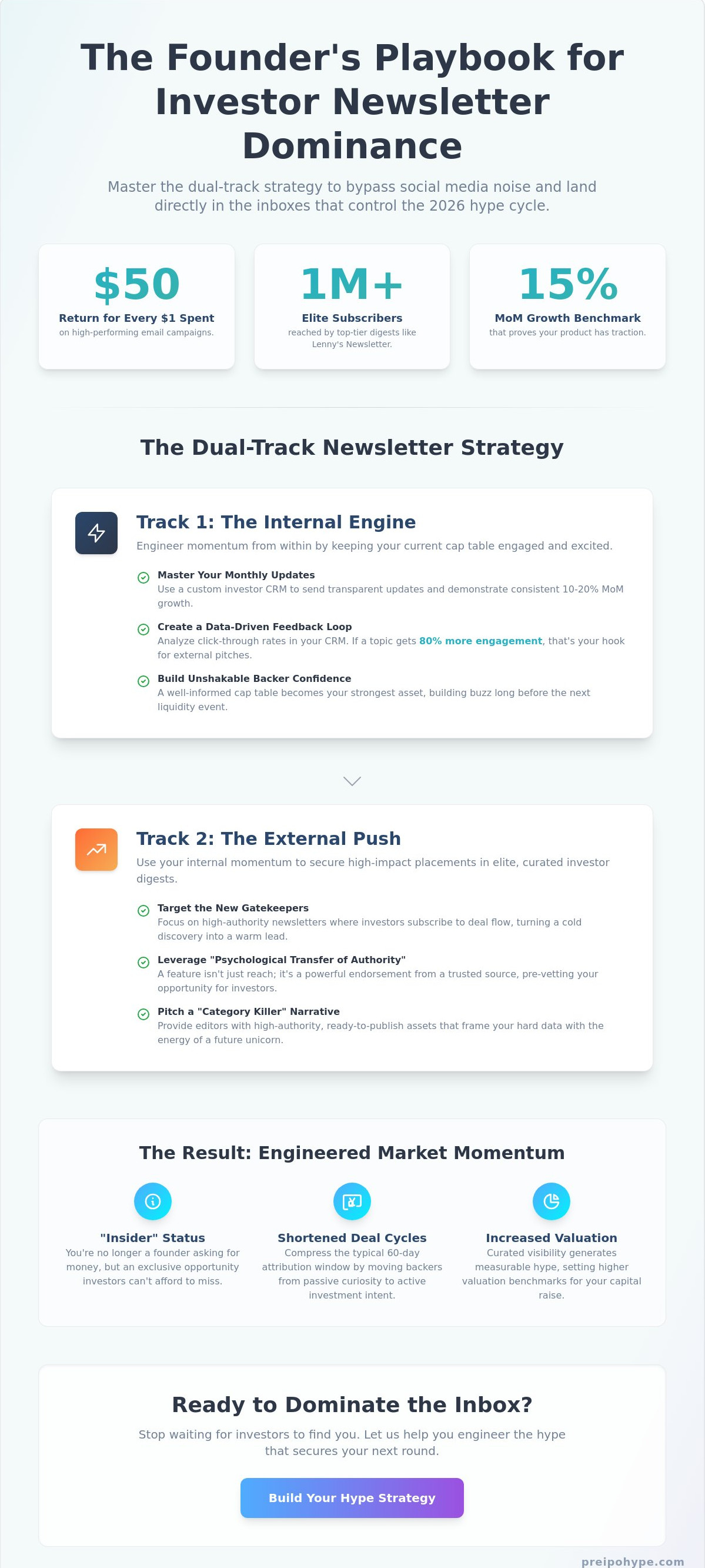
Elite founders don't just wait for a mention; they engineer it. Raising capital in 2026 requires a dual-track offensive that bridges internal transparency with external hype. You need a system that keeps current backers locked in while simultaneously hunting for new ground floor opportunities. The foundation of this entire operation is a custom investor CRM. This isn't just a list of names. It’s a performance engine that tracks engagement and signals exactly when your narrative is ready for the big stage.
Before you worry about how to get my startup on investor newsletters with a global reach, you must dominate the inboxes you already own. If your current cap table isn't excited, why would a stranger be? The Feedback Loop is your secret weapon. By analyzing which sections of your internal updates get the most clicks via your CRM, you identify the hooks that will resonate with external editors. If your section on AI-native UX gets 80% more engagement than your revenue charts, that’s your pitch for the next external feature. This data-driven approach ensures you aren't guessing what the market wants; you're responding to it.
The Internal Engine: Engineering Momentum from Within
Your monthly update is your most potent retention tool. In 2026, investors expect to see at least 10-20% month-over-month growth in early-stage SaaS startups. Don't hide behind fluff. Use Foundation Infrastructure to automate these reports, ensuring your metrics are institutional-grade. Before you scale, ensure you Write your business plan with a clear exit strategy in mind. This clarity turns passive backers into active brand advocates who will champion your next round to their own networks.
The External Engine: Breaking Into Elite Digests
Breaking into elite digests like Strictly VC or the Invst Guru model requires a different tactical approach. You aren't just selling a company; you're selling a movement. With Regulation A+ Tier 2 limits holding steady at $75 million per year as of April 2026, the competition for retail and institutional attention is fierce. Strategic placement involves identifying the Big Three lists in your vertical and providing editors with low-friction, ready-to-publish assets. This is how you find the ground floor investors who are ready to move capital decisively. If you're ready to bridge the gap between private secrecy and public opportunity, book a strategy session today to audit your current outreach.
Engineering the "Hype": What Makes a Startup Feature-Worthy?
Why do some startups command the spotlight while others rot in an editor’s "read later" folder? It isn't luck. It's the result of calculated narrative engineering. To master how to get my startup on investor newsletters, you must stop thinking like a founder and start thinking like a curator. Curators hunt for momentum. They want to feature companies that make their subscribers feel like they've just discovered the next frontier of wealth creation. This requires a "Category Killer" narrative that frames your venture not just as a product, but as a future unicorn destined for a massive exit.
Institutional interest is triggered when you find the perfect equilibrium between hard metrics and soft hype. While revenue numbers provide the floor, the "Secondary Liquidity" angle provides the ceiling. Newsletters love stories with clear exit potential because they validate the subscriber's desire for a return on capital. You must also establish visual authority immediately. In a world of 3-second scans, a high-growth chart or a slide of recognizable partner logos does more work than a thousand words of copy. Before reaching out, consult a startup media coverage guide to ensure your messaging is sharp enough for the big stage.
The Metrics that Trigger Features
Data without a story is just a spreadsheet; story without data is just a dream. To secure a feature in 2026, you need to hit specific benchmarks that signal institutional readiness. For a Series A or a significant Reg CF placement, investors expect to see month-over-month growth between 10% and 20%. Your pitch should highlight Omnichannel Mastery, showing how you've lowered user acquisition costs while scaling the signal across multiple platforms. High-performing newsletters aren't looking for "stable" companies; they're looking for rockets that have already cleared the launchpad.
Positioning for the "Informed Insider"
Elite newsletters cater to the "informed insider" who speaks the language of valuation benchmarks and late-stage growth. Use institutional terminology to build instant credibility. Frame your raise as "Exclusive Access" or a "Limited-Time Opportunity" to trigger a sense of urgency. If you're running a public raise, leveraging Reg CF marketing services can help you craft a pitch that balances regulatory compliance with the infectious energy of a ground-floor deal. This positioning turns your startup into a movement, making the act of investing feel like joining a gated financial circle rather than just executing a transaction.
The Pitch Playbook: How to Get Your Startup on Top-Tier Investor Lists
Cold pitching is a relic of a slower era. In 2026, the elite strategy for how to get my startup on investor newsletters revolves around precision and friction reduction. You don't just send an email; you engineer a "no-brainer" scenario for the editor. This begins with a rigorous audit of vertical-specific influencer inboxes. If you are building a fintech solution, a mention in a general tech digest is white noise. You need lists where institutional allocators and high-net-worth retail investors are actively hunting for secondary liquidity opportunities.
- Step 1: The Vertical Audit. Identify curators who specifically cover your niche. Look for those who have discussed the April 2026 California diversity reporting deadlines or the rise of AI-native UX.
- Step 2: Low-Friction Assets. Provide editors with everything they need to hit "publish." This includes a 150-word blurb, a growth chart showing your 15% month-over-month traction, and a direct link to your raise.
- Step 3: Platform Leverage. Use established investor acquisition platforms to secure warm introductions. A recommendation from a trusted entity like Invst Guru often bypasses the standard editorial queue entirely.
- Step 4: The CRM-Backed Follow-Up. If your initial pitch hasn't landed, use engagement data from your internal updates. Telling an editor that your latest product news saw a 45% spike in clicks proves your startup is trending.
Crafting the "No-Brainer" Pitch for Editors
Editors don't want to do you a favor; they want to provide value to their readers. Never ask for a feature. Instead, offer an "insight" backed by your unique market data. If your startup has proprietary data on how AI is shifting valuation benchmarks, lead with that. Use the "Pre-Written" strategy by providing a ready-to-use blurb and a high-impact graphic. This reduces the editor's workload to a simple copy-paste operation. Positioning yourself through Invst Guru can act as a high-authority gateway, making your narrative feel like an insider tip rather than a cold solicitation.
Timing the Hype: When to Pitch Your Raise
Momentum is a perishable asset. You want a "Day 1" blitz to establish immediate social proof and set the floor for your valuation. As you approach the end of your round, use a "Final 72 Hours" surge to secure a secondary feature. Scarcity is a powerful psychological trigger that converts curiosity into capital. You can Ask our CEO how we coordinate these newsletter blasts to ensure your raise hits its peak when the hype is at its highest. If you're ready to dominate the inbox, watch our video funnel strategy to see how we turn newsletter placement into closed deals.
Scaling the Signal: Omnichannel Mastery and Attribution
Securing a feature in an elite digest is the starter pistol, not the finish line. If you've successfully cracked the code on how to get my startup on investor newsletters, you've won the battle for attention, but the war for capital is just beginning. In 2026, newsletter placement represents only 20% of the total effort. The remaining 80% is pure engineering. You must use your Custom Investor CRM to map the curiosity-to-capital journey with surgical precision. When an institutional allocator clicks your link, they shouldn't just disappear into the digital ether. You need a retargeting loop that follows them across premium financial networks, keeping your ground floor opportunity top-of-mind until they are ready to book a 30-minute strategy session.
High-stakes raises require an omnichannel approach that treats every click as a data point. If a prospect engages with your feature in a VC-led digest, your system should automatically trigger a sequence of high-authority content across their other feeds. This isn't about spamming; it's about creating an "informed insider" environment where your startup feels like an inevitable market leader. By the time they reach out, the "hype" has been validated by multiple touchpoints, moving them from passive curiosity to active investment intent.
Lead Scoring the "Newsletter Lead"
Not all clicks are created equal. Your attribution tracking must distinguish between "Whales" with institutional backing and "Retail" clickers looking for smaller entries. In 2026, subscription-based SaaS companies see an average net revenue retention of 103%, and investors use these benchmarks to score your potential. By automating the 60-day attribution journey, you can identify which newsletter sources deliver the highest quality leads. This level of granular detail requires robust foundation infrastructure to ensure your data is clean and actionable.
The Omnichannel Multiplier
A single newsletter feature should fuel a full month of social media momentum. Take the logos of the digests that featured you and place them prominently on your landing page as "social proof" to build immediate trust. This secondary liquidity of content turns a fleeting mention into a permanent indicator of authority. Elite capital raises aren't discovered by accident; they're engineered through a relentless pursuit of visibility and data-backed follow-ups. Stop waiting for the market to find you and start building the platform that makes your startup impossible to ignore.
Own the Inbox: Engineering Your 2026 Capital Raise
The era of the "best-kept secret" is over. In a market where institutional signal is everything, mastering how to get my startup on investor newsletters is the difference between a stalled round and an oversubscribed exit. You've seen how to bridge the gap between internal transparency and external hype by using narrative engineering and a dual-track outreach strategy. Real momentum requires more than just a feature; it demands a technical bedrock that tracks every click through a 60-day attribution window.
Pre-IPO Hype has facilitated over $100M in funding by providing founders with exclusive access to the Invst Guru elite newsletter network and our proprietary Custom Investor CRM. This is the final frontier of wealth creation, and the keys to this gated world are now within reach. Don't leave your distribution to chance when you can engineer a calculated hype cycle that converts curiosity into capital. Ready to put your startup in front of elite investors? Book a strategy session with Pre-IPO Hype. The future of your venture is waiting for those who act decisively.
Frequently Asked Questions
How do I find the most influential investor newsletters for my industry?
Start by auditing niche-specific digests using data platforms like GrowthList, which provides verified tech startup data for $79 per month in 2026. You want to identify where institutional signal is highest. Look for curators who have already discussed the March 2026 California DFPI registration deadlines. This ensures you're targeting lists where investors are already primed for compliance-heavy, high-growth opportunities in your specific vertical.
Is it better to pay for a featured placement or try for organic mention?
Paid placements offer guaranteed speed and control, while organic mentions provide higher long-term authority. A single slot in a newsletter like investing.io costs $400 as of 2026. This is a small price for bypassing the noise of social media feeds. If you want to master how to get my startup on investor newsletters quickly, a hybrid approach ensures you get the immediate hype while building organic credibility over time.
How often should I send my own internal investor newsletter during a raise?
Maintain a monthly rhythm for standard updates, but increase the frequency to bi-weekly during the peak of a capital raise. Investors expect to see that 10-20% month-over-month growth consistently. During a Final 72 Hours surge, daily micro-updates can trigger the scarcity needed to close the round. Consistency builds the trust required to move a lead from a newsletter click to a signed term sheet.
What is the "Invst Guru" newsletter and how do I get my startup on it?
Invst Guru is an elite, high-authority newsletter network designed to bridge the gap between private secrecy and public opportunity. It's a gated channel that puts your narrative in front of thousands of active, vetted investors. Access isn't open to the public; it's a strategic component of our investor acquisition campaigns. Getting featured here means your startup has survived a rigorous informed insider vetting process.
What metrics do newsletter editors care about most in 2026?
Editors prioritize 10-20% month-over-month growth and net revenue retention rates, which averaged 103% for SaaS companies in 2025. They hunt for Category Killer narratives backed by hard data, such as unique AI-native UX metrics. If your pitch includes proprietary data on algorithmic transparency, you'll likely secure a feature. They want to provide their subscribers with ground floor opportunities that have a clear path to secondary liquidity.
Can newsletter placement help with Reg CF or Reg A+ campaigns specifically?
Newsletter placement is a primary driver for Regulation A+ and Reg CF campaigns because it hits retail and institutional lists simultaneously. As of April 2026, the Tier 2 raise limit for Regulation A+ remains $75 million per year. High-trust digests like Lenny's Newsletter, which has over 1 million subscribers, can drive the massive volume required to hit these high-ceiling targets. It's the most efficient way to scale your signal quickly.
How do I track if an investor actually came from a newsletter feature?
You must use a Custom Investor CRM paired with UTM parameters to track the full 60-day attribution window. This setup allows you to see exactly which newsletter placement triggered the initial curiosity and which follow-up content closed the capital. Without this technical bedrock, you're just guessing where your momentum comes from. Precision tracking is what separates elite founders from those who are just unicorn hunting without a map.
What is the best day and time to have my startup featured in a digest?
The highest engagement for financial digests occurs between Tuesday and Thursday mornings, specifically around 8:00 AM Eastern Time. This is when investors are clearing their inboxes and looking for the day's primary deal flow. Avoid weekends or Monday mornings when the noise is at its peak. Timing your feature for these high-traffic windows maximizes your open rates and ensures your startup dominates the morning hype cycle.
Disclaimer
Educational only. Not investment, tax, or legal advice. Pre-IPO Hype is investor relations infrastructure for Regulation CF and Regulation A+ raises. We are not a broker-dealer, funding portal, or investment adviser, and we do not offer or sell securities or make investment recommendations. Any securities offering is made only by the issuer, through its own offering documents and, where required, a registered intermediary.


