
How to Keep Investors Engaged During a Fundraising Campaign: The 2026 Momentum Playbook
Your fundraising campaign doesn't die from a lack of interest; it dies from a lack of oxygen after the first 48 hours. It's a brutal reality in the 2026 private market where the initial surge of excitement often gives way to a silent, mid-campaign stall. You've likely felt the sting of investors ghosting after viewing your pitch deck or watched your marketing spend spike while conversion rates flatline. Mastering how to keep investors engaged during a fundraising campaign is no longer a soft skill; it's a high-stakes engineering challenge that separates elite founders from the projects that saw donor participation collapse by 10.5% in early 2025.
You deserve a raise that maintains its velocity until the final wire transfer is confirmed. This momentum playbook provides the exact blueprint to build a consistent hype cycle that drives daily investment. We'll show you how to deploy automated CRM systems and omnichannel outreach to nurture leads without hitting founder burnout. You're about to learn the insider tactics for turning passive curiosity into committed capital, ensuring your offering hits that $5 million Reg CF limit with precision and authority.
Key Takeaways
- Understand why the Hype Cycle is the primary indicator of raise velocity in 2026 and how social proof dictates the pace of investor participation.
- Master how to keep investors engaged during a fundraising campaign by leveraging data-driven CRM segmentation to deliver hyper-personalized updates that convert curiosity into capital.
- Deploy omnichannel retargeting strategies to ensure your offering follows high-intent leads across digital platforms, maintaining top-of-mind awareness.
- Identify the tactical triggers needed to re-energize a stalled raise, from strategic "Perk Resets" to objection-crushing live interactions.
- Execute a precision closing playbook to capitalize on the final 72-hour surge, maximizing the FOMO spike before the offering window closes.
The Psychology of the Hype Cycle: Why Momentum is Your Only Currency
In the high-stakes world of private equity, momentum isn't just a buzzword; it's the heartbeat of your raise. If you lose it, your campaign enters a terminal decline that no amount of late-stage pivoting can fix. Understanding the psychology of the Hype Cycle is the first step in learning how to keep investors engaged during a fundraising campaign. This cycle isn't about empty noise. It's a strategic sequence where early velocity creates the social proof necessary to convince the skeptical majority that your deal is the next big thing. Investors are herd animals. They don't want to be the first person through the door; they want to be part of a movement that's already gaining speed.
To better understand the core principles of effective engagement and social proof, watch this helpful video:
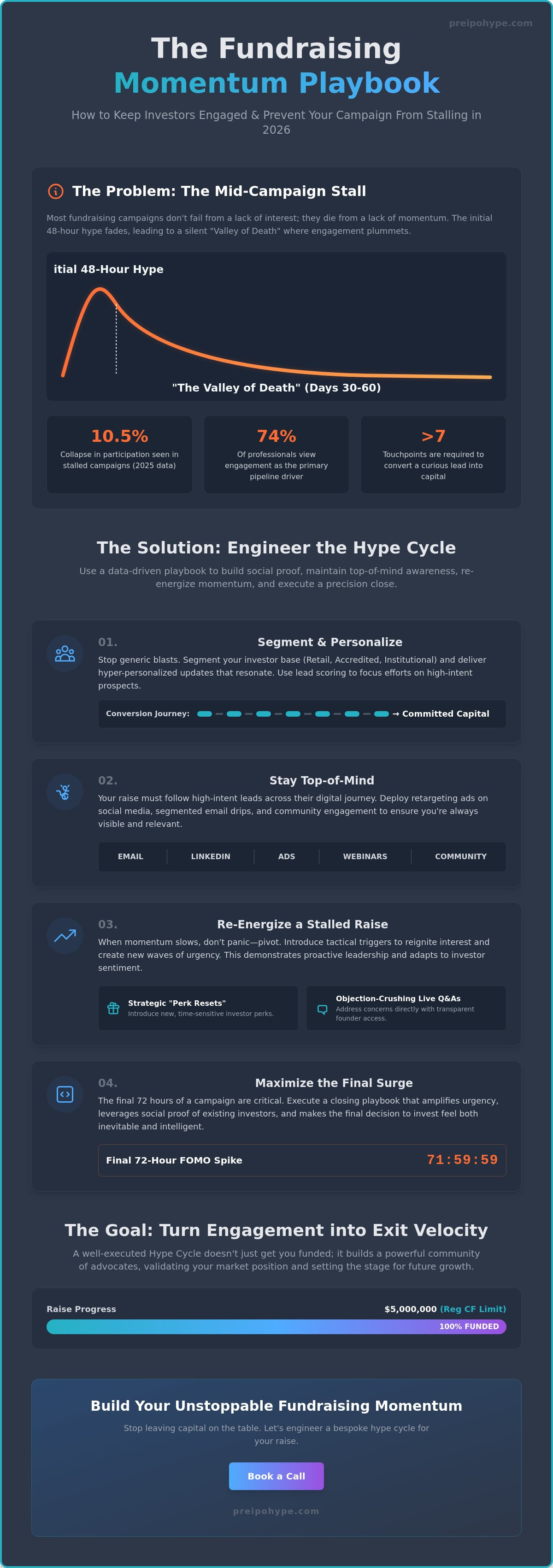
Investors wait for others to move, looking for engagement levels that signal secondary liquidity potential and market validation. In modern fundraising efforts, engagement serves as a proxy for the temperature of a deal. High engagement levels tell the market that the opportunity is scarce and the exit is inevitable. Converting a lead from curiosity to capital typically requires a minimum of seven touchpoints. This journey moves them through a digital funnel that balances data-heavy transparency with the infectious energy of a ground-floor opportunity. If you aren't visible, you're irrelevant.
Breaking the 'Valley of Death' in Mid-Campaign
Most Reg CF and Reg A+ raises hit a brutal stall point between days 30 and 60. This is the point where the initial excitement of the launch fades and the mid-campaign stall begins. Passive communication is the primary culprit. Unlike traditional donors who might give based on a single emotional appeal, equity investors operate on a logic of ROI and defensibility. If they sense a lack of activity, they ghost. You can't just send a monthly update; you need a daily rhythm that keeps the narrative moving forward. Research from 2025 shows that 74% of fundraising professionals now view consistent engagement as the primary pipeline for high-value partners.
Engineering FOMO Through Transparency
Fear of missing out is a powerful motivator, but it must be grounded in data to remain credible. Using percentage funded milestones is a proven way to trigger investment action. You must communicate exclusive updates to your core leads without violating SEC fair disclosure rules by ensuring all material information is available to the entire public pool. This transparency builds the trust necessary to turn a skeptical observer into a committed stakeholder. The Hype Cycle is the quantified measurement of investor sentiment, velocity, and capital commitment density that determines the ultimate valuation ceiling of a private offering in 2026.
The CRM-First Approach: Segmenting Your Investor Base for Maximum ROI
Sending a generic, one-size-fits-all newsletter is the fastest way to flatline your campaign. In the 2026 private market, investors don't just expect transparency; they expect relevance. If you're blasting a retail investor with the same technical jargon intended for a family office, you're losing both. Understanding how to keep investors engaged during a fundraising campaign starts with deep data segmentation. By integrating a custom investor CRM directly into your fundraising portal, you transform a static list into a dynamic engine of capital. This setup allows you to deploy 60-day attribution tracking, identifying exactly which LinkedIn ad or newsletter feature resulted in a verified bank transfer.
Lead scoring is your secret weapon for resource allocation. Digital behavior reveals intent. A lead who views your pitch deck twice and spends five minutes on your valuation benchmarks page is a "Whale" in the making. These individuals often meet the SEC's 2026 accredited investor threshold of $200,000 in annual income or a $1 million net worth. They deserve a high-touch approach, while retail leads can be nurtured through automated sequences. In 2025, AI adoption in fundraising surged to 80% because it allows founders to identify these engagement patterns without burning out. If you're curious about how your current tech stack measures up, you can ask our CEO for a direct perspective on your infrastructure.
Automated Nurture Sequences That Don't Feel Like Spam
The goal is to build authority before making the "Ask." Start with an education-first sequence that highlights your competitive moat and market traction. Use behavior-based triggers to keep the conversation personal. If a lead views your deck twice, trigger a personal video message from the founder explaining the latest growth milestones. For high-urgency moments, such as a round closing in 48 hours, SMS alerts cut through the digital noise with a 98% open rate, ensuring your most engaged leads don't miss the final window.
The Power of Attribution in 2026
You can't manage what you don't measure. Founders must track every click from the initial social impression to the final "Invest" button. This level of granularity allows you to re-engage "abandoned cart" investors who started the subscription agreement but didn't finish. Often, these leads just need a final nudge or a clarifying answer to a technical question. For those starting from scratch, establishing a robust Foundation Infrastructure is the essential first step to ensuring your data is clean and actionable from day one.
Omnichannel Mastery: Keeping the Raise Top-of-Mind Across Platforms
Visibility is not a luxury; it is a prerequisite for liquidity. In the 2026 private market, a single touchpoint on LinkedIn is a wasted opportunity. To master how to keep investors engaged during a fundraising campaign, you must deploy a "Surround Sound" strategy that ensures your offering follows the target investor across every digital frontier they inhabit. This isn't about spamming a list. It is about a coordinated strike where your digital marketing and advertising efforts work in perfect lockstep with your PR hits and newsletter features. When an investor sees your valuation benchmarks in a morning briefing and then encounters a founder interview on their social feed by lunch, you aren't just a project; you're a movement.
Humanizing the founder is the final bridge between interest and an executed wire transfer. High-production video funnels serve as your 24/7 pitchmen, delivering your vision with a level of authority that a static PDF cannot replicate. These videos allow you to articulate your moat and secondary liquidity plans with the infectious energy required to move the needle. With AI adoption in investor relations hitting 80% by late 2025, the standard for professional communication has shifted. Investors now expect a seamless, multi-platform narrative that proves you have the technical infrastructure to scale.
Retargeting: The Secret Weapon of Successful Raises
Retargeting is where the "Hype Cycle" becomes a measurable financial indicator. By setting up Meta and LinkedIn pixels to track everyone who views your pitch deck, you can serve "Milestone Ads" that evolve as your raise progresses. These ads don't just ask for money; they celebrate growth, such as "50% Funded in 14 Days" or "New Strategic Partnership Secured." This approach often yields a 5x higher ROI than cold acquisition because you're talking to a warm audience that has already signaled intent. It's about staying top-of-mind until the investor's logic aligns with their FOMO.
Third-Party Validation and Newsletter Exposure
Internal updates are essential, but third-party validation provides the institutional-grade credibility that closes "Whales." Leveraging newsletter exposure through platforms like Invst Guru places your deal in an "Insider" context that feels like an exclusive recommendation rather than a cold pitch. Using "As Seen In" logos from verified financial outlets reinforces the social proof that 74% of fundraising professionals now cite as a critical component of their 2026 strategy. A well-timed founder update, shared virally by your current investors, can create a "Hype Spike" that carries your momentum through the difficult mid-campaign weeks.
Tactical Fixes for a Stalled Campaign: Re-Energizing Your Audience
When your capital raise hits the inevitable mid-campaign plateau, silence is your greatest enemy. Stalled momentum often occurs because the initial inner circle has already committed, leaving a gap before the broader market feels enough FOMO to jump in. Learning how to keep investors engaged during a fundraising campaign during this phase requires tactical interventions that reignite the hype cycle. One of the most effective tools is the 'Perk Reset.' By introducing exclusive new investor rewards or tiered benefits mid-way through the raise, you give your existing leads a fresh reason to cross the finish line. This second wave of capital often accounts for 15% to 20% of the total raise in successful 2026 offerings.
Another high-impact move is the 'Matching Gift' strategy. This involves highlighting a lead investor's commitment to create a temporary surge in retail action. If a high-net-worth individual or a family office commits a significant block, use that as a catalyst. SEC-compliant 'Flash Updates' can then be deployed to communicate this progress, creating a sense of urgency without violating fair disclosure regulations. If you need a tailored strategy to navigate these complexities, you should book a strategic consulting session to audit your current trajectory.
Addressing the #1 Objection: 'Is this a safe bet?'
Institutional-grade trust is built through radical transparency. In the 2026 landscape, investors are increasingly skeptical of pitches that lack data. You must provide transparency reports that detail your moat and product-market fit. If your offering includes secondary liquidity options, highlight them now to reduce the perceived risk of locked capital. A powerful update might state: "Our current valuation benchmarks are grounded in a 22% year-over-year revenue increase, ensuring your entry point reflects tangible growth rather than speculative hype." This level of directness signals that you are an informed insider, not just a founder looking for a check.
The 'Ask Me Anything' (AMA) Framework
Live interaction is the ultimate objection-crusher. In 2026, LinkedIn Live has emerged as the preferred platform for investor webinars, offering better organic reach than traditional Zoom calls. The key is to seed the session with pre-submitted questions from your CRM to ensure the narrative stays focused on your value proposition. By addressing concerns in real-time, you can convert up to 30% of webinar attendees into committed investors within 24 hours of the broadcast. This high-touch approach cuts through relevance fatigue and proves you are an accessible, forward-thinking founder who is ready to lead a unicorn-hunting expedition.
Scaling the Close: Turning Engagement into a Successful Exit
The final 72 hours of a raise are not the time to coast. They are the high-water mark of the hype cycle. In the 2026 private market, the closing window is where the most significant capital flows occur as the "fear of missing out" reaches its peak. You've spent weeks mastering how to keep investors engaged during a fundraising campaign; now it's time to harvest that attention. By leveraging the $5 million Reg CF offering limit (updated as of February 2026), you can drive a final surge in commitments that pushes your valuation to its maximum defensible ceiling. This isn't just about finishing a raise. It's about engineering a liquidity signal that resonates all the way to your Series B.
Transitioning your investors from "check-writers" into "brand ambassadors" is the ultimate insider move. A successful close turns a list of names into a decentralized marketing army. This process is complex, but it doesn't have to be manual. Advanced Reg CF marketing services now automate this entire arc, ensuring that the transition from lead to stakeholder is seamless. The engagement data you've gathered—every click, every webinar question, and every pitch deck view—is your most valuable asset for future rounds. It proves a level of market validation that institutional VCs cannot ignore.
Leveraging Your New Investor Army
Once the wire transfers are confirmed, the real work of community building begins. Creating an "Investor-Only" portal provides a gated environment where your 1,000+ retail investors can receive exclusive updates and secondary liquidity news. Don't let their energy dissipate. Ask them to assist with business development or social advocacy. When you have a massive group of stakeholders incentivized to see you succeed, you've built a moat that competitors can't easily cross. This sets the stage for a future IPO or a significant exit event by maintaining a steady pulse of opportunity.
Next Steps for Founders
As the campaign concludes, evaluate your data with cold precision. Identify which omnichannel touchpoints drove the highest ROI and where the "relevance fatigue" set in. You must also prepare for post-raise SEC reporting requirements, such as Form C-AR, while keeping the narrative focused on growth. The goal is to maintain the momentum you've built so your next liquidity event feels like a foregone conclusion rather than a struggle. Ready to engineer your own hype cycle? You can ask our CEO anything about your specific raise or book a strategy session to blueprint your path to the ground floor.
Claim Your Stake in the Private Market Frontier
The era of passive fundraising is over. In 2026, capital flows toward the founders who treat momentum as a measurable financial metric. You've seen how the Hype Cycle dictates success and how a CRM-first approach prevents the mid-campaign stall. Mastering how to keep investors engaged during a fundraising campaign means you aren't just selling shares; you're building a movement of brand ambassadors. It's about turning cold leads into a dedicated army of stakeholders who believe in your vision as much as your valuation.
Pre-IPO Hype has already facilitated over $100M for 230+ companies, providing the omnichannel mastery needed to navigate everything from Reg CF to a successful IPO. Our custom CRM is engineered specifically for the complexities of SEC-regulated raises, ensuring your engagement data becomes your most valuable Series B asset. Don't let your vision get lost in the digital noise. You now have the blueprint to engineer exclusivity and drive urgency at every stage of your raise.
Scale Your Capital Raise with Pre-IPO Hype's Custom CRM
The private market remains the final frontier of significant wealth creation. Act decisively, build your hype, and secure the capital your project deserves. The future belongs to the founders who move with purpose.
Frequently Asked Questions
How often should I send updates to investors during a raise?
You should send general campaign updates once per week to your entire list, but high-intent segments require more frequent touchpoints. During the final 72 hours of a raise, daily updates are necessary to capitalize on the FOMO spike that typically drives the largest capital inflows. This rhythm ensures you stay top-of-mind without causing relevance fatigue. Effective 2026 campaigns use these updates to highlight tangible growth milestones rather than just asking for capital.
What are the most effective channels for investor engagement in 2026?
Omnichannel "Surround Sound" is the gold standard for 2026, combining LinkedIn for institutional-grade authority with Meta for retail retargeting. High-production video funnels have become essential for humanizing the founder and explaining complex moats. Additionally, placement in "Insider" newsletters like Invst Guru provides the third-party validation necessary to close skeptical leads. Relying on a single channel is a high-risk strategy that often leads to a mid-campaign stall.
Can I use SMS marketing to engage investors under SEC rules?
SMS marketing is permitted and highly effective, provided every message is filed with the SEC as "offering communications" under Regulation Crowdfunding or Reg A+. With a 98% open rate, SMS serves as the ultimate high-urgency tool for milestone alerts and round closings. You must ensure your CRM tracks these communications for compliance. It's a powerful way to cut through digital noise and reach investors directly on their most personal devices.
How do I re-engage an investor who looked at my pitch deck but didn't invest?
Re-engagement starts with behavior-based triggers in your custom CRM. If an investor views the deck twice but stops, send a personalized video update or a transparency report addressing common valuation concerns. Using retargeting pixels to serve "Milestone Ads" on social media also helps. This is a core part of how to keep investors engaged during a fundraising campaign, as it keeps your opportunity visible until their logic aligns with their fear of missing out.
What kind of content drives the most investment during a Reg CF campaign?
Data-driven traction reports and social proof are the most effective content types in the current market. Investors in 2026 prioritize tangible proof of concept over abstract ideas, so you must highlight revenue growth or strategic partnerships. Using "As Seen In" logos and founder AMAs also builds the institutional-grade trust required for larger checks. Content that demonstrates a clear path to secondary liquidity or an IPO exit consistently outperforms generic mission statements.
Is it better to focus on new leads or existing leads during a stall?
Focusing on existing leads is significantly more efficient, as retargeting warm leads often yields a 5x higher ROI than cold acquisition. A 2025 survey revealed that 74% of fundraising professionals find that their existing pipeline is the most reliable source for high-value partners. During a stall, you should deploy a "Perk Reset" or a matching gift strategy to incentivize your current pool to finally execute their wire transfers.
How do I handle negative comments or 'trolls' on my fundraising page?
Address negative comments with radical transparency and data-backed rebuttals rather than deleting them. In 2026, investors view your response to criticism as a proxy for your overall governance and leadership style. Providing a professional, calm explanation of your competitive advantage or valuation benchmarks can actually turn a public doubt into a trust-building moment. This level of transparency signals to "Whales" that you are an informed insider who can defend the business.
What is a 'lead scoring' system for investors and why do I need one?
Lead scoring is a technical system that ranks prospects based on digital behaviors, such as spending five minutes on your valuation page. It's an essential part of how to keep investors engaged during a fundraising campaign because it identifies who meets the accredited investor income threshold of $200,000. By scoring leads, you can automate retail nurture sequences while dedicating your personal time to high-value "Whales." This ensures your acquisition efforts are focused on the leads most likely to convert into significant capital.
Disclaimer
Educational only. Not investment, tax, or legal advice. Pre-IPO Hype is investor relations infrastructure for Regulation CF and Regulation A+ raises. We are not a broker-dealer, funding portal, or investment adviser, and we do not offer or sell securities or make investment recommendations. Any securities offering is made only by the issuer, through its own offering documents and, where required, a registered intermediary.


