
How to Launch a Successful Crowdfunding Campaign
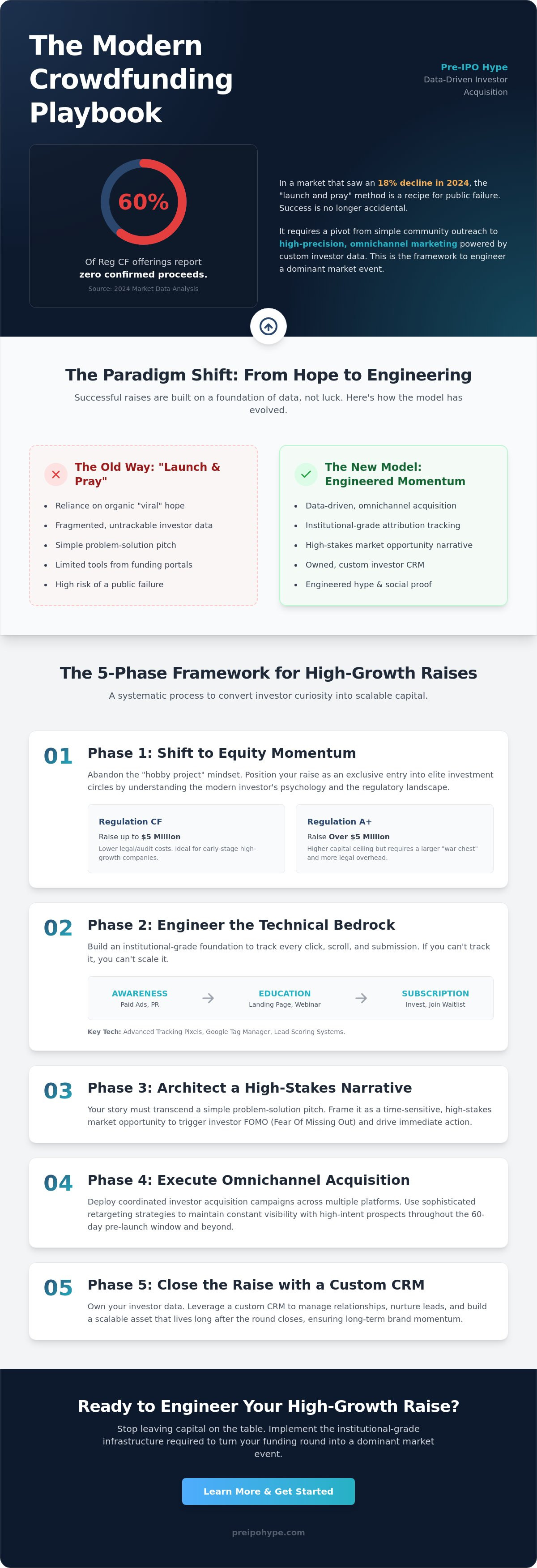
With approximately 60% of all attempted Regulation Crowdfunding offerings reporting zero confirmed proceeds, the dream of a "viral" raise is often a mathematical illusion. In a market that saw an 18% decline in 2024, the margin for error has vanished. To master 5. how to launch a successful crowdfunding campaign, you must pivot from simple community outreach to high-precision, omnichannel marketing powered by custom investor data.
It's frustrating to deal with fragmented investor data and the inability to track attribution across your marketing channels. These inefficiencies lead to a high cost of acquisition and the constant fear of a public failure in your raise. This article provides the data-driven framework needed to engineer high-growth equity raises and convert investor curiosity into scalable capital. We'll examine the institutional-grade infrastructure and performance tracking required to turn your funding round into a dominant market event. You'll learn how to build a scalable investor database that lives long after the round closes, ensuring your brand maintains the momentum of an industry leader.
Key Takeaways
- Stop relying on "launch and pray" tactics and learn to engineer market momentum by positioning your raise as an exclusive entry into elite investment circles.
- Discover the technical blueprints for 5. how to launch a successful crowdfunding campaign by implementing foundation infrastructure that tracks every investor click with institutional precision.
- Transition your pitch from a simple problem-solution narrative to a high-stakes story of market opportunity and exit potential that triggers immediate investor FOMO.
- Execute omnichannel investor acquisition campaigns across multiple platforms, using retargeting strategies to maintain constant visibility with high-intent prospects.
- Secure your long-term growth by leveraging a custom investor CRM to own your data rather than relying solely on the limited tools provided by crowdfunding platforms.
Phase 1: The Shift from Community Projects to Equity Momentum
The era of the "kickstarter" hobby project is dead. Modern Crowdfunding has evolved into a sophisticated gateway to elite investment circles. It's about democratizing access to high-growth opportunities that were once gated by venture capital firms. To understand 5. how to launch a successful crowdfunding campaign, you must first abandon the "launch and pray" mentality. In 2026, successful raises are not accidental; they are the result of an engineered hype model that prioritizes data over hope.
Investors in the current market are more discerning than ever. They don't just want a cool product. They demand institutional-grade transparency and real-time performance data. This shift necessitates a 60-day pre-launch attribution window. You need to know exactly where your leads are coming from and how they engage with your brand before you even open the round. This period isn't just about building a waitlist. It's about stress-testing your narrative and refining your foundation infrastructure to ensure every dollar spent on acquisition is accounted for.
Understanding the Regulatory Landscape (Reg CF vs. Reg A+)
Regulation Crowdfunding (Reg CF) and Regulation A+ serve as the two primary vehicles for high-growth raises. As of July 2026, Reg CF allows companies to raise up to $5 million in a 12-month period. If your ambitions exceed that, Reg A+ offers a higher ceiling but comes with increased legal and audit costs. Your choice here dictates your marketing budget. A Reg A+ raise requires a significantly larger "war chest" for outreach because the scale of the capital target is higher. Regardless of the path, your SEC Form C filing is more than a legal requirement. It's your marketing foundation, proving to potential backers that your venture is vetted and serious.
The Psychology of the 2026 Digital Investor
Today's retail investors act like seasoned venture capitalists. They look for "momentum indicators" before committing capital. They want to see that others are moving first. Social proof is no longer a luxury; it's the primary currency of the digital raise. You aren't asking people to "donate" to a cause. You're offering them a chance to own a piece of the future. By shifting the narrative from a simple problem-solution pitch to a high-stakes market opportunity, you trigger the psychological triggers of early entry and exclusivity. This is about joining a movement, not just executing a transaction. Successful founders know that 5. how to launch a successful crowdfunding campaign begins with capturing this psychological momentum before the first dollar is even pledged.
Phase 2: Engineering the Foundation and Technical Bedrock
Scaling a raise to millions requires more than just a compelling story. It requires a technical bedrock that captures and converts every drop of interest. Before you spend a single dollar on ads, you must audit your digital footprint for "investor readiness." This isn't about having a pretty website. It's about ensuring your Foundation Infrastructure is configured to track every click, scroll, and submission across your entire ecosystem. If your tracking is broken, your capital is being wasted.
Implement advanced tracking pixels and Google Tag Manager (GTM) containers to enable multi-touch attribution. In the complex landscape of equity raises, an investor rarely converts on the first touch. You need to know if they first found you through a LinkedIn ad, returned via a newsletter, and finally committed after seeing a retargeting campaign. As the U.S. Small Business Administration highlights, choosing the right funding path is critical for long-term stability. Your technical setup should reflect that strategic choice by providing the data needed to justify every marketing decision. Establish a lead scoring system to prioritize high-net-worth outreach. By scoring prospects based on engagement depth and self-reported investment capacity, you can focus your manual outreach on the leads most likely to move the needle.
Building Your Investor Acquisition Funnel
A successful funnel operates in three distinct stages: Awareness, Education, and Subscription. Your landing page shouldn't just be a placeholder; it must function as a high-conversion investor portal. This portal serves as the entry point where curiosity is harvested into data. To master 5. how to launch a successful crowdfunding campaign, you must integrate this funnel with a Custom Investor CRM. This allows you to own your data and nurture prospects through automated sequences that build trust over time.
The 60-Day Pre-Launch Warm-up
The most successful campaigns are won before they officially launch. Use the 60 days leading up to your SEC filing to gather "Indications of Interest" (IOIs). This builds a VIP waitlist that creates immediate momentum on day one. Aim to secure commitments for 30% of your funding goal before the public launch. This early social proof is the most powerful tool in your arsenal. If you're unsure if your current stack is ready for a high-growth raise, you can book a technical audit session to identify and bridge your infrastructure gaps.
By using this data-driven approach, you can predict the success of the raise before you commit your full advertising budget. This technical discipline is what separates elite raises from the 60% of campaigns that fail to gain traction. When you understand 5. how to launch a successful crowdfunding campaign through the lens of engineering, you remove the element of luck from your capital raise.
Phase 3: Narrative Architecture—Story-Selling for Capital
Storytelling in the equity space isn't about tugging at heartstrings; it's about stimulating the desire for growth and market dominance. To understand 5. how to launch a successful crowdfunding campaign, you must pivot from the traditional "problem/solution" pitch. Investors in 2026 aren't just looking for a fix to a minor inconvenience. They're looking for a market opportunity with massive exit potential. Your narrative must paint a picture of a future where your company is the inevitable leader of its sector, making the act of investing feel like securing a seat on a rocket ship before it leaves the terminal.
Central to this architecture is the 60-second "Hype" video. This isn't a dry explainer; it's a cinematic trigger for FOMO. It should highlight the velocity of your growth and the exclusivity of the current round. While academic resources might list the basic elements of a successful crowdfunding campaign, the private market demands a more aggressive approach. By utilizing a proven Reg CF marketing services playbook, you position the founder not as a petitioner for funds, but as the informed insider of a gated world. You're offering access to an opportunity that was previously restricted to institutional elites.
The Wealth Creation Narrative
Your startup must be framed as a primary vehicle for wealth creation. This requires a delicate balance. You need to use evocative, aspirational language to describe the "rare opportunity" of early entry, but it must be anchored by precise performance metrics. Don't just promise growth; show the data-driven path to realization events. When you speak to investors, you're communicating that the window of opportunity is narrow and the potential for significant wealth creation is high for those who act decisively.
Omnichannel Storytelling
A narrative only gains momentum when it's heard everywhere. You must adapt your core story for different environments: professional and data-heavy for LinkedIn, fast-paced and rhythmic for X (Twitter), and community-driven for Discord. Securing newsletter exposure is a critical validator in this process. It provides third-party social proof that your story has merit. By maintaining a steady, rhythmic pulse of updates, you mirror the rapid movement of high-growth markets. This constant forward motion ensures your campaign feels like a movement rather than a static transaction, which is the secret to 5. how to launch a successful crowdfunding campaign in a crowded digital landscape.
Phase 4: Omnichannel Investor Acquisition at Scale
If you treat your raise like a one-time event, you've already lost. High-growth capital raises in 2026 require a relentless, automated acquisition engine. To master 5. how to launch a successful crowdfunding campaign, you must move beyond your personal network and scale your outreach across at least five digital platforms. This isn't just about being present; it's about being omnipresent. By executing a sophisticated digital marketing and advertising strategy, you create an environment where potential investors encounter your brand at every stage of their digital journey.
Retargeting is the backbone of this phase. Most investors won't commit on their first visit. You need to "stalk" high-intent prospects with social proof, founder updates, and milestone alerts until they convert. Use lookalike audiences built from existing investor data to find new prospects who mirror the behavior of your most active backers. Once a lead enters your funnel, automated email workflows should take over. The goal is to guide them through a 7-touch cycle that builds trust and urgency without manual intervention. This level of automation ensures your pipeline remains full while you focus on high-level strategy.
Paid Media Strategy for Reg CF
Strategic budget allocation is the difference between a funded round and a failed one. Divide your spend between broad-reach platforms like Meta and Google, and niche financial networks where serious capital resides. Constantly A/B test your creative assets. You aren't just looking for a low "Cost Per Lead." You're optimizing for the "Cost Per Invested Dollar." Managing the "Investor Hype Cycle" is equally vital. You must ramp up spend during the middle weeks of the campaign to prevent the plateau that kills momentum. If you want to see how we engineer these acquisition engines, you can book an acquisition strategy call to review your current media plan.
Cold Outreach and Strategic Partnerships
Paid ads shouldn't work in isolation. Leverage the Invst Guru network to gain instant credibility with a pre-vetted audience of active investors. Combine this with automated LinkedIn outreach targeting accredited individuals who fit your specific sector. Finally, coordinate with "Lead Investors" early. Having an anchor investor who has already committed significant capital provides the social proof required to trigger a mass movement of retail interest. This multi-pronged approach is the only way to ensure 5. how to launch a successful crowdfunding campaign reaches the scale required for market dominance.
Phase 5: Closing the Raise with a Custom Investor CRM
Relying solely on the default tools provided by public funding portals is a strategic bottleneck. While these portals offer a marketplace, they are designed to protect their own ecosystem and user base, not your long-term investor relations. If you want to master 5. how to launch a successful crowdfunding campaign, you must own your data. Transitioning your leads into a Custom Investor CRM gives you the visibility required to see who is opening your updates, who is clicking through to the subscription docs, and who is hovering on the edge of a commitment. This is where the raise is won or lost.
The final 48 hours of an equity raise are a high-velocity event where momentum must be engineered, not expected. This is the time to activate your current investors as brand ambassadors. By providing them with "swipe file" content and real-time milestones, you turn your cap table into a secondary marketing force. This creates a sense of inevitable success that pulls in the hesitant "fence-sitters." You aren't just closing a round; you're finalizing the first chapter of your company's public market story.
Lead Scoring and Engagement Tracking
Precision is paramount during the close. Use your CRM metrics to identify "Whale" investors—high-net-worth individuals who have engaged with your content multiple times but haven't yet executed their subscription agreement. A personalized, direct outreach from the CEO to these top-tier leads often provides the final nudge needed to secure significant checks. Implementing 60-day attribution tracking across your entire stack prevents capital leakage by ensuring every high-intent lead is accounted for and nurtured to the finish line. This data-driven approach ensures your time is spent on the prospects most likely to move the needle.
Post-Raise Momentum
The close of the raise is not the end of the journey; it's the birth of your permanent "Hype Club." Use your CRM to segment your new investors and keep them engaged with exclusive updates and future opportunities. This database is your most valuable asset when preparing for a Series A or a secondary offering. You've built more than a bank account; you've built a scalable engine for future capital. If you're ready to move from "launch and pray" to a high-precision equity raise, schedule a strategy session with Fuzzy Wenzel to architect your custom investor acquisition framework. Understanding 5. how to launch a successful crowdfunding campaign is about more than the raise itself; it's about what your company becomes once the capital is secured.
Secure Your Capital Milestone and Dominate the Market
The window for "launch and pray" crowdfunding has closed. In a market where 60% of campaigns fail to gain traction, success belongs to those who treat their raise as a high-precision marketing operation. You now have the blueprint for 5. how to launch a successful crowdfunding campaign by integrating foundation infrastructure with a narrative built for wealth creation. By owning your investor data and deploying omnichannel acquisition, you move from a state of uncertainty to one of controlled ambition.
We have facilitated over $100M in funding and powered more than 230+ successful campaigns using our proprietary investor CRM technology. This isn't just about reaching a funding goal; it's about building a scalable database that fuels your company's future growth and realization events. You've seen how the informed insiders operate. Now, it's your turn to join the elite circle of founders who command market attention and secure institutional-grade capital.
Are you ready to stop guessing and start engineering your momentum? Launch Your Engineered Raise with Pre-IPO Hype and turn your vision into a dominant market force. The future of your company is within reach for those who act decisively.
Frequently Asked Questions
Is equity crowdfunding legal for all startups in the United States?
Equity crowdfunding is legal for most U.S. startups under Regulation Crowdfunding (Reg CF), allowing companies to raise up to $5 million annually. However, investment companies and those unable to meet SEC disclosure requirements are excluded. Compliance involves filing a Form C and providing financial statements that are either self-certified, reviewed by a CPA, or fully audited depending on your target raise amount.
How much does it cost to launch a successful Reg CF campaign in 2026?
Launching a high-growth campaign involves legal, accounting, and marketing expenses that scale with your target. Portals typically charge success fees between 5% and 7%, while CPA reviews are mandatory for raises over $618,000. To master 5. how to launch a successful crowdfunding campaign, you must also allocate a significant budget for digital acquisition and technical infrastructure to build the necessary pre-launch momentum.
Can I raise money from international investors via crowdfunding?
You can accept capital from international investors, provided you comply with both U.S. laws and the regulations of the investor's home country. While Reg CF is a domestic framework, many platforms facilitate participation from non-U.S. residents. You should ensure your acquisition campaigns are optimized for jurisdictions that allow participation in U.S. private offerings to avoid friction during the closing process.
What happens if my crowdfunding campaign does not reach its minimum goal?
If your campaign fails to reach its "all-or-nothing" minimum target by the deadline, all committed funds are returned to the investors. This is a significant risk, as approximately 60% of attempted Reg CF offerings report zero confirmed proceeds. Reaching your minimum quickly is essential for establishing social proof, which is why securing indications of interest before the official launch is a non-negotiable step.
How long does the preparation phase take before a campaign goes live?
A sophisticated preparation phase typically takes 60 to 90 days before the public launch. This window is used to conduct a digital footprint audit, deploy foundation infrastructure, and build a VIP waitlist. Rushing this process leads to high acquisition costs and fragmented data, which are the primary reasons many campaigns fail to gain the momentum required for a successful round.
Is a Custom Investor CRM necessary if I am using a major funding portal?
A Custom Investor CRM is essential because major portals are designed to own the relationship with the investor, not you. While the portal handles the transaction, a CRM allows you to track multi-touch attribution and nurture leads who haven't yet committed. Owning this data enables you to convert investor curiosity into scalable capital and maintain a permanent database for all future funding rounds.
What is the difference between an accredited and non-accredited investor?
Accredited investors meet specific SEC thresholds, such as a $1 million net worth excluding their primary residence or an annual income exceeding $200,000. Non-accredited investors are members of the general public. In 2026, non-accredited individuals can invest based on their income and net worth, allowing for the democratization of elite investment circles that were previously gated by institutional requirements.
How much equity should I give away in a crowdfunding round?
Most startups divest between 5% and 15% of their equity during a crowdfunding round, though this varies based on valuation and capital needs. The goal is to balance immediate funding requirements with the dilution expected in future rounds. Understanding 5. how to launch a successful crowdfunding campaign involves pricing your round to attract early backers while ensuring enough founder control to drive the company toward a high-value exit.
Disclaimer
Educational only. Not investment, tax, or legal advice. Pre-IPO Hype is investor relations infrastructure for Regulation CF and Regulation A+ raises. We are not a broker-dealer, funding portal, or investment adviser, and we do not offer or sell securities or make investment recommendations. Any securities offering is made only by the issuer, through its own offering documents and, where required, a registered intermediary.


