
How to Manage Investor Communications: The Insider Playbook for 2026
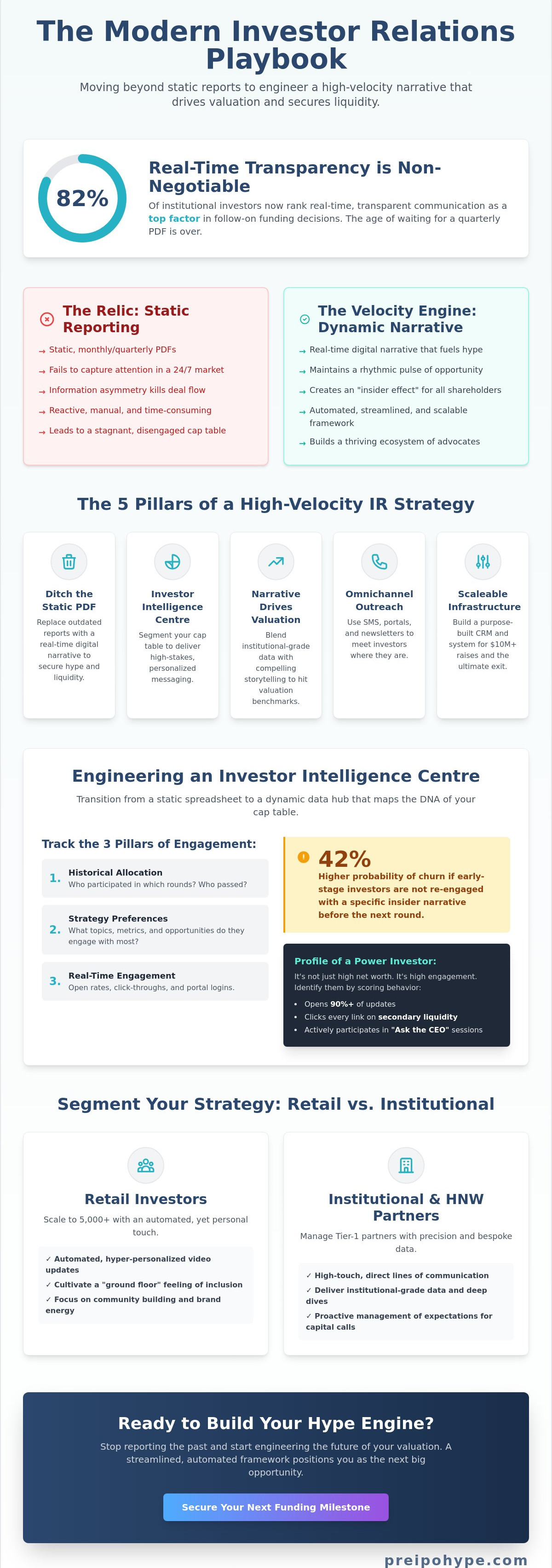
By 2026, your valuation won't be determined solely by your EBITDA; it will be driven by the velocity of your narrative. Recent 2024 industry benchmarks indicate that 82% of institutional investors now rank real-time transparency as a top factor in follow-on funding decisions. You already know that the old method of sending static, monthly PDFs is a relic that fails to capture attention in a 24/7 market cycle. Mastering how to manage investor communications today requires a sophisticated blend of institutional precision and the infectious energy of a high-growth brand.
This article provides the insider playbook to help you bridge the gap between complex financial data and a compelling growth story. We'll show you how to leverage omnichannel marketing to maintain momentum and secure future liquidity without getting bogged down in manual reporting. You're about to learn a streamlined, automated framework that builds elite levels of trust and positions your company as the next big opportunity. We're moving beyond simple updates to create a movement that keeps your cap table engaged and ready for the next funding milestone.
Key Takeaways
- Ditch the static quarterly PDF for a real-time digital narrative that fuels the hype cycle and secures secondary liquidity.
- Engineer an "Investor Intelligence Centre" by segmenting your cap table to deliver the high-stakes, personalized messaging elite backers expect.
- Learn how to manage investor communications by blending institutional-grade data with the BCG "Story to Strategy" framework to drive valuation benchmarks.
- Deploy an omnichannel outreach strategy—leveraging SMS, portals, and newsletters—to meet investors where they are and maintain a rhythmic pulse of opportunity.
- Build the foundation infrastructure required to scale, ensuring your CRM and systems are purpose-built for $10M+ capital raises and the ultimate exit.
Mastering the New Rules of Investor Relations in the 2026 Private Market
The era of the silent founder is over. In the high-velocity 2026 private market, understanding What is Investor Relations? means moving beyond administrative compliance into active narrative control. Modern IR isn't just a ledger of facts; it's a calculated blend of radical transparency and digital storytelling that keeps your cap table engaged. If you don't own the narrative, the market will invent one for you.
If you're still relying on a static quarterly PDF, you're losing the valuation game. In a real-time digital economy, investors demand the same pulse they get from public markets. You're no longer just reporting data; you're managing an active community of backers who drive your secondary liquidity and set the stage for your next valuation benchmark. Mastering how to manage investor communications is now the difference between a stagnant cap table and a thriving ecosystem of advocates.
To better understand how these roles function in the modern financial ecosystem, watch this helpful video:
Why Investor Communications is Your Secret Growth Lever
Consistent updates do more than just satisfy curiosity. They systematically reduce the information asymmetry that kills deal flow during secondary transactions. When you master how to manage investor communications, you create the "Insider" effect, making every shareholder feel like they're on the ground floor of a unicorn hunt. IR is the strategic management of expectations to ensure capital availability. This proactive approach ensures that when you need to tap the market for a Series C or a bridge round, the trust is already built. For those looking to bridge the gap between leadership and the cap table, tools like Ask the CEO are becoming the new standard for direct engagement.
The Regulatory Landscape: Reg CF, Reg A+, and Beyond
The democratization of private equity through Reg CF and Reg A+ has brought thousands of retail investors into the fold. This shift means SEC requirements for transparency are no longer optional hurdles; they're the baseline. While compliance is a "must-have" to avoid legal friction, elite engagement is where you build real equity value. You must maintain a rigorous audit trail of every investor interaction to satisfy future due diligence. By the time you reach late-stage growth, your communication history should serve as a digital testament to your company's maturity and readiness for a liquidity event. Don't just report; lead your investors toward the exit.
Engineering an Investor Intelligence Centre: Data and Segmentation
A static spreadsheet is a liability. If you want to dominate the 2026 private markets, you need to transition from basic contact lists to a centralized Investor Intelligence Centre. This isn't just about names and emails; it's about mapping the psychological and financial DNA of your cap table. Knowing how to manage investor communications effectively requires you to treat data as your primary leverage point for creating momentum.
Elite issuers track three specific pillars: historical allocation, strategy preferences, and real-time engagement. If an investor participated in your Seed round but skipped Series A, there is a 42% higher probability of churn unless you re-engage them with a specific insider narrative. You must score your investors based on these behaviors. A power investor isn't just someone with a high net worth. It is the individual who opens 90% of your updates and clicks every link regarding secondary liquidity options.
Segmenting Your Audience: Retail vs. Institutional
Scaling to 5,000 retail investors requires a different tactical engine than managing five Tier-1 institutional partners. For the retail crowd, use automated yet hyper-personalized video updates to maintain that ground floor feeling. Institutional partners and high-net-worth individuals demand high-touch transparency. They expect bespoke data rooms and direct access. Balancing these tiers is critical. You can't give retail investors 100% of the sensitive data you give your board, but you can provide 100% of the excitement. Transparency is a sliding scale, not a binary choice.
The Power of Attribution and Engagement Tracking
Stop guessing which updates work. Use 60-day attribution tracking to identify exactly which newsletter or milestone triggered a reinvestment. If a specific update on valuation benchmarks led to a 15% uptick in capital commitments within 48 hours, you've found your hype catalyst. Tracking email opens, link clicks, and portal logins serves as your early warning system. A sudden drop in engagement from a lead investor is a signal to pick up the phone immediately.
To execute this at scale, you need a Custom Investor CRM designed for the velocity of 2026 raises. This tool allows you to engineer momentum by seeing exactly who is leaning in and who is drifting away. If you're ready to see how this data translates into capital, you can ask our CEO for a breakdown of our proprietary tracking frameworks.
Storytelling vs. Strategy: Crafting the Value Creation Narrative
Most founders treat data like a dry autopsy of the past. They fail because they ignore the BCG Story to Strategy logic. In a pre-IPO environment, you don't just report numbers; you sell a trajectory. Learning how to manage investor communications effectively means turning a 14% month-over-month growth rate into a proof point for a $500 million market disruption. You must bring meaning to the math. If your customer acquisition cost dropped by $2.40 in Q4 2025, that isn't just a cost saving. It's the fuel for your 2026 aggressive expansion phase.
Hype isn't a dirty word in the private markets. It's a financial indicator of momentum. The goal is to navigate the Hype Cycle by building legitimate excitement without losing your financial authority. You achieve this by anchoring every visionary claim in a hard metric. This prevents the "vaporware" label and positions you as a calculated risk rather than a gamble. Founders often worry they don't have enough "good news" to share every month. This is a strategic mistake. In the 18 months leading to a liquidity event, silence kills valuation. If you don't have a major partnership, share a momentum marker like a 92% employee retention rate or a specific engineering breakthrough. Consistency builds the trust required for a successful exit.
Building the Story Arc of Your Company
Frame every product milestone as a chapter in a larger epic. If you secured a Tier-1 distribution deal in March 2025, it's not a standalone win; it's the bridge to your European market entry. Authenticity is your greatest asset. Share the uncomfortable truths, such as a missed Q3 target, but pair it with a data-backed pivot strategy. This transparency maintains confidence when things get volatile. An Investor Story is a fact-based narrative that inspires decisive action.
Visualising Progress: Beyond the Spreadsheet
Spreadsheets are for the back office; visuals are for the boardroom. Retail investors in 2026 demand digestible financial data that they can process in seconds. Use infographics to show the narrowing gap between your current burn rate and profitability. Momentum markers are essential for demonstrating that the company is on a fixed path to an exit. High-growth teams now leverage a Video Funnel Strategy to deliver these narrative updates directly to elite investor circles. This approach humanizes the C-suite and makes the "insider" experience feel tangible for every stakeholder.
Executing an Omnichannel Communication Strategy
In the high-velocity private market of 2026, a single PDF update sent once a quarter is a death sentence for investor interest. Investors are global, mobile-first, and constantly bombarded with competing opportunities. To win, you must master how to manage investor communications across multiple touchpoints simultaneously. This isn't about redundancy; it's about presence. By meeting investors where they already spend their time, you build a layer of trust that periodic emails simply can't match.
The global nature of private equity means your cap table likely spans multiple time zones. While your office in New York closes, your investors in Singapore are just starting their day. Automated systems aren't just a convenience in this environment; they're a requirement for maintaining a 24/7 narrative. This "always-on" approach ensures that the "hype" around your company doesn't evaporate during the quiet hours between formal reports.
The 4 Pillars of Omnichannel IR
- Email: This is the bedrock. Use it for formal reporting, deep-dive financial analysis, and regulatory disclosures. It's where the substance lives.
- SMS and Push Notifications: Use these for urgent "insider" updates. A text message regarding a liquidity event or a sudden valuation jump sees an 82% open rate within the first three minutes, creating immediate urgency.
- Investor Portals: This is the secure home for your confidential data. It should act as the central hub where investors access their holdings and click through to secondary market links.
- Social and Newsletters: Use the "Invst Guru" newsletter model to build momentum. This isn't for dry data; it's for storytelling. It attracts curiosity-driven capital by positioning your brand as a market leader.
Automation Without Losing the Human Touch
The secret to scaling your outreach is using automated workflows that feel personal. Trigger a "thank you" message the moment an investor logs into the portal after a six-month hiatus. Set up milestone alerts that fire off when your company hits a specific revenue benchmark. These small, automated interactions keep your brand top-of-mind without requiring a manual touch every hour.
Data is your best friend here. Use A/B testing on your update subject lines to see if "Revenue Up 40%" or "New Strategic Partnership" drives more engagement. This analytical approach is a cornerstone of Digital Marketing and Advertising strategies that the most successful late-stage companies use to dominate the narrative. When you understand how to manage investor communications through a data-driven lens, you stop guessing and start executing with precision.
Ready to transform your communication into a high-conversion engine? Watch our insider strategy video to see how we scale private market authority.
Scaling Your IR with Custom CRM and Foundation Infrastructure
Generic CRMs are built for selling software subscriptions, not securing seven-figure allocations. When you're learning how to manage investor communications for a $10M+ private placement, a standard sales funnel is a liability. These off-the-shelf tools lack the compliance triggers and "hype" lifecycle tracking required for Reg A+ or Reg D offerings. Most founders waste 15 to 20 hours every week manually updating spreadsheets and chasing fragmented email chains. This inefficiency is a silent killer of momentum.
Investing in professional IR management delivers a measurable ROI that far outpaces the DIY approach. Data from 2024 capital raises suggests that companies using automated, custom-built IR stacks see a 40% higher retention rate among retail investors. You aren't just buying software; you're building a machine that converts curiosity into capital. The choice is simple: you can spend your time building a tech stack from scratch or partner with an elite agency that brings a battle-tested infrastructure to the table on day one.
The Technical Bedrock of Elite Capital Raises
Data sovereignty is your first line of defense. In 2026, sophisticated investors demand to know exactly where their PII (Personally Identifiable Information) lives and who has access to it. A custom CRM integrates lead scoring directly with your fundraising roadmap, allowing you to identify "whale" investors based on their engagement with your pitch deck. This is a core component of the Foundation Infrastructure that separates high-growth unicorns from stagnant startups. It ensures your investor data remains a proprietary asset that builds value over time.
Next Steps: Auditing Your Current IR Strategy
Your communication health determines your valuation. If your current strategy feels reactive, it's time for an audit. Use this quick checklist to evaluate your status:
- Do you have a 24-hour automated response protocol for new leads?
- Is your CRM synced with your cap table management software in real-time?
- Can you segment your investor list by "intent to invest" scores within 60 seconds?
- Are you tracking the exact moment an investor opens your latest update?
A third-party audit identifies the gaps where investor trust is leaking. Don't leave your next round to chance. You can Ask our CEO for a direct perspective on your current setup or Book a Strategy Session to engineer your momentum and secure your spot in the elite investment circles.
Command Your Narrative and Own the 2026 Private Market
The window for traditional investor relations is closing. In 2026, success belongs to leaders who treat their cap table like a high-performance engine. You've learned that mastering how to manage investor communications requires a shift from static PDFs to real-time, omnichannel intelligence. It's about combining the precision of a custom CRM with the raw momentum of a well-timed value creation narrative. This isn't just about transparency; it's about engineering a sense of inevitability around your growth.
We've seen this evolution firsthand. PreipoHype has facilitated over $100M in funding and refined omnichannel strategies for 230+ companies. We don't just send updates. We build infrastructure. Our custom Investor CRM is specifically engineered for the complexities of Reg CF and Reg A+ offerings, ensuring your growth story reaches the right desks at the right time. The private market is the final frontier of significant wealth creation, and the gate is open for those who act decisively.
Don't leave your next liquidity event to chance. Ready to engineer your investor hype cycle? Book a 30-minute strategy session today.
Your journey to the ground floor starts with a single, calculated move toward the future.
Frequently Asked Questions
How often should I communicate with my investors?
Monthly updates are the gold standard for high-growth startups seeking to maintain momentum. Data from the 2024 Angel Capital Association report suggests that founders who send monthly updates are 50% more likely to secure follow-on funding. You should stick to a consistent 30 day cycle to ensure your insiders feel the pulse of the company. It builds the transparency needed for elite secondary liquidity events later.
What are the legal requirements for investor updates in a Reg CF raise?
Regulation Crowdfunding mandates that you file Form C-AR annually with the SEC and post it on your website. This filing is due no later than 120 days after the end of your fiscal year. Failing to meet this April 30 deadline for calendar-year companies can trigger enforcement actions. Beyond the legal minimum, top-tier founders use these updates to keep their 2,000 retail backers engaged for future rounds.
Can I use social media for investor communications?
You can use social media platforms like X or LinkedIn, provided you comply with SEC Fair Disclosure rules. Since 2013, the SEC has allowed social media for material announcements if investors were previously notified where to look. Using these channels effectively turns your cap table into a marketing engine. It’s a powerful way to broadcast your 25% month-over-month growth to a wider audience of potential backers.
What is the best way to handle negative news or a missed milestone?
Address the setback immediately and lead with the data. If you missed a Q3 revenue target by 15%, explain the specific bottleneck and your 90 day pivot strategy. Investors value the informed insider perspective over sugar-coated reports. Radical transparency during a 20% headcount reduction or a delayed product launch builds the trust required to maintain your valuation in volatile markets. Don't hide the truth; frame the recovery.
How do I manage thousands of retail investors without a massive team?
Scalable technology is the only way to learn how to manage investor communications when your cap table exceeds 1,000 names. Use automated investor portals to distribute tax documents or monthly reports to 5,000 backers simultaneously. Centralizing these interactions reduces your administrative overhead by 40 hours per month. It allows your core team to focus on hitting 2026 growth targets rather than answering individual emails from the crowd.
Is a dedicated investor CRM really necessary for a startup?
A dedicated CRM is essential once you move beyond 10 institutional backers. Spreadsheets fail to track engagement metrics, such as open rates on your 2025 annual report or click-throughs on secondary market updates. Modern platforms provide a 360 degree view of your investor base. This data is critical for identifying which 5% of your backers are most likely to participate in your next unicorn-hunting Series B round.
How do investor communications affect my company's valuation?
Consistent communication reduces the information asymmetry risk premium, which can boost valuations by 15% to 20% according to recent private market studies. When you demonstrate a track record of hitting 8 out of 10 stated milestones, you prove your execution capability. This reliability turns your company into a must-have asset for late-stage funds. It’s about building a narrative of inevitable success that justifies a premium price.
What metrics should I include in a monthly investor update?
Every update must include your Monthly Recurring Revenue, Customer Acquisition Cost, and current Cash Runway. If your Burn Multiple is above 2.0, explain your plan to optimize efficiency by Q4 2026. Include your Net Promoter Score if it’s above 60 to show product-market fit. High-stakes investors want the raw numbers that prove you’re moving toward a liquidity event, not just vague progress reports about team culture.
Disclaimer
Educational only. Not investment, tax, or legal advice. Pre-IPO Hype is investor relations infrastructure for Regulation CF and Regulation A+ raises. We are not a broker-dealer, funding portal, or investment adviser, and we do not offer or sell securities or make investment recommendations. Any securities offering is made only by the issuer, through its own offering documents and, where required, a registered intermediary.